How music startups present the solution in a pitch deck: show how it works for each side (artist, fan, licensee, teacher), what changes, and the real product.
Music Startup Solution Slide: Real Pitch Deck Examples
Eight solution slides from music startups (licensing, artist–fan platforms, matching, education and listening), shown in full, compare whether each slide answers its problem, shows how it works, and says what each side gets.
TL;DR
A music solution slide works when it shows how the product works for each side of the deal. Freshsound is the clearest: rights holders put in "pre-cleared music"; businesses get "transparent and dynamic licensing fees direct to consumer. No quote requests required" and "users can license a song with the click of a button", answering its problem slide's months of negotiation. It then lists what each side gets, "For customers" and "For music rights holders". Beatstoc sets artists and fans side by side, step by step. Hannah Chapplain's "I thought of it from the fans point of view", a quote with a forest photo and no product, is the weaker pattern.
Music solution slides from real pitch decks
Each example shows the exact stored slide or slides above its analysis and links to the full teardown. Claims are as shown on the slides; we have not verified them.
Freshsound solution slide — slide 4
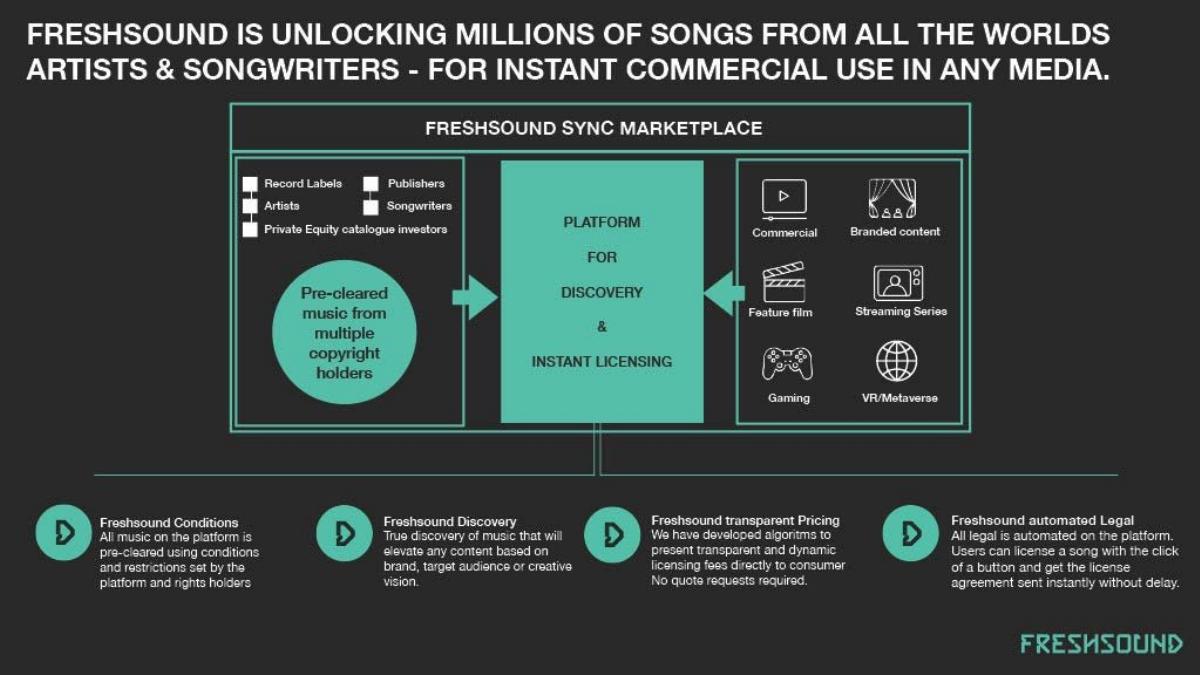
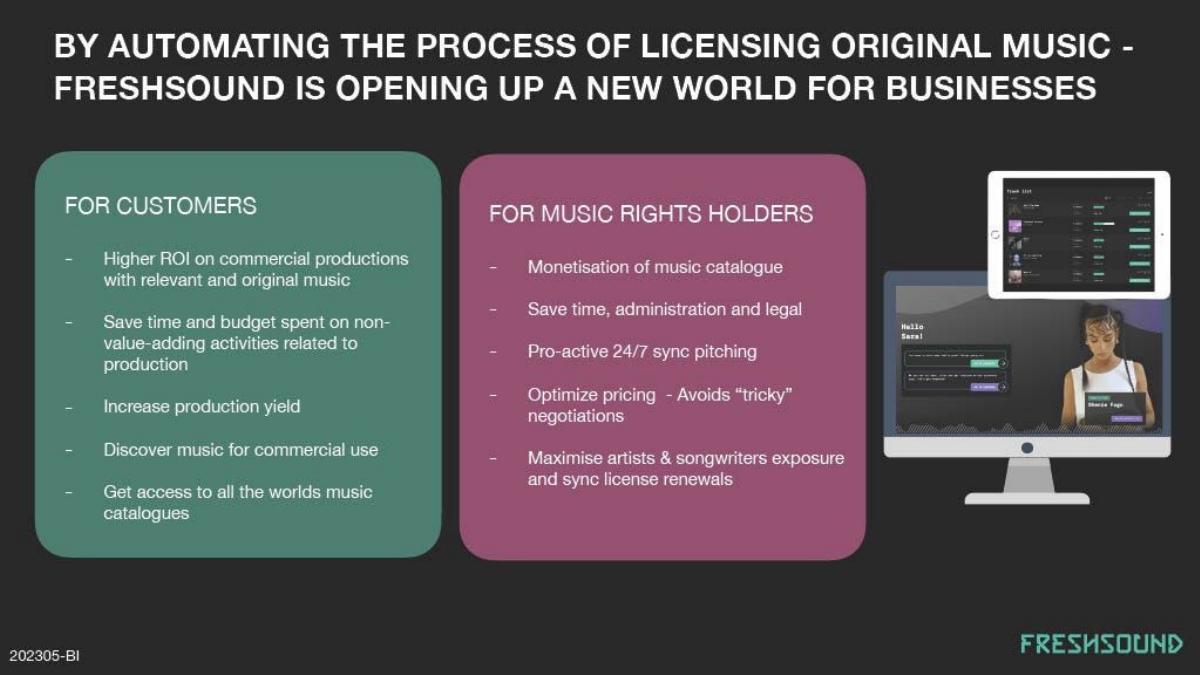
Commercial music licensing. Slide 4 is a marketplace diagram with four features; slide 5 lists benefits for each side.
Freshsound deck, slide 4. Exact stored slide matched to this analysis.Freshsound deck, slide 5. Exact stored slide matched to this analysis.
Our analysis: The strongest example here: each feature answers a pain on its problem slide, and both sides get their own list of benefits.
Evidence and limitation: A product screen on slide 5; no figures.
What a founder can adapt: Write each feature as the reverse of a problem point, then list benefits per side.
Supporting analysis
What the deck claims: Slide 4: "Freshsound is unlocking millions of songs from all the worlds artists & songwriters – for instant commercial use in any media." "Pre-cleared music from multiple copyright holders." "Freshsound transparent Pricing: We have developed algorithms to present transparent and dynamic licensing fees direct to consumer. No quote requests required." "Freshsound automated Legal: All legal is automated on the platform. Users can license a song with the click of a button." Slide 5: "For customers": "Save time and budget…", "Get access to all the worlds music catalogues." "For music rights holders": "Monetisation of music catalogue", "Save time, administration and legal", "Pro-active 24/7 sync pitching."
Presentation choice: "No quote requests required" directly reverses "request a quote and negotiate with every single rights holder".
When it does not fit: Small type across two dense slides; one number, such as time to license, would carry more.
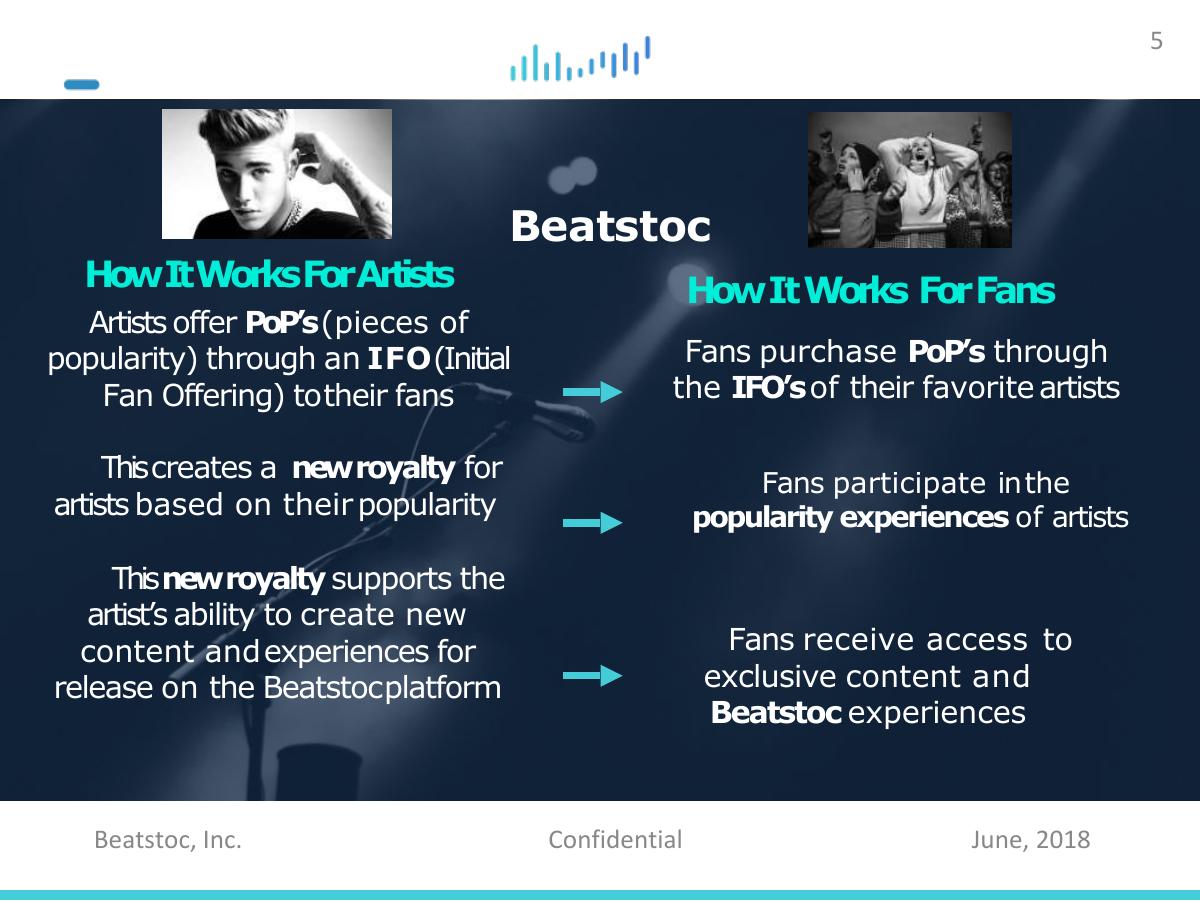
Artist–fan investment platform (2018). Two columns, artists and fans, linked by arrows.
Beatstoc deck, slide 5. Exact stored slide matched to this analysis.
Our analysis: Each artist step is matched by a fan step, so the two-sided mechanics are clear.
Evidence and limitation: No figures.
What a founder can adapt: For a two-sided product, pair each step on one side with what the other side does.
Supporting analysis
What the deck claims: "How It Works For Artists": "Artists offer PoP's (pieces of popularity) through an IFO (Initial Fan Offering) to their fans." "This creates a new royalty for artists based on their popularity." "This new royalty supports the artist's ability to create new content and experiences for release on the Beatstoc platform." "How It Works For Fans": "Fans purchase PoP's through the IFO's of their favorite artists." "Fans participate in the popularity experiences of artists." "Fans receive access to exclusive content and Beatstoc experiences."
Presentation choice: The arrows make the exchange readable at a glance.
When it does not fit: Coined terms (PoP, IFO) need a plain-English line: what a fan pays and gets.
Digital sheet music (Sonata). Slide 5 lists features over three tablets; slide 6 shows one score large.
Miso Media deck, slide 5. Exact stored slide matched to this analysis.Miso Media deck, slide 6. Exact stored slide matched to this analysis.
Our analysis: It answers the problem slide's "digital sheet music… lackluster" by showing the product large and readable.
Evidence and limitation: Product screens; named catalogue deals, no figures.
What a founder can adapt: Follow a feature list with one large screen of the main use.
Supporting analysis
What the deck claims: Slide 5: "Sonata. An immersive and complete platform for musicians." "Buy, store, and publish digital sheet music." "Real time pitch detection, feedback and analysis." "Comprehensive distribution deals with major music publishers and content providers." Slide 6: "All the standards of paper without the pulp." A tablet showing "Blackbird" sheet music. "Annotate as easy as scribbling or highlighting."
Presentation choice: Slide 6's one large screen shows the product better than a list.
When it does not fit: Ten features on one slide; pick the three that answer the problem.
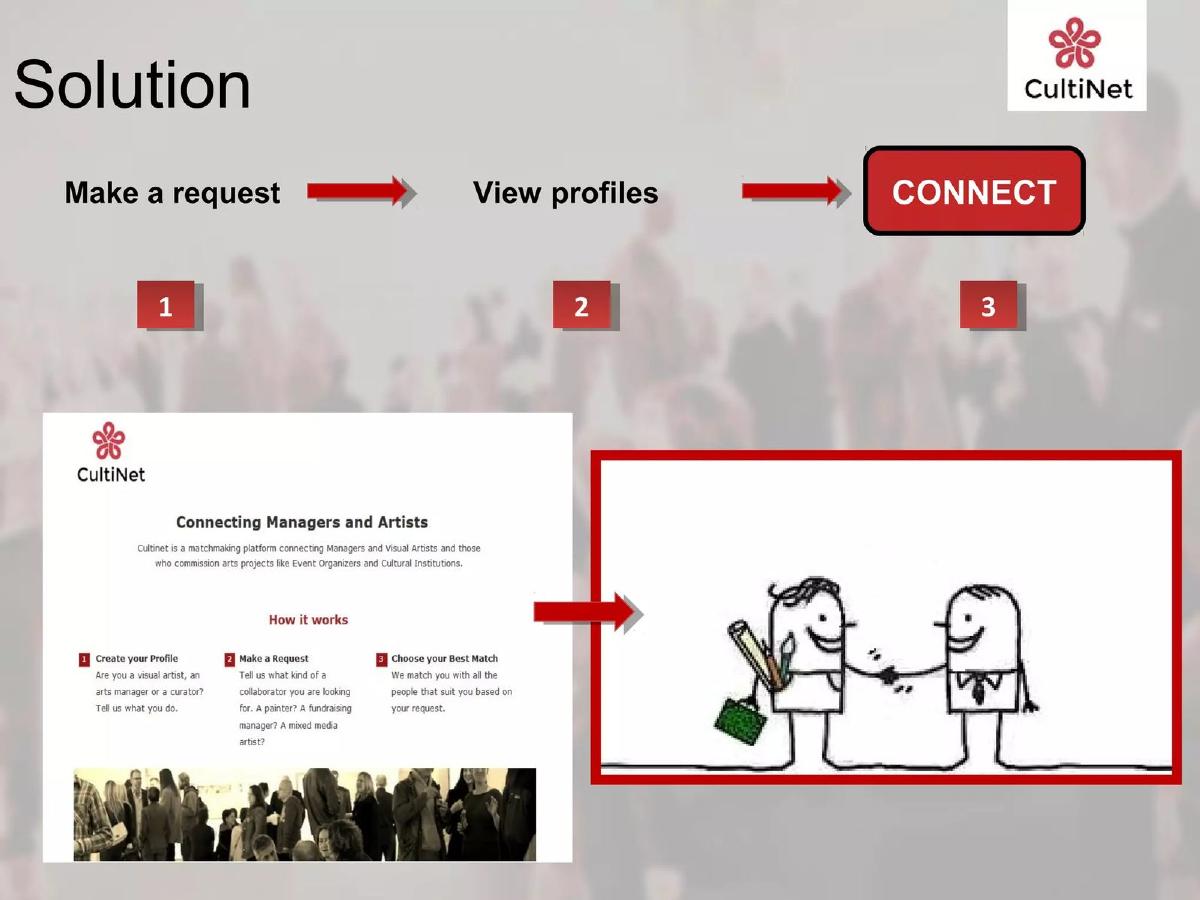
Artist–manager matching. Three numbered steps with a site screenshot and a cartoon handshake.
CultiNet deck, slide 5. Exact stored slide matched to this analysis.
Our analysis: Three clear steps that answer Katerina's and Anton's questions from the problem slide.
Evidence and limitation: A site screenshot; no figures.
What a founder can adapt: Show your flow in three steps with one real screen.
Supporting analysis
What the deck claims: "Solution." "Make a request" → "View profiles" → "Connect." Screenshot: "Connecting Managers and Artists." "How it works": "Create your Profile", "Make a Request", "Choose your Best Match."
Presentation choice: Three steps are easy to follow and remember.
When it does not fit: The cartoon adds nothing; a matched profile would show the result.
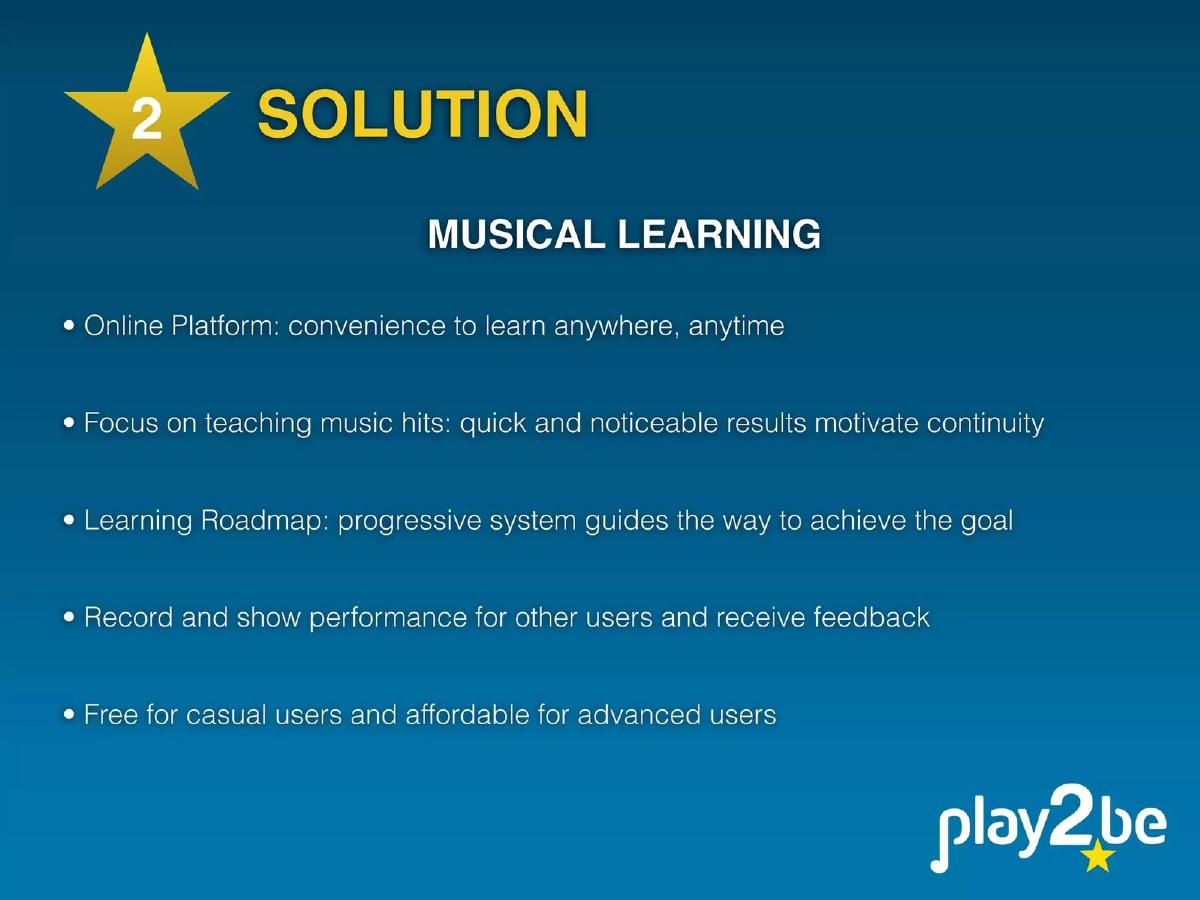
Play2be deck, slide 4. Exact stored slide matched to this analysis.
Our analysis: Each bullet pairs a feature with why it matters, and it gives the pricing model.
Evidence and limitation: No figures or screens.
What a founder can adapt: Write each feature with its reason, as Play2be does.
Supporting analysis
What the deck claims: "Solution. Musical learning." "Online Platform: convenience to learn anywhere, anytime." "Focus on teaching music hits: quick and noticeable results motivate continuity." "Learning Roadmap: progressive system guides the way to achieve the goal." "Record and show performance for other users and receive feedback." "Free for casual users and affordable for advanced users."
Presentation choice: "Teaching music hits: quick and noticeable results motivate continuity" names why learners stay.
Crowdfunding for school music programmes. A headline and two paragraphs.
Fund Music Ed deck, slide 5. Exact stored slide matched to this analysis.
Our analysis: Partial: it explains why crowdfunding works, but not what Fund Music Ed's product is or how a school uses it.
Evidence and limitation: Refers to market data on another slide.
What a founder can adapt: Show a school's campaign page and the steps to launch it.
Supporting analysis
What the deck claims: "Crowdfunding – A Proven Solution to Solve a Timely Problem." "Unlike other online fundraising methods, crowdfunding is proven and growing rapidly (see page 7). Crowdfunding allows each school's community to donate online, while also receiving one of several tangible rewards for themselves."
Presentation choice: It ties the method to its problem slide's lost programme funding.
When it does not fit: Describing a category (crowdfunding) instead of your product.
Listin deck, slide 4. Exact stored slide matched to this analysis.
Our analysis: Partial: the screens suggest live listening and following, but no text says how they solve the problems on its previous slide.
Evidence and limitation: Prototype screens; no figures.
What a founder can adapt: Label each screen with the problem it solves.
Supporting analysis
What the deck claims: "Prototype." Screens show a live feed of artists ("Live"), a now-playing view with a live listener count, and a profile with "356 following" and "235 followers".
Presentation choice: Showing the product is better than describing it.
Artist career platform (2012). A quote beside a photo of a misty forest.
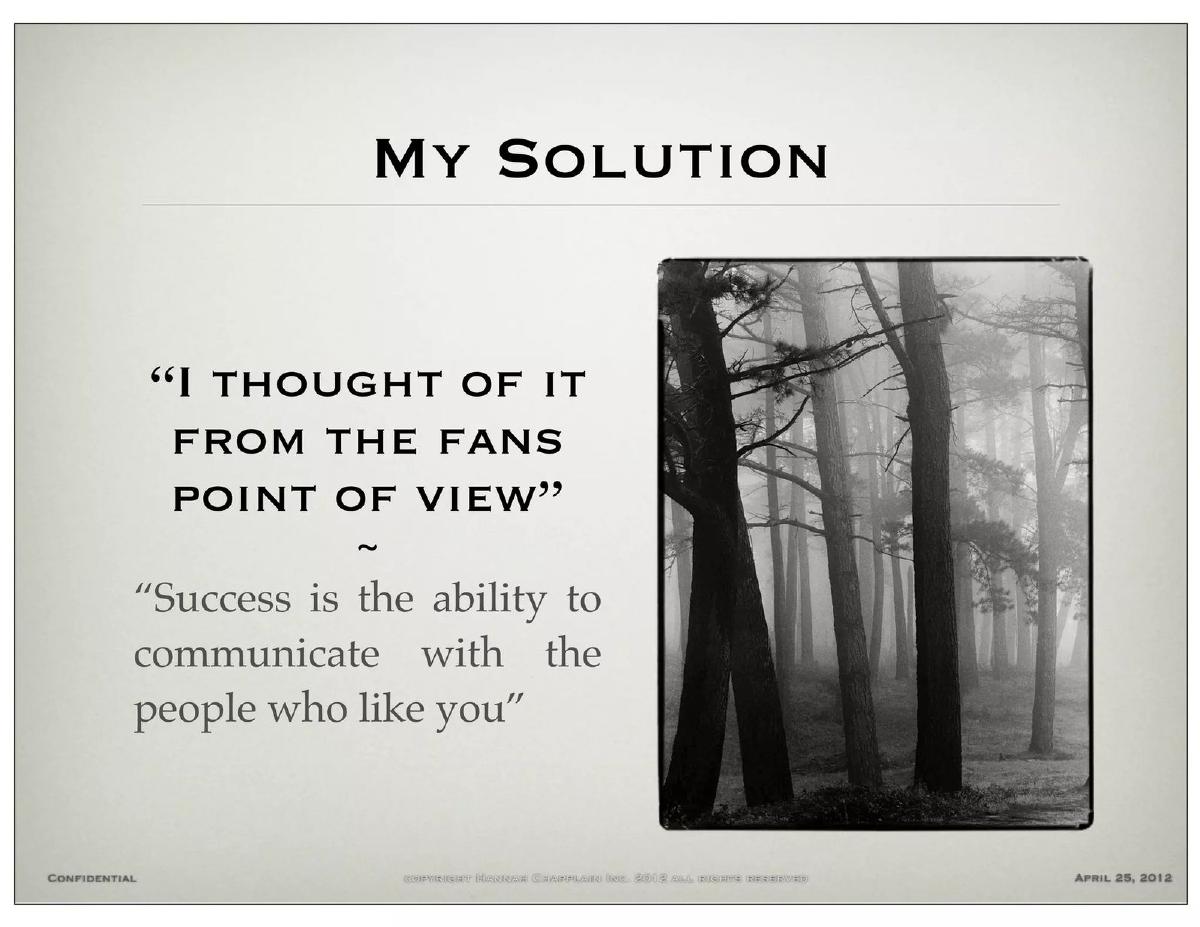
Hannah Chapplain deck, slide 4. Exact stored slide matched to this analysis.
Our analysis: Weak on purpose: a motto, no product, no steps and no answer to the problem slide.
Evidence and limitation: None.
What a founder can adapt: Replace the quote with what the fan does in the product.
Supporting analysis
What the deck claims: "My Solution." "'I thought of it from the fans point of view.'" "'Success is the ability to communicate with the people who like you.'"
Presentation choice: Kept as a contrast; compare Beatstoc, which shows what artists and fans each do.
When it does not fit: A solution slide with no solution on it.
Before: A platform connecting artists and fans for a better music experience.
After: Artists list merch and tracks in 10 minutes and keep 92% of each sale; fans buy in two taps and get early access to tickets. Pilot: 40 artists, $18,000 in sales in 3 months.
What improved: Our illustrative rewrite; the figures are invented for the example. It gives each side steps and a benefit, plus proof.
What this guide adds
This follows the music problem slide guide and uses the same companies where their decks continue (Freshsound, Fund Music Ed, CultiNet, Hannah Chapplain, Miso Media, Listin), plus Beatstoc and Play2be.
Most music products sit between two groups, so the best slides show both.
Three things a music solution slide proves
It answers the problem: Freshsound's "No quote requests required" answers "customers needs to request a quote and negotiate with every single rights holder".
It shows how it works: CultiNet's "Make a request, View profiles, Connect".
It says what each side gets: Beatstoc's artists gain "a new royalty… based on their popularity"; fans get "access to exclusive content".
Common mistakes
One side only. Most music products need both sides to show up; show both.
A quote instead of a product. Show the screen.
Describing the category. "Crowdfunding works" is not your product.
Uncaptioned screens. Say what each screen fixes.
Coined terms. Explain in plain English what users pay and get.
Diagnostic checklist
It shows steps for each side.
Each step answers a problem point.
Each side's benefit is named.
It shows a real screen or flow.
Coined terms are explained.
Frequently asked questions
How we chose these examples
Corpus: published pitch deck teardowns on StartupFundraising.com. Founder-uploaded private decks are excluded.
Selection (2026-09-25): we started from the decks in the music problem guide and inspected their stored solution slides, then searched slides 3–6 for other music solution slides. Fifteen stored images were inspected. 8merch has no stored image after slide 6; Chartmetric slide 4 (a vision statement) and Phanatiq slide 3 were left out as weaker duplicates. Fund Music Ed and Listin are marked partial; Hannah Chapplain is kept as a weaker contrast.
Overlap check: none of these slides appears in another guide.
Review: all ten stored slide images used were inspected on 2026-09-25 and matched to company, deck and slide number (editorial model review). No person has yet completed an editorial review of this page.
Claims are as shown on the slides; we have not verified them. We make no claim that any slide caused a fundraising outcome.