Play2be’s pitch deck outlines a vision for a 'Musical Learning Social Game' designed to capitalize on the massive global population of instrument players. By integrating with the Facebook platform, the company aimed to drive engagement through collaborative challenges, leaderboards, and a virtual economy featuring 'Play Money.' The business model relies on a freemium structure, with premium tiers priced at US$ 19.90 and US$ 29.90 per month. While the deck provides a clear roadmap for 2012—targeting a commercial launch in September—it suffers from significant omissions common in early-stage pi…
Key takeaways
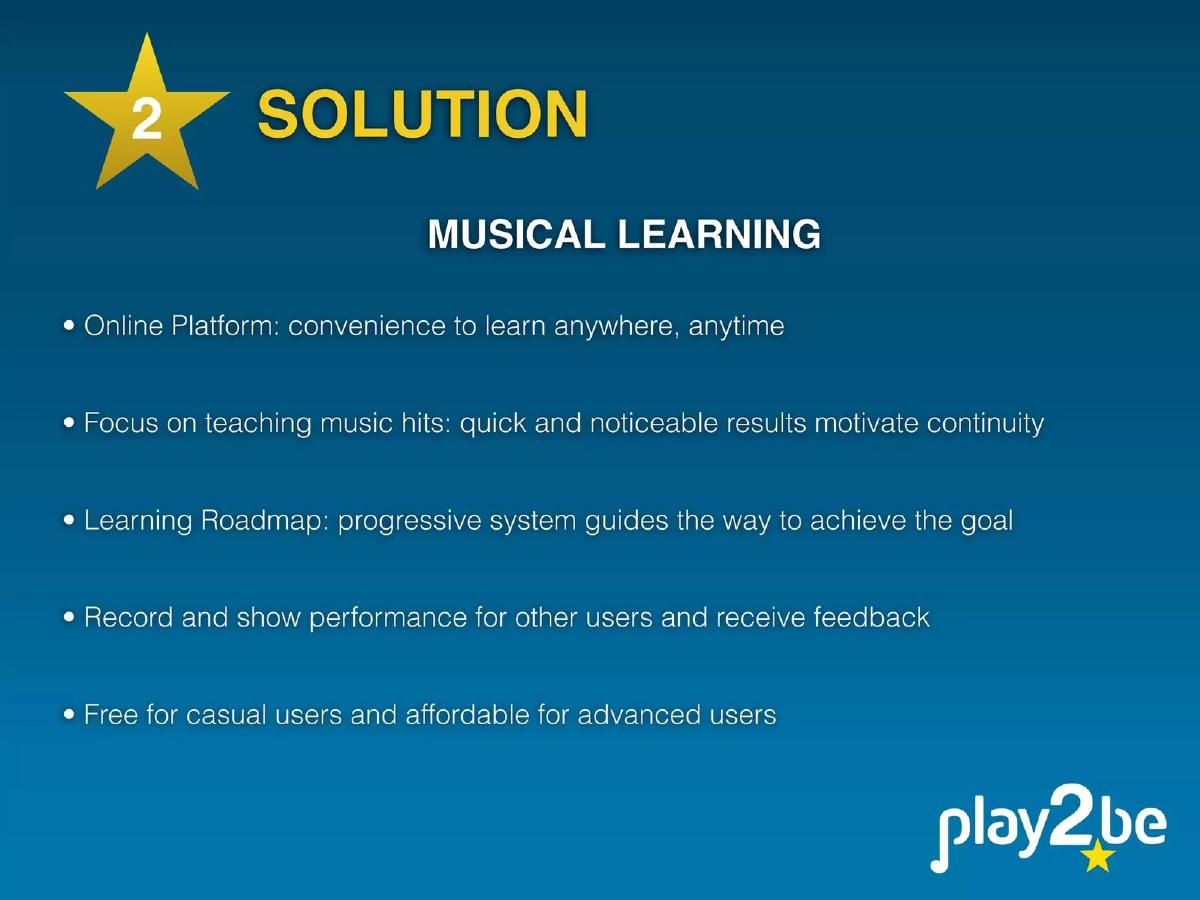
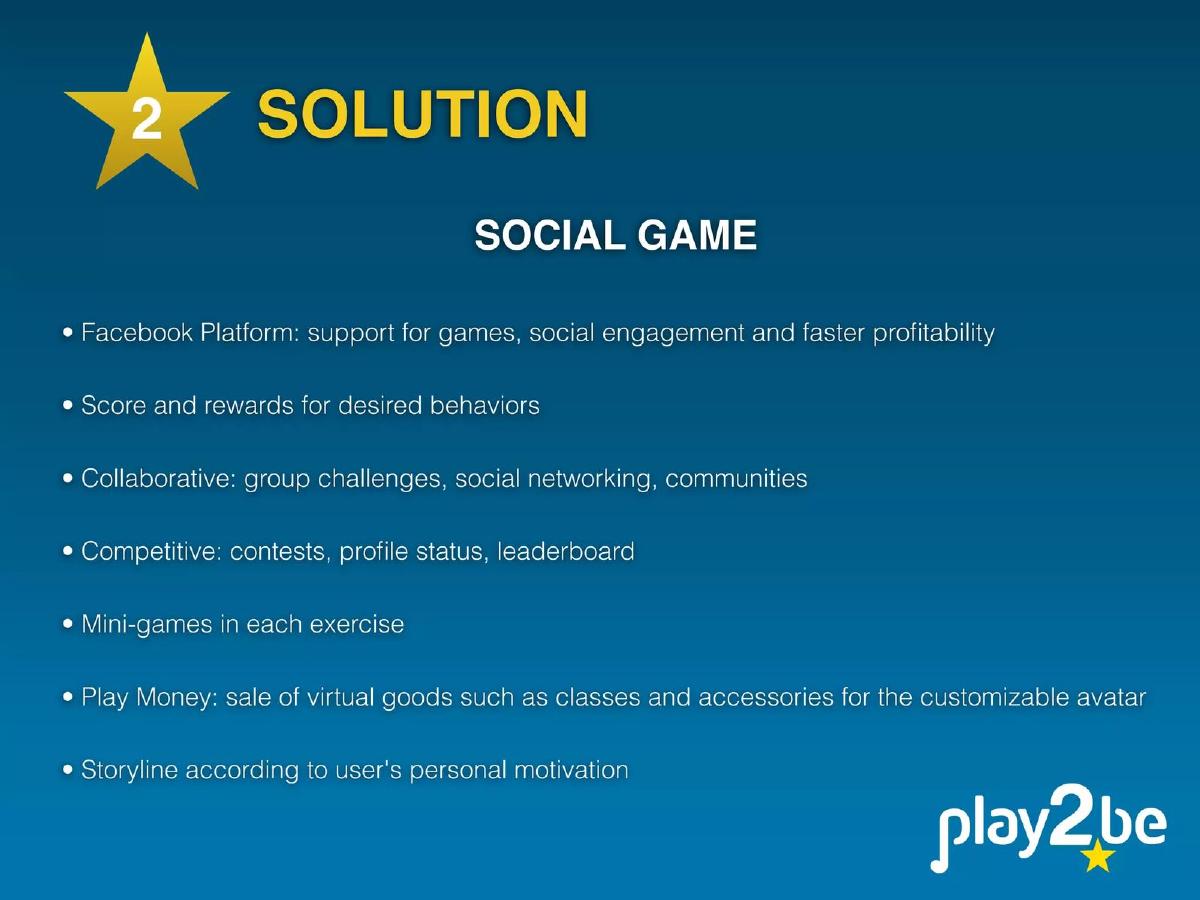
- The platform is positioned as a social game rather than a traditional educational tool, utilizing Facebook for social engagement (Slide 3).
- Market sizing estimates 420 million worldwide internet users who play an instrument, valuing the opportunity at US$ 5 billion (Slide 4).
- Revenue is driven by a freemium model, with basic lessons offered for free and premium tiers starting at US$ 19.90 per month (Slide 5).
- The product roadmap targeted an Alpha completion in February 2012 and a full commercial launch by September 2012 (Slide 6).
- Monetization strategies include the sale of virtual goods, such as avatar accessories and classes, using an in-game currency (Slide 3).
- The deck omits a team slide, leaving investors with no information regarding the founders' expertise in music or gaming.
- There is no explicit 'Ask' slide in the provided sequence, meaning the capital requirements and valuation are unknown.
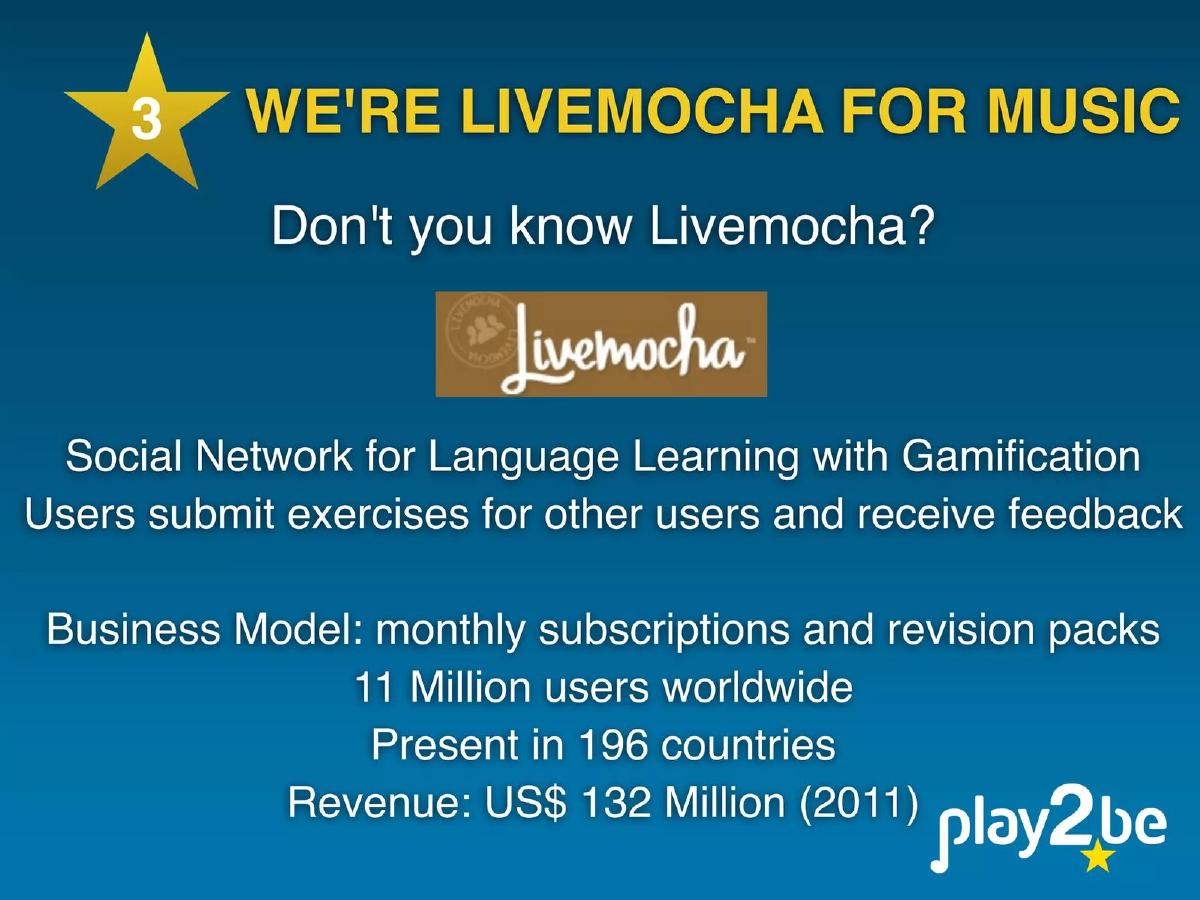
- The market calculation assumes a US$ 12/year per user revenue figure based on the language-learning platform Livemocha (Slide 4).
Play2be Pitch Deck Analysis
The Play2be pitch deck presents a vision for a gamified music education platform. By blending the mechanics of social gaming with the structured environment of musical learning, the company sought to solve the engagement problems often associated with self-taught instrument practice. The following teardown examines the six provided slides from their 12-slide deck, focusing on their product strategy, market assumptions, and business model.
Slide 1: Title Slide
The opening slide introduces the brand name, play2be , accompanied by the tagline: "Musical Learning Social & Fun." The visual identity is simple, featuring a blue gradient background and a logo that incorporates a yellow star. The URL www.play2.be is listed at the bottom. This slide establishes the two pillars of the value proposition: education ("Musical Learning") and entertainment ("Social & Fun"). It avoids technical jargon, opting for a consumer-facing tone.
Slide 2: Solution Overview
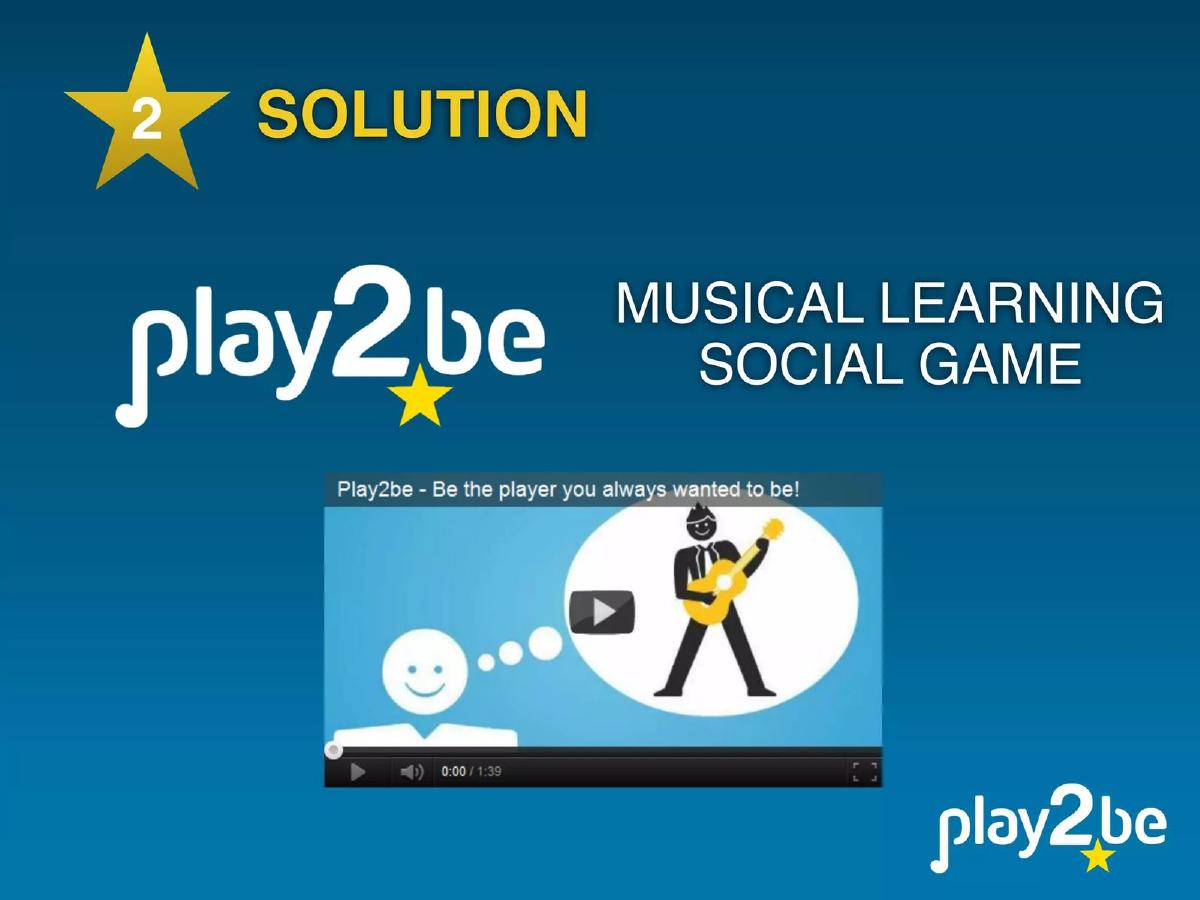
Slide 2 is titled "SOLUTION" and reinforces the product category as a "MUSICAL LEARNING SOCIAL GAME." It features a screenshot of a video titled "Play2be - Be the player you always wanted to be!" showing a stick-figure character dreaming of playing the guitar. This slide is intended to evoke the emotional aspiration of the user—the desire to become a skilled musician—while positioning the "game" as the vehicle to achieve that dream. The use of a video placeholder suggests that the original presentation relied on a demo to explain the mechanics, which is a standard practice for interactive products.
Slide 3: Social Game Mechanics
This slide provides the first deep dive into the "SOCIAL GAME" features. The company outlines seven key components of their platform:
Facebook Platform: The deck explicitly states they will use Facebook for "support for games, social engagement and faster profitability." This highlights a heavy reliance on the Facebook ecosystem, which was a dominant strategy for social gaming in the early 2010s. · Score and rewards: Implementation of gamification to encourage "desired behaviors." · Collaborative: Features include group challenges, social networking, and communities. · Competitive: Includes contests, profile status, and leaderboards. · Mini-games: Integrated into each exercise to maintain engagement. · Play Money: A virtual economy for the "sale of virtual goods such as classes and accessories for the customizable avatar." · Storyline: Content is tailored to the "user's personal motivation."
This slide is dense with product features but lacks a clear hierarchy. It confirms that Play2be is not just a lesson provider, but a virtual world built around music.
Slide 4: Market Opportunity
The "MARKET" slide uses a pie chart to visualize the number of "Internet users that play a musical instrument." The figures cited are:
To calculate the market value, the deck uses a proxy metric: "$ 12 / year per user (Livemocha) = US$ 5 Billion." Livemocha was a popular social language-learning site at the time. While this provides a ballpark figure, it is a significant leap to assume that music students will monetize at the exact same rate as language students. The sources for these statistics are listed as "Internet World Stats, NAMM and Livemocha." This slide successfully demonstrates a large Top-Down market but fails to provide a Bottom-Up analysis of how Play2be specifically will capture this share.
Slide 5: Business Model
Titled "HOW WE MAKE MONEY," this slide outlines a freemium revenue strategy. The primary tiers are:
Basic lessons: FREE. · Premium (Monthly US$ 19.90): Intermediate and advanced lessons. · Premium Plus (Monthly US$ 29.90): Includes "X virtual coins/month."
The deck also mentions "Virtual coins packs" with values to be determined during beta testing. Beyond subscriptions, the company lists four "Other possibilities":
Advertising space for music-related businesses. · Trade agreements for direct sales of instruments and equipment. · Sale of lessons/reviews by certified teachers (referencing the Livemocha model again). · Packages for educational institutions.
The pricing of $19.90/month is relatively high for a social game, placing it closer to the cost of professional software or physical lessons than a casual mobile game.
Slide 6: Roadmap and Current Situation
The final provided slide, "CURRENT SITUATION," outlines the 2012 development timeline:
Alpha version: To be completed in February/2012. · Open beta: Goal of May/2012. · Commercial version: Goal of Sept/2012.
This slide gives investors a clear sense of the project's stage (pre-launch) and the expected time-to-market. However, it lacks any mention of technical milestones or the current state of the build beyond these dates.
What Works in This Deck
The Play2be deck is successful in clearly defining its product category. By calling itself a "Social Game," it sets expectations for high engagement and viral growth through the Facebook platform. The monetization slide is also quite specific, providing exact dollar amounts for subscription tiers, which allows for immediate financial modeling. The use of a proxy (Livemocha) for market sizing is a clever way to provide context for a new category, even if the comparison isn't perfect.
What is Missing
The omissions in this deck are substantial and represent significant risks for a potential investor:
Team Slide: There is no information regarding the founders. In early-stage investing, the team is often more important than the idea. We do not know if they have experience in game design, music pedagogy, or software engineering. · Competitive Landscape: The deck mentions Livemocha as a reference but does not list actual competitors in the music space (such as Yousician or Fender Play). · The Ask: There is no slide detailing how much money is being raised, what the valuation is, or how the funds will be allocated. · Unit Economics: While the subscription price is clear, there is no mention of the Cost Per Acquisition (CPA) or the expected Lifetime Value (LTV) of a user. · Technology: There is no explanation of how the software actually "listens" to the user play or provides feedback, which is the core technical challenge of music education software.
Founder Takeaways
Founders can learn from Play2be's attempt to bridge two distinct industries (Gaming and Education). Use proxies wisely: If you are creating a new category, comparing your revenue potential to a successful company in a parallel industry (like Livemocha) helps investors grasp the scale. Be specific with pricing: Don't just say "subscriptions"; list the tiers and the price points. Don't skip the team: Never leave out the team slide. Investors need to know why you are the right person to solve this specific problem. Finally, address the technical 'how': If your product involves a complex interaction—like learning an instrument—briefly explain the technology that makes it possible to build trust with the audience.
Frequently asked questions
- What is the core product of Play2be?
- Play2be is a 'Musical Learning Social Game.' It combines instrument education with gaming mechanics like mini-games, rewards, and customizable avatars. The platform was designed to run on the Facebook ecosystem to facilitate social networking, group challenges, and competitive leaderboards, aiming to make the process of learning an instrument more engaging and social than traditional methods.
- How does Play2be plan to generate revenue?
- The company uses a multi-tiered freemium model. Basic lessons are free, while 'Intermediate and advanced' lessons require a monthly subscription of either US$ 19.90 or US$ 29.90 (the latter including virtual coins). Additional revenue streams mentioned include the sale of virtual goods for avatars, advertising space for music businesses, and potential trade agreements for selling physical musical equipment.
- What is the estimated market size according to the deck?
- The deck identifies a total addressable market of 420 million internet users worldwide who play a musical instrument, with 67 million of those located in the USA. By applying a US$ 12 per year per user revenue metric—borrowed from the language-learning site Livemocha—Play2be estimates the total market value at US$ 5 billion.
- What are the most significant missing elements in this pitch?
- The most critical omission is the team slide; there is no mention of who is building the company or their qualifications. Additionally, the deck lacks a competitive landscape analysis, unit economics (CAC/LTV), and a specific financial ask. Without these, it is difficult for an investor to assess the execution risk or the scale of the investment opportunity.
- What was the company's timeline for launch?
- According to the 'Current Situation' slide, the company planned to complete its Alpha version in February 2012. This was to be followed by an open beta launch in May 2012, with the goal of reaching a full commercial version by September 2012. The deck appears to have been authored in late 2011 or early 2012.