PledgeGo is a philanthropic platform designed to connect individual, corporate, and nonprofit users through a vetted marketplace. The deck emphasizes a four-step verification process—including questionnaires, interviews, and document reviews—to ensure donor funds reach credible causes. While the slides effectively map out the 'Business of Philanthropy' and the specific pain points of donors (trust and impact tracking) and charities (revenue forecasting and data analytics), the presentation is fundamentally incomplete. It lacks a team slide, a business model, unit economics, and a specific fun…
Key takeaways
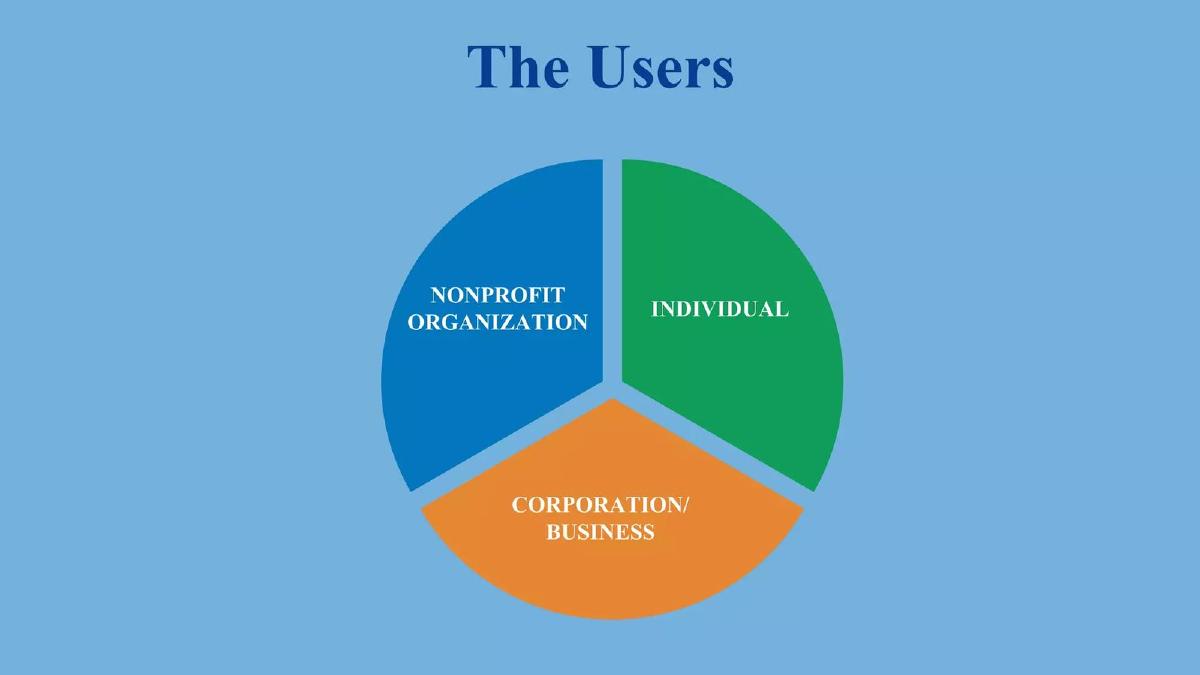
- The platform targets a three-sided market consisting of individuals, corporations, and nonprofit organizations (Slide 2).
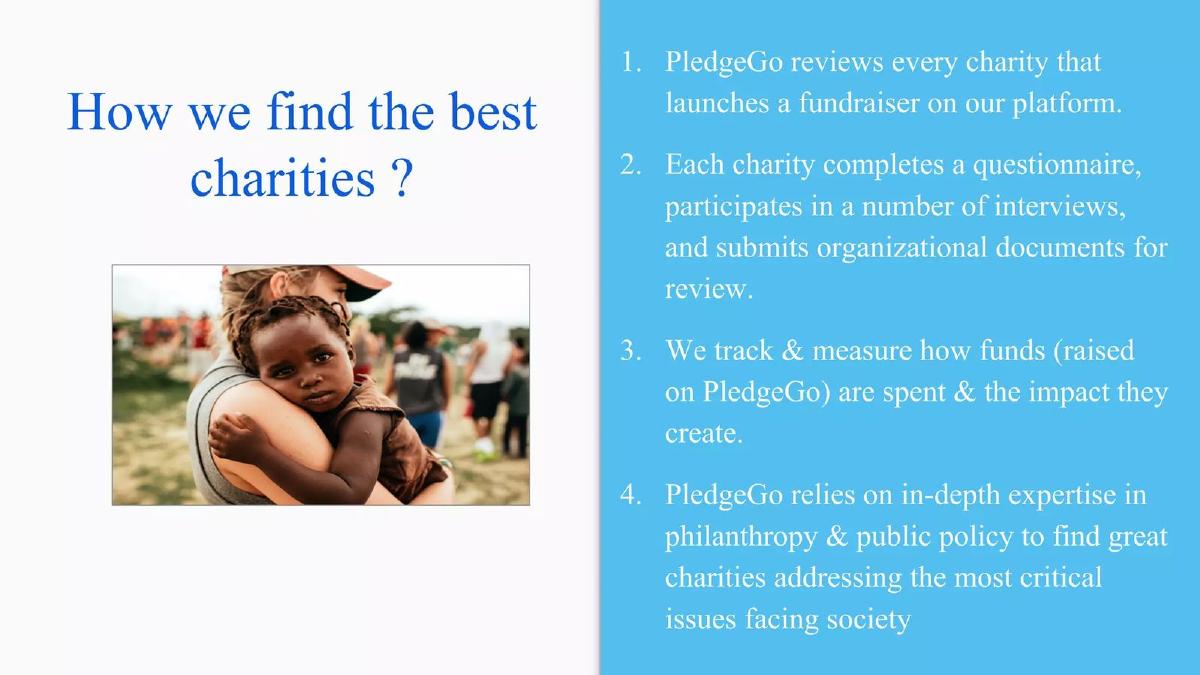
- A core value proposition is a rigorous vetting process involving questionnaires, interviews, and organizational document reviews for every charity (Slide 3).
- PledgeGo aims to solve donor desires for 'assurance they are supporting a credible and impactful organization' (Slide 4).
- The deck identifies a need for charities to access 'data, analytics, & business intelligence' and 'workflow automation' (Slide 5).
- Market context is provided by citing the Urban Institute (2015), noting that organizations rely on over a billion hours of volunteering (Slide 6).
- The 'PledgeGo Process' diagram illustrates a closed-loop system where data on fund usage returns to the donor as a 'Social Impact Report' (Slide 7).
- The deck omits a business model, failing to explain how the platform generates revenue from these transactions.
- There is no team slide, leaving the 'in-depth expertise in philanthropy & public policy' mentioned on Slide 3 unsubstantiated.
The PledgeGo Pitch Deck Teardown
PledgeGo presents a vision for a more transparent and efficient philanthropic ecosystem. The deck focuses heavily on the mechanics of trust—specifically how a platform can act as a gatekeeper to ensure that donor money is used effectively. However, as a fundraising tool, the deck is missing the 'business' side of the business, focusing almost entirely on the 'impact' side.
Slide 1: Title Slide
The deck opens with the company name, logo, and the tagline: "Giving philanthropy more impact." The visual identity is clean, using a soft blue and green palette. The inclusion of the URL (www.pledgego.com) is a standard but necessary practice for early-stage decks to allow investors to perform immediate due diligence.
Slide 2: The Users
This slide uses a simple pie chart to segment the target audience into three equal parts: Nonprofit Organizations, Individuals, and Corporations/Businesses. While this clearly defines the marketplace participants, it fails to explain the relationship between them or which segment is the primary driver of growth. In a three-sided marketplace, the 'chicken and egg' problem is a major concern for investors; this slide identifies the players but not the strategy for acquiring them.
Slide 3: How we find the best charities?
This is the core of PledgeGo's value proposition. The slide outlines a four-step vetting process: 1. Reviewing every charity, 2. Questionnaires and interviews, 3. Tracking fund usage, and 4. Leveraging expertise in public policy. This suggests a high-touch, manual process. While this builds trust, it raises questions about scalability. Investors would typically want to know if this vetting is automated or if the company plans to hire a massive team of auditors, which would impact margins.
Slide 4: What Donors Want
PledgeGo uses a pyramid graphic (Fundraise, Cause, Volunteer, Support) to categorize donor needs. The bulleted list on the right is comprehensive, covering everything from "assurance they are supporting a credible... organization" to "build a personal brand as socially responsible." This slide does a good job of identifying the emotional and functional drivers of the donor, but it reads more like a marketing persona document than a pitch for investment.
Slide 5: What Charities Need
Using a puzzle piece graphic, this slide shifts focus to the supply side of the marketplace. It identifies needs such as revenue forecasting, volunteer management, and "workflow automation." By mentioning "data, analytics, & business intelligence," PledgeGo hints at a potential SaaS (Software as a Service) play for nonprofits, though it doesn't explicitly state that this is a paid feature.
Slide 6: Business of Philanthropy
This slide attempts to provide market context. It lists various sectors (Health, Education, Arts & Culture, etc.) and cites the Urban Institute (2015). The data points are broad: "Billions of dollars of private and public funding" and "over a billion hours of volunteering." The main issue here is the age of the data (2015) and the lack of a specific dollar amount for the platform's serviceable market. Investors need to see a path to a billion-dollar valuation, not just proof that the charity sector is large.
Slide 7: PledgeGo Process
This is the most technical slide in the deck, showing the flow of information and capital. It illustrates how a donor provides funds and communication through PledgeGo, which then vets the charity before passing the funds along. Crucially, it shows a return loop: "Data on use of funds & social impact" flows back through PledgeGo to the donor as a "Social Impact Report." This visualizes the platform's role as a permanent intermediary rather than a one-time transaction facilitator.
What PledgeGo Does Well
Clarity of Purpose: The deck makes it very clear that PledgeGo is about trust and vetting. In a crowded field of donation platforms, focusing on the "how" of vetting is a strong differentiator.
Identifying Pain Points: Slides 4 and 5 show a deep understanding of the frustrations felt by both donors (lack of transparency) and nonprofits (lack of sophisticated tools). This empathy is crucial for product-market fit.
Visual Consistency: The deck is professionally designed and easy to read. The use of simple diagrams (pyramids, puzzles, flowcharts) helps explain a complex three-sided market without overwhelming the reader with text.
What is Missing from the Deck
The Business Model: This is the most glaring omission. There is no mention of how PledgeGo makes money. Do they take a percentage of donations? Do they charge nonprofits for the "workflow automation"? Do they charge corporations for CSR reporting? Without this, it is a pitch for a nonprofit project, not a venture-backed startup.
The Team: Slide 3 mentions "in-depth expertise," but provides no names. Investors invest in people first, especially at the seed stage. The absence of a team slide with relevant backgrounds in tech, finance, or the nonprofit sector is a major red flag.
Traction and Metrics: There are no numbers regarding the current state of the business. Even if the product is in beta, the deck should list the number of charities currently being vetted or the size of the waitlist. Without traction, the deck remains purely theoretical.
The Ask: A pitch deck is a request for capital. This deck ends without stating how much money is being raised, what the valuation is, or what the specific milestones are that the funding will help achieve.
What a Founder Should Copy
The Process Map: Slide 7 is a great example of how to visualize a complex marketplace. It clearly shows the inputs, the intermediary's role, and the outputs. Founders building marketplaces should use similar diagrams to explain their value-add in the transaction chain.
Segmented Value Propositions: By dedicating separate slides to "What Donors Want" and "What Charities Need," the deck ensures that the benefits for all stakeholders are addressed. This is a good way to demonstrate that the founder has thought through the incentives for every participant in the ecosystem.
Final Analysis
The PledgeGo deck is a strong conceptual overview of a philanthropic platform but a weak investment pitch. It succeeds in defining a problem—the lack of trust and data in giving—and proposes a logical process to solve it. However, by omitting the team, the business model, and the financial ask, it fails to answer the most basic questions an investor would have. To be successful, the founders would need to supplement these slides with a robust financial plan and proof of their ability to execute on the high-touch vetting process they have proposed.
Frequently asked questions
- What is PledgeGo's primary business model?
- The deck does not explicitly state a business model. While it outlines the flow of funds and services between donors and charities on Slide 7, it does not mention transaction fees, subscription models for nonprofits, or corporate social responsibility (CSR) licensing fees. This is a significant omission for a professional pitch deck.
- How does PledgeGo differentiate itself from platforms like GoFundMe or Charity Navigator?
- PledgeGo positions itself as a hybrid. Unlike pure crowdfunding sites, it emphasizes a manual vetting process (Slide 3). Unlike rating sites, it facilitates the actual transaction and provides ongoing 'Social Impact Reports' to donors (Slide 7), attempting to own the entire lifecycle of the donation.
- What market data does the deck provide to justify the opportunity?
- The deck provides limited macro data on Slide 6, titled 'Business of Philanthropy.' It mentions that billions of dollars are provided through grants and loans and cites a 2015 Urban Institute stat regarding volunteer hours. However, it lacks a specific Total Addressable Market (TAM) calculation for the platform itself.
- Who are the founders of PledgeGo?
- The provided slides do not include a team slide. Slide 3 claims the company 'relies on in-depth expertise in philanthropy & public policy,' but no specific names, bios, or past successes are listed to validate this claim for potential investors.
- Is there any evidence of traction or a product roadmap?
- No. The deck is conceptual. There are no mentions of current user counts, total volume of donations processed (GMV), or specific nonprofit partners already onboarded. The 'PledgeGo Process' (Slide 7) is a theoretical workflow rather than a report of historical performance.