PLDG Funding (The Paul L. Dunbar Group) is a 501c3 non-profit organization focused on the economic revitalization of the East Spencer community. Their pitch deck outlines a multi-faceted approach to sustainability, integrating affordable housing, skills training, and infrastructure development. The core of their proposal is a $14.6 million real estate investment plan that includes a sports plex, an organic food center, and a conference center. The deck utilizes a 'Non-Profit Hub Model' to bridge the gap between the public and private sectors, aiming to create a 'Live-Work-Play' environment. W…
Key takeaways
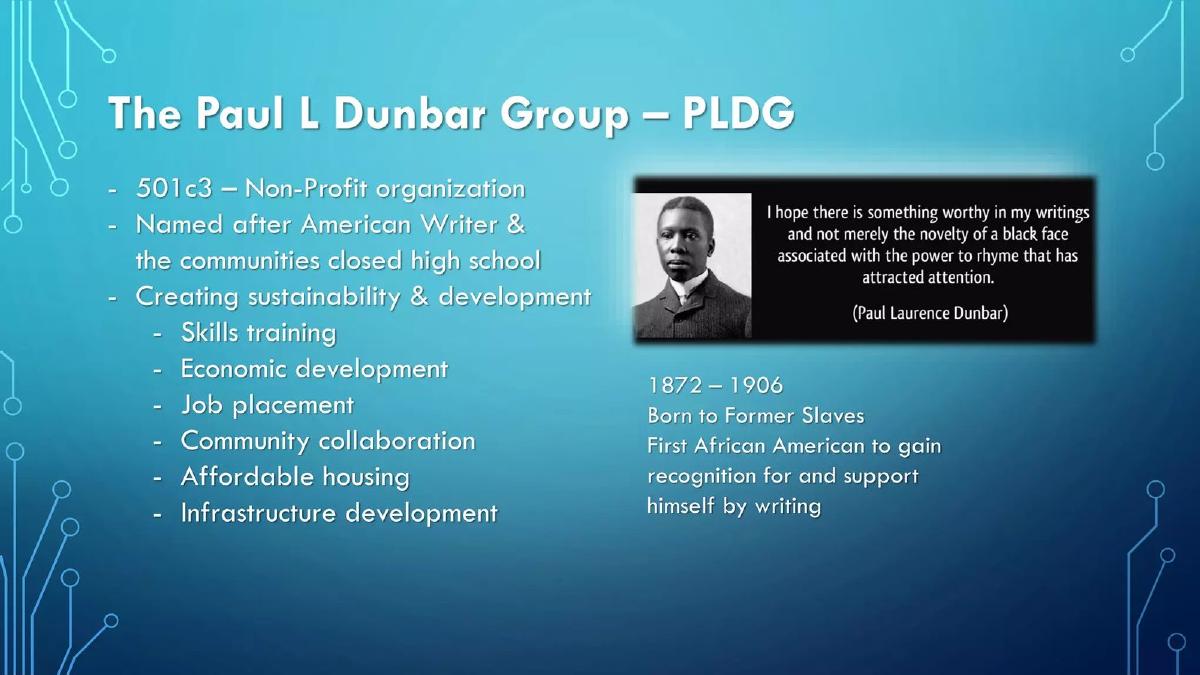
- The organization is a 501c3 non-profit named after American writer Paul Laurence Dunbar, focusing on the East Spencer community (Slide 2).
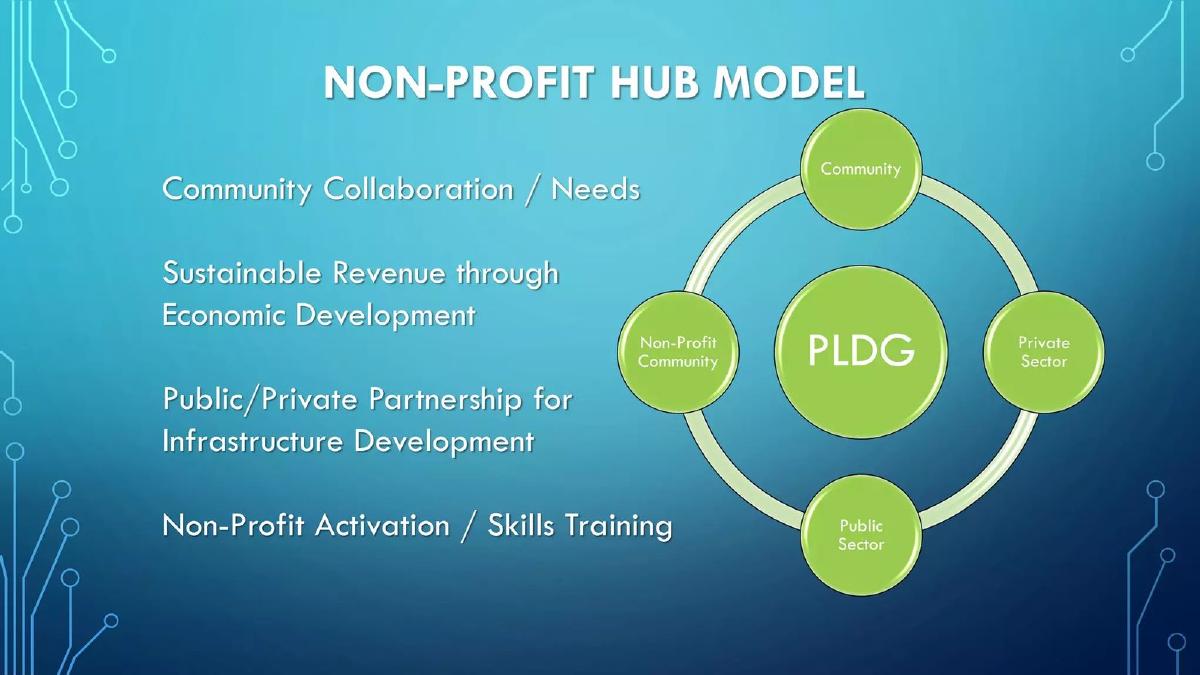
- The 'Non-Profit Hub Model' positions PLDG as a central coordinator between the community, public sector, and private sector (Slide 3).
- The real estate investment requirement is exactly $14,600,000, covering nine distinct projects (Slide 6).
- The largest individual real estate allocations are $2,500,000 each for the Dunbar School, Dunbar Conference Center, and Sports Plex (Slide 6).
- A separate $625,000 start-up budget is requested for skills development programs, including home building and auto technician training (Slide 7).
- The deck lists specific economic development partners across food production, automotive, and business services (Slide 8).
- The projected start-up balance sheet shows total assets of $30,745,000, largely driven by property and investments (Slide 10).
- Long-term liabilities include a $30,445,000 USDA Debt Principle, suggesting a heavy reliance on government-backed financing (Slide 10).
Executive Summary: The Paul L. Dunbar Group Revitalization Plan
The Paul L. Dunbar Group (PLDG) deck is a mission-driven proposal for a large-scale community redevelopment project in East Spencer. Unlike traditional tech startup decks that focus on scalable software, this deck is a blueprint for physical infrastructure and social services. It frames the non-profit as a 'hub' that facilitates cooperation between government entities and private businesses to achieve local economic sustainability. The financial ask is significant, totaling over $15 million when combining real estate and operational budgets, with a heavy emphasis on federal debt financing.
Slide 1: Title and Mission
The opening slide introduces 'The Paul L. Dunbar Group' with the tagline 'Empowering a Self-Sustaining East Spencer Community.' The visual design uses a circuit-board motif, which is somewhat at odds with the community and real estate focus of the content, but it establishes a professional, if generic, aesthetic. The focus is immediately placed on a specific geographic location: East Spencer.
Slide 2: Organization Overview
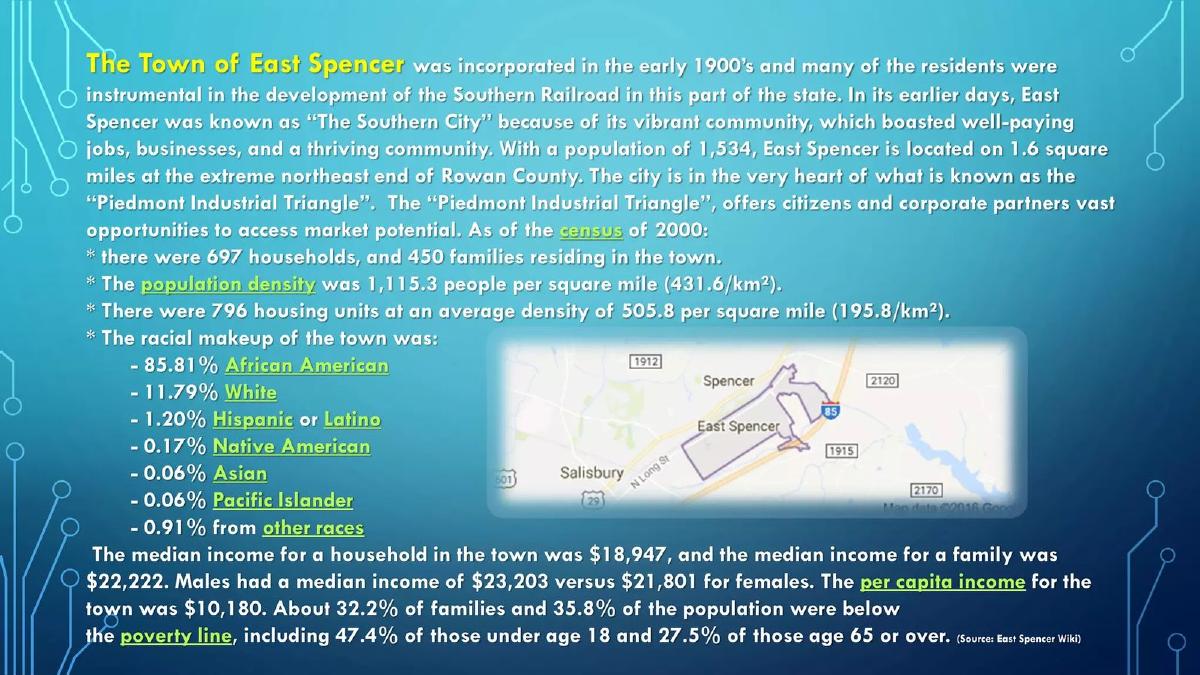
Slide 2 defines the entity as a 501c3 non-profit organization. It provides historical context, noting that the group is named after Paul Laurence Dunbar, a prominent African American writer. The slide lists the core pillars of the organization: skills training, economic development, job placement, community collaboration, affordable housing, and infrastructure development. By citing the closure of a local high school, the deck establishes a 'need' based on lost community assets.
Slide 3: The Non-Profit Hub Model
This slide presents a conceptual diagram of how PLDG operates. It places 'PLDG' at the center of a circle connected to four quadrants: Community, Private Sector, Public Sector, and Non-Profit Community. The text highlights 'Sustainable Revenue through Economic Development' and 'Public/Private Partnership for Infrastructure Development.' This is a crucial slide as it explains the business logic: the non-profit isn't just a charity; it is a coordinator of economic activity.
Slide 4: Dunbar Village & Community Center
Slide 4 introduces the physical manifestation of the mission. It features a photo of an existing, somewhat dilapidated building alongside an architectural sketch and a photo of a modern community facility. The slogan 'LIVE ~ WORK ~ PLAY' is used to describe the intended environment. This slide serves as the 'Product' slide in a typical deck, showing the transition from current state to the proposed vision.
Slide 5: Affordable Housing
This slide focuses specifically on the residential aspect of the project. It uses a hexagonal grid to display various housing styles, ranging from multi-unit architectural sketches to photos of completed single-family homes and senior living facilities. There are no specific numbers on this slide regarding unit counts or pricing, but it visually communicates the intended aesthetic and variety of the housing stock.
Slide 6: Real Estate Start-Up Investment
This is the most data-dense slide in the deck. It features a 3D pie chart totaling $14,600,000 . The breakdown is as follows:
Dunbar School: $2,500,000 · Dunbar Conference Center: $2,500,000 · Sports Plex: $2,500,000 · Organic Food Center: $2,000,000 · Live/Work Center: $1,500,000 · Business Center: $1,200,000 · Land Acquisition: $1,000,000 · Auto Center: $1,000,000 · Women's Shelter: $400,000
The use of a pie chart for these figures is slightly unconventional, as these are individual project costs rather than percentages of a whole, but it clearly states the capital requirements for each phase.
Slide 7: Skills Development Programs
Slide 7 shifts from physical assets to human capital. It requests a $625,000 start-up budget for four programs: 1) Home Builders Institute, 2) Auto Technician Academy, 3) Digital Media, and 4) Entrepreneurial Business Program. This slide bridges the gap between the buildings (the Auto Center and Business Center) and the people who will work in them, showing an integrated approach to community development.
Slide 8: Economic Development Partners
This slide lists specific companies and entities that PLDG intends to work with. It categorizes them by the facility they will occupy. For example, the 'Organic Food Production Center' lists Dream Bean Products and Archie Farms, while the 'Dunbar Automotive Center' lists Run Right Auto Repair and CarQuest. This acts as a 'Traction' or 'Validation' slide, suggesting that there is already interest or commitment from local businesses to participate in the hub.
Slide 9: Infrastructure Development
Slide 9 uses three images to represent the technical side of the project: solar panels, a water treatment or industrial facility, and fiber optic cabling. The text is minimal, simply stating 'INFRASTRUCTURE DEVELOPMENT.' This reinforces the 'Self-Sustaining' part of the mission statement from Slide 1, implying that the community will have its own power, water, and data capabilities.
Slide 10: Start-Up Balance Sheet
The final slide provided is a projected balance sheet. It lists Total Assets of $30,745,000 . Key figures include:
Cash: $300,000 · Pre-Paid Expenses: $3,015,000 · Property: $14,600,000 (matching the investment slide) · Investment: $11,630,000
On the liabilities side, it shows a USDA Debt Principle of $30,445,000 . This is a critical piece of information, as it indicates the entire project is predicated on securing a massive government loan rather than raising private equity or relying solely on donations.
What Works Well in This Deck
The deck is exceptionally clear about its financial requirements. By providing a specific dollar amount for every sub-project on Slide 6, the founders avoid the vagueness that often plagues non-profit pitches. The 'Hub Model' on Slide 3 is also a strong conceptual framework; it explains why a non-profit is getting involved in things like auto repair and digital media—it’s about creating a closed-loop local economy.
The inclusion of a balance sheet (Slide 10) is a professional touch that many early-stage projects omit. It shows that the founders have considered the long-term financial structure of the entity, specifically the role of debt. The partnership list on Slide 8 also provides a sense of scale and local buy-in, making the $14.6M ask feel more grounded in reality.
What Is Missing From the Deck
The most glaring omission in the provided slides is a Team Slide . For a project of this complexity—involving real estate, federal loans (USDA), vocational training, and municipal infrastructure—the background of the leadership is paramount. Investors or grant-makers would need to see experience in large-scale construction, non-profit management, and government relations.
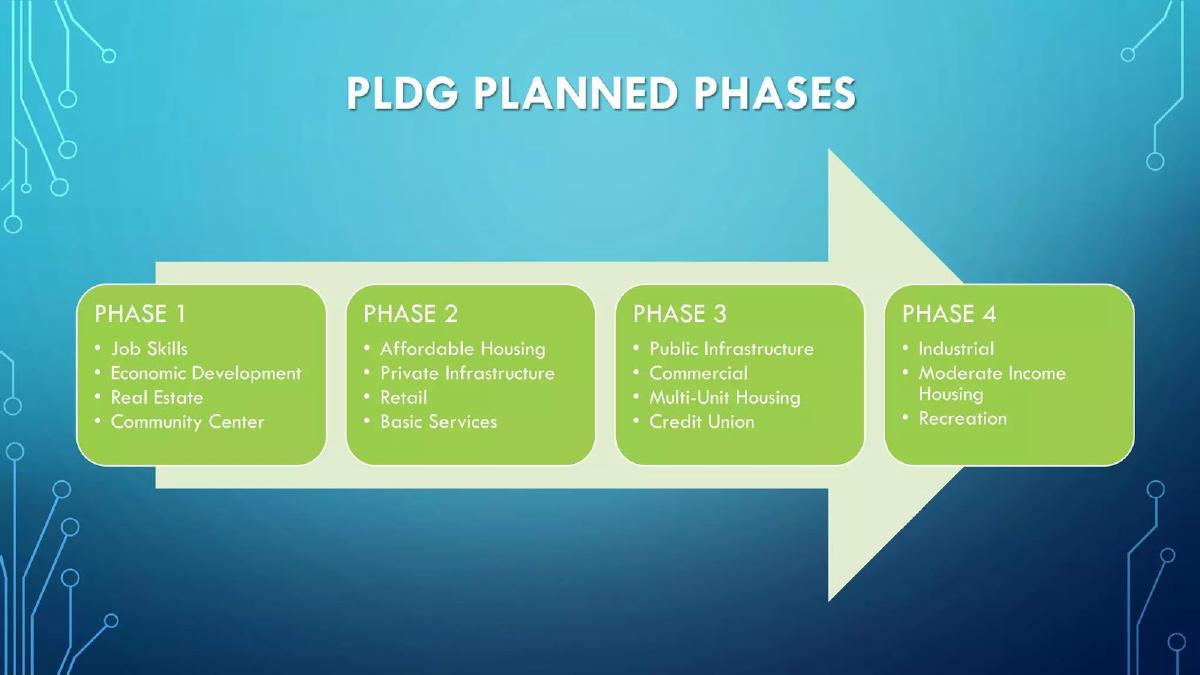
Additionally, there is no Timeline . A $14.6M multi-facility build-out does not happen overnight. A slide detailing the phases of development (e.g., Phase 1: Land Acquisition, Phase 2: School Renovation) would help manage expectations. Finally, the deck lacks Impact Metrics . While it mentions 'empowering' the community, it doesn't project how many jobs will be created, how many people will be housed, or what the expected increase in local GDP might be.
Founder's Guide: What to Copy
Founders working in the 'Tech for Good' or 'Impact' space should emulate the way PLDG categorizes its activities. Instead of just saying 'we help people,' they break their impact down into specific, fundable units (Slide 6 and 7). This allows a donor or investor to say, 'I want to fund the Women's Shelter' or 'I want to fund the Skills Training,' rather than just giving to a general fund.
The use of a 'Partners' slide (Slide 8) that is categorized by facility is also a best practice. It shows that the 'Product' (the buildings) already has 'Customers' (the tenants/partners). If you are building a marketplace or a physical hub, showing who will occupy that space is the best form of early-stage validation.
Conclusion
The PLDG Funding deck is a detailed, ambitious proposal for community-level economic engineering. It successfully moves beyond the 'charity' mindset by presenting a balance-sheet-driven approach to revitalization. However, the heavy reliance on a $30M USDA loan and the lack of visible leadership profiles suggest that this is a high-stakes project that requires significant institutional backing to move from architectural sketches to reality.
Frequently asked questions
- What is the primary goal of PLDG Funding?
- The primary goal is to empower a self-sustaining community in East Spencer through a combination of economic development, skills training, and infrastructure improvements. As stated on Slide 2, they aim to create sustainability through job placement, affordable housing, and community collaboration, centered around the legacy of the Paul L. Dunbar community.
- How much capital is the organization seeking for its real estate projects?
- According to Slide 6, the total real estate start-up investment is $14,600,000. This is distributed across various facilities, including a $2.5M Conference Center, a $2.5M Sports Plex, a $2M Organic Food Center, and a $1.5M Live/Work Center, among others.
- What types of vocational training does PLDG offer?
- Slide 7 outlines four specific skills development programs: the Home Builders Institute (pre-apprenticeship certification), the Auto Technician Academy (entry-level mechanic training), Digital Media (graphics, audio, and web design), and an Entrepreneurial Business Program for real-world business skills.
- Who are the partners involved in the economic development plan?
- Slide 8 lists numerous partners including Dream Bean Products and Archie Farms for the Organic Food Production Center, and Run Right Auto Repair for the Automotive Center. It also mentions business partners like DBS Staffing and America’s Tax Office for the Dunbar Business Center.
- What is the financial structure of the project according to the balance sheet?
- Slide 10 shows a total asset value of $30,745,000. The financing appears to be heavily leveraged, with $30,445,000 listed as a 'USDA Debt Principle' under long-term liabilities. This indicates the project is designed to be funded primarily through federal debt programs rather than equity.