The Playbasis deck is a masterclass in narrative positioning, framing gamification not as a luxury, but as a competitive necessity for incumbents facing rapid digital disruption. By anchoring their value proposition in the 'Super App' playbook—pioneered by Chinese giants like Alipay and Pinduoduo—Playbasis makes a compelling case for the export of these mechanics to Southeast Asia and India. The deck excels at showing, rather than just telling, through detailed case studies with DBS Bank and MyDigi. However, it is a purely strategic document; it lacks a team slide, specific financial performa…
Key takeaways
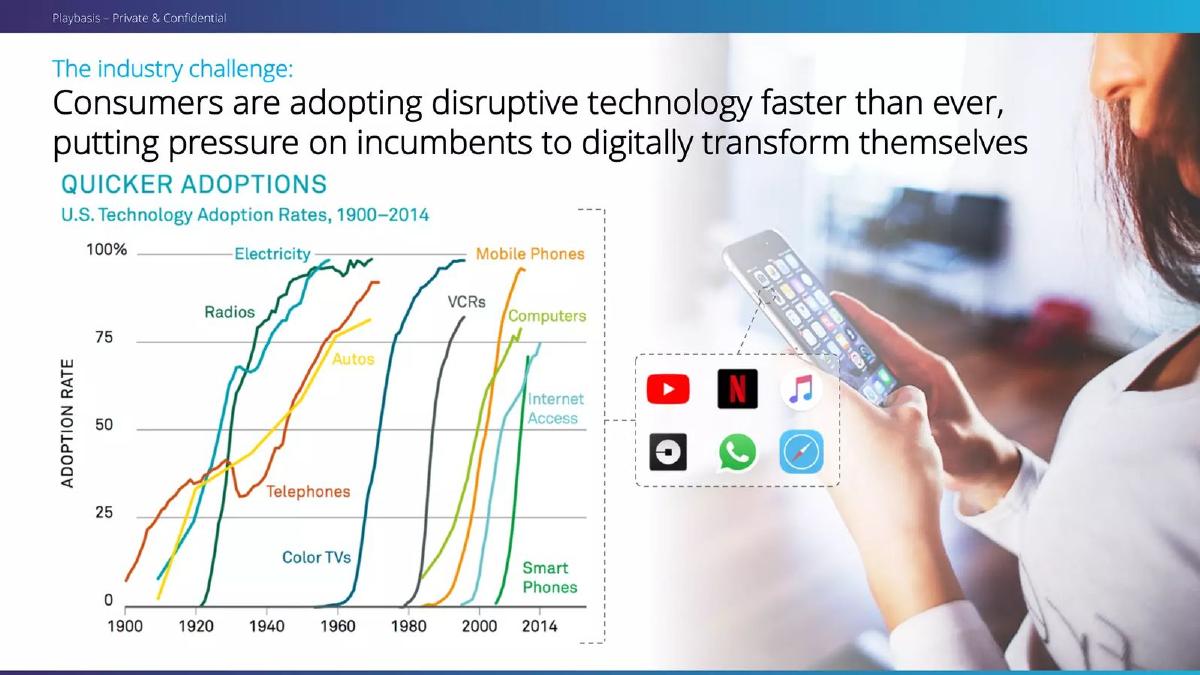
- The deck uses a U.S. Technology Adoption Rates chart (1900–2014) on Slide 2 to create a sense of urgency for incumbents.
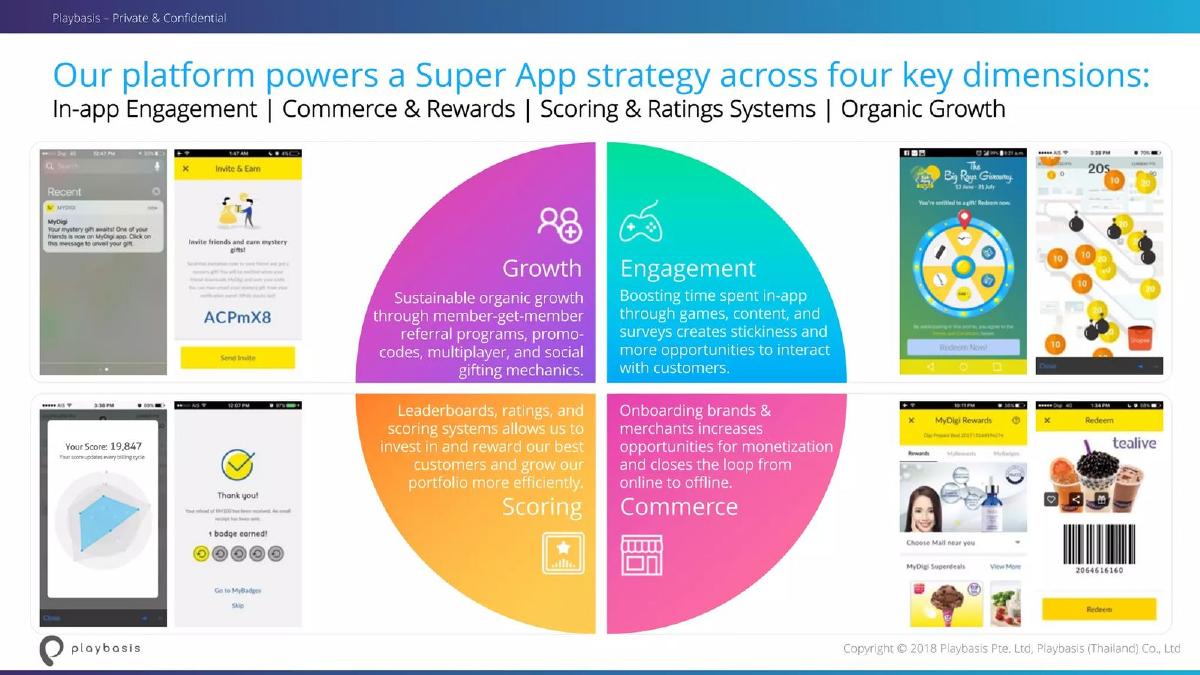
- Playbasis defines its platform across four dimensions: Growth, Engagement, Scoring, and Commerce (Slide 3).
- The strategy is explicitly modeled after Chinese 'Super Apps' like Taobao, QQ, Alipay, and Pinduoduo (Slide 4).
- Slide 5 highlights a massive market shift, noting that China's mobile payment volume (WeChat + Alipay) exceeded $16T in 2017, surpassing Visa's global volume.
- Detailed case studies for DBS Bank (Slide 6) and MyDigi (Slide 7) demonstrate real-world application in banking and telecom.
- Slide 8 introduces a theoretical unit economics model where 'PB Rewards' lower CAC and increase LTV compared to a 'Base' model.
- The deck provides no information regarding the founding team, their backgrounds, or technical expertise.
- There is no mention of current revenue, burn rate, or a specific capital requirement for a funding round.
Slide-by-Slide Analysis
Slide 1: Title Slide
The deck opens with a clean, professional aesthetic, positioning Playbasis as a "gamified rewards & customer engagement platform." The subtitle, "Transform any app into a Super App," immediately identifies the company's target market: established businesses with existing apps that are struggling to retain users or drive transactions. The branding is consistent, featuring a modern logo and a clear value proposition.
Slide 2: The Industry Challenge
This slide establishes the "Why Now?" by showing a chart of U.S. Technology Adoption Rates from 1900–2014 . It highlights that modern technologies like smartphones and the internet have reached 50-75% adoption significantly faster than electricity or telephones did in the past. The text states: "Consumers are adopting disruptive technology faster than ever, putting pressure on incumbents to digitally transform themselves." This is a classic fear-based opening designed to make potential corporate clients or investors feel the urgency of the market shift.
Slide 3: The Four Dimensions of the Platform
Playbasis breaks its platform down into four functional quadrants: Growth, Engagement, Scoring, and Commerce .
Growth: Focuses on organic growth through referral programs and social gifting. · Engagement: Uses games and surveys to create "stickiness." · Scoring: Implements leaderboards and ratings to identify and reward high-value customers. · Commerce: Onboards merchants to increase monetization and bridge the online-to-offline gap.
The slide uses actual screenshots of the interface, which helps ground the abstract concepts in a tangible product.
Slide 4: The Chinese 'Super App' Playbook
This slide is a strategic anchor. It argues that unicorns in India and Southeast Asia are following the China playbook: "Offer rewards & signup bonuses -> Gamify user engagement -> Monetize via microtransactions." It showcases specific game mechanics from Taobao, QQ, Alipay, and Pinduoduo , such as virtual scavenger hunts and lucky wheels. By aligning themselves with these multi-billion dollar successes, Playbasis positions its B2B offering as the infrastructure for the next wave of Asian unicorns.
Slide 5: The Scale of Mobile Payments
To prove the financial viability of this model, Slide 5 presents a dramatic growth chart. It shows that Mobile Payment Volume in China (WeChat+Alipay) reached over $16T in 2017 , compared to Visa's Global Payment Volume of approximately $8T in the same period. A pie chart breaks down the Chinese market: Alipay at 58%, WeChat Pay at 34%, and Others at 8% . This slide validates the "Commerce" quadrant of their platform by showing the massive transaction volumes possible when engagement is done correctly.
Slide 6: Case Study - DBS Bank (Hong Kong)
This slide provides a deep dive into a real-world application for a major financial institution. The "Prosperity Catch" game for DBS Omni is detailed as a four-step process: 1. Bank sends real-time transaction info to Playbasis. 2. Cardholders are invited to play. 3. Gameplay is managed via bank-defined rules. 4. Player data is sent back for real-time rewards settlement. This slide is crucial for B2B credibility, proving they can handle the security and data requirements of a Tier-1 bank.
Slide 7: Case Study - MyDigi Rewards (Malaysia)
Similar to the DBS slide, this focuses on the telecom sector. It shows how Playbasis provides the backend for Digi's referral campaigns and online-to-offline marketplace. It mentions that subscribers are invited to play new games every month to earn points, which are then redeemed for vouchers (e.g., Tealive ) using their wallet balance. This demonstrates the platform's versatility across different industries (FinTech vs. Telco).
Slide 8: Unit Economics and Scalability
The final attached slide addresses the math behind the platform. It presents a conceptual graph of Customer Lifetime Value (LTV) vs. Time . The core argument is that using Playbasis ("PB") results in a lower CAC (Customer Acquisition Cost) and a higher LTV compared to the "Base" model. The slide states: "The more sticky your users/players are the farther out you can push your payback period." While the numbers on the Y-axis ($0 to $50) appear to be illustrative rather than actual company data, the logic is sound for a growth-stage pitch.
What Works
Strong Narrative Arc: The deck moves logically from a global problem (rapid disruption) to a regional solution (the China playbook) to specific proof points (DBS and MyDigi case studies). It tells a cohesive story about the inevitability of gamified commerce.
Visual Proof: The inclusion of numerous app screenshots and specific game mechanic descriptions (Slide 4) makes the product feel "real." It avoids the trap of being too high-level or academic.
Market Validation: Using the $16T mobile payment figure (Slide 5) creates a massive sense of opportunity. It reframes "games" from a toy to a serious financial engine.
What is Missing
The Team: There is no team slide in the provided selection. For a B2B platform requiring integration with banks and telcos, the founders' experience in enterprise sales and security is a critical omission.
Financial Performance: While the case studies show how the product works, they don't show how well it works in terms of hard ROI for the clients or revenue for Playbasis. There are no figures for MRR, churn, or contract values.
The Ask: The deck does not state how much money is being raised, the valuation, or the intended use of funds. This makes it feel more like a sales deck for clients than a pure investor pitch.
Competition: The deck ignores other gamification API providers or internal build teams at large corporations. It assumes a vacuum that rarely exists in the B2B SaaS space.
Founder's Guide: What to Copy
The "Playbook" Strategy: If your startup is bringing a proven model from one geography (like China) to another (like Southeast Asia), use the "Playbook" slide (Slide 4). It reduces the perceived risk for investors by showing that the model already works at scale elsewhere.
Quadrant Product Definition: Slide 3 is an excellent way to categorize a complex platform. By breaking the product into Growth, Engagement, Scoring, and Commerce, Playbasis makes it easy for a buyer to identify which specific "module" they need first.
Visualizing the Unit Economics Shift: Slide 8 is a powerful way to show the value of your product without needing to disclose sensitive internal margins. By graphing the "Base" vs. "Product-Enhanced" LTV/CAC curves, you can visually demonstrate the economic impact of your solution.
Frequently asked questions
- What is the core product of Playbasis according to the deck?
- Playbasis is a gamified rewards and customer engagement platform designed to help companies transform their existing applications into 'Super Apps.' As shown on Slide 3, the platform provides tools for member-get-member referrals, in-app games, leaderboards, and merchant onboarding to close the loop between online engagement and offline commerce.
- How does Playbasis justify the need for gamification in traditional industries?
- The deck argues that consumer adoption of disruptive technology is accelerating, putting pressure on incumbents to digitally transform (Slide 2). It specifically points to the success of Chinese giants who use game mechanics—like virtual scavenger hunts and lucky wheels—to monetize users via microtransactions and high-frequency engagement (Slide 4).
- What specific results are shown in the case studies?
- While the deck lacks aggregate portfolio metrics, it details specific workflows. For DBS Bank (Slide 6), Playbasis managed real-time credit card transaction data to trigger 'Prosperity Catch' games for rewards. For MyDigi (Slide 7), it provided the backend for a referral system and an online-to-offline marketplace for merchant vouchers.
- What is the 'Super App' playbook mentioned in the deck?
- According to Slide 4, the playbook consists of three steps: offering rewards and signup bonuses, gamifying user engagement, and finally monetizing that engagement via microtransactions. The deck suggests that unicorns in India and Southeast Asia are now following this established Chinese model.
- How does Playbasis claim to affect a company's unit economics?
- On Slide 8, Playbasis presents a graph comparing 'Base' unit economics to 'PB' (Playbasis) economics. It claims that their rewards and referral mechanics result in a lower Customer Acquisition Cost (PB CAC) and a higher, steeper Customer Lifetime Value (PB LTV) curve, effectively shortening the payback period.