Plentific raised $100M in 2021 with a Series C deck that prioritizes traction and ecosystem depth over complex technical explanations. The presentation effectively communicates its value proposition across four distinct user groups: residents, property managers, landlords, and service providers. By showcasing a 93% first-time fix rate and 25% operational savings, the company provides clear evidence of product-market fit in the fragmented property maintenance sector. The deck is notably concise for a late-stage round, relying on a heavy roster of institutional clients like Knight Frank and Leg…
Key takeaways
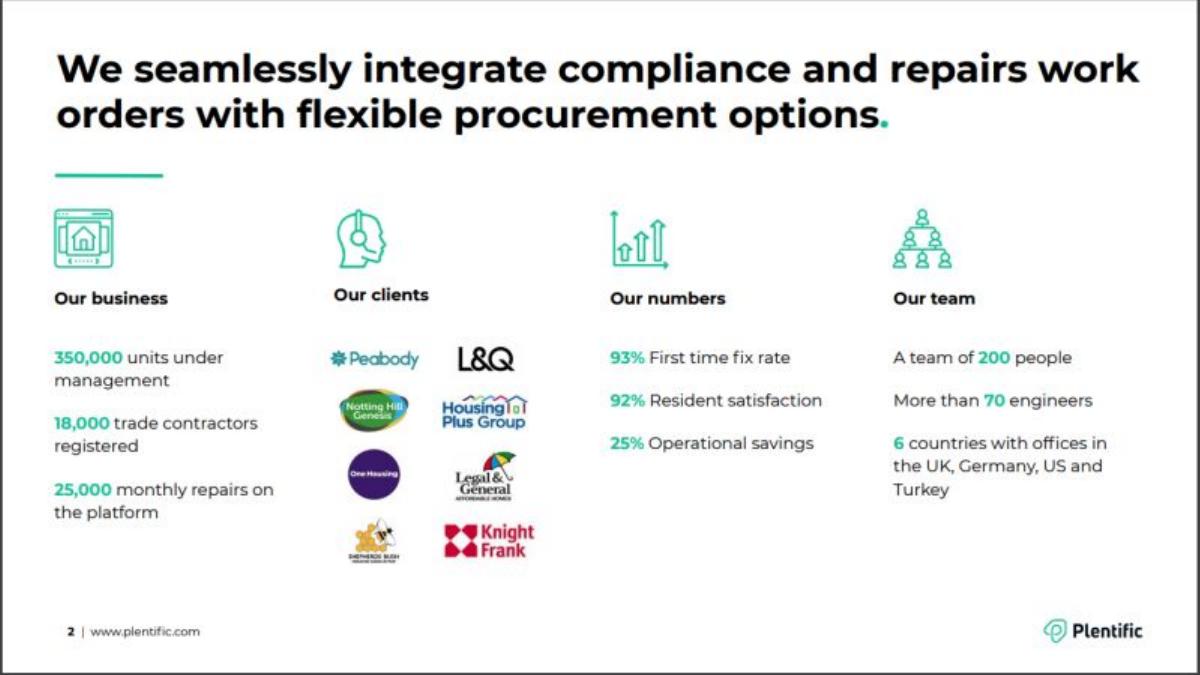
- The platform manages 350,000 units and facilitates 25,000 monthly repairs as of slide 2.
- Plentific claims a 93% first-time fix rate and 92% resident satisfaction on slide 2.
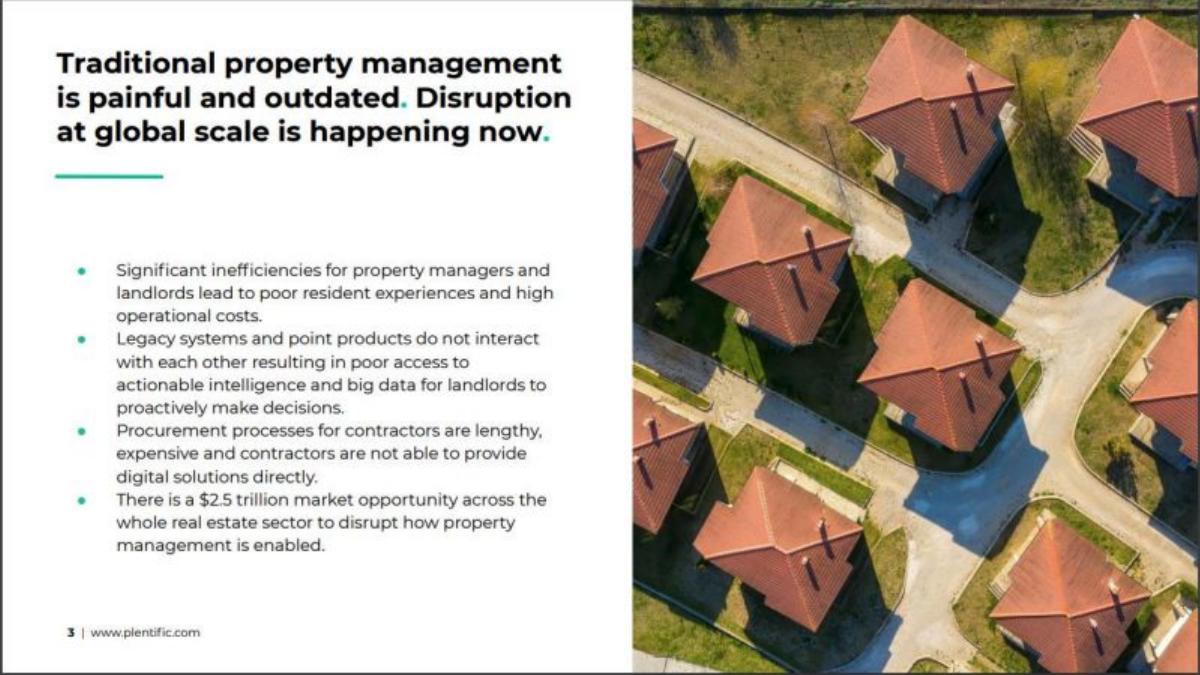
- The market opportunity is valued at $2.5 trillion across the real estate sector according to slide 3.
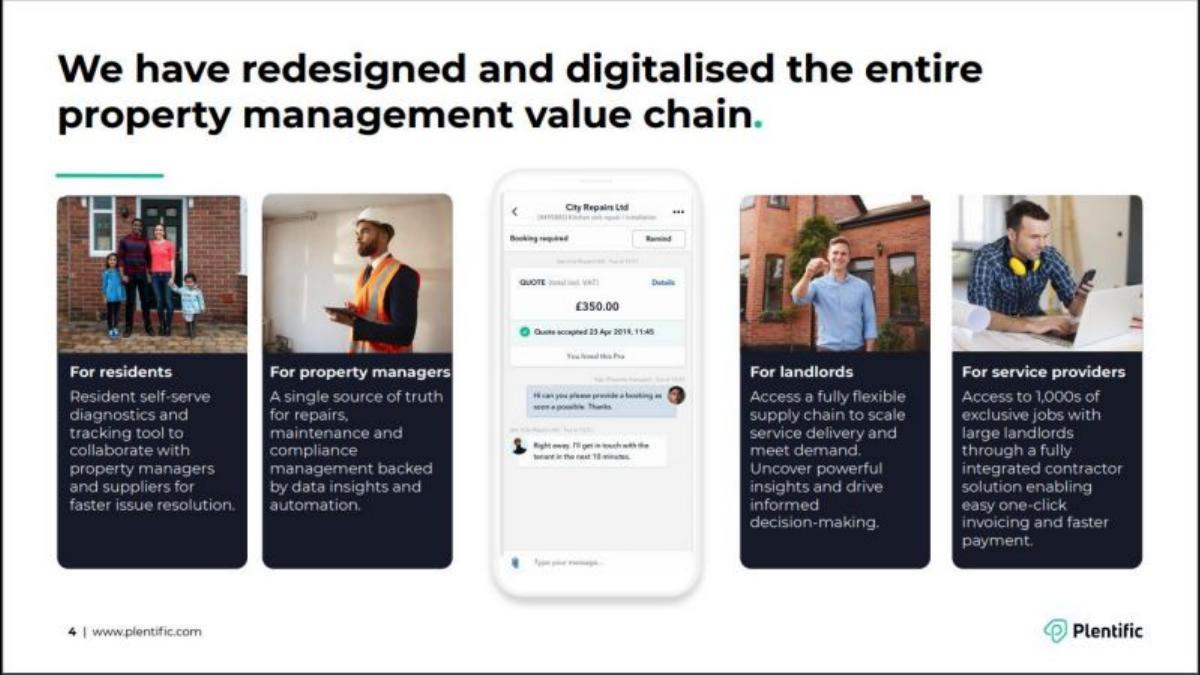
- The business model serves four distinct personas: residents, property managers, landlords, and service providers (slide 4).
- The company is active in 76 cities across three major global real estate markets (slide 5).
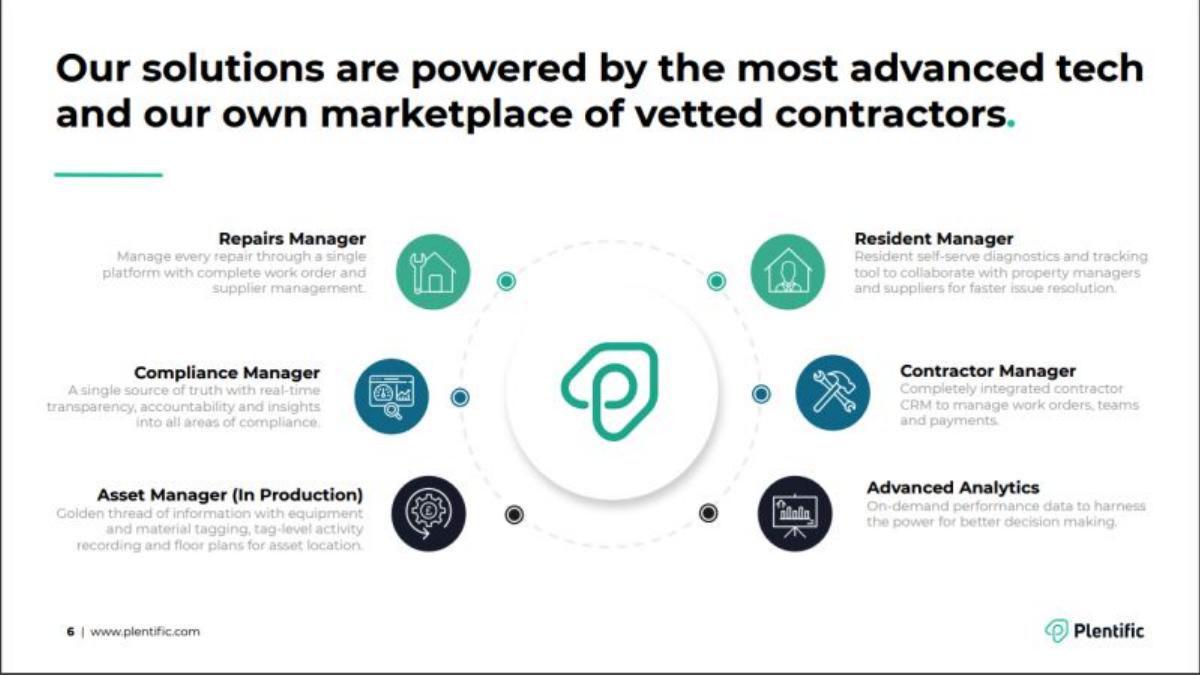
- Product development includes a new 'Asset Manager' tool currently in production (slide 6).
- The 'Property Labs' initiative uses 14-week, 6-week, and 2-hour programs to co-create features with clients (slide 8).
- The deck features a high-density logo wall including Peabody, L&Q, and Knight Frank (slide 9).
The Series C Narrative: Scale Over Mechanics
Plentific’s 2021 Series C deck is a study in brevity. At just 11 slides, it bypasses the granular 'how-it-works' explanations typical of Seed or Series A decks and moves straight to the 'how-much-we-own' narrative required for a $100M round. The deck serves as a high-level summary of a dominant marketplace that has already achieved significant density in its primary markets.
Slide 1: Title and Positioning
The cover slide establishes a bold claim: 'The only platform for flexible end-to-end maintenance and compliance.' By using the word 'only,' Plentific immediately positions itself as a category leader. The branding is clean, professional, and corporate, signaling a transition from a disruptive startup to an established enterprise partner.
Slide 2: The Traction Summary
This is arguably the most important slide in the deck. It provides a comprehensive snapshot of the business across four pillars: Business, Clients, Numbers, and Team. Plentific reports 350,000 units under management and 18,000 registered trade contractors. The operational efficiency is highlighted by a 93% first-time fix rate and 25% operational savings. For a Series C investor, these numbers prove that the marketplace has reached the 'flywheel' stage where supply and demand are self-sustaining.
Slide 3: The $2.5 Trillion Problem
Slide 3 defines the market pain points. It characterizes traditional property management as 'painful and outdated.' The slide lists four key issues: inefficiencies leading to high costs, siloed legacy systems, lengthy procurement processes, and a lack of digital solutions for contractors. It quantifies the market opportunity at $2.5 trillion , providing the necessary 'venture scale' context for a large investment round.
Slide 4: The Four-Sided Value Proposition
Plentific visualizes its impact across the entire property management value chain. This slide is critical because it explains how the platform creates value for everyone in the ecosystem. Residents get self-serve tools; property managers get a 'single source of truth'; landlords get a flexible supply chain; and service providers get '1,000s of exclusive jobs.' This multi-sided approach suggests high switching costs and deep platform defensibility.
Slide 5: Global Footprint and Social Proof
The company demonstrates its geographic reach, stating it is present in 76 cities across 3 of the largest Real Estate markets. The map highlights the UK, Germany, and the US. To add emotional weight to the data, the slide includes video testimonials from executives at Notting Hill Genesis and Peabody. These aren't just small landlords; they are major institutional players, which validates Plentific's enterprise-grade reliability.
Slide 6: Product Ecosystem
This slide moves beyond simple maintenance to show a suite of integrated modules: Repairs Manager, Compliance Manager, Resident Manager, Contractor Manager, and Advanced Analytics. Notably, it mentions an 'Asset Manager' tool as being 'In Production.' This indicates to investors that the company is still expanding its product surface area to capture more of the property management budget.
Slide 7: ESG and Social Value
In 2021, ESG (Environmental, Social, and Governance) became a core focus for institutional investors. Plentific dedicates a full slide to this, explaining how they help clients raise EPC ratings to C levels by 2035 and how using local supply chains creates employment opportunities. This slide isn't just about 'doing good'; it's about aligning with the regulatory and reporting requirements of their large enterprise clients.
Slide 8: Property Labs and Co-Creation
Slide 8 introduces 'Property Labs,' a structured way for Plentific to innovate alongside its customers. By offering 14-week, 6-week, and 2-hour programs, Plentific ensures that its product roadmap is directly influenced by the 'pain points' of at least 15 organizations in the sector. This is a sophisticated B2B strategy that turns customers into long-term product partners.
Slide 9: The Logo Wall
The penultimate slide is a high-density logo wall. It features 20+ major organizations, including Knight Frank, Legal & General, and Grand City Properties. For a Series C deck, this slide acts as the final 'de-risking' mechanism. It shows that the largest names in the industry have already vetted and adopted the technology.
Slide 10 & 11: Closing and Call to Action
The deck concludes with a 'Thank You' and a link to a video. There is no 'Ask' slide detailing the $100M raise or the specific use of funds. This is common in late-stage decks where the terms are often discussed in separate, highly confidential data rooms or supplemental documents.
What Works in the Plentific Deck
Massive Social Proof: The inclusion of specific, high-tier client logos and video testimonials from heads of product and delivery managers provides immediate credibility. · Quantifiable Efficiency: Stating a 25% operational saving and a 93% first-time fix rate gives investors hard metrics to model the platform's ROI for its customers. · Ecosystem Breadth: By showing how they serve residents, managers, landlords, and contractors, they demonstrate a 'sticky' platform that is difficult for a single-point solution to displace. · ESG Alignment: Proactively addressing energy efficiency and local employment (Slide 7) makes the company more attractive to modern institutional funds.
What is Missing from the Plentific Deck
The Team: There is no slide introducing the founders or the leadership team. While the company has 200 employees, investors still want to see the pedigree of the people steering the ship. · Financial Performance: There are no mentions of Revenue, ARR, or growth rates. While this information is likely in the data room, its absence in the main deck is notable. · The Ask: The deck does not specify how much capital is being raised or how it will be spent (e.g., US expansion vs. R&D). · Competitive Landscape: The deck assumes a vacuum. It does not address how Plentific compares to traditional ERPs or other emerging PropTech competitors.
What Founders Should Copy
The Traction Snapshot (Slide 2): Every deck should have a 'business at a glance' slide that summarizes the core KPIs. It allows an investor to understand the scale of the business in under 10 seconds. · Persona-Based Value Props (Slide 4): If your product serves multiple stakeholders, break them down clearly. Showing that you understand the unique needs of each user group is vital for platform plays. · Structured Innovation (Slide 8): The 'Property Labs' concept is a brilliant way to show investors that your product development is not guesswork, but a collaborative process with paying customers. · Clean Visual Hierarchy: The deck uses a consistent color palette, professional iconography, and minimal text. It looks like a product from a company that values design and user experience.
Frequently asked questions
- How much did Plentific raise with this deck?
- According to the catalogue facts, Plentific raised $100M in a Series C round in 2021. The deck itself focuses on the scale achieved leading up to this round rather than the specific terms of the investment.
- What is the core problem Plentific is solving?
- Slide 3 identifies the problem as 'painful and outdated' traditional property management. Specifically, it cites significant inefficiencies, legacy systems that don't interact, and lengthy, expensive procurement processes for contractors.
- Who are the primary users of the Plentific platform?
- Slide 4 breaks the value chain into four segments: Residents (self-serve diagnostics), Property Managers (single source of truth), Landlords (flexible supply chain), and Service Providers (access to thousands of jobs).
- What is the 'Property Labs' mentioned in the deck?
- Slide 8 describes Property Labs as a collaborative framework for shaping the future of property management. It offers three tiers: Full Labs (14 weeks), Mini Labs (6 weeks), and Micro Labs (2 hours) to define solution requirements with industry organizations.
- Does the deck include information about the founding team?
- No. Slide 2 mentions a total team of 200 people with more than 70 engineers, but there is no dedicated team slide featuring the founders, their backgrounds, or the executive leadership team.