Plumbr's pitch deck targets a specific, high-pain technical problem: manual troubleshooting of software performance glitches. By focusing on the Java ecosystem—which they cite as the #1 programming language with over 8 million developers—they establish a clear, addressable market. The deck excels at demonstrating product utility through a literal screenshot of a memory leak report, which provides actionable resolution instructions rather than just raw data. While the deck lacks a specific dollar amount for the 'Ask,' it clearly outlines three strategic milestones for the investment round: bui…
Key takeaways
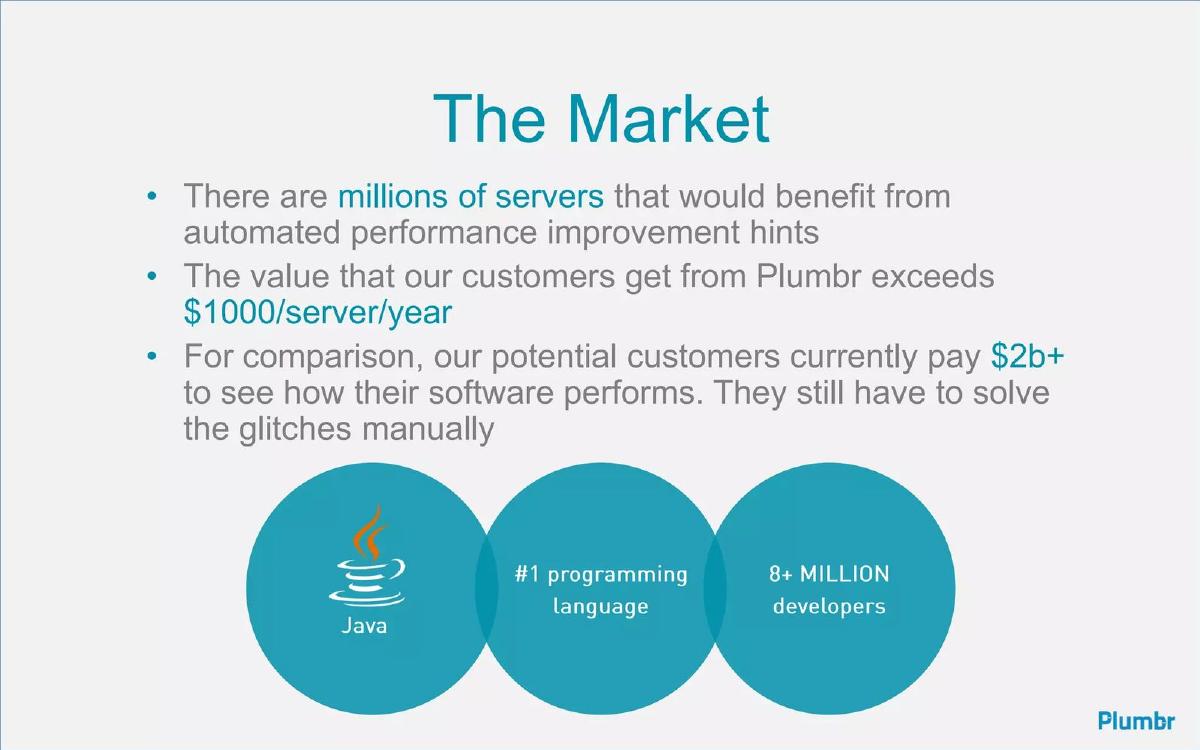
- The company estimates the value provided to customers exceeds $1000 per server per year (Slide 2).
- Plumbr identifies a $2b+ market where potential customers currently pay to see performance data but still solve glitches manually (Slide 2).
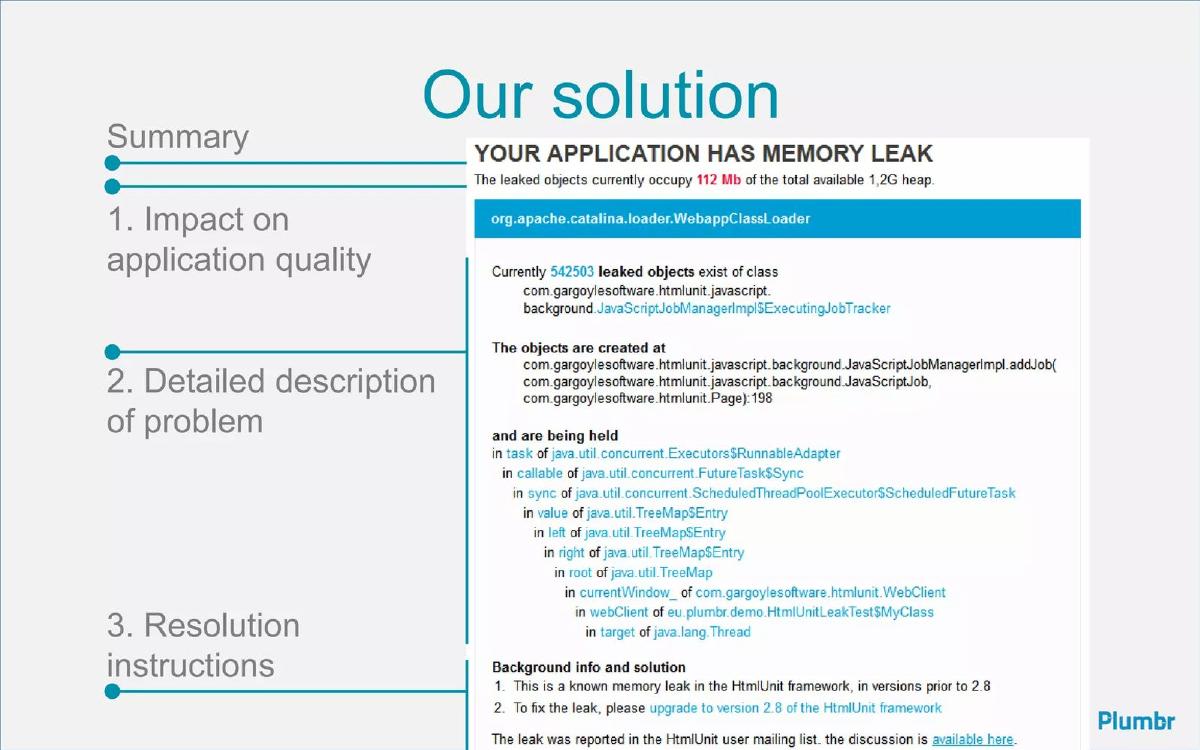
- The solution provides specific resolution instructions, such as advising a user to upgrade to version 2.8 of the HtmlUnit framework to fix a known leak (Slide 3).
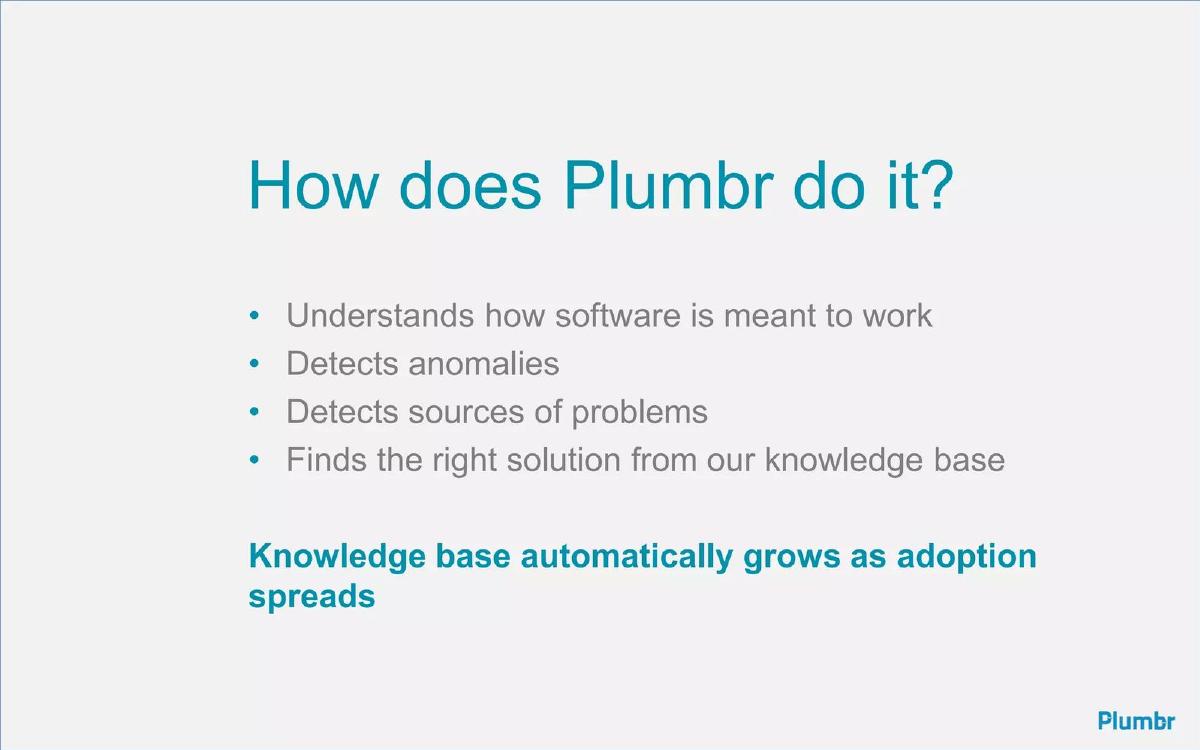
- The product development cycle relies on a feedback loop of gathering data, crowd-sourcing solutions, and launching detection algorithms (Slide 4).
- The founding team includes a CEO who led a team of 70 and a CTO who invented the core technology during PhD research (Slide 5).
- Early enterprise validation is evidenced by quotes from J.B. Hunt, Ericsson, and TeliaSonera (Slide 6).
- The deck omits a specific financial 'Ask' or valuation, focusing instead on three operational milestones (Slide 7).
- The market focus is strictly on the Java ecosystem, leveraging its 8+ million developer base (Slide 2).
Introduction
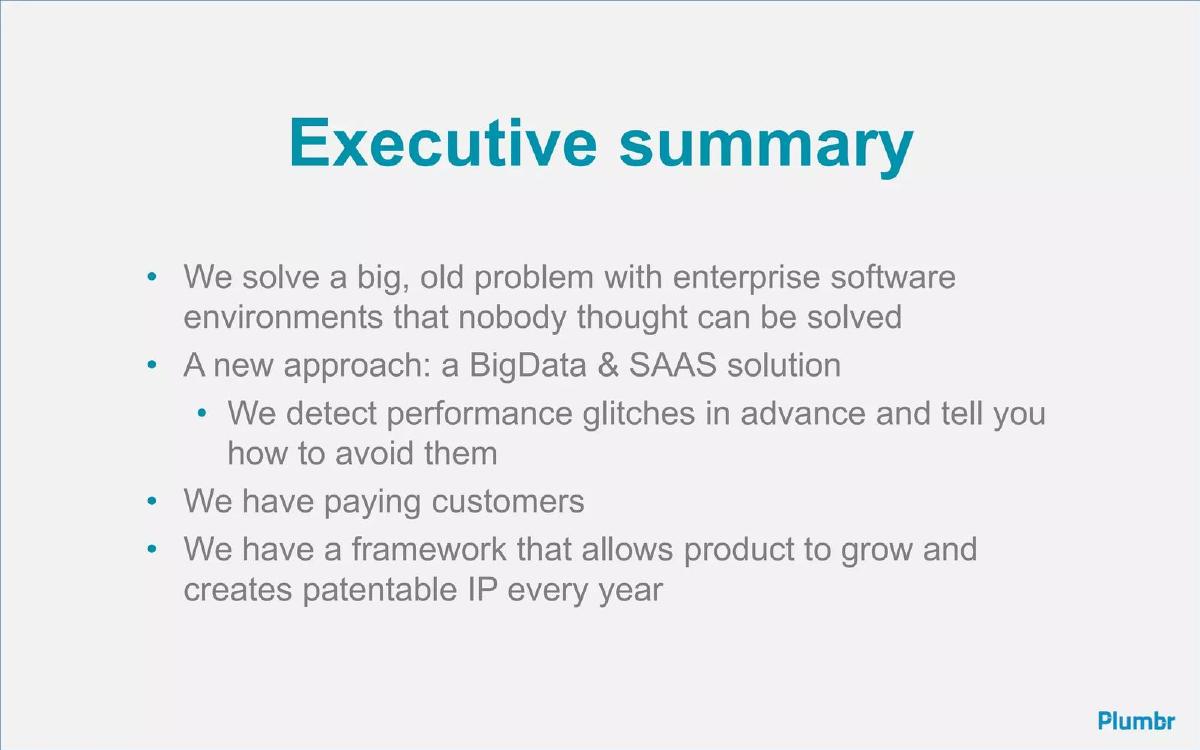
Plumbr is a technical utility startup focused on the Java ecosystem. Their pitch deck is a lean, 14-slide presentation (of which 7 are analyzed here) that moves quickly from the high-level problem of performance monitoring to the specific, automated solution they have built. The deck is notable for its lack of fluff; it focuses heavily on the technical pedigree of the founders and the tangible results delivered to early enterprise clients.
Slide 1: Title and Vision
The deck opens with a minimalist title slide. The core message is clear: "Solving performance problems is hard. We don't think it needs to be." This sets the stage for a "pain-killer" product rather than a "vitamin." It immediately identifies the target audience—people who are currently struggling with the difficulty of performance optimization.
Slide 2: The Market Opportunity
Slide 2 defines the market through the lens of the Java ecosystem. It makes three specific claims:
There are millions of servers that need automated performance hints. · The value per server exceeds $1000/year . · The existing market spend is $2b+ , but current tools only show performance without solving the underlying glitches.
By highlighting that there are 8+ million developers and that Java is the #1 programming language , Plumbr justifies its narrow focus on a single language as a massive, underserved opportunity.
Slide 3: The Solution in Practice
This is arguably the most important slide in the deck. Instead of using abstract icons, Plumbr shows a literal screenshot of their product output. The report identifies a memory leak, quantifies it ( 112 Mb ), identifies the specific class causing the leak ( org.apache.catalina.loader.WebappClassLoader ), and provides a direct resolution instruction: "To fix the leak, please upgrade to version 2.8 of the HtmlUnit framework." This demonstrates the transition from monitoring to automated resolution.
Slide 4: The Feedback Loop
Slide 4, titled "How we train Plumbr," explains the technical moat. It describes a four-stage cycle: Gather data , Launch/improve detection algorithm , Crowd source solutions , and Instructions in "plain English." This suggests that the product becomes more valuable and accurate as the user base grows, creating a data network effect in bug resolution.
Slide 5: Team Pedigree
The "Why we will pull this off" slide focuses on technical and leadership credibility. Priit Potter (CEO) is noted for leading a team of 70, while Vladimir Šor (CTO) is credited with inventing the technology during his PhD. The inclusion of Ivo Mägi (ZeroTurnaround board member) and Nikita Salnikov (Java conference speaker) reinforces their deep roots in the Java community. There are five additional team members pictured without text, suggesting a solid engineering foundation.
Slide 6: Enterprise Validation
Slide 6 provides social proof from three major entities: J.B. Hunt , Ericsson , and TeliaSonera . The quotes are specific to the value proposition. The Ericsson quote— "Our developers now have one major concern less to worry about" —directly supports the vision statement from Slide 1. The J.B. Hunt quote emphasizes that the software proved its worth from the very first leak report.
Slide 7: The Path Forward
The final slide in this set, "Milestones for investment round," outlines the immediate roadmap. It lists three objectives: building a sales organization , releasing detection for problems #3-6 , and PAAS integration . This slide tells investors exactly what the company intends to do with the capital, even if the specific amount of capital is not disclosed in this version of the deck.
What Plumbr Does Well
The deck is exceptionally good at demonstrating Product-Led Growth (PLG) potential. By showing a report that gives a developer the exact answer to a problem, they prove the product's utility without needing a long sales cycle. The focus on the "Plain English" resolution is a strong differentiator against traditional APM (Application Performance Monitoring) tools that simply provide dashboards of charts.
Furthermore, the team slide is well-constructed. It doesn't just list titles; it lists specific achievements that are relevant to the problem they are solving (e.g., PhD research in the specific field, leadership in the specific language community).
What is Missing
The most glaring omission in these slides is the Unit Economics and Financials . While they mention a value of $1000/server/year, they do not state their actual pricing model, their current Monthly Recurring Revenue (MRR), or their Customer Acquisition Cost (CAC). For a company looking to "build a scalable sales organization," investors would want to see the efficiency of their current sales efforts.
Additionally, there is no Competition Slide . The APM market is crowded with giants like New Relic, AppDynamics, and Dynatrace. While Slide 2 alludes to them by saying customers pay $2b+ to "see how their software performs," a direct comparison of why Plumbr’s automated resolution is superior to the "manual" resolution required by competitors would be beneficial.
Founder Takeaways
Show, Don't Tell: If you have a technical product, show a screenshot of the output. Plumbr's Slide 3 is more effective than ten slides of marketing copy. · Quantify the Pain: Don't just say the market is big; say how much the current inefficiency costs. The $2b spend on tools that don't solve the problem is a compelling hook. · Focus on a Niche: Plumbr doesn't try to solve performance for every language. By owning the Java niche, they make their 8-million-developer market feel attainable and specific. · Use Specific Testimonials: The quotes from Ericsson and J.B. Hunt aren't generic "great product" blurbs. They address specific pain points like "multi-vendor environment finger pointing."
Frequently asked questions
- What specific problem does Plumbr solve?
- Plumbr solves the problem of manual performance troubleshooting in Java applications. According to Slide 2, while companies spend over $2 billion on monitoring tools, these tools often only show that a problem exists. Plumbr automates the detection of the root cause—specifically memory leaks—and provides 'plain English' instructions on how to fix them, as shown in the sample report on Slide 3.
- How does Plumbr quantify its value proposition?
- The deck quantifies its value in two ways on Slide 2. First, it claims the value delivered to customers exceeds $1,000 per server per year. Second, it contrasts its automated solution against the current $2 billion market spend on monitoring tools that still require manual labor to resolve the actual glitches identified.
- Who are the key members of the Plumbr team?
- The team is led by Priit Potter (CEO), who previously managed a team of 70, and Vladimir Šor (CTO), who developed the technology during his PhD research. Other key members include Ivo Mägi, a former board member of ZeroTurnaround, and Nikita Salnikov, a lead developer and frequent speaker at Java conferences (Slide 5).
- What is the company's strategy for growth after the investment?
- According to Slide 7, the company has three primary milestones for the investment round: building a scalable sales organization, expanding the software's capabilities to detect four additional types of performance problems (labeled #3-6), and integrating their distribution with three major Platform-as-a-Service (PAAS) providers.
- Does the deck include financial projections or a specific funding request?
- No. The provided slides do not contain a slide for financial projections, historical revenue, or a specific dollar amount for the funding round. Slide 7 is titled 'Milestones for investment round,' but it lists operational goals rather than financial terms or the intended use of a specific capital amount.