The Pluralsight acquisition deck is not a traditional startup pitch; it is a high-stakes proxy solicitation document. Following a $3.5B offer from Vista Equity Partners, Pluralsight’s board had to defend the deal against activist investors Eminence and Akaris, who argued the price was too low. The presentation meticulously dismantles the 'standalone' bull case by highlighting decelerating LTM dollar-based net retention (falling from 128% in Q1'19 to 113% in Q3'20) and rising competitive pressure from titans like LinkedIn and YouTube. By framing the $20.26 per share cash offer as a premium ove…
Key takeaways
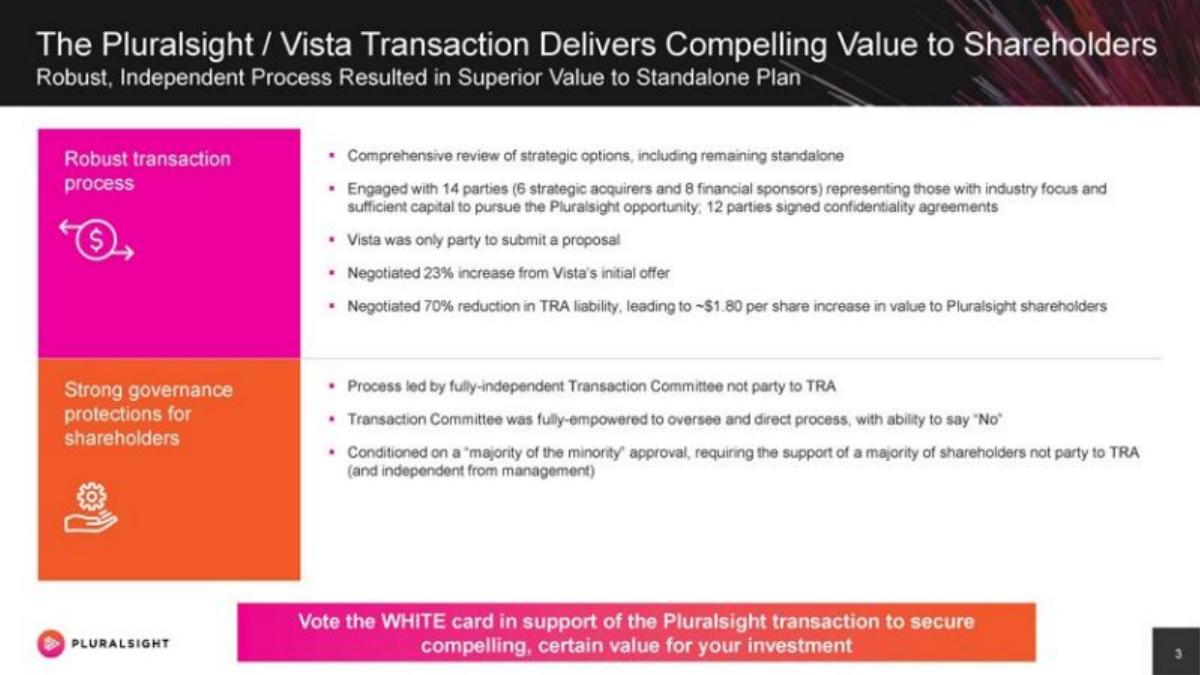
- The deck explicitly urges shareholders to 'Vote the WHITE card' to support the transaction (Slide 3).
- Management highlights a significant decline in LTM Dollar-Based Net Retention from 128% in 2019 to 113% by Q3 2020 (Slide 9).
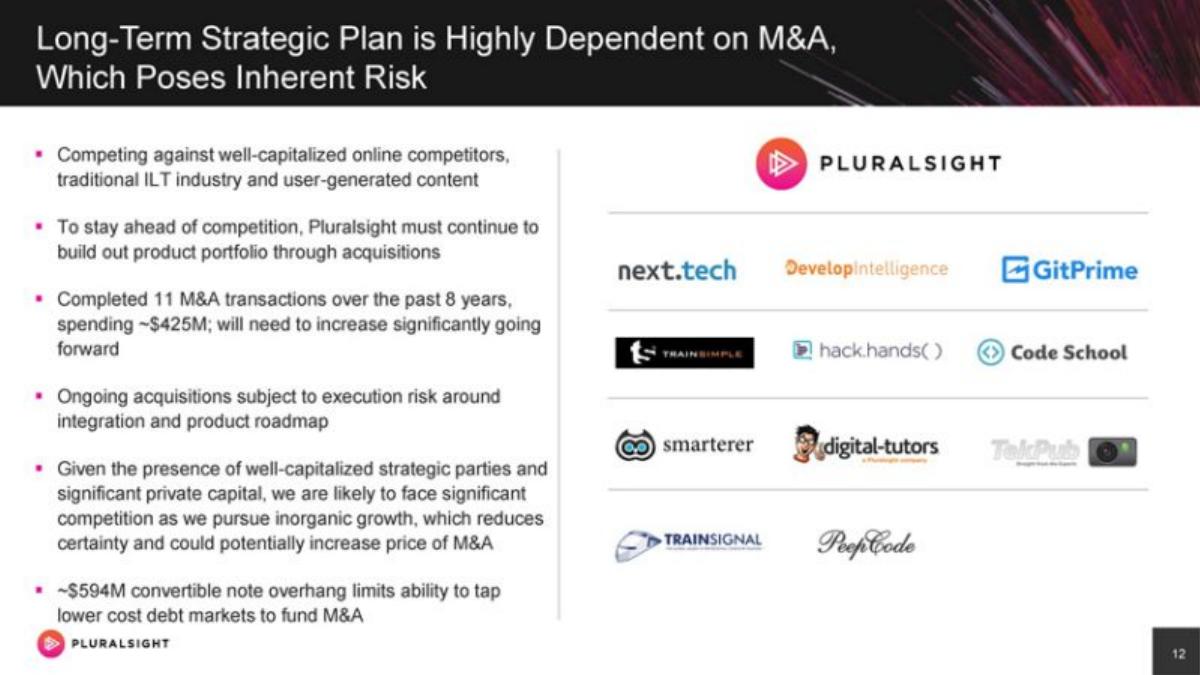
- The company admits to a $594M convertible note overhang that limits its ability to fund necessary future M&A (Slide 12).
- The board negotiated a 70% reduction in Tax Receivable Agreement (TRA) liability, adding ~$1.80 per share in value for shareholders (Slide 18).
- Pluralsight positions its 9.2x LTM revenue multiple as superior to the peer median of 7.9x (Slide 5).
- The presentation identifies 'User-Generated' content like YouTube and GitHub as primary competitive threats to their premium model (Slide 7).
- The Independent Transaction Committee engaged with 14 parties, but Vista was the only one to submit a formal proposal (Slide 3).
- The deal was conditioned on a 'majority of the minority' approval to ensure governance protection for non-management shareholders (Slide 24).
The Defensive Art of the Take-Private Deck
The Pluralsight acquisition deck, dated February 2021, is a fascinating artifact of corporate defense. Unlike a Series A deck designed to inspire hope, this M&A presentation is designed to manage expectations. It was created at a moment when Pluralsight was caught between a disappointing public market performance and an aggressive activist investor base. The goal of these 33 slides (17 of which are analyzed here) was simple: convince shareholders that $20.26 in cash today is better than the risk of a standalone tomorrow.
Slide 1-3: The Transaction Mandate
The presentation opens with a clear call to action. Slide 3 establishes the narrative: the board conducted a 'Robust, Independent Process' that resulted in 'Superior Value to Standalone Plan.' This is the core thesis of the entire deck. It reveals that while 14 parties were engaged, Vista was the only party to submit a proposal . This is a critical piece of evidence used to silence activists who claimed the company was being sold too cheaply; if no one else wanted to buy it, the market had spoken. The slide also highlights a 23% increase from Vista’s initial offer, framing the board as tough negotiators.
Slide 5: Valuation Benchmarking
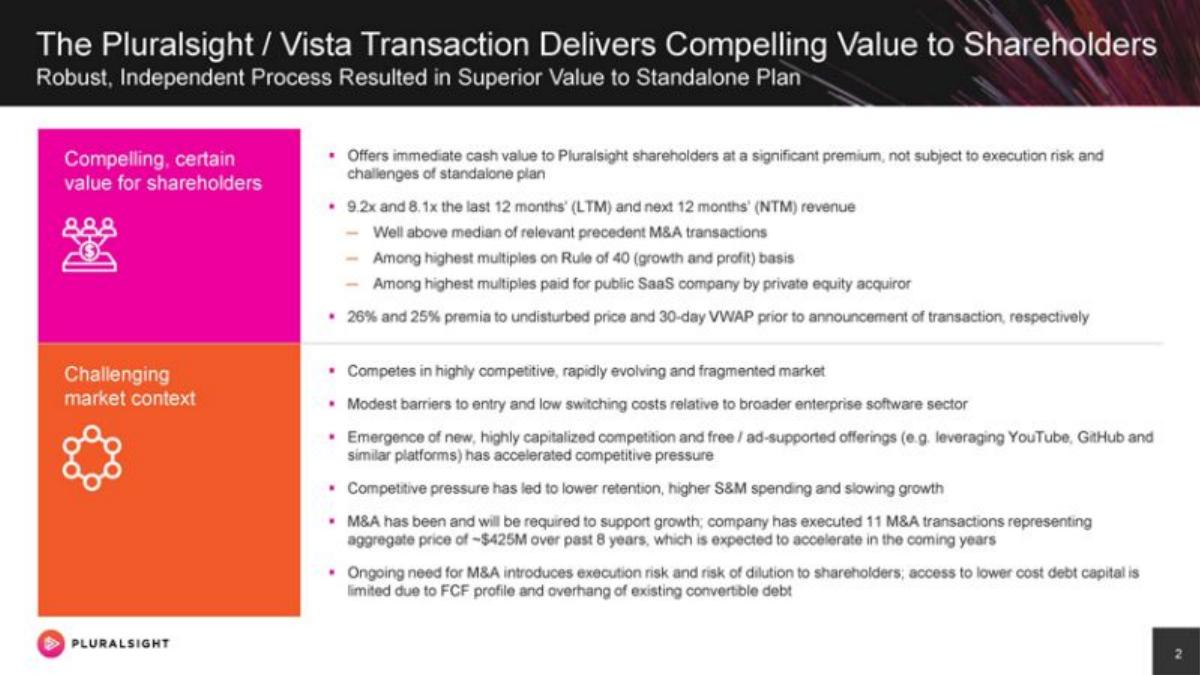
On Slide 5, Pluralsight uses valuation multiples to prove the deal's worth. They show an LTM Revenue Multiple of 9.2x , which they contrast against a Peer Median of 7.9x. By showing that they are being acquired at a premium relative to how the market values their peers, they attempt to invalidate the claim that the $3.5B price tag is an 'under-sell.' They also introduce the 'Rule of 40' multiple (Enterprise Value / Revenue / (Growth + FCF Margin)), showing Pluralsight at 0.54x versus a peer median of 0.26x. This is a sophisticated way of saying: 'We are getting a great price for a company with our specific growth and margin profile.'
Slide 7-9: The 'Why Now' (The Bear Case)
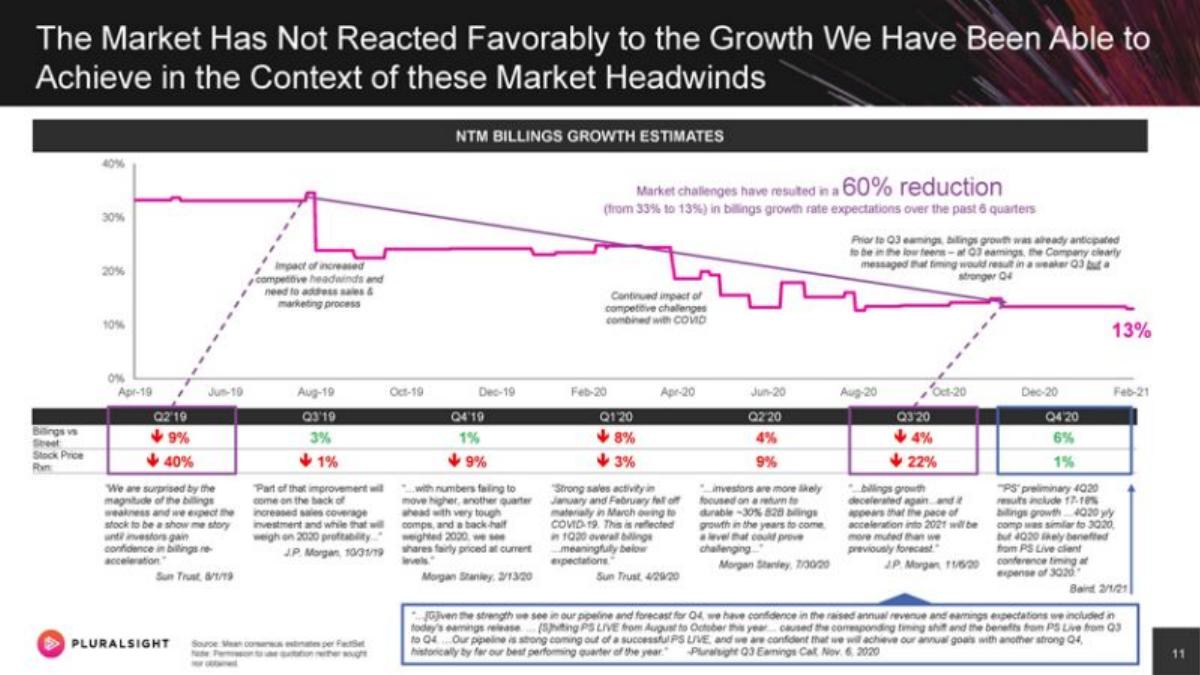
This section is where the deck becomes brutally honest about the company's struggles. Slide 7 lists 'Significant Challenges,' including the discretionary nature of L&D budgets and the rise of free content on YouTube and GitHub . Slide 9 provides the data to back up this pessimism. It shows LTM Dollar-Based Net Retention Rates dropping from 128% in early 2019 to 113% in Q3 2020. For a SaaS company, this downward trend is a 'falling knife' signal. Furthermore, the slide shows Pluralsight’s S&M expenses at 52% of revenue, placing it as the second most expensive sales motion in its peer group. The message is clear: growth is getting harder and more expensive to buy.
Slide 12: The M&A Dependency
Slide 12 is perhaps the most strategic in the deck. It argues that Pluralsight’s long-term plan is 'Highly Dependent on M&A.' It lists 11 previous acquisitions (including GitPrime, Code School, and Smarterer ) totaling ~$425M. However, it then points to a $594M convertible note overhang . This is a 'poison pill' argument: the company needs to buy other companies to grow, but it has too much debt to borrow more money to do so. Therefore, the only way to execute the strategy is under the wing of a well-capitalized private equity firm like Vista.
Slide 14-18: Governance and the TRA
The deck spends considerable time on the 'Independent Transaction Committee.' Slide 16 introduces Bonita C. Stewart (Google) and Leah Johnson (Lincoln Center) as the independent leads. This is meant to reassure shareholders that the deal wasn't a 'sweetheart deal' for management. Slide 18 focuses on the Tax Receivable Agreement (TRA) . By negotiating a 70% reduction in this liability (from $417M to $127M), the committee 'found' an extra $1.80 per share for common stockholders. This is presented as a major win for the 'minority' shareholders who aren't part of the management team.
Slide 20: Attacking the Activists
Slide 20 is a 'Fact vs. Fiction' table targeting Eminence and Akaris . It systematically rebuts their claims. When the activists say the premium is 'de minimis,' Pluralsight counters that it is a 26% premium to the undisturbed price. When activists point to high-growth comps like MuleSoft, Pluralsight points out that MuleSoft was growing at 39% with positive FCF, whereas Pluralsight’s growth expectations were declining. It is a rare, aggressive look at how public companies fight back against hostile shareholders during an acquisition.
Slide 24-28: The Final Terms and Timeline
The deck concludes with the mechanics of the deal. Slide 24 confirms the $20.26 per share all-cash consideration . Slide 26 returns to the Akaris precedent transactions, showing that Pluralsight’s multiple is actually at the top of the pack when adjusted for the Rule of 40. Finally, Slide 28 provides a timeline of the 'Market-check Process,' showing that the board didn't just take the first offer—they spent months in outreach before Vista emerged as the sole viable buyer.
What Pluralsight Did Well
Data-Driven Pessimism: The deck successfully uses the company's own declining metrics (Net Retention, S&M efficiency) to make the 'standalone' option look terrifying. · Clear Benchmarking: By focusing on the 'Rule of 40' instead of just raw revenue multiples, they were able to justify a higher valuation than their growth rate would otherwise suggest. · Governance Transparency: Highlighting the independent committee and the TRA reduction was essential for winning the 'majority of the minority' vote required to close the deal.
What Was Missing
Product Roadmap: Because this is a financial defense deck, there is almost no mention of the actual product or technology. It treats the company as a financial asset rather than a learning platform. · Future Upside: The deck intentionally avoids talking about how great Pluralsight could be under Vista. To do so would give the activists ammunition to demand a higher price. The focus is entirely on the 'downside' of not doing the deal. · Employee Impact: There is no mention of what happens to the workforce or the culture post-acquisition, which is typical for proxy materials but notable given the 'people-first' nature of EdTech.
Lessons for Founders
Know Your 'Rule of 40': In later stages, your revenue multiple is meaningless without the context of your growth and profitability. Pluralsight used this to their advantage to prove they were 'over-valued' in a good way. · The Exit is a Sale: Whether you are selling to a VC or a PE firm, you are selling a narrative. Pluralsight’s narrative was: 'We are a great product in a broken public market structure.' · Clean Up Your Liabilities: The TRA liability almost derailed this deal. Founders should be wary of complex financial structures (like TRAs or heavy debt) that can become massive hurdles during an exit.
Frequently asked questions
- Why did Pluralsight choose to go private for $3.5B?
- Pluralsight faced significant headwinds including declining revenue growth, increased competition from free and low-cost platforms, and a heavy debt load. The deck argues that as a standalone public company, Pluralsight would struggle to fund the acquisitions necessary to stay competitive. The $3.5B offer from Vista Equity Partners represented a 26% premium to the undisturbed price and provided immediate liquidity in a volatile market.
- What was the main argument against the activist investors?
- Activist investors Eminence and Akaris claimed the valuation was too low. Pluralsight countered by stating the activists' analysis was 'flawed and misleading.' Specifically, management argued that the activists used outdated stock prices and ignored the 'Rule of 40' metrics, which showed Pluralsight was actually trading at a higher multiple than peers when adjusted for its lower growth and margins.
- How did the Tax Receivable Agreement (TRA) affect the deal?
- The TRA was a major point of contention. Originally a $417M liability, the Independent Transaction Committee negotiated it down to $127M. This 70% reduction directly increased the cash available to common shareholders by approximately $1.80 per share, which management used as proof that they were fighting for the best possible deal for the 'minority' shareholders.
- Who were Pluralsight's primary competitors according to the deck?
- The deck categorizes competition into three tiers: User-Generated (YouTube, GitHub), Online Training (LinkedIn Learning, Udemy, Coursera, Udacity), and Classroom (General Assembly). Management emphasized that the emergence of 'free video tutorial options' from user-generated communities was creating significant pricing pressure and increasing customer acquisition costs.
- What financial metrics showed the company was in trouble?
- The most damaging metric was the LTM Dollar-Based Net Retention, which showed a steady downward trend for seven consecutive quarters, ending at 113% in Q3 2020. Additionally, the deck showed that Pluralsight's Sales & Marketing expenses as a percentage of revenue (52%) were among the highest in its peer group, suggesting an inefficient growth model.