AceUp's 2019 pitch deck presents a transition from traditional, elite executive coaching to a scalable 'career development platform.' The narrative is anchored in the 'Skill Gap'—a $95B problem where leadership pipelines are failing despite massive corporate spend. AceUp's solution is a tech-enabled platform that facilitates video-based coaching, backed by a framework of assessments and 360-degree feedback. The deck's primary strength is its 'supply-side credibility,' boasting a network of 500+ coaches with advanced degrees and experience at firms like Google and IBM. It provides significant…
Key takeaways
- The deck heavily leverages its Techstars affiliation as an initial trust signal for investors.
- AceUp's 'moat' is built on a curated supply of +500 high-pedigree coaches from institutions like Harvard, MIT, and Google.
- The platform seeks to solve the 'Skill Gap' and 'Leadership Pipeline' issues by making coaching measurable through 360-assessments.
- The deck uses high-quality 'social proof' through a dense cloud of Fortune 500 and high-growth startup logos.
- While claiming to be 'tech-enabled,' the deck focuses more on the human coaching process than on proprietary software features or AI.
- The business model and revenue mechanics are completely omitted from the presentation.
What this deck actually is
The AceUp pitch deck is a 2019 seed-stage presentation designed to position the company as a tech-enabled bridge between traditional executive coaching and scalable corporate training. It functions primarily as a "Product and Credibility" deck. Rather than leaning heavily on financial projections, unit economics, or complex go-to-market strategies, it focuses on the supply-side quality (the coaches) and the initial validation from corporate clients.
The single most important finding in this deck is its reliance on curated supply as a moat . While the product is described as a "career development platform," the narrative is built almost entirely around the caliber of its "+500 coaches" and the pedigree of the institutions they are associated with, such as Google, GE, Sanofi, IBM, MIT, Deloitte, and Harvard Business School. The deck attempts to solve the "black box" problem of executive coaching by promising "Measured Impact" and "data-driven" assessment, though it remains light on the specific mechanics of how that data is captured or visualized beyond a mentions of "360-assessments."
Notably absent from the deck is any mention of the business model, pricing tiers, or the specific "affordable" price point mentioned on Slide 2. The deck establishes a high degree of "social proof" through a dense logo cloud and specific coach profiles, but it leaves the investor to guess at the actual software's feature set and the company's financial health.
Slide-by-slide walkthrough
Slide 1: Title Slide
The title slide features the AceUp branding, a tagline "BECAUSE EVERYONE DESERVES A COACH," and a prominent "techstars" logo in the bottom right. The background is a full-page photo of a professional woman in a suit smiling at a man (who is out of focus in the foreground), all under a heavy blue color overlay. It includes standard legal disclaimers: "Hi the and Innovation Confidential and Proprietary. Copyright © 2019 by AceUp, Inc. All Rights Reserved."
An investor looks at this slide and immediately sees the Techstars affiliation. In the venture ecosystem, this serves as a significant trust signal, suggesting the company has already undergone a rigorous vetting process and initial acceleration. The tagline "Because everyone deserves a coach" signals a democratization play—moving coaching from the C-suite down to broader levels of management. The phrasing suggests a mission-driven approach aimed at the "everyone," which contrasts with the traditional "executive-only" coaching model.
The strongest version of this slide would replace the generic stock-style photography with a screenshot of the actual platform interface or a visualization of the "everyone" they aim to serve. While the Techstars logo provides credibility, the visual real estate is currently occupied by an image that doesn't explain the "Tech-Enabled" part of their value proposition. For a 2019 deck, the clean aesthetic is professional, but it lacks a "hook" beyond the brand name and the accelerator logo. It fails to specify which "everyone" they are targeting—individual consumers or corporate employees—until later slides.
Slide 2: The Value Proposition
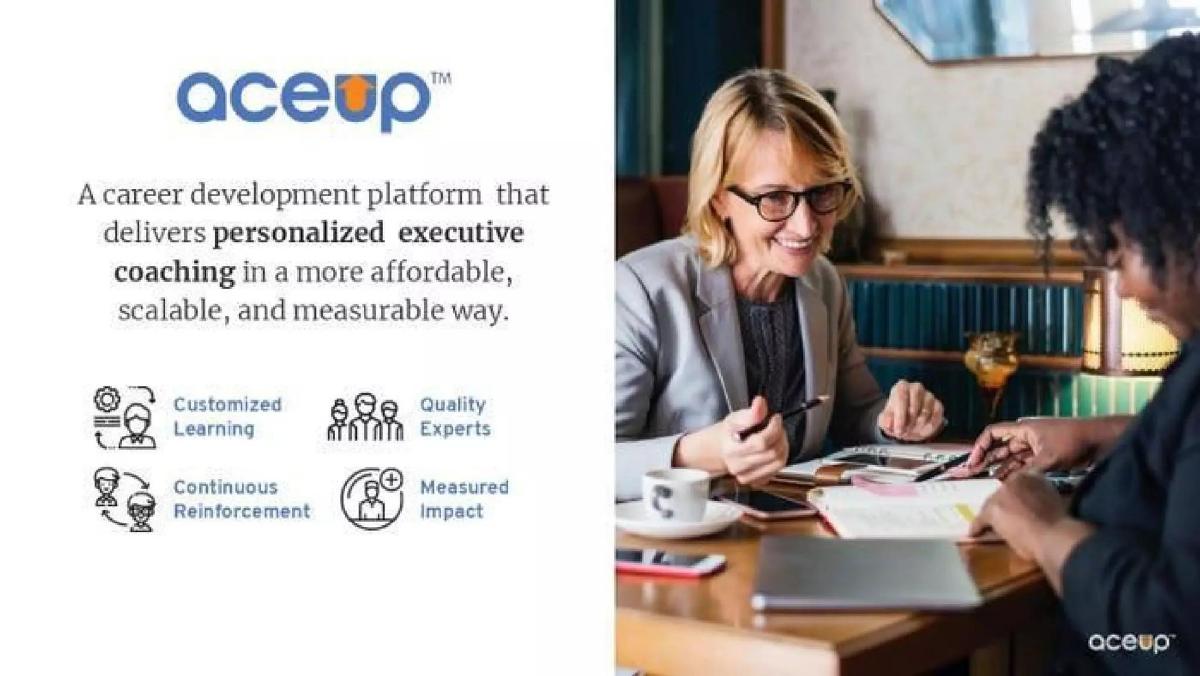
This slide defines AceUp as "A career development platform that delivers personalized executive coaching in a more affordable, scalable, and measurable way." The layout is split, with the text and four icons ("Customized Learning," "Quality Experts," "Continuous Reinforcement," and "Measured Impact") on a white background on the left, and a photo of two women working together at a table on the right. The branding is consistent with the "aceup TM" logo.
Investors are looking for the "how" behind the "what." This slide hits the three main pain points of the coaching industry: cost (affordability), reach (scalability), and ROI (measurability). By using these specific keywords, AceUp is positioning itself against traditional coaching firms that are often viewed as expensive, manual, and impossible to track. The four pillars listed are meant to be the company's core values, but they are presented as abstract concepts rather than software features. The mention of "Continuous Reinforcement" is particularly interesting to an investor, as it hints at a higher retention rate or "stickiness" compared to a one-time workshop.
To strengthen this slide, the founders should have quantified the "affordable" and "scalable" claims. For example, stating "Reducing coaching costs by X% compared to traditional firms" or "Enabling 1 coach to manage Y% more coachees through our platform." Using icons is a standard design choice, but replacing those icons with brief, 10-word descriptions of the actual technology—such as "AI-driven coach matching" or "Real-time ROI dashboard"—would provide more substance. The photo on the right is again generic; showing the "Measured Impact" dashboard here would be a much stronger way to prove the claim made in the text.
Slide 3: The Problem
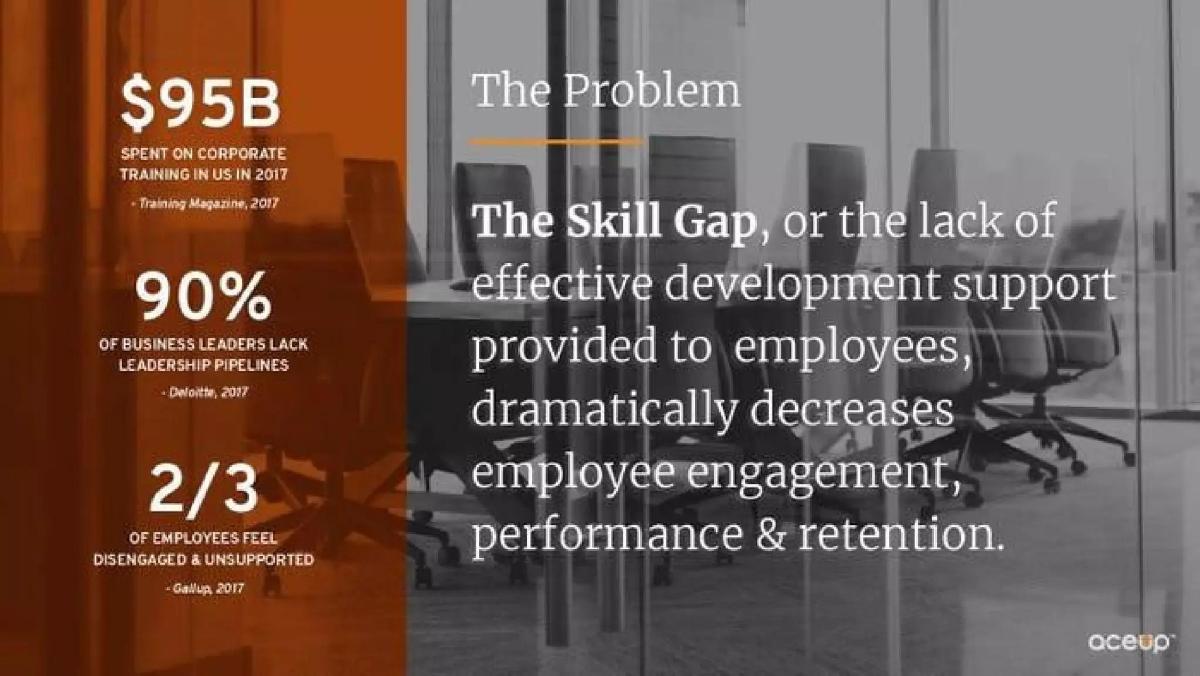
Slide 3 uses a three-pronged statistical approach to define the market gap. It cites "$95B SPENT ON CORPORATE TRAINING IN US IN 2017" (Training Magazine), "90% OF BUSINESS LEADERS LACK LEADERSHIP PIPELINES" (Deloitte, 2017), and "2/3 OF EMPLOYEES FEEL DISENGAGED & UNSUPPORTED" (Gallup, 2017). It concludes with a summary statement: "The Skill Gap, or the lack of effective development support provided to employees, dramatically decreases employee engagement, performance & retention."
This is a classic "Large Market/Broken Process" slide. By citing $95B, the deck establishes that the budget exists, but the following two stats suggest that the current spend is failing to produce results. An investor reads this as: there is a massive pool of capital being inefficiently deployed, and a solution that improves the outcome (engagement and leadership pipelines) can capture a portion of that $95B. The "2/3 disengaged" stat provides the emotional stakes, framing the problem not just as a financial inefficiency but as a human capital crisis.
The strongest version of this slide would bridge the gap between these macro stats and the specific problem AceUp solves. The "Skill Gap" is a broad term; the deck would be more compelling if it focused specifically on the "Coaching Gap"—explaining why traditional training (like videos or seminars) fails where personalized coaching succeeds. It is currently a bit too generic, describing a problem that any HR tech company, from a LMS (Learning Management System) to a recruitment platform, could claim to solve. Explicitly stating "Classroom training has a 0% retention rate after X days" would make the case for coaching more visceral.
Slide 4: The Timing
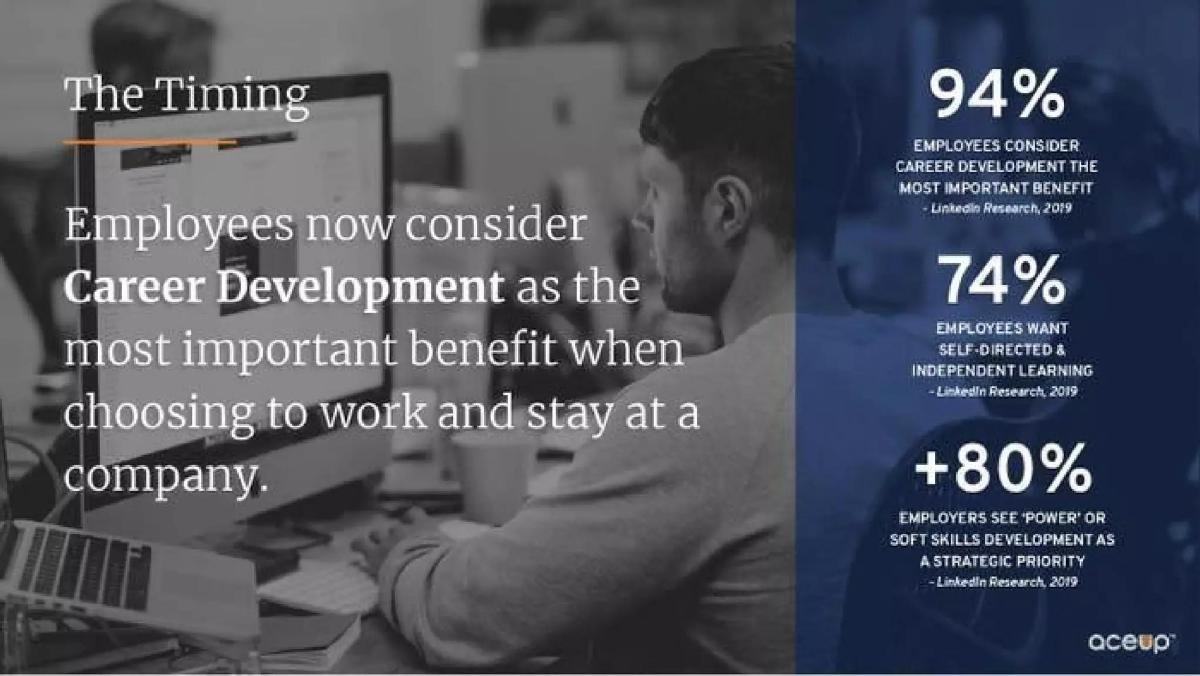
This slide, titled "The Timing," uses 2019 LinkedIn Research to argue that career development is now the most important benefit for employees. It highlights three data points: "94% EMPLOYEES CONSIDER CAREER DEVELOPMENT THE MOST IMPORTANT BENEFIT," "74% EMPLOYEES WANT SELF-DIRECTED & INDEPENDENT LEARNING," and "+80% EMPLOYERS SEE 'POWER' OR SOFT SKILLS DEVELOPMENT AS A STRATEGIC PRIORITY."
Investors look for a "Why Now?" to understand the urgency of the investment. This slide suggests a shift in employee sentiment where development is no longer a perk but a retention requirement. The mention of "self-directed and independent learning" is a direct setup for AceUp’s platform, which presumably allows employees to drive their own coaching journey rather than waiting for HR to assign it. The emphasis on "power" skills (soft skills) is a strategic choice, as these are the skills most effectively taught through coaching rather than automated software modules or textbooks.
A stronger version would include a market shift that isn't just a survey result. For instance, is there a regulatory change, a massive shift in remote work (highly relevant in 2019), or a specific technological breakthrough in video or AI that makes this possible now when it wasn't five years ago? Relying solely on survey data from LinkedIn feels slightly thin compared to a fundamental shift in market structure. An investor wants to know why AceUp didn't exist ten years ago; highlighting the reduction in video latency or the rise of the "gig economy" for coaches would add technical and structural depth to the "Timing" argument.
Slide 5: The Solution (Product)
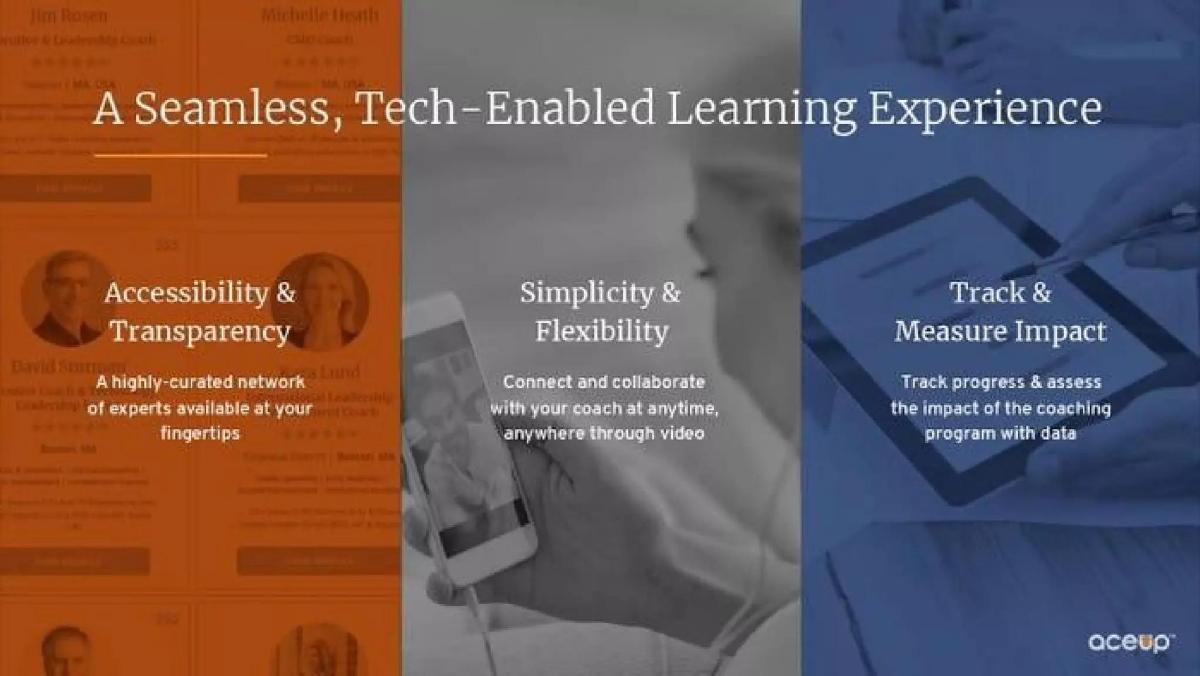
Slide 5 showcases "A Seamless, Tech-Enabled Learning Experience" across three vertical sections: "Accessibility & Transparency" (showing a desktop), "Simplicity & Flexibility" (showing a phone), and "Track & Measure Impact" (showing a tablet). It mentions a "highly-curated network of experts," "video collaboration at anytime, anywhere," and the ability to "assess the impact of the coaching program with data."
This is the first time the investor sees the "Product," though it is represented via mockups on hardware rather than full-frame screenshots. The names "Jim Rosen" and "Michelle Heath" are visible on the screens, providing a sense of realism. The focus on "anytime, anywhere through video" signals that AceUp is a platform play, not a services firm. The mention of "Track & Measure Impact" is the most important part of this slide, as it addresses the primary objection of CFOs who view coaching as a "soft" cost. The deck is asserting that their tech makes the intangible (leadership growth) tangible (data).
The slide would be much more effective if it showed the actual data being tracked. Instead of saying "Track progress," the tablet screen should show a mock-up of a dashboard with specific metrics: "Skill improvement across 5 key competencies" or "Employee NPS score." The current visuals are "lifestyle" mockups—phones and tablets in hands—which tell the investor less about the software's capabilities than a direct UI screenshot would. It is missing any indication of how the "transparency" mentioned in the first column is actually achieved.
Slide 6: A Framework for Impact
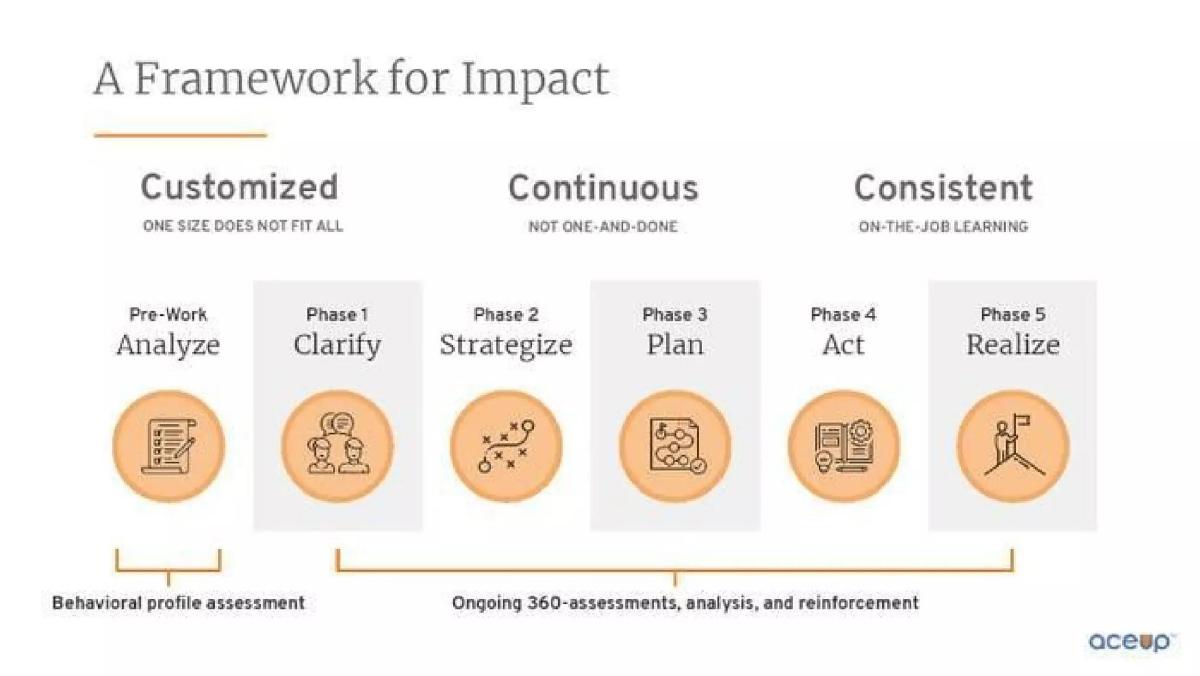
This slide outlines a six-step process labeled "A Framework for Impact." The steps are: "Pre-Work" (Behavioral profile assessment), "Phase 1: Analyze," "Phase 2: Clarify," "Phase 3: Strategize," "Phase 4: Plan," and "Phase 5: Realize." It emphasizes three principles: "Customized" (one size does not fit all), "Continuous" (not one-and-done), and "Consistent" (on-the-job learning). It also mentions "Ongoing 360-assessments, analysis, and reinforcement."
This slide is meant to reassure the investor that there is a methodology behind the technology. It shows that AceUp isn't just a "Tinder for Coaches" but a structured pedagogical framework. The inclusion of "Ongoing 360-assessments" suggests a feedback loop that keeps the platform sticky and integrated into the employee's work life. The transition from "Analyze" to "Realize" follows a standard consulting cadence, which will feel familiar and "safe" to corporate buyers (and investors who come from consulting backgrounds).
The strongest version of this slide would clarify what is automated by tech and what is handled by the human coach. As written, this could be the workflow of a standard, manual, paper-based consultancy. To justify a tech-startup valuation, AceUp needs to show how the "Analyze" and "Plan" phases are accelerated or enhanced by their proprietary platform. For example, stating "Automated 360-analysis reduces prep time by 80%" would turn a process slide into a value-propositions slide. It currently fails to explain what "Realize" actually looks like in a data sense.
Slide 7: Proof of Impact
This slide provides social proof and internal metrics. On the left, it features a quote from "Sampath T. Kandala, Director of Product Management at GE Healthcare," stating: "I've become a better and more effective leader for my team, but also for myself!" On the right, it claims: "After 3 months of usage, our users... 98% FEEL MORE CONFIDENT... 92% SEE SIGNIFICANT IMPROVEMENT IN LEADERSHIP, COMMUNICATION & ORGANIZATIONAL SKILLS... 90% FIND THAT RECEIVING COACHING POSITIVELY AFFECTED THE FEELINGS FOR THEIR EMPLOYER."
For an investor, this slide validates "Product-Market Fit." The GE Healthcare logo is a massive "whale" client that suggests the platform can handle enterprise-grade requirements and security standards. The percentages are exceptionally high (90%+), which is impressive, though a skeptical investor will immediately note that these are self-reported "feelings" rather than objective business outcomes. "98% feel more confident" is a testimonial, not a business metric, but in the HR tech world, employee sentiment is a valid leading indicator of retention.
The metrics here are "soft." To make this slide truly undeniable, the deck should have included "hard" metrics if they existed—such as "20% increase in retention among coached groups" or "15% faster time-to-promotion." However, the current stats are strong for a seed-stage deck to prove that users actually value the service. The strongest version would include the sample size (n=?) for these percentages to ensure they aren't based on a pilot of only ten people. It should also specify how "significant improvement" was measured—was it by the coach, the manager, or the employee?
Slide 8: Client Logos
This slide is a logo cloud titled "Some of Our Clients," displayed over a blue-tinted background image of two people shaking hands. The logos include: SCOR, BCG (The Boston Consulting Group), Rapid 7, Localytics, Ginkgo Bioworks, Lovepop, naviHealth, GE, Biomodex, Sanofi, Fidelity Investments, Wyndham Hotel Group, Bossard, Aldeyra Therapeutics, iorahealth, and MOO.
This is the "Credibility Slide." The diversity of industries—from biotech (Ginkgo) to consulting (BCG) to finance (Fidelity) and hospitality (Wyndham)—shows that the solution is horizontally applicable. It demonstrates that the sales team can close high-value corporate contracts and that the platform passes the procurement hurdles of major Fortune 500 companies. For a seed-stage company, this is an unusually dense and high-quality list of logos, suggesting strong early traction or a very well-connected founding team.
The slide is missing context on the depth of these relationships. Are these site-wide deployments or a pilot with five people in one department? An investor knows that a "GE" logo can sometimes mean one manager used a corporate credit card. A stronger version would group these logos by "Enterprise-wide" vs "Departmental Pilot" or include a "Net Revenue Retention" (NRR) stat to show that once a company starts with AceUp, they grow their spend. Adding a "Average contract size" or "Total number of employees covered" would transform this from a simple logo wall into a business traction slide.
Slide 9: The Coach Network
Slide 9 focuses on the supply side of the marketplace. It claims "+500 coaches" with a "proven track record." Two key stats are highlighted: "+80% HOLD A PHD, MSC, OR MBA DEGREE" and "+90% HAVE MANAGERIAL EXPERIENCE AT FORTUNE 500 COMPANIES." It features a logo wall of where coaches have worked (Google, GE, Sanofi, IBM, MIT, Deloitte, Harvard Business School) and where they are certified (ICF, iPEC, Lean Six Sigma, Korn Ferry, William James College).
In a marketplace model, the quality of supply is everything. By highlighting that their coaches are not just "life coaches" but former Google managers and Harvard grads, AceUp is positioning itself as a premium, high-trust solution. The "+80% hold PhD/MBA" stat is a direct counter to the perception that coaching is a "soft" or unscientific field. This slide is designed to de-risk the "Quality Experts" claim made on Slide 2. The mention of "ICF" (International Coaching Federation) and "Korn Ferry" certifications adds a layer of professional legitimacy that enterprise HR buyers require.
The strongest version of this slide would explain the vetting process. "We accept only 5% of coach applicants" is a more powerful statement than just listing the degrees they hold. It would also be beneficial to know the geographical spread or language capabilities—if they are pitching for global enterprise contracts, having coaches in multiple time zones and languages is a requirement. The arithmetic here is simple: if they have 500 coaches and 90% have Fortune 500 experience, they have a pool of 450 enterprise-ready mentors, which is a significant asset.
Slide 10: Coach Profiles
The final slide, "Get the Right Expert at the Right Time," shows five specific coach profiles: Jim Rosen (Executive & Leadership Coach), Michelle Heath (CEO Coach), David Sturman (Executive Coach & Tech Leadership), Kara Lund (International Leadership), and Alexis Haselberger (Time-Management & Productivity). Each profile includes a photo, location (mostly Boston-based), a star rating, and tags like "Serial Entrepreneur" or "Productivity Expert."
This slide puts a human face on the "+500 coaches" mentioned in the previous slide. It demonstrates the UI of the pairing process and the specific niches covered. The locations (Newton, Boston, San Francisco) suggest a strong initial density in Boston with a bridge to the West Coast. The star ratings (all five stars) confirm the "curated" nature of the platform, although they also suggest the ratings might not be heavily utilized or varied yet. The diverse titles show the platform can handle various needs, from "Time-Management" to "CEO Coaching."
The slide would be stronger if it showed the "Matching Algorithm" in action. Instead of just showing profiles, it could show "Because user X has Y challenge, the platform recommended these 3 coaches." This would reinforce the "Tech-Enabled" claim from Slide 2 and Slide 5, proving that the platform adds value beyond just being a manual directory. It is also unclear if the "Serial Entrepreneur" and "Serial CTOs" labels at the bottom are tags within the software or just descriptors for the slide; clarifying the platform's tagging system would show more technical depth.
Concrete fixes in priority order
Quantify the "Scalable/Affordable" Claim: The deck repeatedly claims to be more affordable and scalable than traditional coaching but never provides a price point, a margin, or a direct comparison. Adding a "Traditional Coaching vs. AceUp" comparison table with specific cost-per-employee figures would be the highest-priority fix to justify the "democratization" narrative. · Show the Data Dashboard: The "Measured Impact" is the biggest selling point for HR leaders. Replacing one of the generic lifestyle photos with a high-fidelity mockup of the ROI dashboard—showing specific skill growth metrics—would prove the "Measurable" claim from Slide 2. · Clarify the Tech/Human Split: The deck leaves it unclear how much of the "Framework for Impact" (Slide 6) is manual vs. automated. A visual indicator showing which steps are "Platform-led" (like the behavioral assessment) vs. "Coach-led" would help investors value it as a scalable software company rather than a human-intensive consulting firm. · Provide Case Study Specifics: Slide 7 has high percentages (90%+), but they are subjective (feelings/confidence). Adding even one hard business outcome—such as "20% reduction in management turnover" or "10% increase in promotion rates"—would transform the deck's credibility for institutional investors. · Define the Business Model: There is no mention of how AceUp makes money. Is it a SaaS subscription per seat? A marketplace take-rate? A hybrid? An investor cannot evaluate the "95B market" opportunity without knowing the company's revenue mechanics. · Detail the Vetting Process: With 500 coaches, the bottleneck is quality control. Explicitly stating the "Acceptance Rate" or the "Vetting Steps" (e.g., background check, interview, live coaching demo) would solidify the "Quality Experts" pillar.
Frequently asked questions
- How much does AceUp cost compared to traditional coaching?
- AceUp positions itself as "more affordable" than traditional coaching, though specific pricing or price-per-seat figures are not provided in the deck.
- How does the platform measure the impact of coaching?
- The deck mentions a "Framework for Impact" consisting of six phases, including behavioral profile assessments and ongoing 360-assessments to track development.
- What is the qualification level of the coaches on the platform?
- The deck claims a network of +500 coaches, with 80% holding advanced degrees (PhD, MSc, MBA) and 90% having managerial experience at Fortune 500 companies.
- Which companies are currently using AceUp?
- The deck highlights several major clients including GE Healthcare, BCG, Fidelity Investments, Sanofi, and Ginkgo Bioworks.
- Why is now the right time for this product?
- AceUp uses 2019 LinkedIn Research showing that 94% of employees consider career development the most important benefit and 74% want self-directed learning options.