Everything Blockchain’s June 2021 corporate presentation outlines a four-pillar strategy: Developing, Securing, Adopting, and Compounding. The company, formerly known as OBITX, Inc. (OTBTX), positions itself as a comprehensive blockchain solutions provider. A significant portion of the deck focuses on the $1.5M acquisition of Mercury, Inc., intended to serve as an R&D and mining operations hub. The deck provides transparency regarding its OTC capitalization, noting $3.1M in cash and equivalents as of mid-2021. While the revenue projections are aggressive—targeting nearly $80M by 2024—the deck…
Key takeaways
- The company operates under four business pillars: Developing (consulting), Securing (proprietary protocols), Adopting (utilizing created blockchains), and Compounding (earning 5-40% interest on staked assets) as seen on slide 9.
- Everything Blockchain acquired Mercury, Inc. for $1.5M in a mix of cash and stock to serve as a future product incubation center (slide 11).
- As of June 2021, the company was traded on OTC Markets under the symbol OBTX with 6.1M common shares outstanding (slide 15).
- The company reported $3.1M in cash and cash equivalents, which includes liquidated cryptocurrencies (slide 15).
- Revenue projections show a steep growth curve, aiming for approximately $80M in total revenue by 2024, driven largely by 'EB CRYPT' and 'EB SECURE' (slide 17).
- The leadership team includes Eric Jaffe (CEO), who has a history of orchestrating 11 technology buyouts for MSPs (slide 13).
- The deck includes a detailed breakdown of the Mercury, Inc. acquisition, showing $1.02M in total assets acquired against $602,936 in liabilities (slide 11).
- A name and symbol change with FINRA was scheduled for June 14, 2021, transitioning the company from OBITX, Inc. to Everything Blockchain, Inc. (slide 15).
Everything Blockchain: The Corporate Presentation Analysis
The June 2021 corporate presentation for Everything Blockchain, Inc. serves as a transition document for a company moving through a name change and a strategic acquisition. Formerly known as OBITX, Inc., the company uses this deck to signal a pivot toward a multi-faceted blockchain ecosystem. Unlike early-stage startup decks that focus on a single product-market fit, this deck presents a diversified holding-company style approach to the blockchain sector.
Slide 1: Title Slide
The title slide is standard, featuring the company logo and the date "June 2021." It labels the document as a "Corporate Presentation" rather than a pitch deck, which is appropriate for a company already trading on the OTC markets. The background imagery—a digital handshake—emphasizes the themes of connectivity and trust inherent in blockchain technology.
Slide 3: Who We Are
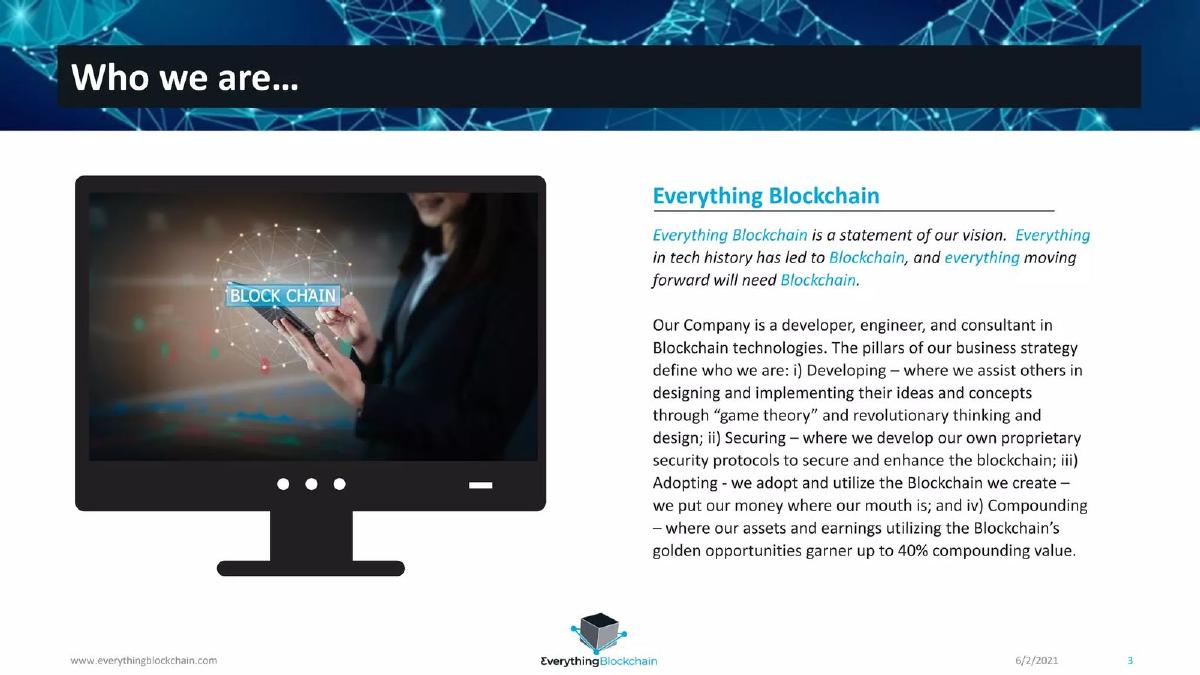
This slide introduces the company's vision statement: "Everything in tech history has led to Blockchain, and everything moving forward will need Blockchain." It defines the company as a developer, engineer, and consultant. Crucially, it introduces the four pillars of their business strategy: Developing, Securing, Adopting, and Compounding. The mention of "garnering up to 40% compounding value" is a bold claim that sets the stage for their financial projections later in the deck.
Slide 5: What is Blockchain
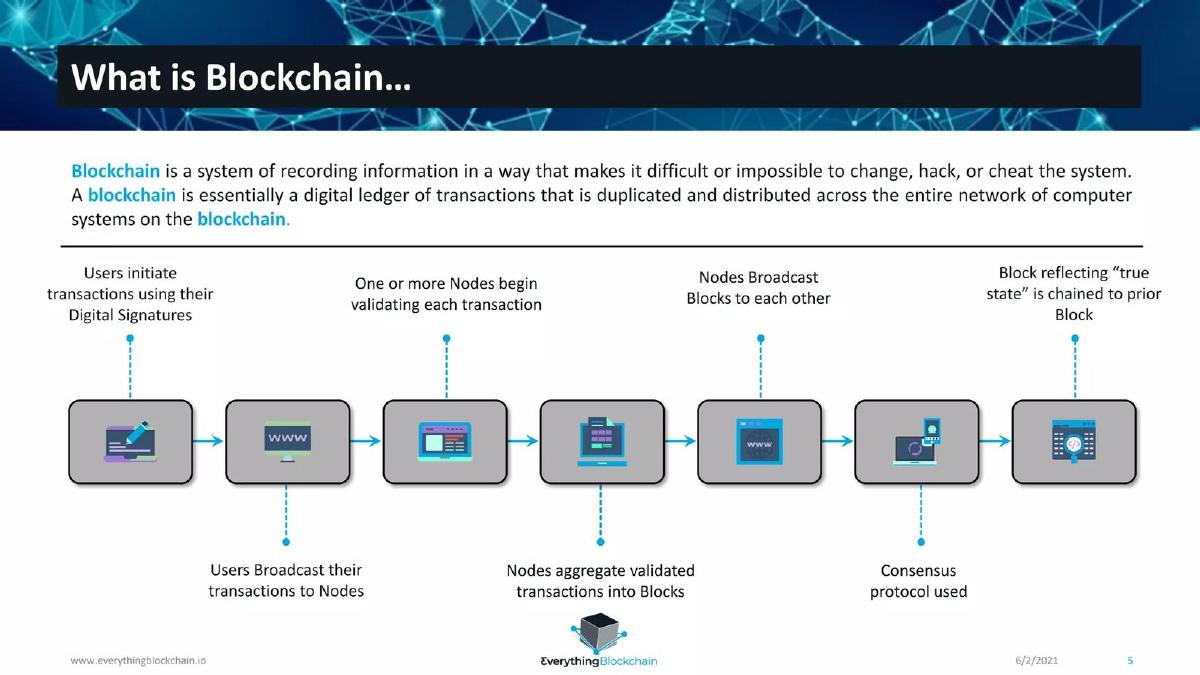
Slide 5 provides a high-level educational overview of blockchain technology. It uses a linear flow chart to explain how transactions are initiated, validated by nodes, broadcasted, and eventually chained to the prior block via a consensus protocol. For a corporate presentation, this slide acts as a baseline to ensure all stakeholders—regardless of technical expertise—understand the underlying mechanism of the company's core industry.
Slide 7: Our Approach
The "Approach" slide uses a puzzle metaphor to show how Everything Blockchain fits into the larger industry. The text mentions partnering with "industry gurus and disruptors" and developing internal security protocols. It lists specific sectors where they intend to increase data flow: healthcare, petroleum pipelines, crypto assets, and contract tracing. This indicates a broad horizontal ambition rather than a vertical focus.
Slide 9: The "ing" of Our Thought Process
This slide expands on the four pillars introduced on slide 3. Developing involves working with outside clients for Fair Market Value (FMV) payment in fiat and crypto. Securing focuses on licensing proprietary security protocols. Adopting involves mining and utilizing cryptocurrencies for retention and growth. Compounding involves staking assets to earn interest between 5-40% per year. This slide is the most important for understanding how the company actually generates revenue.
Slide 11: The Mercury, Inc. Acquisition
Slide 11 details the acquisition of Mercury, Inc. for $1.5M in cash and stocks. It provides a balance sheet of the acquisition, showing $1,025,299 in total assets (including $365k in property and $250k in intellectual property) against $602,936 in liabilities. The net acquisition assets are listed as $422,363. The company justifies the purchase by citing Mercury's historical $2.5M average revenue and its role as a future R&D and mining hub.
Slide 13: Leadership Team
The team slide presents five key figures. CEO Eric Jaffe is highlighted for orchestrating 11 technology buyouts. CTO Robert Adams brings enterprise experience from Blue Cross/Blue Shield. CFO Michael Hawkins is noted for his work with public and private nanotech companies. The inclusion of Mark Gilroy (CEO of Fornetix) and Paul Rosenberg (software engineer) rounds out a team with significant corporate and technical tenure.
Slide 15: Capitalization
This slide provides transparency for OTC investors. It lists the ticker symbol OBTX and details the share structure: 6.1M common shares outstanding, a 0.7M float, and 4.8M in insider ownership. It also notes $3.1M in cash and equivalents. Footnotes explain the recent name change from OBITX, Inc. and the existence of Series A and B preferred shares, which are set to convert in 2022.
Slide 17: Revenue Projections
The projections slide is highly optimistic. It features two charts: one showing revenue by category and another showing total revenue growth. The company projects growing from roughly $20M in 2021 to nearly $80M by 2024. The "EB CRYPT" and "EB SECURE" lines show the steepest upward trajectories, suggesting these are the primary growth engines the company is betting on.
Slide 19: Legal Disclaimer
The final slide is a dense legal disclaimer titled "Hey, our lawyers told us to add this..." It covers forward-looking statements, securities laws, and the nature of the financial information provided. This is a standard and necessary inclusion for a publicly traded entity providing future projections.
What Everything Blockchain Does Well
The deck excels at transparency regarding its corporate structure and recent M&A activity. Including a specific balance sheet for the Mercury, Inc. acquisition (Slide 11) provides a level of detail often missing from startup decks. It allows investors to see exactly what was purchased and how it fits into the broader strategy. Furthermore, the four-pillar business model (Slide 9) clearly delineates how the company intends to diversify its income streams, moving between service-based consulting and asset-based staking.
What is Missing from the Deck
The most glaring omission is a specific "Problem" slide. The deck assumes that the need for blockchain is universal and self-evident. While this may be true in a broad sense, it fails to identify the specific pain points Everything Blockchain is solving for its consulting clients or the specific vulnerabilities its security protocols address. Additionally, there is no competitive analysis. The blockchain space is crowded with consultants and security firms; the deck does not explain why a client would choose Everything Blockchain over established players or specialized startups. Finally, the unit economics of the "Compounding" pillar are not explained—earning 40% interest is a high-yield claim that requires more risk-mitigation detail to be credible to sophisticated investors.
What a Founder Should Copy
Founders should emulate the clear categorization of business lines found on Slide 9. By breaking the business into "Developing, Securing, Adopting, and Compounding," the company makes a complex, multi-faceted operation easy to digest. Founders should also take note of the capitalization table on Slide 15. Even for private companies, providing a clear view of share classes, insider ownership, and cash position builds immediate trust with potential investors. Lastly, the use of a specific acquisition case study to demonstrate growth strategy is a powerful way to show that the management team is capable of executing complex corporate maneuvers.
Frequently asked questions
- What is the primary business model of Everything Blockchain?
- Everything Blockchain utilizes a four-pronged approach described on slide 9: Developing (consulting for outside clients for FMV payment), Securing (designing internal security protocols for licensing), Adopting (mining and acquiring cryptocurrencies), and Compounding (staking assets to earn 5-40% interest). This suggests a hybrid model of a service agency, a software IP holder, and a crypto hedge fund.
- How does the company justify its acquisition of Mercury, Inc.?
- According to slide 11, Mercury, Inc. was acquired for $1.5M to serve as a strategic R&D hub and mining operations center. The slide notes that Mercury had a $2.5M average revenue with a $400K profit line in six of the last seven years, though it saw a decline during the COVID-19 pandemic before regaining traction in Idaho.
- What are the specific revenue drivers projected for 2024?
- Slide 17 breaks down projected revenue into five categories: EB CRYPT (the largest projected driver at nearly $40M), EB SECURE (projected at ~$25M), EB FLEX, EB STAKE, and EB MINE. The total aggregate revenue is projected to grow from under $20M in 2021 to nearly $80M by 2024.
- What is the company's current capitalization structure?
- As of the June 2021 deck (slide 15), the company had 6.1M common shares outstanding with a float of 0.7M. Insider ownership was high at 4.8M shares. The company also noted two classes of preferred shares (Series A and Series B) eligible for conversion into common shares in 2022.
- Who are the key members of the leadership team?
- The team (slide 13) is led by CEO Eric Jaffe, who has experience in technology buyouts. Other key members include Robert Adams (CTO), formerly a Technology Director at Blue Cross/Blue Shield; Michael Hawkins (CFO & Chairman), with experience in nanotech public companies; and Directors Mark Gilroy and Paul Rosenberg, who bring international growth and software engineering expertise.