Everpix’s August 2013 deck is a data-heavy executive summary that prioritizes engagement metrics and technical superiority over flashy marketing. At the time of this deck, the company had raised $2.3M and was seeking to scale. The slides reveal a product with staggering retention: 97% of paid users were active weekly (Slide 8). However, the deck also hints at the company's ultimate downfall—the massive technical cost of managing 'The Photo Mess.' While they achieved a 13.1% conversion rate from free to paid (Slide 9), the financial projections required reaching 1,000,000 signups to achieve ca…
Key takeaways
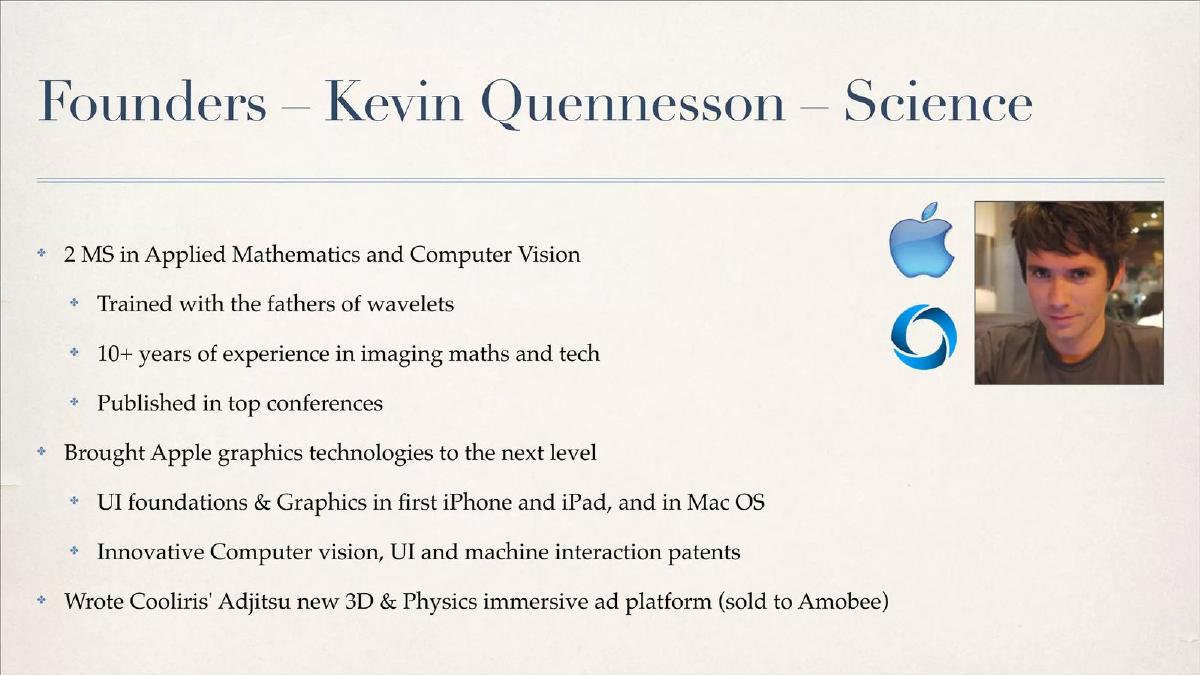
- Everpix positioned its founder, Kevin Quennesson, as a deep-tech expert with a background in Apple's original iPhone and iPad graphics (Slide 2).
- The company leveraged high-profile consultants like Julie Supan, who had previously worked with Dropbox and Airbnb, to bolster their marketing credibility (Slide 3).
- User engagement was exceptionally high, with 75% of new users performing the key action of syncing a photo (Slide 8).
- The product achieved a 13.1% conversion rate to paid subscriptions, significantly higher than typical freemium benchmarks (Slide 9).
- Everpix claimed a 5X speed advantage over competitors in syncing large photo libraries (Slide 13).
- Technical innovation allowed them to reduce average image size to 500 KB, representing a 5X saving in bandwidth and storage (Slide 14).
- The path to profitability was steep, requiring 1,000,000 signups to become cash flow positive (Slide 17).
- The deck omits a specific 'Ask' slide, though it mentions a $500K bridge note as an 'advance' on a Series A (Slide 4).
Everpix: The Technical Pursuit of the Perfect Photo Library
The Everpix deck from August 2013 is a fascinating artifact in startup history. It represents a company that had achieved what most founders dream of: incredible user retention and a high conversion rate to paid subscriptions. However, it also serves as a cautionary tale about the infrastructure costs of high-utility consumer software. This teardown examines the 17 slides of their executive summary, focusing on how they articulated their value proposition to VCs.
Slides 1-4: The Foundation and Team
Slide 1: Title The deck opens simply as an 'Executive Summary' dated August 2013. The branding is minimal, suggesting a focus on substance over style.
Slide 2: Founders – Kevin Quennesson – Science Everpix leads with technical pedigree. Kevin Quennesson is presented not just as a founder, but as a scientist. The slide highlights two Master's degrees in Applied Mathematics and Computer Vision, and ten years of experience. Crucially, it notes his role in the UI foundations and graphics for the first iPhone and iPad. This establishes 'founder-market fit' immediately; if anyone can solve a complex imaging problem, it is someone who built the original Apple graphics stack.
Slide 3: Consultants Rather than a standard 'Advisors' slide, Everpix lists 'Consultants,' specifically Julie Supan. By highlighting her work with Dropbox and Airbnb, the company signals that while the founders are technical, they are receiving world-class guidance on product positioning and marketing. This is a strategic move to offset the 'heavy tech' perception of the founding team.
Slide 4: Financing ($2.3M Raised) This slide provides a transparent history of their funding. It lists $800K in 2011, a $1M Seed in 2012, and a $500K bridge note in May 2013 from Index Ventures and 500 Startups. The bridge is explicitly labeled as an 'advance' on a Series A, indicating that the company was in active scaling mode and looking for a larger round shortly after this deck was circulated.
Slides 5-7: The Problem Space
Slide 5: Every Moment Will Be Captured as Photos This is the 'Macro Trend' slide. It acknowledges that hardware giants (Apple, Google, Samsung) have made capturing photos easy. It also looks forward to wearables like GoPro and Google Glass, predicting an explosion in the volume of images created.
Slide 6: The Photo Mess Everpix defines the problem using a Google survey of 1,500+ consumers. The data is compelling: 77% of people are frustrated by a lack of organization, and 23% don't even know where all their photos are stored. This validates that the 'Photo Mess' is a mass-market problem, not just a niche concern for enthusiasts.
Slide 7: Everpix Solves the Photo Mess A simple transition slide that sets up the solution. It is a bold, singular claim that leads directly into the traction data.
Slides 8-10: Traction and Engagement
Slide 8: Already Very High User Engagement This is the strongest slide in the deck. The metrics are world-class: 75% of new users sync a photo, and the average user syncs 10,000 photos. The retention figures—53% weekly active for free users and 97% weekly active for paid users—are rarely seen in consumer apps. It proves that once a user commits their library to Everpix, they rarely leave.
Slide 9: Users Spend Money on Everpix Everpix demonstrates a clear path to revenue. A 13.1% conversion rate from signup to paid subscription is roughly 3-4x the industry average for freemium products. The slide also notes that 50% of yearly subscribers pay within just 3 days of joining, suggesting the value proposition is immediate and obvious to the target user.
Slide 10: Photo Mess Awareness Rising in the Press A standard 'Logos' slide showing press coverage. It includes major tech publications like TechCrunch, Mashable, and The Verge, as well as photography-specific outlets like PetaPixel. This serves as social proof that the problem they are solving is being recognized by the broader market.
Slides 11-15: The Technical Moat
Slide 11: Everpix in Action Another transition slide leading into the product mechanics.
Slide 12: Camera Roll Upload (iOS & Android) This slide shows the mobile interface. The most important detail is the small text at the bottom: 'Works around iOS background apps limitation with geofencing.' This highlights a specific technical hack that allowed Everpix to sync photos in the background when competitors could not, showcasing their deep understanding of the OS.
Slide 13: Built for Scale Everpix emphasizes that their technology is built for 'entire life photo collections.' They claim to be 5X faster than the competition and able to sync entire libraries from professional tools like Lightroom and Aperture with one click. This positions them as the 'pro' choice for serious users.
Slide 14: Technological Bets Paying Off This slide addresses the cost of the business. By optimizing images to 500 KB (a 5X saving), they reduced their own storage and bandwidth costs. The chart shows a flat line for their optimized size against a much higher line for standard JPEGs. This was their attempt to prove that the business could eventually be profitable despite the massive data volumes.
Slide 15: Building the Visual Vocabulary of Real-World Photos This slide is redacted in the source, but the title suggests it covered their computer vision or image recognition capabilities—the 'AI' of 2013.
Slides 16-17: The Road Ahead
Slide 16: End of Year Goals The roadmap includes upgrading to '4th Generation infrastructure' to increase capacity by 10X and launching a full Android client. It also mentions a 'large BD deal,' suggesting they were looking for distribution partners to lower their customer acquisition costs.
Slide 17: Financial Projections The final slide in this set reveals the company's burn and targets. They planned to double the team to 12 employees ($150K/month payroll). While the gross margins were healthy (76% for paid users), the 'Cash flow positive at 1,000,000 signups' was a daunting target. For a company that was still in the low hundreds of thousands of users, reaching 1 million was a significant hurdle that required substantial new capital.
What Works in the Everpix Deck
Deep Data: The engagement and conversion metrics (Slides 8 and 9) are the stars of the show. They don't just say users like the product; they prove it with 97% weekly retention. · Technical Authority: By emphasizing the founder's Apple background and specific technical wins like geofencing for background sync, they make a strong case that they have a 'moat' through engineering. · Problem Validation: Using third-party survey data (Slide 6) to quantify the 'Photo Mess' makes the problem feel urgent and universal rather than anecdotal.
What is Missing from the Everpix Deck
The Ask: While the deck mentions a previous bridge note, it does not state how much they are currently raising or what the specific terms are. · Competitive Landscape: There is no slide comparing Everpix to iCloud, Google Photos (then Picasa/Google+ Photos), or Flickr. Given the giants in the space, investors would have wanted to see a direct comparison. · Unit Economics: While they mention gross margins, they don't provide Customer Acquisition Cost (CAC) or Lifetime Value (LTV) projections, which are critical for a subscription business.
Founder Lessons: What to Copy
The 'Key Action' Metric: Slide 8 identifies 'syncing a photo' as the key action. Founders should always identify the one action that correlates with long-term retention and report on it prominently. · Transparency on Technical Hurdles: Everpix didn't shy away from the fact that storing photos is expensive. Instead, they showed how their engineering team was actively reducing those costs (Slide 14). · Pedigree as a Moat: If your team has a 'superpower' (like building the original iPhone graphics), make it the second slide in your deck. It frames everything that follows as being built by the best possible people.
Frequently asked questions
- What was the primary problem Everpix aimed to solve?
- Everpix identified 'The Photo Mess' as their core problem. According to Slide 6, 77% of consumers were frustrated by a lack of photo organization, and 53% stored photos in multiple places. The product was designed to automatically aggregate, organize, and surface these disparate collections into a single, searchable interface.
- How did Everpix differentiate itself from competitors like Google or Apple?
- Their differentiation was technical. Slide 13 highlights a 'unique syncing technology' that was 5X faster than the competition, allowing users to upload thousands of full-resolution photos in hours rather than days. Slide 14 also notes a proprietary optimization that reduced image sizes to 500 KB while maintaining quality, providing a 5X saving in storage costs.
- What were the key engagement metrics shown in the deck?
- The metrics were elite for a consumer app. Slide 8 shows that 45% of free users synced more than 1,000 photos, and 53% of free users were active weekly. Most impressively, 97% of subscribed users engaged with the app every 7 days, indicating that the product became a core part of the user's digital life.
- What did the financial projections reveal about the business model?
- Slide 17 shows a high-margin subscription business (76% gross margin on paid users), but one with high fixed costs. The company needed to double its team to 12 employees and reach 1 million signups to become cash flow positive. This high break-even point eventually became a critical challenge for the company.
- Who were the investors and how much had been raised?
- By August 2013, Everpix had raised $2.3M. This included $800K in convertible notes from 2011, a $1M Series Seed in July 2012, and a $500K bridge note in May 2013. The bridge was led by Index Ventures and 500 Startups, intended to fund the company until a Series A (Slide 4).