Evervault's 2019 pitch deck is a focused, technical presentation that addresses a specific gap in the cybersecurity market: the need to process data without decrypting it. The deck successfully balances high-level problem statements—citing massive breaches at Uber and Equifax—with granular technical details, including code snippets and hardware specifications like Intel SGX. With a clear focus on developer experience and a usage-based pricing model, the deck outlines a path from a $1.5M seed round to a $19.4M Series A. While it lacks a traditional competitive matrix, it relies heavily on the…
Key takeaways
- The deck identifies 'data processing' as the weakest link in security because data traditionally had to be decrypted to be used (Slide 5).
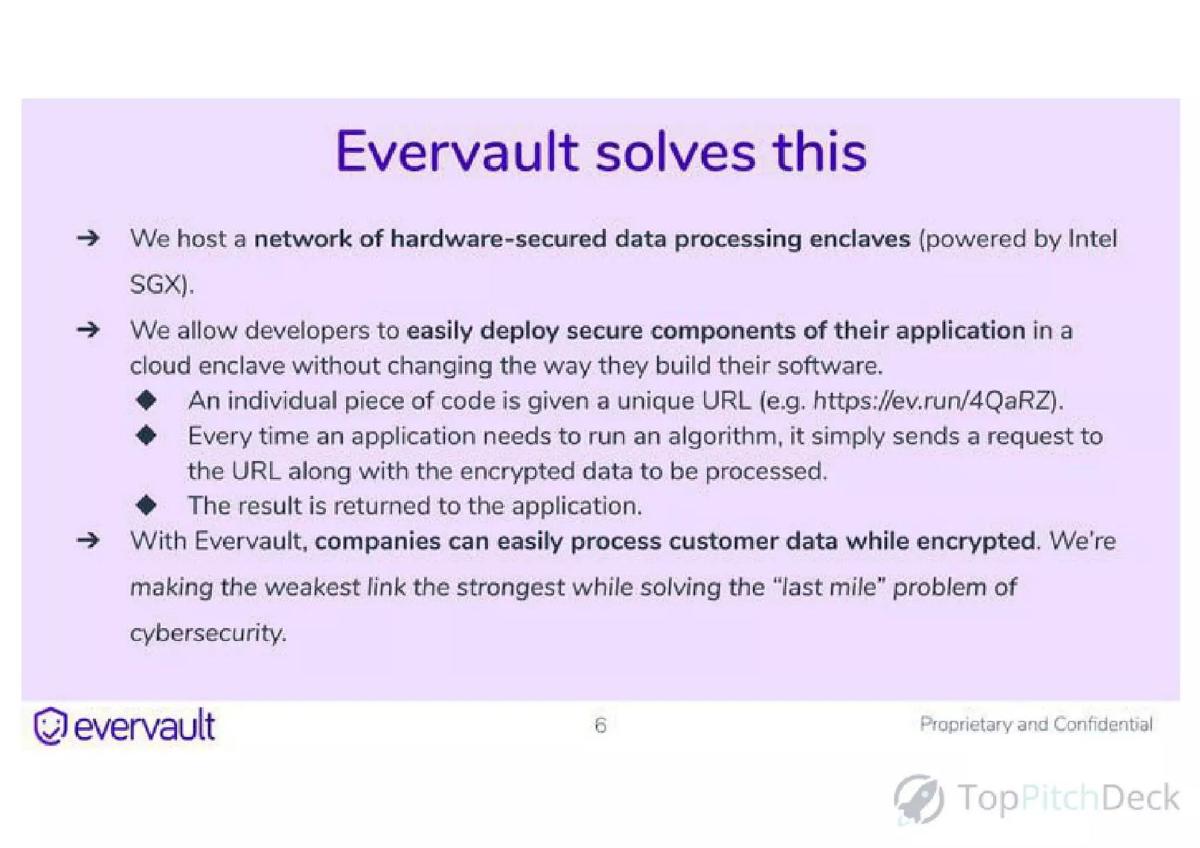
- Evervault utilizes hardware-secured data processing enclaves powered by Intel SGX to allow encrypted data processing (Slide 6).
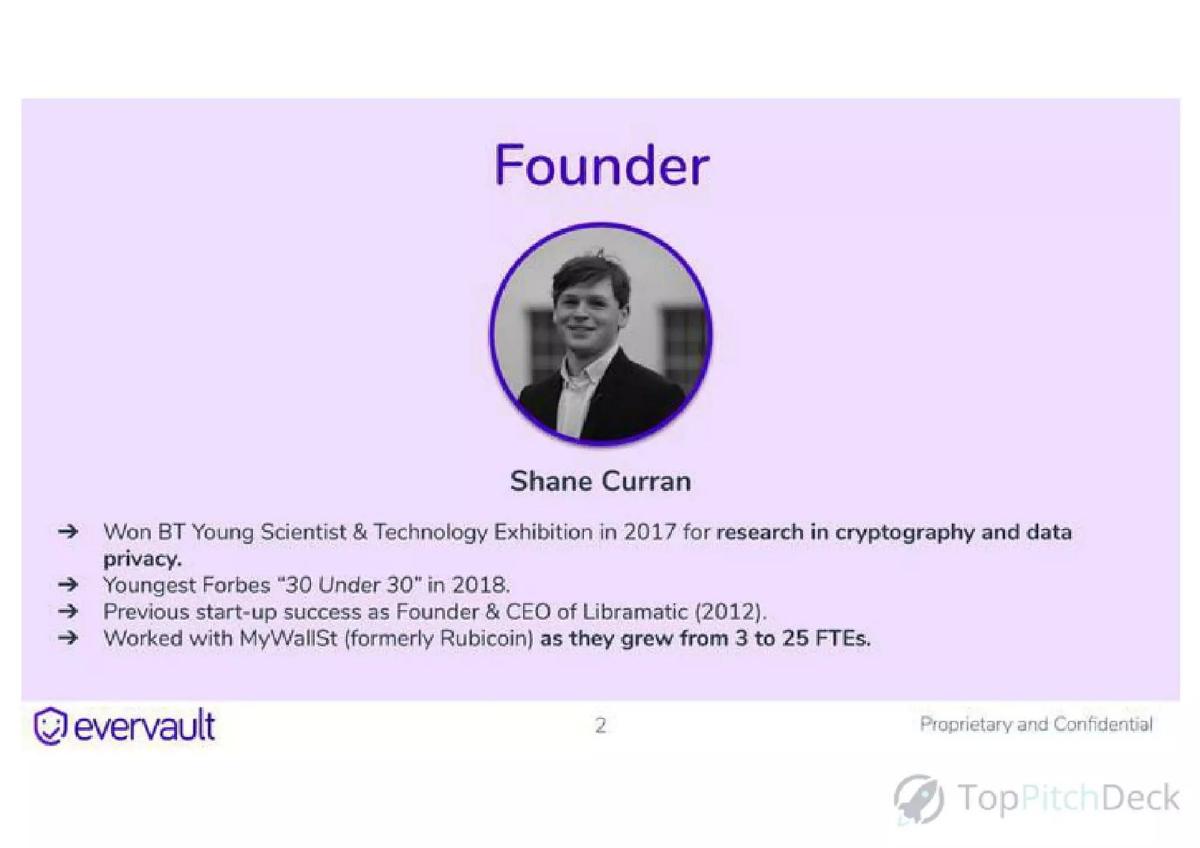
- The founder, Shane Curran, is positioned as a domain expert, having won the BT Young Scientist & Technology Exhibition for cryptography research (Slide 2).
- Strategic partnerships with Intel and Microsoft are cited as a primary competitive advantage and a 'seal of approval' (Slide 9).
- The product is designed for ease of use, requiring only four steps for client integration, supported by a visible code snippet (Slide 12).
- The business model follows a 'Heroku-style' usage-based pricing structure to align costs with cloud infrastructure spend (Slide 13).
- The deck includes a specific financial ask for a $1.5M round to fund a 19-month runway and hire 5 developers (Slide 17).
- A detailed development roadmap tracks progress from October 2019 through a planned security audit with Microsoft in April 2020 (Slide 16).
Introduction: The Infrastructure of Privacy
Evervault entered the market in 2019 with a bold claim: they could end the data breach epidemic. At a time when massive data leaks were becoming weekly headlines, Evervault focused on the technical bottleneck that most security companies ignored—the moment data is actually used. This teardown examines the 16-slide deck that helped propel the company toward a $19.4 million Series A, focusing on how they translated complex cryptography into a compelling developer-first business case.
The Hook: Problem and Founder Pedigree
Slide 1: Title The deck opens with a simple, minimalist brand identity. The tagline, "Simple developer tools for data privacy," immediately identifies the target audience (developers) and the value proposition (simplicity in a complex field).
Slide 2: Founder Unusually, the founder slide appears second. This is a strategic choice. For a deep-tech company, the founder's technical credibility is the most important asset. Shane Curran is presented not just as a businessman, but as a researcher in cryptography. The slide highlights his win at the BT Young Scientist & Technology Exhibition in 2017 and his inclusion in Forbes "30 Under 30." By establishing this authority early, the technical claims in later slides carry more weight.
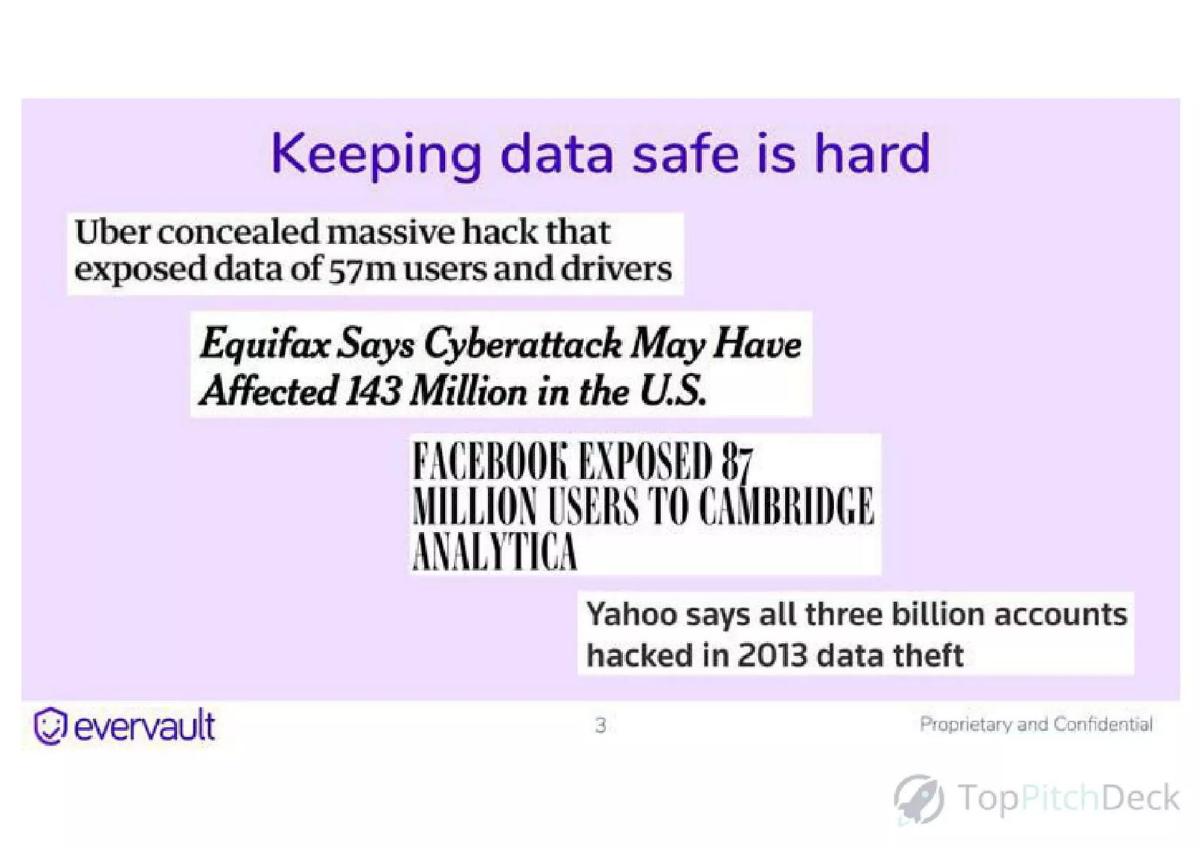
Slide 3: Keeping data safe is hard This slide uses the "social proof of failure" method. It displays headlines from Uber (57m users exposed), Equifax (143m users), Facebook (87m users), and Yahoo (3b accounts). It frames the problem as a universal failure of current systems, regardless of company size.
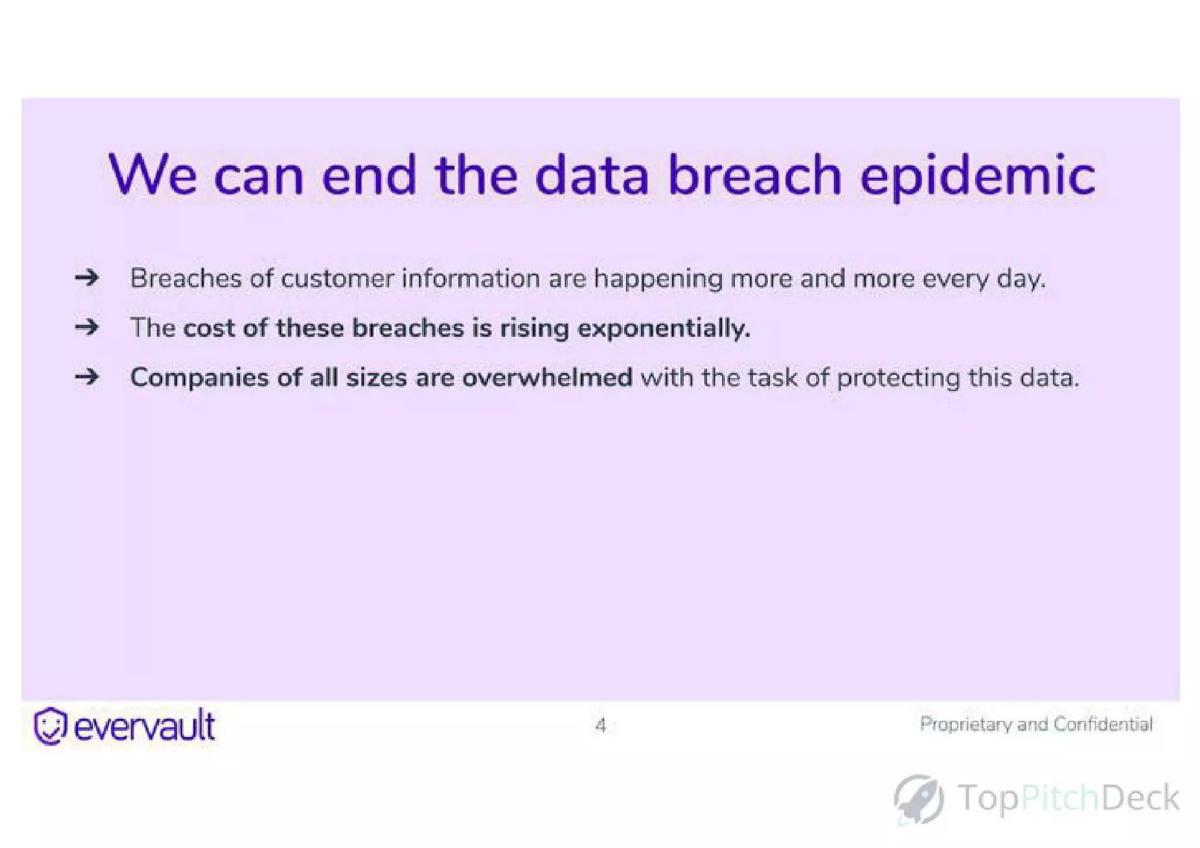
Slide 4: We can end the data breach epidemic This slide transitions from the problem to the opportunity. It notes that breaches are increasing, costs are rising exponentially, and companies are overwhelmed. It sets the stage for a solution that promises to remove the burden of data protection from the company itself.
The Solution: Bridging the Missing Link
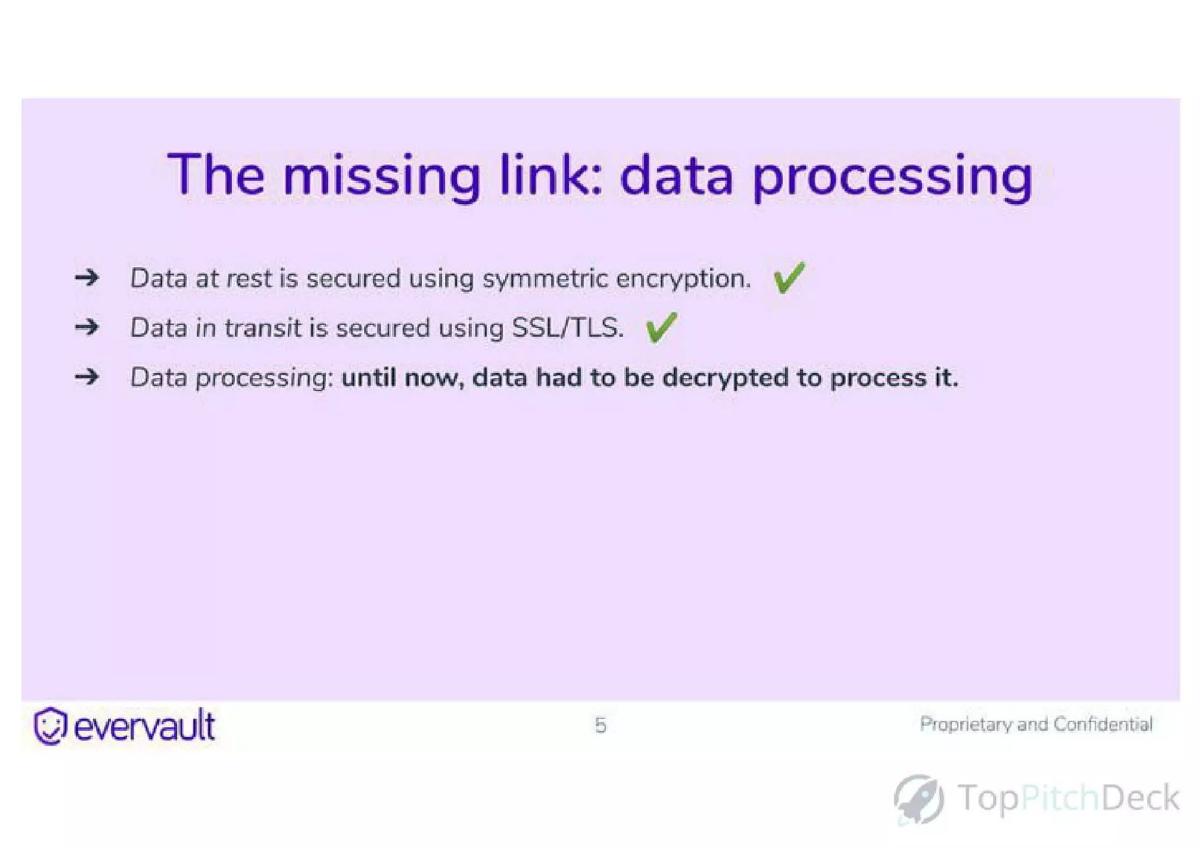
Slide 5: The missing link: data processing This is the most critical slide in the deck. It identifies the specific technical gap Evervault fills. It acknowledges that data at rest (symmetric encryption) and data in transit (SSL/TLS) are already "solved" problems. The "missing link" is data processing, which previously required decryption. This slide creates a clear "Aha!" moment for an investor.
Slide 6: Evervault solves this The solution is described as a network of hardware-secured data processing enclaves powered by Intel SGX. The slide explains the workflow: a piece of code gets a unique URL, the application sends encrypted data to that URL, and the result is returned. This frames a complex hardware/software interaction as a simple API call.
Slide 7: Evervault solves this (continued) This slide focuses on the SDK and the concept of "Remote Attestation." It explains that the SDK verifies the integrity of the cloud enclave before sending sensitive information. This is a key security feature that prevents tampering, reinforcing the "trustless" nature of the platform.
Slide 8: Why Evervault? Here, the company translates technical features into business benefits. The primary value is that databases will now contain "useless encrypted information" that is unreadable without the Evervault key. It also mentions streamlined compliance (SOC-2, PCI, GDPR), which is a major pain point for CTOs.
Market Position and Technical Execution
Slide 9: Competitive Advantage Evervault claims to be building the "world's first cloud-based secure processing product." The most significant point here is the mention of partnerships with Intel and Microsoft. For a startup, these partnerships serve as a massive validation of their technical approach and provide a "seal of approval" for larger customers.
Slide 12: Client integration steps This slide is designed to prove the "Simple" part of their tagline. It lists a four-step process: create account, include SDK, isolate components, and process results. The inclusion of a JavaScript code snippet on the right side of the slide is a classic developer-marketing tactic, showing exactly how little code is required to implement the solution.
Slide 13: Pricing Evervault proposes a "Heroku-style" usage-based pricing model. This is a smart move for a developer tool, as it removes the friction of high upfront costs and aligns the company's revenue with the customer's growth. It also makes the cost predictable for CFOs, as it scales with general cloud infrastructure spend.
Roadmap and The Ask
Slide 14: Long term: Evervault for Enterprise This slide addresses the "how do you get big?" question. The plan includes on-premises deployments, private clouds, and a "robust breach insurance policy." The mention of insurance is particularly interesting, as it suggests Evervault is willing to put financial skin in the game regarding their security claims.
Slide 15: Timeline The timeline shows a clear progression from a Seed round in Q4 2019 to a Series A in Q1 2021. It sets a milestone of 10 paying customers and $25k MRR by Q4 2020. This provides investors with clear KPIs to measure success over the following 12 months.
Slide 16: Development Roadmap This slide gets granular on the product build. It tracks the development of the underlying enclave software, the developer tools/SDKs, the web application, and a security audit with Microsoft. It shows a disciplined approach to product development.
Slide 17: What we need The deck concludes with a very specific ask: a lead investor for $1 million of a $1.5 million round. It details exactly what the money is for (5 developers + 1 designer) and what it will achieve (19 months of runway and 10 paying clients). This level of specificity is highly effective in closing a round.
Slide 18: Thank you A standard contact slide with the founder's email and the company website.
What Works in the Evervault Deck
The deck excels at problem isolation . By checking off "data at rest" and "data in transit" as solved problems, they force the investor to focus entirely on the "data processing" gap. This makes their solution feel like the final piece of a puzzle rather than just another security tool.
The developer-first framing is also a major strength. In 2019, the "Stripe for X" or "Twilio for Y" model was highly attractive to VCs. By showing code snippets and emphasizing simple SDKs, Evervault positioned itself as the "Stripe for Privacy," a very lucrative mental model for investors.
Finally, the strategic use of partnerships (Intel and Microsoft) provides the necessary "weight" to a deck led by a young, first-time founder. It suggests that the industry giants have already vetted the technology, which significantly de-risks the investment.
What is Missing from the Evervault Deck
The most notable omission is a competitive landscape . While they claim to be the "world's first," there were certainly other players in the homomorphic encryption and secure enclave space (such as Enigma or various academic projects). A slide addressing why their approach is superior to emerging cryptographic methods like Fully Homomorphic Encryption (FHE) would have strengthened the technical moat.
There is also a lack of market sizing (TAM/SAM/SOM) . While the problem of data breaches is clearly large, the deck doesn't quantify how much companies are currently spending on the specific problem of secure processing, or how large the "privacy infrastructure" market could become.
Lastly, the unit economics are entirely absent. While they mention usage-based pricing, there is no indication of the margins associated with running these hardware enclaves. Since they are hosting the network (Slide 6), the cost of goods sold (COGS) could be significant, and investors would eventually want to see how those costs scale relative to revenue.
What a Founder Should Copy
Founders building in deep tech or infrastructure should copy the "Missing Link" slide (Slide 5) . It is a masterclass in framing. By acknowledging what the industry already does well, you build credibility and make your specific innovation seem essential rather than redundant.
The specific ask (Slide 17) is another element to emulate. Many founders are vague about how they will use the funds. Evervault's breakdown of headcounts, runway months, and specific customer milestones makes the investment feel like a calculated bet rather than a blind leap.
Finally, the integration of code (Slide 12) is vital for any developer-facing product. If you claim your product is "simple," you must show, not just tell. A clean, readable code snippet is the most effective way to prove ease of use to a technical audience or an investor who understands the developer market.
Conclusion
Evervault's deck is a lean, technical document that relies on the founder's expertise and the undeniable logic of their "missing link" argument. It avoids the fluff of many Series A decks, focusing instead on the mechanics of the product and the immediate roadmap. By securing early validation from hardware partners and focusing on the developer experience, Evervault successfully navigated the transition from a research-heavy concept to a venture-backed infrastructure company.
Frequently asked questions
- What is the core problem Evervault aims to solve?
- Evervault addresses the 'last mile' problem of cybersecurity. While data at rest and in transit are typically encrypted, data processing has historically required decryption, creating a massive vulnerability. Evervault allows developers to process sensitive information while it remains encrypted using hardware-secured enclaves, effectively closing this security gap.
- How does Evervault differentiate itself from other security startups?
- The company differentiates itself through its developer-first approach and hardware integration. Instead of complex enterprise software, they provide simple SDKs. They also leverage Intel SGX hardware for remote attestation, ensuring the integrity of the cloud enclave before sensitive data is ever sent, a technical moat they claim makes them the first in the world to do so.
- What was the specific funding ask in this deck?
- On slide 17, the company explicitly asks for a lead investor to contribute $1 million toward a total $1.5 million seed round. This capital was earmarked for hiring an initial engineering team of five developers and one UI/UX designer, providing approximately 19 months of runway to reach a public paid launch.
- What is Evervault's long-term enterprise strategy?
- Beyond its initial developer tools, Evervault plans to offer on-premises deployments and private cloud orchestration for large enterprises. They also intend to offer a robust breach insurance policy and maintain full compliance with major standards like ISO 27001, SOC-2, GDPR, HIPAA, and PCI to satisfy corporate requirements.
- Who is the founder and why is he relevant to this space?
- Shane Curran is the sole founder featured in the deck. His credibility stems from winning a major technology exhibition for cryptography research in 2017 and being named to Forbes 30 Under 30. His background as a former CEO of Libramatic and early employee at MyWallSt demonstrates both technical depth and startup experience.