Evisort’s deck is a masterclass in category positioning. Rather than focusing on granular feature lists, the slides prioritize the 'why now' by highlighting a $49B enterprise content management market and the inefficiencies of 'Gen 1' legacy systems. The deck effectively uses visual metaphors to show how contracts are currently siloed across CRM, ERP, HCM, and Finance systems, then presents Evisort as the unifying layer. While the deck is notably missing a team slide, financial traction, and a specific funding ask, its strength lies in its clear articulation of the 'AHA' moment: the automated…
Key takeaways
- The deck identifies a massive market opportunity, citing a $49B Enterprise Content Management market with a 16.5% CAGR on slide 5.
- Evisort positions itself as the '5th System of Engagement' to unify data across CRM, ERP, HCM, and Finance/Accounting on slide 4.
- The problem is framed as a lack of transparency and costly mistakes due to manual post-signing silos on slides 2 and 3.
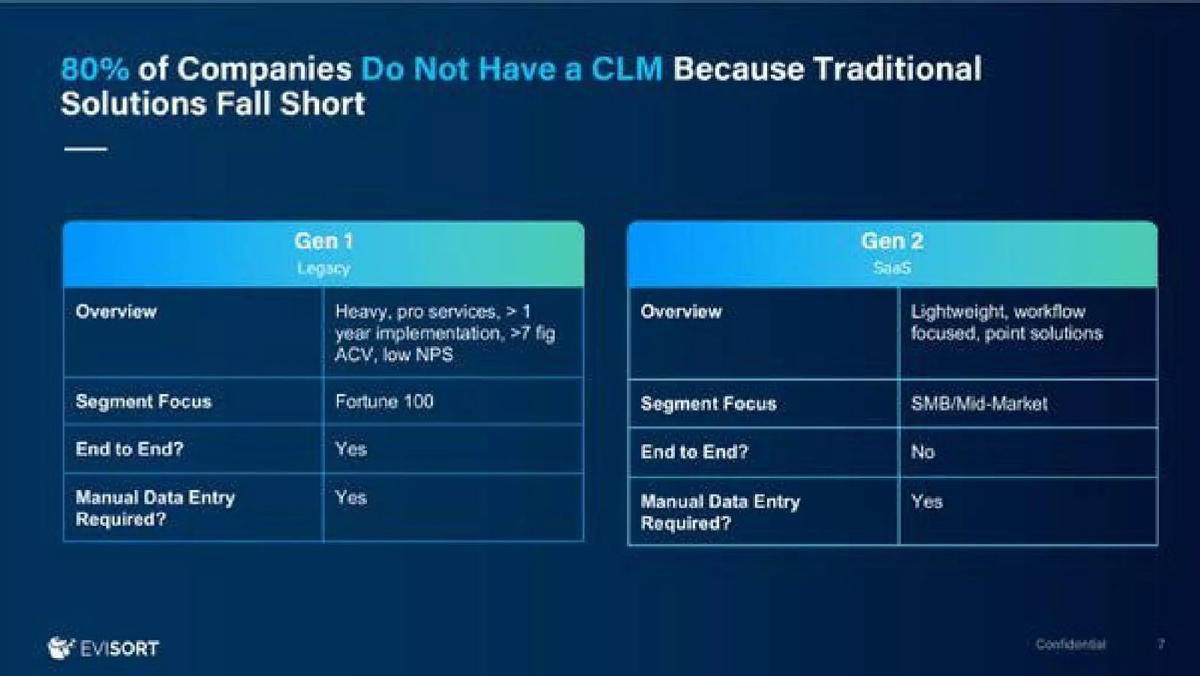
- A competitive comparison on slide 7 contrasts Evisort against 'Gen 1' legacy tools that require >1 year implementation and 'Gen 2' point solutions.
- The platform's technical capability is highlighted by its ability to handle 230+ document types and 50+ provisions/clauses on slide 10.
- The deck emphasizes speed to value, claiming implementation takes 'weeks, not months' on slide 11.
- There is no mention of the founding team, despite the catalogue listing noting they are Harvard Law and MIT researchers.
- The deck completely omits a slide for the funding ask, current valuation, or specific use of proceeds.
Evisort Pitch Deck: The Strategic Narrative of AI-Driven Legal Tech
Evisort’s pitch deck is a concise 11-slide presentation that focuses on category creation and market positioning. Founded in 2016, the company has successfully raised $155,600,000 to date. This teardown examines how they framed the transition from manual legal work to automated intelligence. The deck is notable for its clean design and focus on the 'System of Engagement' narrative, though it leaves out several standard fundraising components like team bios and financial metrics.
The Problem: Manual Friction and Disconnected Silos
Slide 1: Title Slide The deck opens with a simple title: "Intelligent Contract Management - 2021 Overview." It establishes the brand immediately, though it lacks a punchy one-sentence value proposition on the cover.
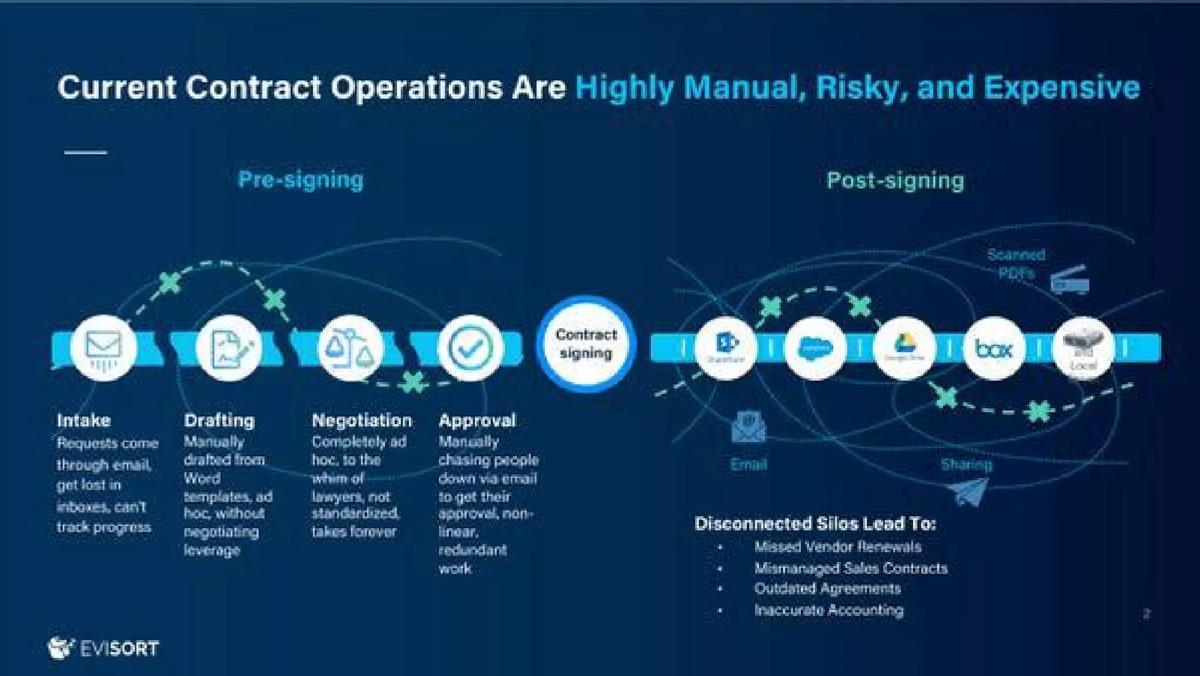
Slide 2: Current Contract Operations This slide uses a visual timeline to show the friction in the contract lifecycle. It divides the process into "Pre-signing" (Intake, Drafting, Negotiation, Approval) and "Post-signing." The visual highlights that post-signing documents end up in "Disconnected Silos" like SharePoint, Salesforce, Google Drive, and Box. The slide explicitly states that this leads to "Missed Vendor Renewals" and "Inaccurate Accounting."
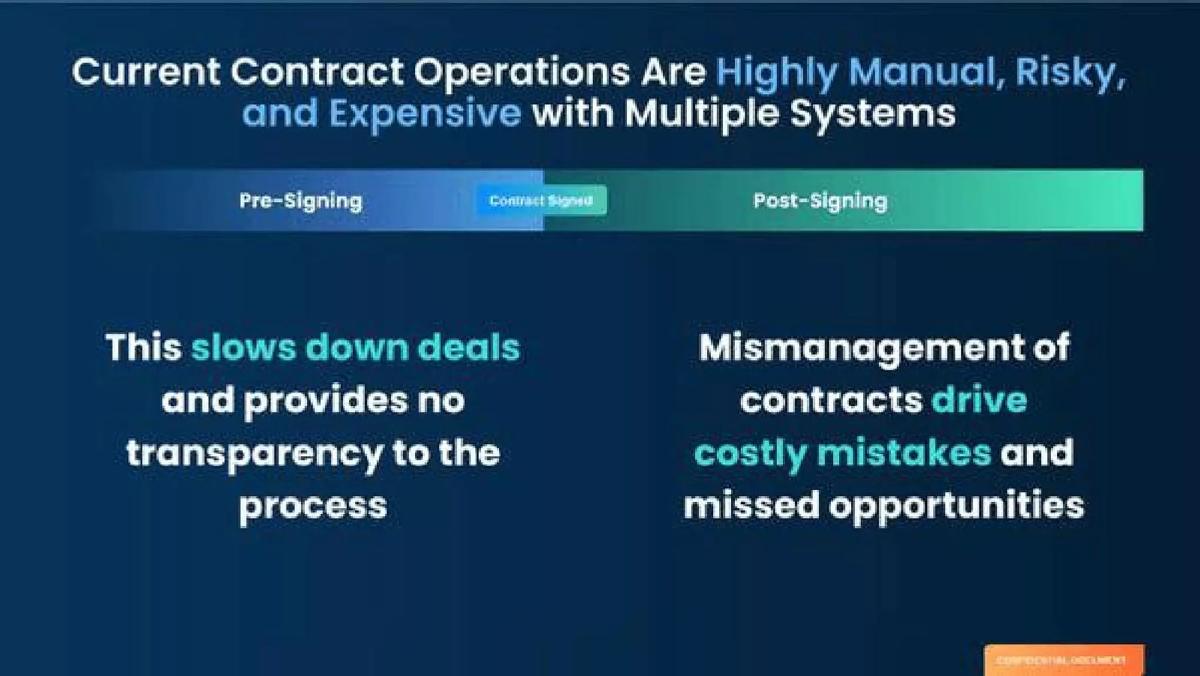
Slide 3: The Cost of Inefficiency Slide 3 reinforces the previous point with larger text, stating that current operations are "Highly Manual, Risky, and Expensive." It emphasizes two main outcomes: slowing down deals and creating costly mistakes through mismanagement. This is a classic 'pain point' slide designed to build urgency.
The Solution: The 5th System of Engagement
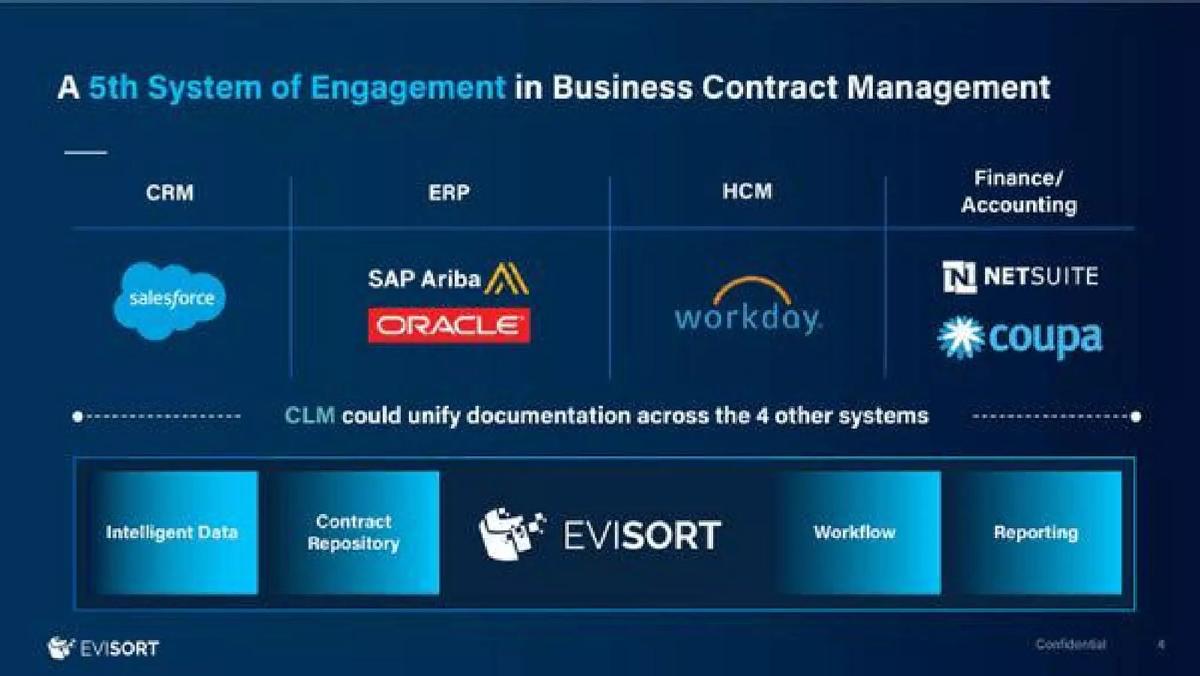
Slide 4: A 5th System of Engagement This is arguably the most important slide in the deck for enterprise investors. Evisort positions itself alongside the four pillars of enterprise software: CRM (Salesforce), ERP (SAP/Oracle), HCM (Workday), and Finance (NetSuite/Coupa). By calling itself the "5th System," Evisort is arguing that Contract Lifecycle Management (CLM) is not a niche tool but a fundamental requirement for the modern enterprise stack. It claims CLM could "unify documentation across the 4 other systems."
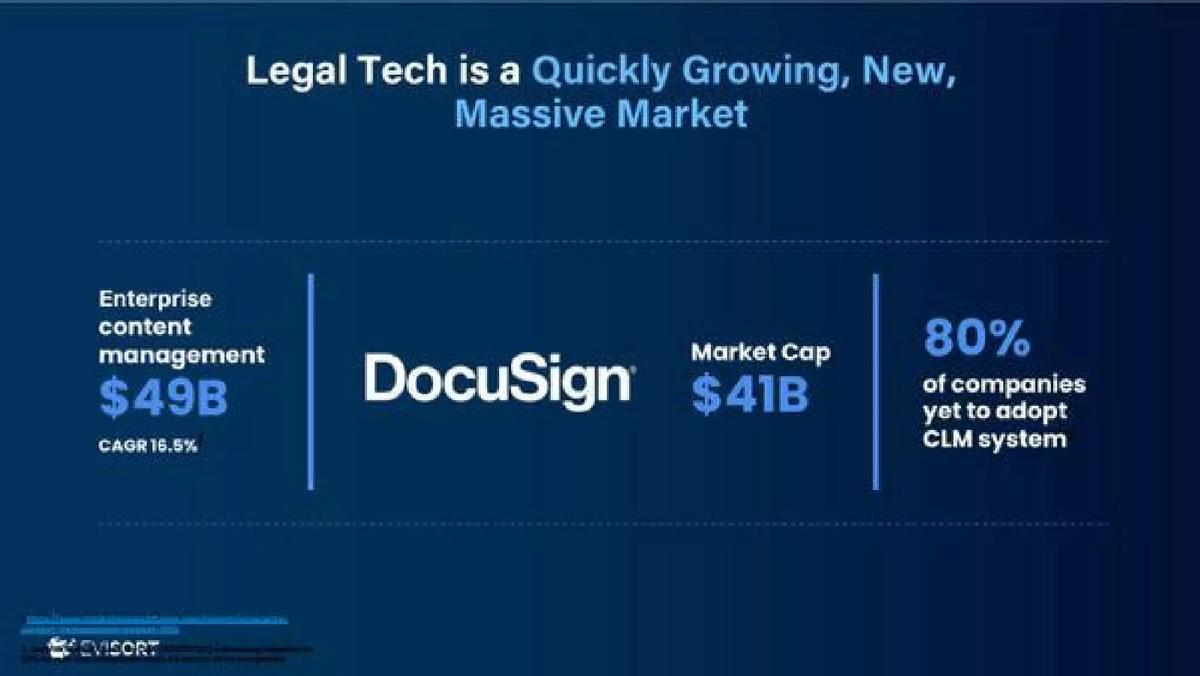
Slide 5: Market Opportunity To justify the "5th System" claim, slide 5 provides market data. It quotes a $49B Enterprise Content Management market with a 16.5% CAGR. It also uses DocuSign’s $41B market cap as a benchmark for success in the space. The most compelling stat here is that "80% of companies yet to adopt CLM system," indicating that the market is far from saturated.
Competitive Landscape and Category Redefinition
Slide 6: Industry Redefinition A simple transition slide that states: "The Contract Lifecycle Management (CLM) Industry Needs to be Completely Redefined." This sets the stage for the competitive comparison.
Slide 7: Traditional Solutions Fall Short Evisort breaks the competition into two generations. "Gen 1 (Legacy)" is described as having heavy professional services, implementation times longer than a year, and 7-figure ACVs (Annual Contract Values) with low NPS. "Gen 2 (SaaS)" is described as lightweight point solutions that are not end-to-end. Crucially, Evisort notes that both generations still require "Manual Data Entry." This sets up Evisort’s AI as the unique differentiator.
Product and Platform Capabilities
Slide 8: Redefining the CLM Category Slide 8 introduces the "No-Code, AI Platform." It splits the platform into two functions: a "System of Engagement" for workflows (generation, approval, negotiation) and a "System of Record" for management (repository, data extraction, reporting). It lists a wide variety of use cases across Sales, Legal, Privacy, Procurement, and HR, demonstrating the horizontal nature of the product.
Slide 9: The "AHA" Moment This slide visualizes the data extraction process. It shows documents flowing from various silos (Dropbox, Salesforce, etc.) into Evisort, which then outputs "Deep, contextual insights." The slide provides concrete numbers: the AI handles 230+ Document Types and extracts 50+ Provisions, Clauses, and Metadata points. This is the technical proof point of the deck.
Slide 10: Enterprise Value Proposition The final content slide summarizes why enterprises choose Evisort. It lists three pillars: 1) Fast implementation (weeks, not months), 2) AI to remove manual data entry, and 3) A configurable end-to-end workflow. This directly addresses the weaknesses of the Gen 1 and Gen 2 competitors mentioned on slide 7.
Slide 11: Thank You A standard closing slide with the company logo. No contact information or call to action is visible on this slide.
What Works in the Evisort Deck
Strategic Positioning: The "5th System of Engagement" narrative is a powerful way to move a product from a 'nice-to-have' to a 'must-have' in the eyes of an enterprise buyer or investor. · Clear Competitive Moat: By categorizing competitors into Gen 1 and Gen 2 and identifying a shared flaw (manual data entry), Evisort creates a clear space for its AI-first approach. · Visualizing the Mess: Slide 2 does an excellent job of visualizing the 'spaghetti' of modern document storage. Founders often struggle to explain why silos are bad; Evisort shows it. · Quantified Technical Power: Stating the exact number of document types (230+) and provisions (50+) makes the AI claims feel grounded and verifiable rather than just marketing hype.
What is Missing from the Evisort Deck
The Team: There is no team slide. While the catalogue listing mentions Harvard Law and MIT researchers, the deck itself fails to highlight the expertise required to build a legal-grade AI. · Traction and Financials: The deck is entirely devoid of growth metrics. There is no mention of ARR, number of customers, churn rates, or logo walls. For a Series stage company, this is a significant omission. · The Ask: There is no slide detailing how much money is being raised or what the capital will be used for. This suggests this version of the deck may have been used for general partnerships or as a preliminary teaser. · Case Studies: While the deck lists use cases, it does not provide a specific success story or ROI calculation from a real-world customer.
What a Founder Should Copy
The "System of Engagement" Framework: If you are building enterprise software, try to map your product to the existing pillars (CRM, ERP, etc.). It helps investors understand where you fit in the budget. · The Generational Comparison: Instead of a standard check-mark grid, use the "Gen 1 vs. Gen 2" format to show how the market has evolved and why your company represents the logical next step. · Focus on Implementation Time: For B2B SaaS, implementation friction is a major deal-killer. Evisort’s explicit promise of "weeks, not months" on slide 11 is a strong selling point that founders should emulate if their product allows for it. · High-Level Simplicity: The deck is not cluttered. Each slide has one clear message, which is essential for maintaining an investor's attention during a pitch.
Frequently asked questions
- What is the primary problem Evisort aims to solve?
- According to slides 2 and 3, Evisort targets 'highly manual, risky, and expensive' contract operations. The deck argues that current processes are split into disconnected silos (pre-signing and post-signing), leading to missed vendor renewals, mismanaged sales contracts, and inaccurate accounting. The core issue is that contracts are currently 'locked away' in various storage systems like Box, Google Drive, and SharePoint without a unified way to extract data.
- How does Evisort differentiate itself from legacy competitors?
- On slide 7, Evisort categorizes competitors into 'Gen 1' (Legacy) and 'Gen 2' (SaaS). Legacy systems are criticized for having implementation times exceeding one year and requiring heavy professional services. Gen 2 solutions are described as 'lightweight point solutions' that are not end-to-end. Evisort claims to offer an end-to-end, no-code AI platform that eliminates manual data entry, which both previous generations still require.
- What market size does Evisort reference?
- Slide 5 cites the Enterprise Content Management market as being worth $49B with a 16.5% CAGR. It also references DocuSign's $41B market cap as a proxy for the scale of the legal tech space. Crucially, the slide notes that 80% of companies have yet to adopt a Contract Lifecycle Management (CLM) system, suggesting a large greenfield opportunity.
- What are the technical capabilities of the Evisort AI?
- Slide 10 details the 'AHA' moment, stating the AI can automatically extract key data from over 230 document types. It specifically identifies more than 50 provisions, clauses, and metadata points. The platform is described as 'No-Code' on slide 9, allowing it to function as both a 'System of Engagement' for workflows and a 'System of Record' for management.
- Is there any financial or team information in the deck?
- No. This specific 11-slide deck omits the team slide, financial performance (ARR/MRR), and the specific investment ask. While the catalogue listing mentions the founders are from Harvard Law and MIT and that the company has raised $155.6M, these facts are not present on the slides themselves. This suggests the deck was likely used as a high-level overview or a 'teaser' rather than a full due-diligence presentation.