Evvnt’s 2019 investor deck outlines a clear value proposition: automating the distribution of event listings across a massive network of local media and event calendars. The company identifies a significant market gap where 65 million events are created annually but fail to generate digital revenue for publishers. With a $3M ask at a $12M pre-money valuation, Evvnt demonstrates strong existing traction through a logo-heavy partner slide including giants like Oracle, Eventbrite, and Ticketmaster. The deck is notable for its explicit exit strategy, targeting a $250m-$300m trade sale within 3-5…
Key takeaways
- The platform acts as an aggregator for over 4,600 event calendars and targets 9,660 local media companies (Slide 2).
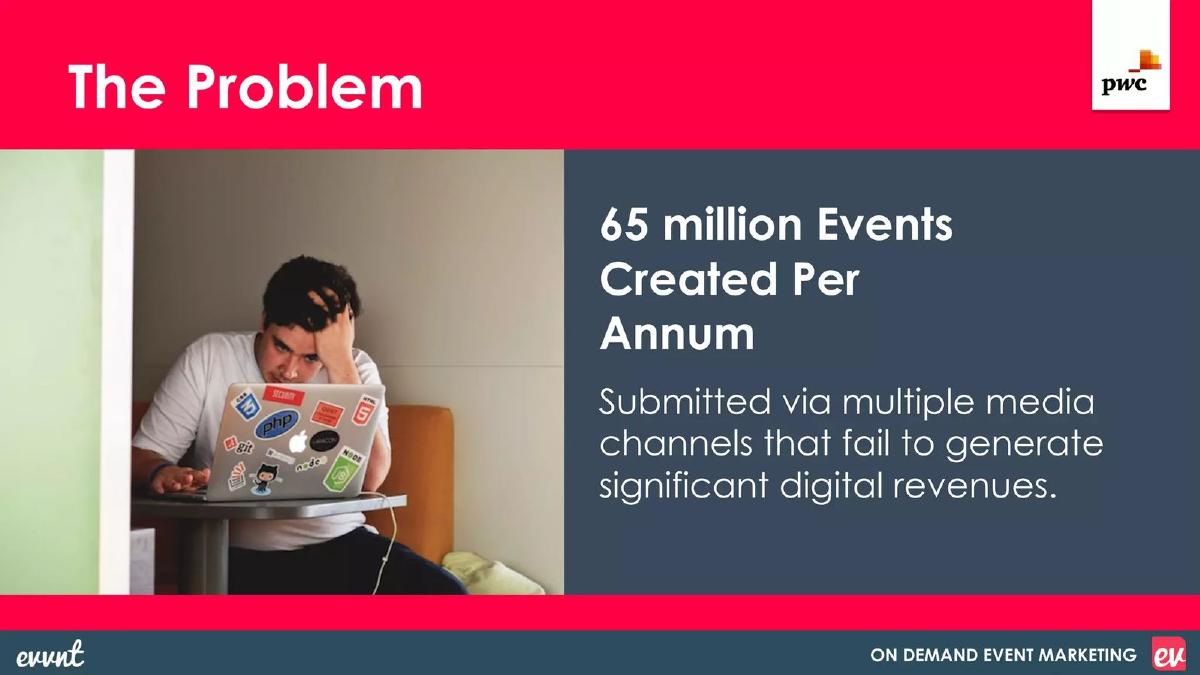
- Evvnt addresses a market of 65 million events created per annum that currently fail to generate significant digital revenue (Slide 3).
- The technology suite includes a content distribution engine, an ad network, and an API for developers (Slide 4).
- Evvnt achieved profitability in 2018 with $1.1M in actual revenue (Slide 6).
- Revenue is projected to grow from $1.9M in 2019 to $30M by 2023 (Slide 6).
- The $3M raise is allocated across Technology (35%), Partners (25%), Digital Marketing (25%), and Revenue/Sales (15%) (Slide 7).
- The company is seeking a $3M investment at a $12M pre-money valuation (Slide 9).
- The stated exit goal is a trade sale to a media or ticketing corporation for $250M-$300M, representing a 12x-16x return (Slide 9).
Evvnt Pitch Deck Analysis: The Automation of Local Event Discovery
The Evvnt investor deck from June 2019 presents a mature SaaS business looking to transition from a profitable niche player into a dominant global ad network for events. The deck is structured around the core thesis that the current event marketing landscape is fragmented and inefficient, providing a clear opening for an automated distribution layer. With a PwC logo appearing on every slide, the deck carries a tone of professional validation, likely stemming from an accelerator or advisory relationship.
Slide 1: Title Slide
The cover slide establishes the brand identity and the core value proposition: "Event Marketing Automation." It is clean and minimalist, using a bold red and dark grey color palette. The inclusion of the PwC logo in the top right corner immediately signals to investors that the company has undergone some level of professional vetting or is part of a structured program.
Slide 2: Introduction
Slide 2 serves as the executive summary. It defines Evvnt as an "Event Marketing Automation Platform" and provides two critical scale metrics: an aggregator of 4,600+ event calendars and a target of 9,660 local media companies. By using a smartphone mockup, it emphasizes the mobile-first, accessible nature of the platform. The sub-headline "On Demand Event Marketing" reinforces the SaaS nature of the business.
Slide 3: The Problem
The problem slide identifies a massive volume of activity—65 million events created per annum—paired with a failure of existing media channels to generate "significant digital revenues." This is a classic "inefficiency" problem. It suggests that while the content exists, the monetization and distribution mechanisms are broken, which is the exact gap Evvnt intends to fill.
Slide 4: Our Technology
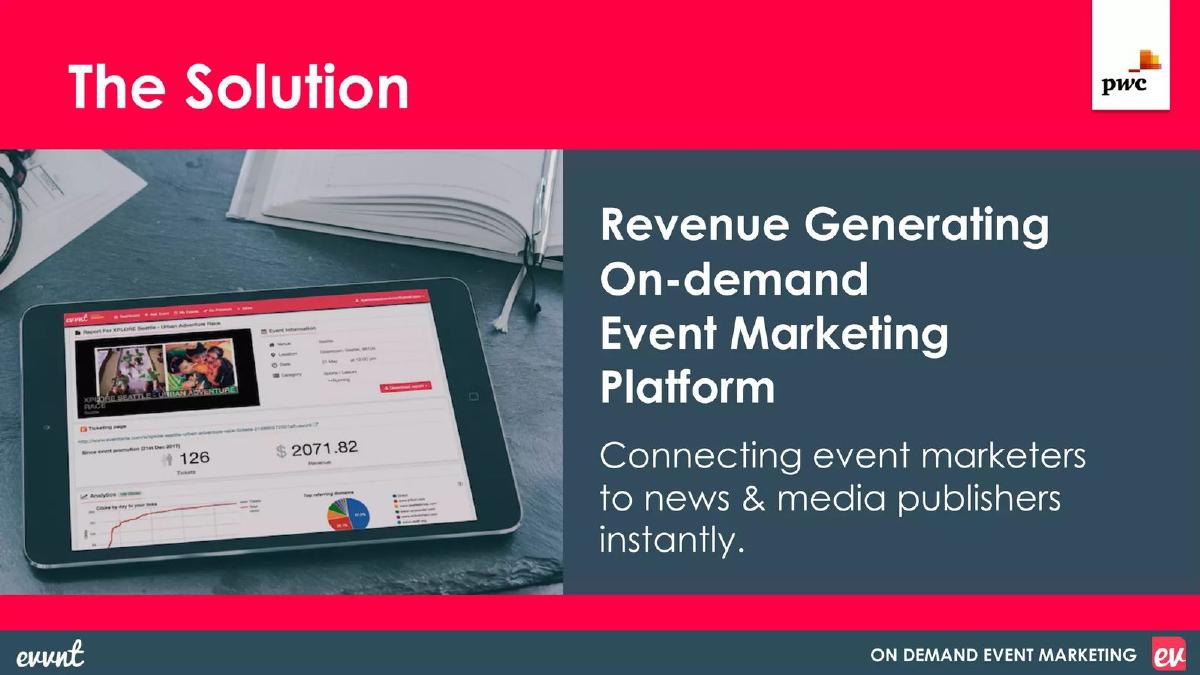
This slide moves from the abstract problem to the concrete solution. It describes the technology as "Market Ready" and "Scalable." The bullet points break down the product into five components: a content distribution engine, an ad network, marketing services, self-service calendars, and an API. This shows that the company isn't just a single tool but a multi-faceted ecosystem that can integrate with other platforms.
Slide 5: Customer & Partners
This is a high-impact social proof slide. It is densely packed with logos from three distinct categories: enterprise (Oracle, Gartner), media (Hearst, Financial Times, The Economist), and ticketing/events (Eventbrite, Ticketmaster, Live Nation). The presence of these logos suggests that Evvnt has already successfully navigated the difficult task of enterprise sales and integration, reducing the perceived risk for new investors.
Slide 6: Revenue Projections
The financial slide is exceptionally transparent. It notes that the company was "Profitable in 2018" with $1.1M in actual revenue (marked 'A'). The forecast ('F') shows a hockey-stick growth curve, aiming for $30M in revenue by 2023. The inclusion of an EBITDA line (white curve) indicates that the company expects to maintain or grow profitability alongside revenue, which is a strong signal for investors wary of "growth at all costs" models.
Slide 7: Go To Market – Use of Funds
Evvnt breaks down the $3M ask into four clear buckets. The largest portion ($1M) is dedicated to technology scaling. Interestingly, they allocate $750k specifically to building the event ad network for 2,200 US local news sites, showing a clear geographic focus on the US market. The breakdown is specific, citing "new sales hires (UK-US)" and "data analytics," which gives investors confidence that the founders know exactly where the next dollar goes.
Slide 8: Advisory Board
Notably, this deck leads with an Advisory Board rather than a standard "Team" slide. The advisors listed are heavyweights: Tim Chambers (ex-Ticketmaster/Live Nation), Lee McCabe (Facebook/Alibaba), Colin Nunn, and Robert Salesas. While these are impressive names that provide deep industry expertise, the lack of a slide dedicated to the day-to-day executive team (CEO, COO, etc.) is a significant omission. Investors generally invest in the people running the company, not just those advising it.
Slide 9: Return on Investment
The final slide is a direct "Ask" and "Exit" slide. It explicitly states the terms: $3M at a $12M pre-money valuation. It also outlines a very specific exit strategy: a trade sale to a media, ticketing, or news corporation in 3 to 5 years for $250M-$300M. This level of specificity regarding the exit is rare and indicates a founder who is focused on a liquidity event rather than building a "forever company."
What Works in the Evvnt Deck
1. Clear Social Proof: Slide 5 is the strongest part of the deck. By showing they are already working with the biggest names in the industry (Oracle, Eventbrite, Hearst), they prove that their technology is not just theoretical—it is already integrated into the workflows of market leaders.
2. Financial Transparency: Many early-stage decks hide their actual revenue or profitability. Evvnt’s decision to highlight their 2018 profitability and $1.1M in actual revenue (Slide 6) sets them apart from pre-revenue startups and justifies their $12M valuation.
3. Specificity of the Ask: Slide 7 and Slide 9 leave no room for ambiguity. They state the amount, the valuation, the allocation of funds, and the expected return. This efficiency is highly valued by professional investors who want to see a clear path to a 10x+ return.
What is Missing from the Evvnt Deck
1. Management Team Slide: As mentioned, the deck only shows advisors. While the advisors are top-tier, the absence of the actual founders and their backgrounds is a glaring hole. Investors need to know who is executing the strategy on a daily basis.
2. Competitive Landscape: The deck assumes that the "fragmented media channels" are the only competition. It does not address other event discovery platforms or automated marketing tools that might be competing for the same publisher budgets.
3. Unit Economics: While the deck shows total revenue and EBITDA, it does not detail the Customer Acquisition Cost (CAC) or Lifetime Value (LTV). For a SaaS business, these metrics are vital to understanding if the projected growth on Slide 6 is actually sustainable.
What Founders Should Copy
1. The "Problem as a Number" Approach: Slide 3 uses a single, massive number (65 million events) to frame the scale of the problem. This is much more effective than a long list of grievances about the industry.
2. The Exit-Centric Finale: While not every founder wants to sell in 3 years, being clear about who the potential acquirers are (media, ticketing, news corps) helps investors visualize the "end game" and how they will eventually get their money back.
3. Use of Actuals vs. Forecasts: Always clearly label what is actual data ('A') and what is a forecast ('F'). Evvnt does this perfectly on Slide 6, which builds trust by showing they aren't trying to pass off future hopes as current reality.
Frequently asked questions
- What is Evvnt's core business model?
- Evvnt operates as a SaaS event promotion platform. It uses a content distribution engine to push event listings to a network of over 4,600 calendars. According to Slide 4, they also function as an ad network for events and provide self-service revenue-generating calendars for local media partners, allowing them to monetize the 65 million events created annually.
- How much capital is Evvnt raising and at what valuation?
- As stated on Slide 9, Evvnt is seeking a $3M investment. This is set against a $12M pre-money valuation. The deck explicitly frames this as an opportunity for a 12x-16x return based on their projected exit valuation of $250M to $300M.
- What is the company's financial track record?
- Slide 6 shows that Evvnt was profitable in 2018, recording $1.1M in actual revenue. The deck projects a steady climb in both revenue and EBITDA, forecasting $4.6M in 2020 and reaching $30M by 2023. This suggests the company had already found product-market fit before seeking this specific round of expansion capital.
- Who are Evvnt's primary customers and partners?
- Slide 5 displays an extensive list of high-profile partners and customers. These include enterprise tech firms like Oracle and Gartner, media outlets like The Economist and Hearst, and ticketing giants such as Eventbrite and Ticketmaster. This indicates a two-sided marketplace approach, serving both the event creators and the publishers who host the calendars.
- What is the planned use of the $3M investment?
- According to Slide 7, the funds are split into four categories: $1M (35%) for scaling software and data analytics; $750k (25%) for building the event ad network across 2,200 US local news sites; $750k (25%) for digital marketing to drive self-service users; and $500k (15%) for doubling key account revenue through new sales hires in the UK and US.