Exakt Health’s pre-seed deck is a highly structured argument for the digitization of musculoskeletal (MSK) care. By focusing on a three-stage evolution—Core (D2C), Virtual (Telehealth), and Hybrid (Onsite)—the founders demonstrate a sophisticated understanding of how to scale a regulated medical product. The deck successfully balances high-level mission statements with granular financial projections, such as the €95 net revenue per user for their D2C product. While it lacks a specific dollar-amount 'ask' on the final slide, the inclusion of retention metrics (22% at week 8) and a clear regula…
Key takeaways
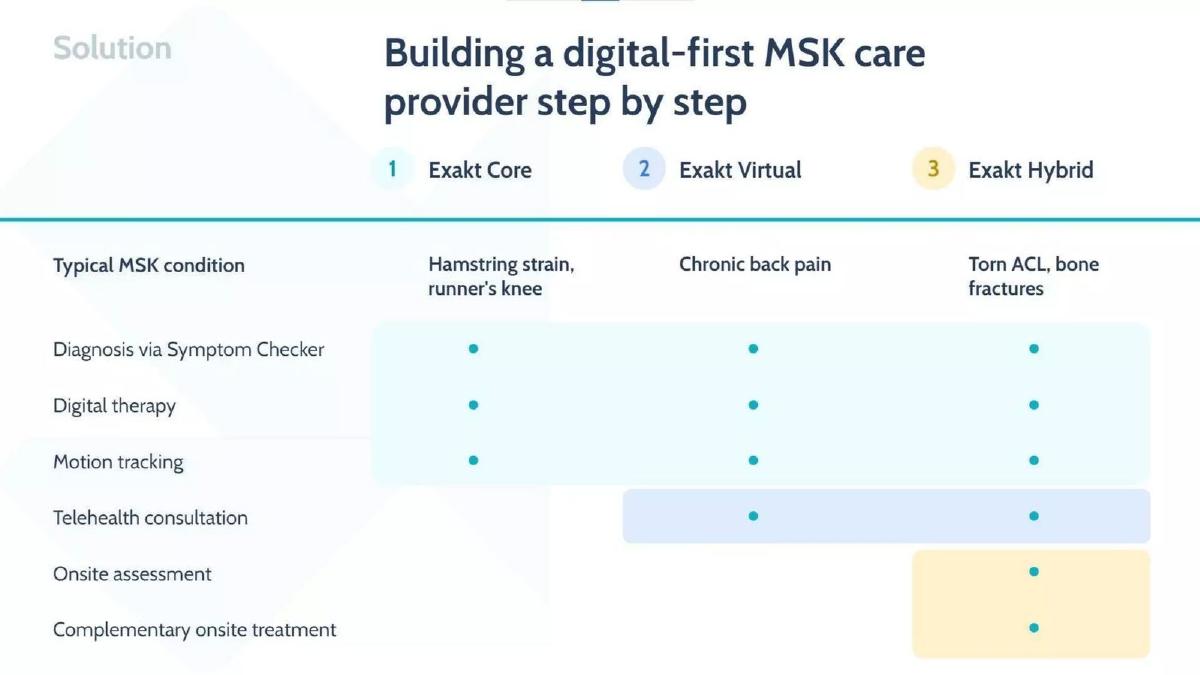
- The deck outlines a clear three-tier product evolution: Exakt Core, Exakt Virtual, and Exakt Hybrid (Slide 5).
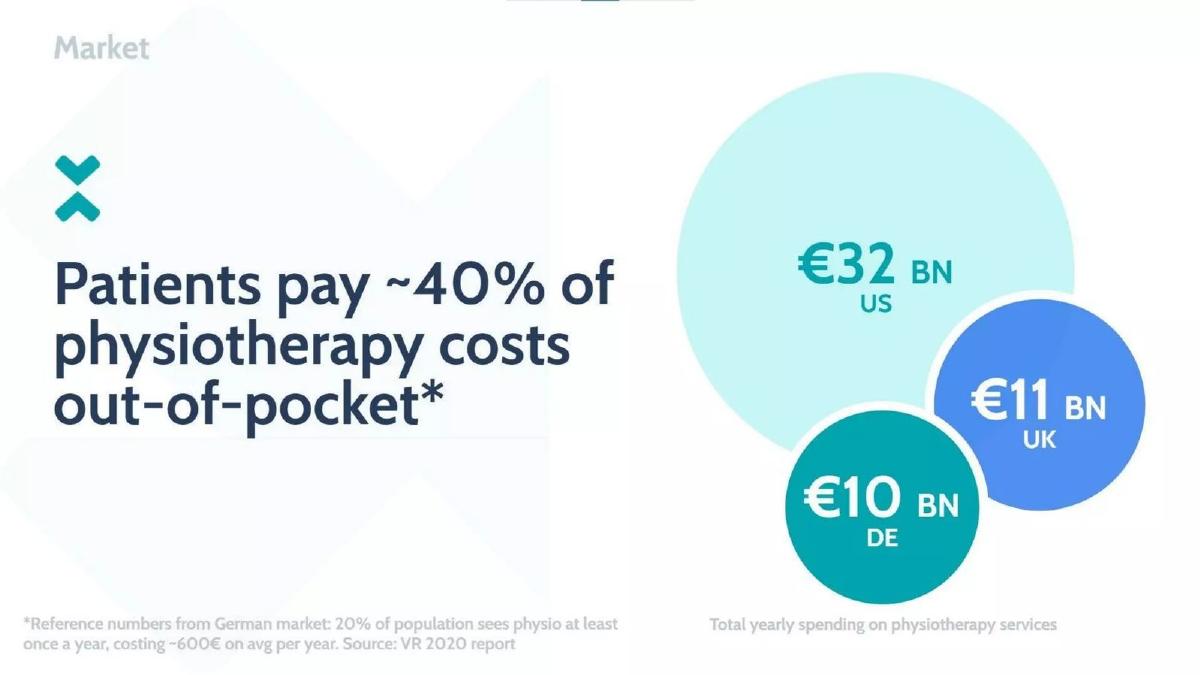
- Market sizing focuses on high out-of-pocket costs, noting patients pay ~40% of physiotherapy costs themselves (Slide 3).
- Unit economics are broken down specifically for the D2C model, projecting €95 net revenue against a €12 CAC (Slide 10).
- The B2B2C model projections show significant margin expansion, targeting €230 net revenue per user (Slide 11).
- Retention data is transparently shared, showing 53% at Week 1 and stabilizing at 22% by Week 8 (Slide 14).
- The team leverages strong pedigree, featuring founders with experience at N26 and Vodafone (Slide 12).
- Regulatory de-risking is highlighted through the achievement of European certification as a medical device in May 2021 (Slide 15).
- The roadmap includes ambitious international expansion plans to the US and India (Slide 16).
What this deck is: A roadmap for digital-first MSK care
The Exakt Health pitch deck is a 17-slide presentation used in 2021 to secure a $2.1 million pre-seed round. It is a highly professional, product-centric deck that focuses on the transition from a simple mobile app to a comprehensive healthcare provider. The narrative is built on the premise that musculoskeletal (MSK) care is ripe for technological disruption due to high costs and limited access to specialists. By presenting a clear three-stage product evolution, the founders demonstrate how they will move from a low-friction D2C app to a high-margin, regulated medical service integrated with insurance providers.
The Hook: Problem and Market Opportunity (Slides 1-4)
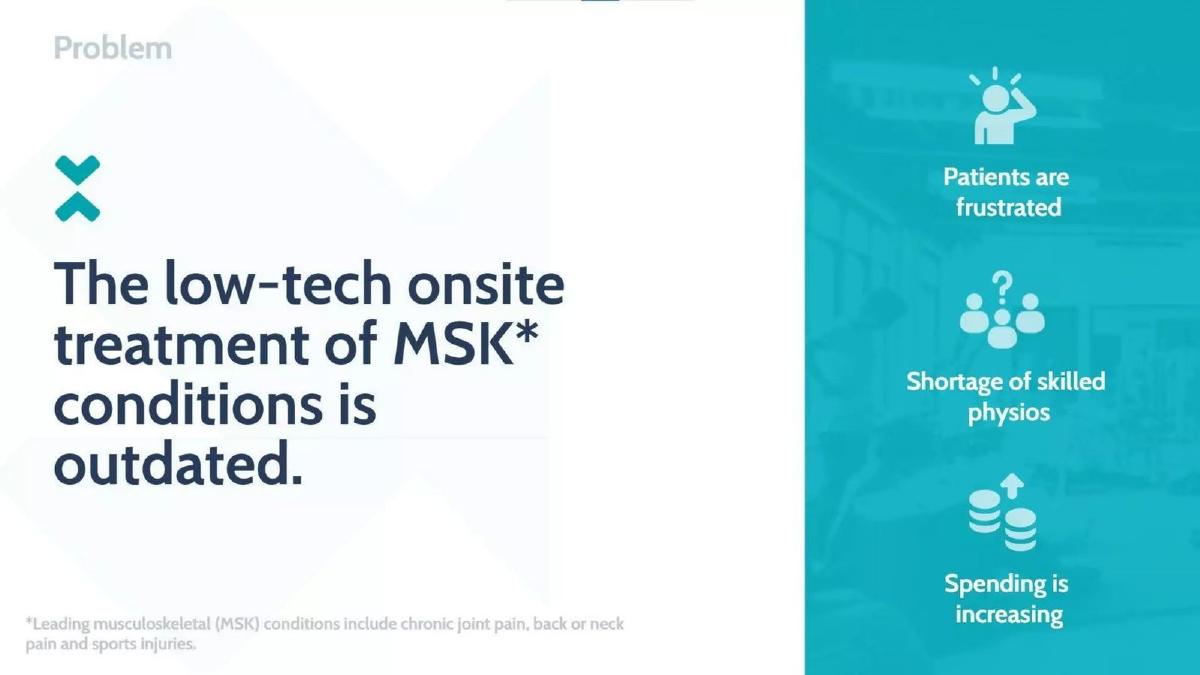
The deck opens with a clean title slide (Slide 1) featuring the tagline "Physical Therapy Reengineered." This immediately positions the company as a tech-driven disruptor in a traditional space. Slide 2 defines the problem: the "low-tech onsite treatment of MSK conditions is outdated." It lists three drivers: patient frustration, a shortage of physios, and rising spending. A footnote helpfully defines MSK conditions as chronic joint pain, back or neck pain, and sports injuries, ensuring investors understand the breadth of the market.
Slide 3 quantifies the market opportunity by highlighting that patients pay approximately 40% of physiotherapy costs out-of-pocket. It provides total yearly spending figures for three key markets: €32 billion in the US, €11 billion in the UK, and €10 billion in Germany (DE). By citing the German market specifically (20% of the population sees a physio annually, costing ~€600), the deck establishes a realistic baseline for user value. Slide 4 concludes this section with a simple mission statement: making best-in-class physiotherapy accessible to everyone, anywhere.
The Solution: A Three-Tiered Product Strategy (Slides 5-9)
Slide 5 is the most important slide in the deck. It presents a matrix titled "Building a digital-first MSK care provider step by step." It breaks the product into three versions: Exakt Core (digital therapy for minor injuries), Exakt Virtual (telehealth for chronic pain), and Exakt Hybrid (onsite treatment for fractures/ACL tears). This slide tells investors that the company isn't just building an app; they are building a scalable healthcare system.
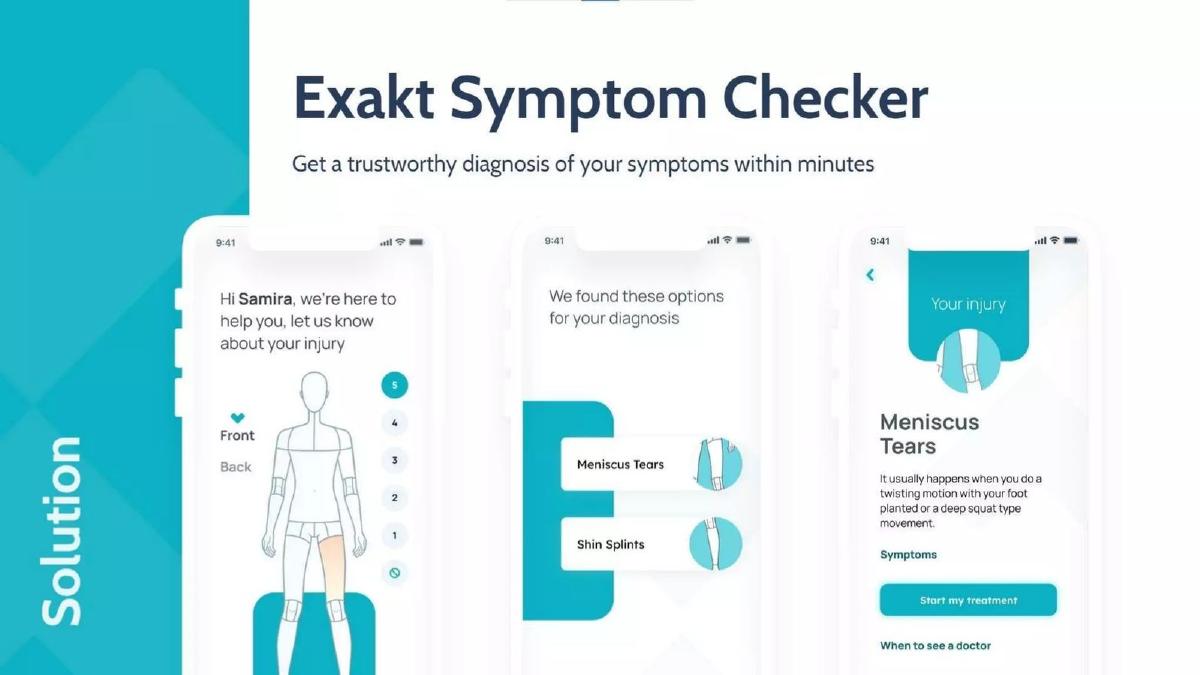
Slides 6 through 9 provide visual evidence for these tiers. Slide 6 showcases the "Symptom Checker," which offers a diagnosis within minutes. Slide 7 introduces "Exakt Core," showing mobile screens for digital therapy plans and motion tracking. Slide 8 explains "Exakt Virtual," which adds a human element via telehealth calls to adjust plans if a patient is in pain. Finally, Slide 9 illustrates "Exakt Hybrid," showing the integration of onsite clinical assessments with home-based exercise routines. The use of consistent UI mockups across these slides makes the product feel real and well-developed.
The Business Model: D2C vs. B2B2C (Slides 10-11)
Exakt Health provides an unusually transparent look at their unit economics. Slide 10 breaks down the D2C strategy for Exakt Core. Based on a €19 monthly subscription and 6-month retention, they project €114 in total revenue. After subtracting €7 for service costs and €12 for Customer Acquisition Cost (CAC), they claim a net revenue of €95 per user. This 7.9x LTV/CAC ratio is a strong signal for a pre-seed company.
Slide 11 pivots to the "high margin" B2B2C model. By integrating into local healthcare systems where doctors prescribe the app, they project revenue of €390 per user (based on an initial €250 prescription plus a €140 follow-up). Even with higher costs for physiotherapists (€120) and a higher CAC (€30), the net revenue jumps to €230. This slide effectively communicates the long-term scalability and profitability of the business beyond simple app store subscriptions.
Team and Social Proof (Slides 12-13)
Slide 12 introduces the team, leaning heavily on their experience at N26, a prominent European neobank. CTO Lucia Payo and CEO Philip Billaudelle both cite N26 in their backgrounds, suggesting they have experience scaling high-growth, regulated tech products. The inclusion of Physiotherapy Lead Maryke Louw provides the necessary clinical credibility. The slide also lists "Selected Investors," including the Co-Founder of N26 and the Ex-Head of Strategy at Kry, further validating the founders' pedigree.
Slide 13 focuses on traction through user testimonials and app store ratings. It shows a 5.0-star rating (from 48 total reviews) and quotes a user named Georgie who calls the app the "single one thing I've been looking for." While the sample size is small, it provides qualitative evidence of product-market fit.
Metrics and Milestones (Slides 14-17)
Slide 14 presents hard data on retention and growth. The retention curve is respectable for a health app: 53% at Week 1, 27% at Week 4, and 22% at Week 8. The bar chart shows Monthly Active Users (MAU) growing from 268 in August to 1,480 in November 2021, with a projection of 60,000 by late 2022. Slide 15 provides a timeline of 2021, highlighting the $0.5M pre-seed round in March and the critical European medical device certification in May.
Slide 16, titled "Outlook," serves as the closing argument. It lists goals for the Seed investment: expanding to 20+ MSK conditions, monetizing Exakt Core, expanding to the US and India, and opening the first onsite clinic. The final slide (Slide 17) is a simple contact page for CEO Philip Billaudelle. Notably, the deck does not include a specific 'Ask' slide detailing the amount of capital sought or the valuation, which is common in decks shared publicly after a round closes.
What works in this deck
Clear Product Evolution: The three-step roadmap (Core, Virtual, Hybrid) is a brilliant way to show how a simple app becomes a massive healthcare company. · Transparent Unit Economics: Breaking down CAC and Net Revenue for two different business models (D2C and B2B2C) builds immediate trust with analytical investors. · Regulatory Awareness: Mentioning the European medical device certification is a major de-risking factor for a health-tech startup. · Founder-Market Fit: The N26 pedigree suggests the team knows how to build secure, regulated, and user-friendly digital products.
What is missing from this deck
The Funding Ask: There is no slide stating how much money they are raising or how they will spend it. While they raised $2.1M, a founder using this as a template should include a specific 'Use of Funds' slide. · Competitive Landscape: The deck assumes the problem is "low-tech onsite treatment," but it ignores other digital MSK competitors (like Hinge Health or Kaia Health). A slide showing their unique edge over other apps would be beneficial. · Detailed Unit Economics for Hybrid: While they show economics for Core and Virtual, they don't explain the costs or margins for the "Hybrid" onsite clinics, which are likely much more capital-intensive.
What a founder should copy
The Unit Economics Stack: Use the stacked bar chart format from slides 10 and 11 to show exactly how you get from gross revenue to net profit. It is much more effective than a simple table. · The Step-by-Step Solution: If your product has a long-term vision that is hard to build all at once, use a matrix like Slide 5 to show how you will gradually add features and address more complex use cases. · Retention Transparency: Don't just show a growth chart. Show a retention table (Slide 14). Investors know that growth without retention is a 'leaky bucket,' and showing these numbers early proves you are focused on product quality.
Frequently asked questions
- What is the core problem Exakt Health is solving?
- According to slide 2, the company addresses the 'outdated' nature of low-tech onsite treatment for musculoskeletal (MSK) conditions. They highlight three specific pain points: frustrated patients, a shortage of skilled physiotherapists, and increasing healthcare spending. Slide 3 further emphasizes that 40% of these costs are currently paid out-of-pocket by patients, suggesting a massive opportunity for a more affordable digital alternative.
- How does Exakt Health plan to make money?
- The company employs a dual-track business model. Slide 10 details a D2C freemium model with a €19 monthly subscription, yielding a €95 net revenue over a 6-month retention period. Slide 11 introduces a B2B2C model integrated into local healthcare systems, where medical professionals prescribe the app. This model targets much higher net revenue (€230) through insurance reimbursement schemes.
- What does the product roadmap look like?
- Slide 5 illustrates a 'step by step' build. It starts with Exakt Core (digital therapy and motion tracking for minor injuries like runner's knee), moves to Exakt Virtual (adding telehealth for chronic pain), and culminates in Exakt Hybrid (adding onsite assessments and treatment for severe injuries like torn ACLs). This allows the company to expand its addressable clinical use cases over time.
- What traction did the company have at the time of the pitch?
- Slide 14 shows significant early growth, with Monthly Active Users (MAU) rising from 268 in August 2021 to 1,480 in November 2021. The company also projected reaching 60,000 MAUs by the second half of 2022. Additionally, slide 15 notes they had already validated their MVP and achieved European medical device certification by May 2021.
- Is there a specific funding ask in the deck?
- No, the deck does not state a specific dollar amount. Slide 16 mentions they are 'ready to accelerate... with a Seed investment,' but it omits the target raise amount and the planned allocation of funds. While the catalogue facts state they raised $2.1 million, the deck itself focuses more on the milestones that the next round will enable, such as expansion to the US and India.