Experify’s 10-slide pitch deck focuses on the erosion of trust in online shopping caused by fake reviews. By creating a platform where shoppers can connect with real product owners to ask questions or see items in person, Experify addresses a $150B market for 'Social Trust.' The deck is lean, prioritizing high-level vision and impressive conversion metrics over granular financial projections. With a reported reach of 3.5 million shoppers monthly and a 3x conversion lift for participating brands, the startup successfully closed a $4M Seed round led by Vertex Ventures US. While the deck lacks a…
Key takeaways
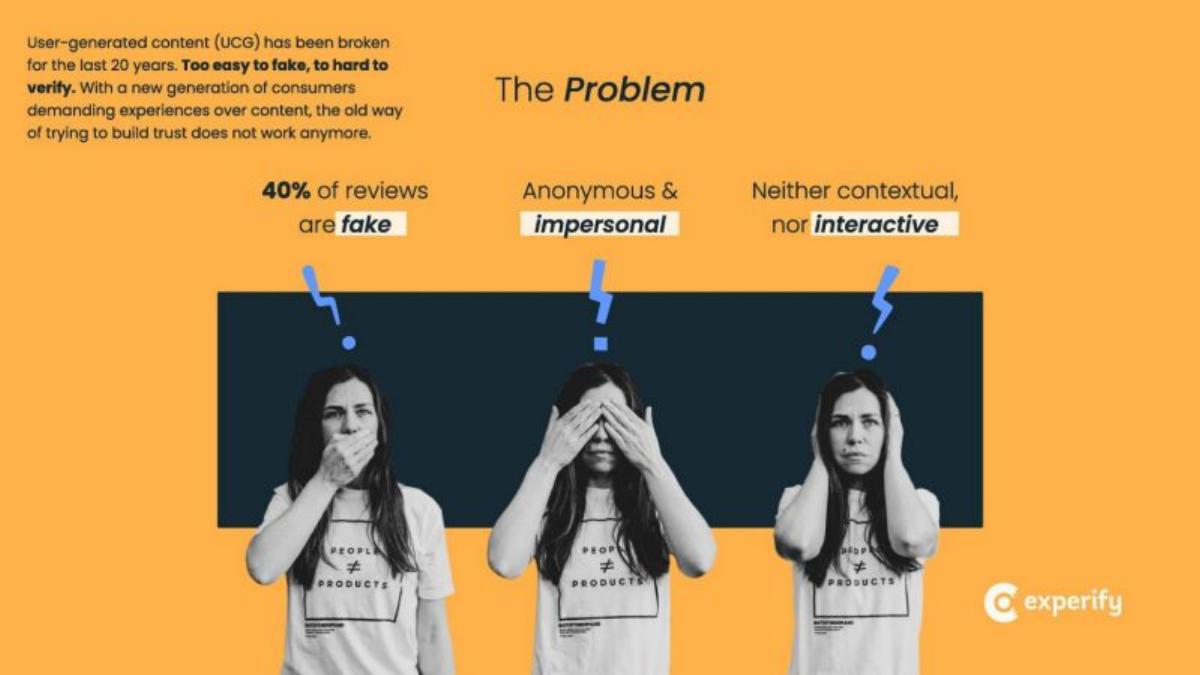
- The problem slide identifies that 40% of online reviews are fake, creating a trust gap in user-generated content (Slide 2).
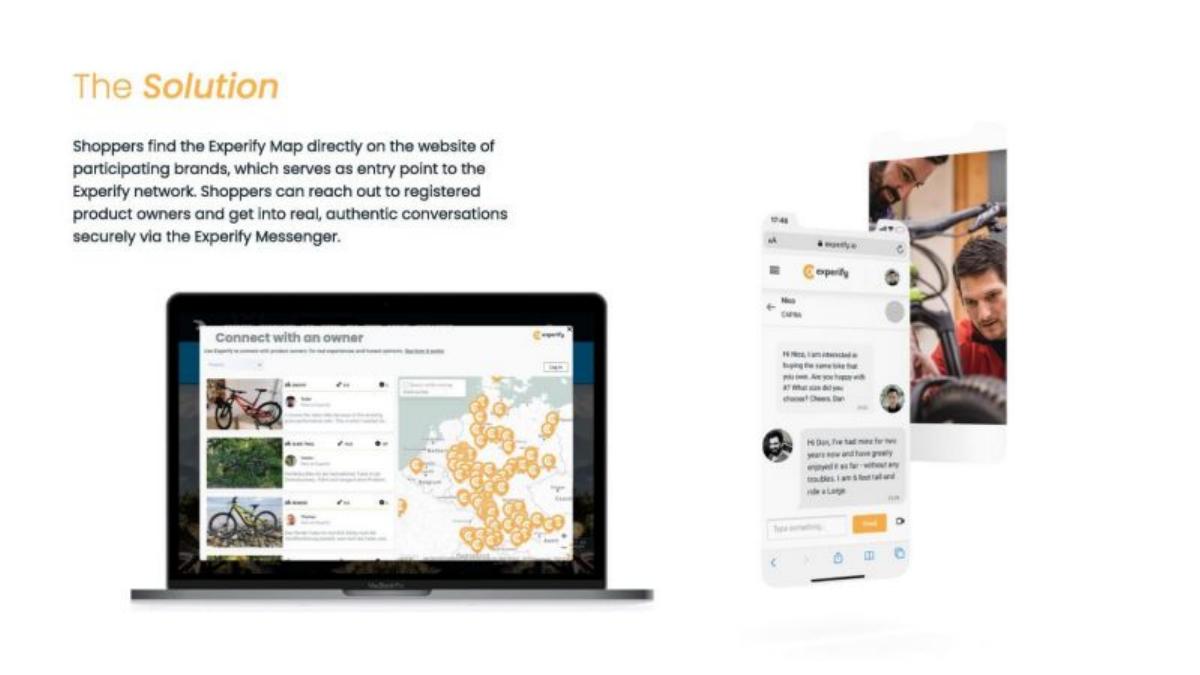
- Experify positions itself as a SaaS tool and platform that embeds directly into brand websites via an 'Experify Map' (Slide 5).
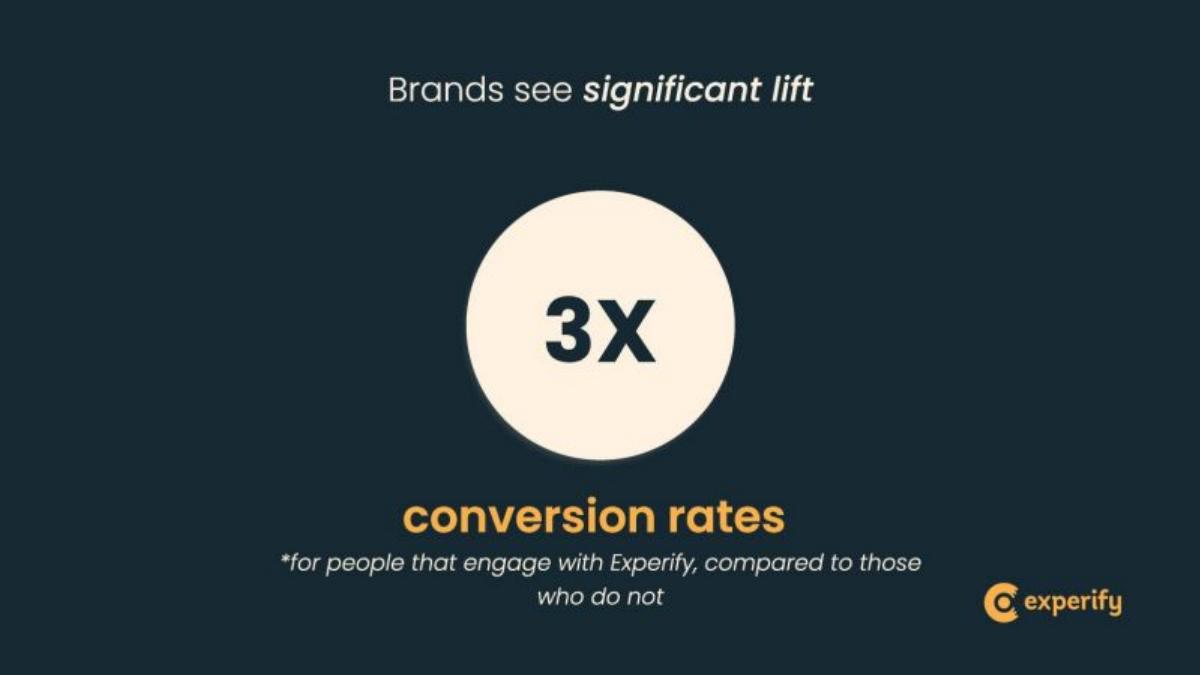
- The platform delivers a 3x conversion rate lift for shoppers who engage with the Experify network compared to those who do not (Slide 6).
- As of the 2022 deck, the company reached 3.5 million shoppers every month (Slide 7).
- Traction is focused on high-consideration categories including bicycles, HiFi audio, furniture, and electronics (Slide 7).
- The market opportunity is split into two segments: a $150B Social Trust market and a $10B Customer Review Software market (Slide 8).
- The $4M Seed round was led by Vertex Ventures US, with participation from SonaeIM and Berkeley SkyDeck Fund (Slide 9).
- The founding team includes René Pfitzner (CEO/CTO), Nicolas Beck (CPO), and Niklas Etzel (CCSO), operating out of Zurich and Palo Alto (Slide 9).
The Experify Pitch Deck: A Masterclass in Category Creation
Experify’s pitch deck is a concise, 10-slide presentation that successfully raised $4M in Seed funding in 2022. The deck does not get bogged down in technical architecture or complex financial modeling; instead, it focuses on a singular, powerful psychological lever: trust. By identifying that the current system of online reviews is fundamentally broken, Experify proposes a new category of 'experiential e-commerce' where the community acts as the ultimate sales force.
Slide 1: Title and Introduction
The deck opens with a clean title slide featuring CEO René Pfitzner. The tagline, "Real-life trust for online businesses," immediately sets the stage. It defines the company not by its technology, but by the emotional and functional outcome it provides to its customers. This is a strong start for a Seed-stage company looking to define a new niche in the crowded e-commerce software space.
Slide 2: The Problem - The Death of Trust
Slide 2 identifies the core pain point: User-generated content (UGC) is broken. The slide lists three critical failures of the current system: "40% of reviews are fake," reviews are "Anonymous & impersonal," and they are "Neither contextual, nor interactive." By using the visual of the 'three wise monkeys' (see no evil, hear no evil, speak no evil), the deck emphasizes that consumers are currently flying blind when making online purchases. This slide successfully creates a sense of urgency for a solution.
Slide 3: Our Vision - A Global Social Platform
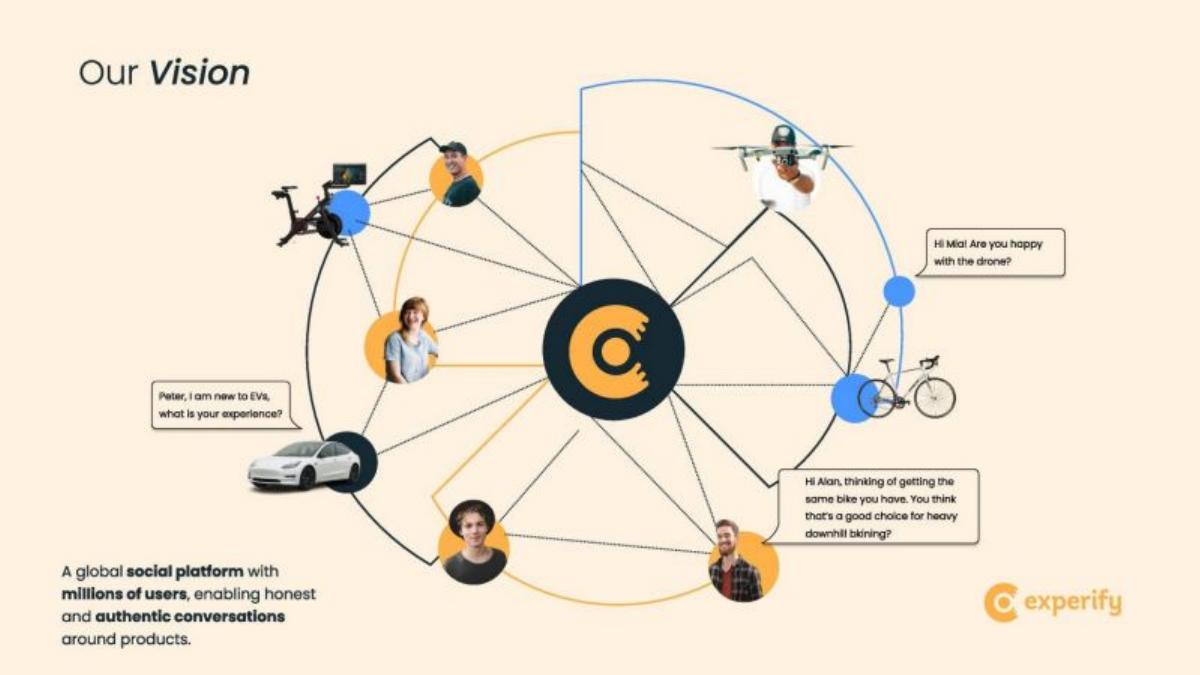
The vision slide moves from the problem to a high-level conceptualization of the solution. It depicts a network of users connected to various high-value products like Tesla cars, Peloton bikes, drones, and road bikes. The text describes a "global social platform with millions of users, enabling honest and authentic conversations around products." This slide is crucial because it shows that Experify isn't just a widget for a website; it’s a network play with potential for scale.
Slide 4 & 5: The Solution - SaaS Meets Community
These two slides explain the product mechanics. Slide 4 defines Experify as a "SaaS tool & platform to connect customers for authentic opinions." It shows a laptop interface with a map of Europe dotted with Experify icons. Slide 5 goes deeper into the user journey, explaining that the 'Experify Map' lives on brand websites and leads to the 'Experify Messenger.' The visual of a mobile chat interface shows a real interaction: "Hi Nico, I am interested in buying the same bike that you own... What size did you choose?" This makes the abstract concept of 'trust' very tangible for the investor.
Slide 6: The 'Big Number' - 3X Conversion
If an investor only remembers one slide, Experify wants it to be this one. Slide 6 features a massive "3X" in the center of the page. It claims that brands see a 3x lift in conversion rates for people who engage with Experify compared to those who do not. In the world of e-commerce SaaS, a 3x lift is an extraordinary claim that demands attention. It justifies the cost of the software by showing a direct, massive impact on the bottom line.
Slide 7: Traction and Market Validation
Slide 7 provides the 'proof' that the 3x conversion isn't just a fluke. It states a "User Reach: Currently 3.5 Million shoppers every month." It also includes a testimonial from Radon, a bicycle brand, citing "ROIs of 15x and more." The slide lists their target industries—Bicycles, HiFi Audio, Furniture, and Electronics—and their geographic focus on the US and EU. This shows that the team has found product-market fit in specific, high-ticket verticals.
Slide 8: Market Size
Experify avoids the standard 'TAM/SAM/SOM' pyramid in favor of two simple circles. They value the "Social Trust for Businesses" market at "$150 B" and the "Customer Review Software" market at "$10 B." By positioning themselves in the larger 'Social Trust' circle, they signal that their ambitions go far beyond just replacing Yelp or Trustpilot; they want to own the entire trust layer of the internet.
Slide 9: The Team and The Round
The final content slide introduces the founders: René Pfitzner (CEO/CTO), Nicolas Beck (CPO), and Niklas Etzel (CCSO). It highlights their remote-first culture with offices in Zurich and Palo Alto. Crucially, it announces that the "Seed round is now closed! ($4M)" and lists the heavy hitters who joined: Vertex Ventures US, SonaeIM, and Berkeley SkyDeck Fund. This slide serves as a final validation of the company's credibility.
What Works in the Experify Deck
The deck’s greatest strength is its clarity of purpose . It doesn't try to be everything to everyone. It identifies a specific, massive problem (fake reviews) and offers a specific, high-ROI solution (peer-to-peer verification). The use of the 3x conversion metric is a powerful anchor that makes the business case nearly undeniable for any e-commerce brand manager.
Furthermore, the visual storytelling is excellent. By showing actual chat logs and maps, the founders help the investor visualize exactly how the product fits into a consumer's life. The focus on high-ticket items (bikes, cars, electronics) is also a smart strategic move, as these are the areas where 'trust' has the highest monetary value.
What is Missing from the Experify Deck
Despite its success, the deck leaves several questions unanswered. First, there is no business model slide . While it mentions being a 'SaaS tool,' it doesn't specify if they charge per seat, per interaction, or a percentage of the attributed sales lift. For a $4M round, investors usually want to see the mechanics of how the company captures the value it creates.
Second, there is no competition slide . Experify isn't the only company trying to solve trust. Traditional review platforms, video testimonial startups, and even brands' own community forums are competitors. The deck would be stronger if it explicitly stated why a peer-to-peer map is superior to a video review on YouTube or a Reddit thread.
Finally, there is no mention of the 'supply side' incentives . Why do product owners spend their time answering questions for strangers? Is there a gamification element, a discount program, or is it purely altruistic? Understanding what keeps the 'verified owners' engaged is critical to the long-term defensibility of the network.
Founder Takeaway: Copy the 'Outcome-First' Approach
Founders should study how Experify leads with the outcome rather than the feature . They don't start by talking about their API or their messenger interface; they start by talking about the 3x conversion lift and the 15x ROI. If you can prove that your software makes your customers significantly more money, the technical details become secondary. Additionally, the brevity of this deck (10 slides) is a reminder that you don't need a 30-page document to raise millions if your core thesis is strong and your traction is undeniable.
Frequently asked questions
- What specific problem does Experify solve for e-commerce brands?
- Experify addresses the 'broken' state of user-generated content. According to slide 2, 40% of reviews are fake, and most are anonymous, impersonal, and non-interactive. This makes it difficult for consumers to trust online information, especially for expensive or complex products. Experify solves this by facilitating real-life, authentic conversations between prospective buyers and verified owners.
- How does the Experify platform actually work for a shopper?
- Shoppers find an 'Experify Map' directly on a participating brand's website. This map serves as an entry point to the network, allowing shoppers to see nearby owners of the product they are considering. They can then reach out to these registered owners to ask questions or arrange to see the product in person via a secure messenger (Slide 5).
- What kind of ROI can brands expect from using Experify?
- The deck highlights two primary metrics for brand success. Slide 6 claims a 3x lift in conversion rates for shoppers who engage with Experify. Additionally, slide 7 features a testimonial from the brand Radon, stating they have seen ROIs of 15x and more since embedding the platform into their customer experience.
- Which industries is Experify currently targeting?
- Based on slide 7, the company is focusing on high-involvement purchase categories in the US and EU. These include the bicycle industry, HiFi audio, furniture, and electronics. These sectors typically require more 'trust' and physical verification before a consumer is willing to commit to a purchase.
- Who were the primary investors in Experify's $4M Seed round?
- The Seed round was led by Vertex Ventures US. Other participating investors listed on slide 9 include SonaeIM and the Berkeley SkyDeck Fund. The company also notes it is a member of the Innosuisse and Swissnex networks and was named 'Swiss Retail Startup of the Year' in 2021.