EZ Farming’s 2015 pitch deck is a masterclass in visual simplicity and metric-forward storytelling. The 12-slide presentation focuses heavily on the massive addressable market of 50 million small farms in Africa and the company's early traction, including $800,000 in GMV within its first eight months. The deck effectively uses a 'problem-solution' framework, highlighting the 40% revenue loss faced by farmers and offering a three-step investment model promising 20% annual returns. While it lacks detailed unit economics or a specific use-of-funds slide, the strength of the founding team—led by…
Key takeaways
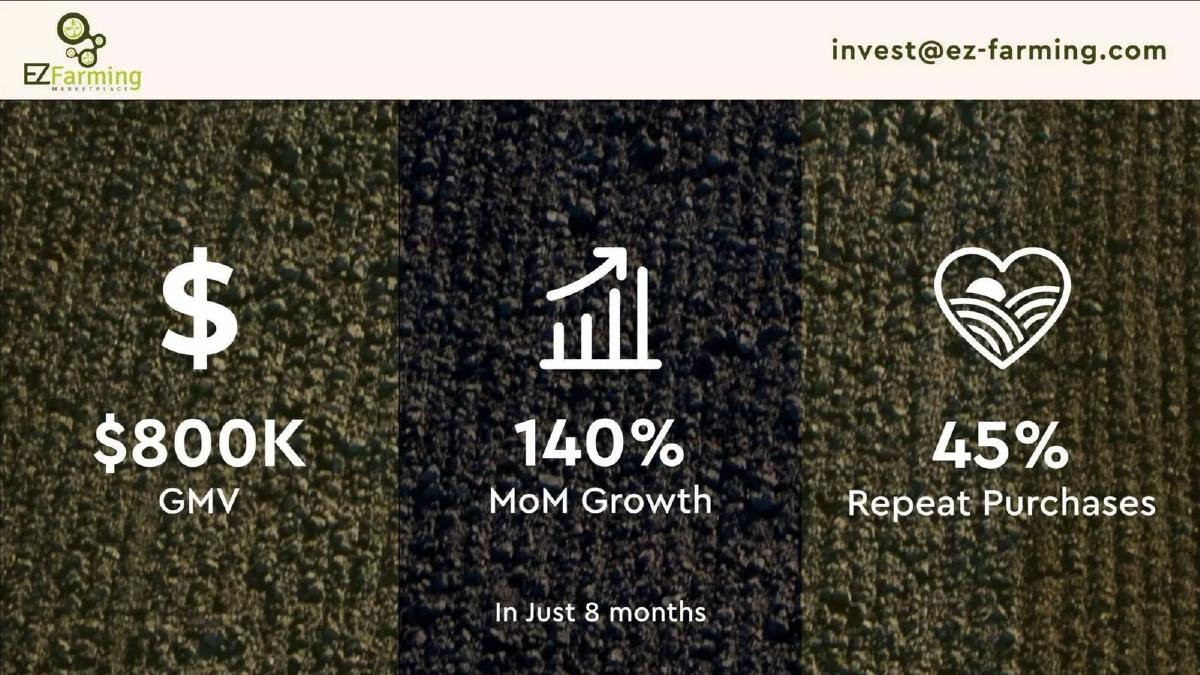
- The startup achieved $800,000 in Gross Merchandise Volume (GMV) within its first 8 months of operation (Slide 2).
- EZ Farming reported a significant 140% Month-over-Month (MoM) growth rate during its initial launch phase (Slide 2).
- The platform maintains a 45% repeat purchase rate, indicating strong retention on the buyer side of the marketplace (Slide 2).
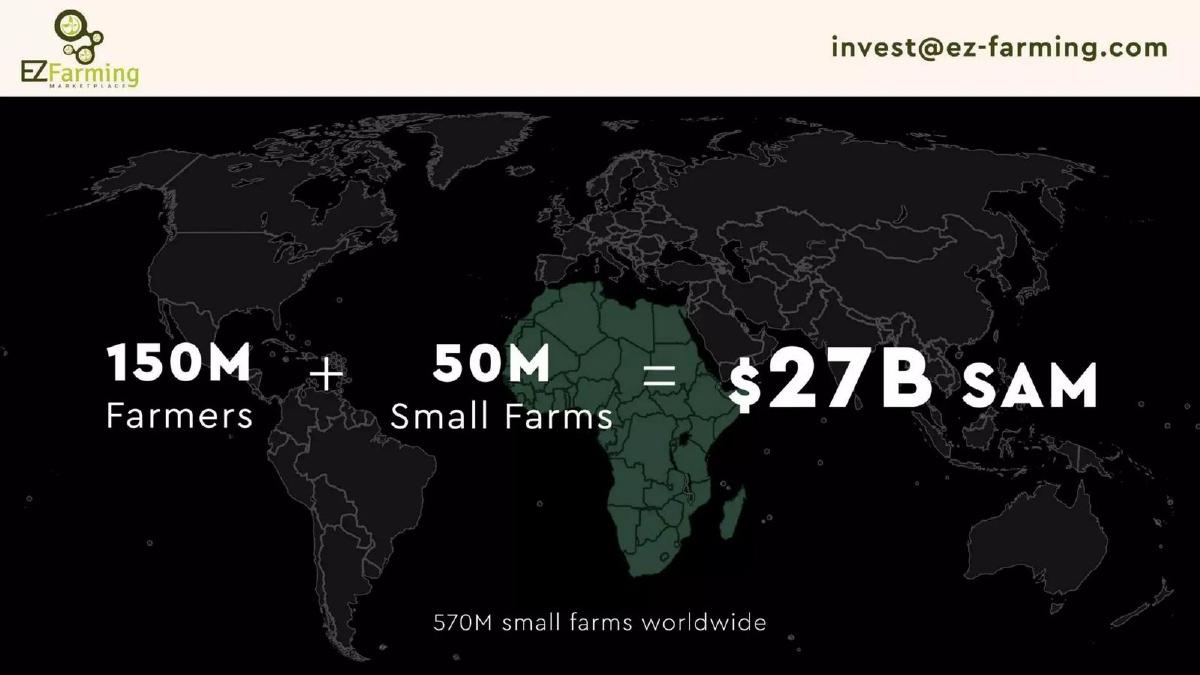
- The Serviceable Addressable Market (SAM) is valued at $27 billion, targeting 50 million small farms in Africa (Slide 3).
- Farmers currently face a 40% revenue loss, which the platform aims to mitigate through better market access (Slide 4).
- The investment model offers a 20% annual return for those who fund 'insured farms' selected by experts (Slide 8).
- The founding team is anchored by CEO Adewale Oparinde, who holds a Ph.D. in Agricultural Economics from Cambridge University (Slide 9).
- At the time of the pitch, the platform had successfully onboarded and supported 121 farmers (Slide 12).
Executive Summary: The Power of Traction and Pedigree
EZ Farming’s 12-slide deck is a lean, high-impact presentation that relies on two pillars: impressive early traction and an overqualified founding team. In the world of agricultural technology (AgTech) in emerging markets, investors are often wary of operational complexity and environmental risks. EZ Farming addresses these concerns head-on by leading with a $800,000 GMV figure and a 140% growth rate. The deck, used to raise $250,000 in 2015, successfully translates a complex supply chain problem into a simple marketplace opportunity.
Slide 1: Title and Value Proposition
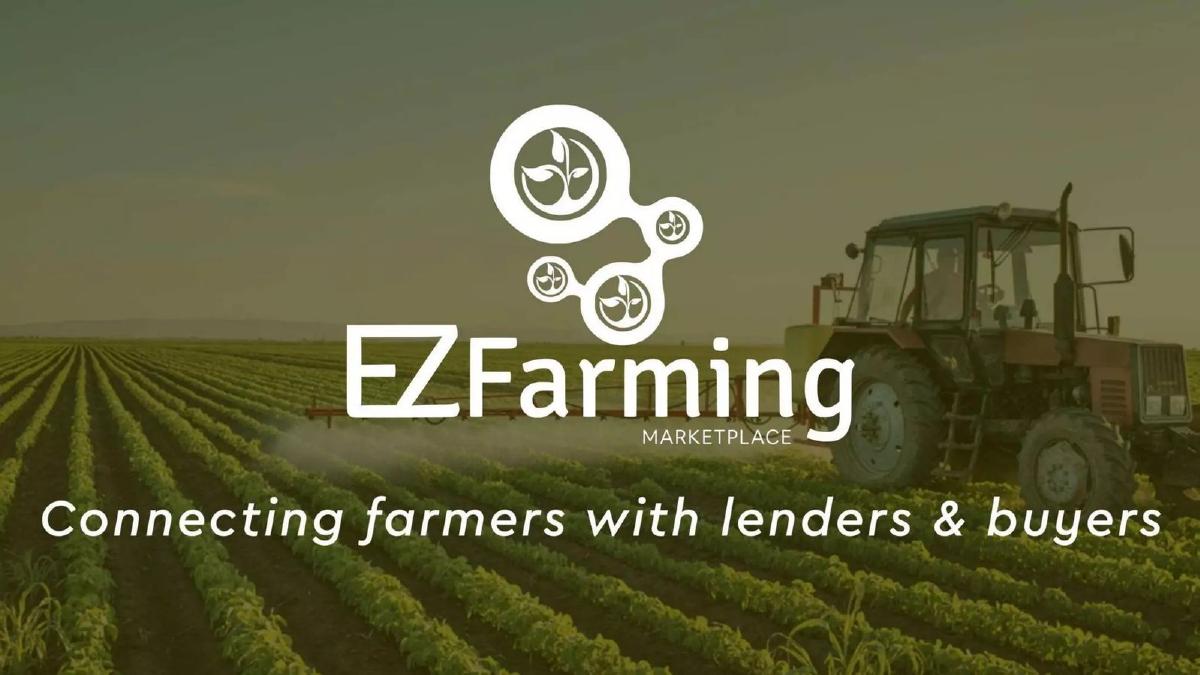
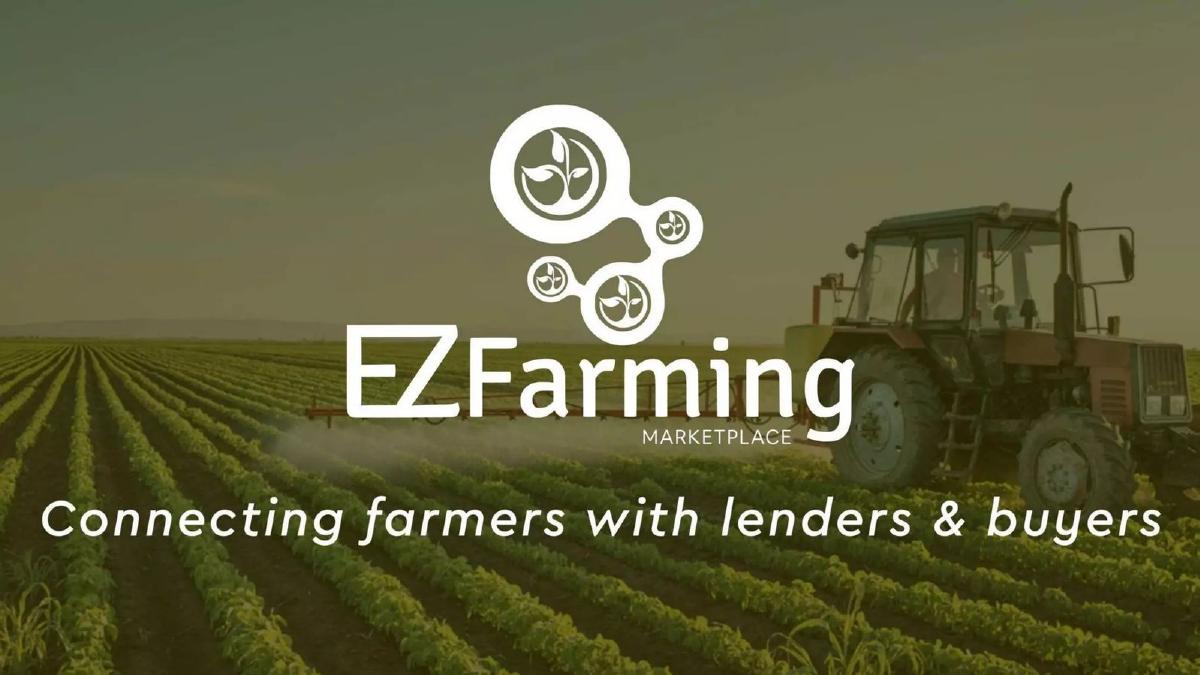
The cover slide establishes the company's identity as the 'EZ Farming Marketplace.' The tagline, 'Connecting farmers with lenders & buyers,' immediately identifies the startup as a three-sided marketplace. The background image of a tractor in a well-maintained field suggests modernization and scale, aligning with the company's mission to implement modern technology and good agricultural practices.
Slide 2: The Traction Tease
Instead of starting with a problem, EZ Farming starts with proof. Slide 2 presents three key metrics: $800K GMV , 140% MoM Growth , and 45% Repeat Purchases . By stating these were achieved 'In Just 8 months,' the founders establish a sense of urgency and momentum. This slide is designed to prevent an investor from tuning out during the market and problem slides that follow.
Slide 3: Market Size (TAM/SAM)
The deck moves to the global and regional opportunity. It notes there are 570 million small farms worldwide. However, it narrows its focus to the 50 million small farms in Africa, which it combines with a 150 million farmer figure to arrive at a $27B SAM (Serviceable Addressable Market). The use of a dark world map with Africa highlighted in green keeps the focus on the primary geographic target.
Slide 4: The Problem Statement
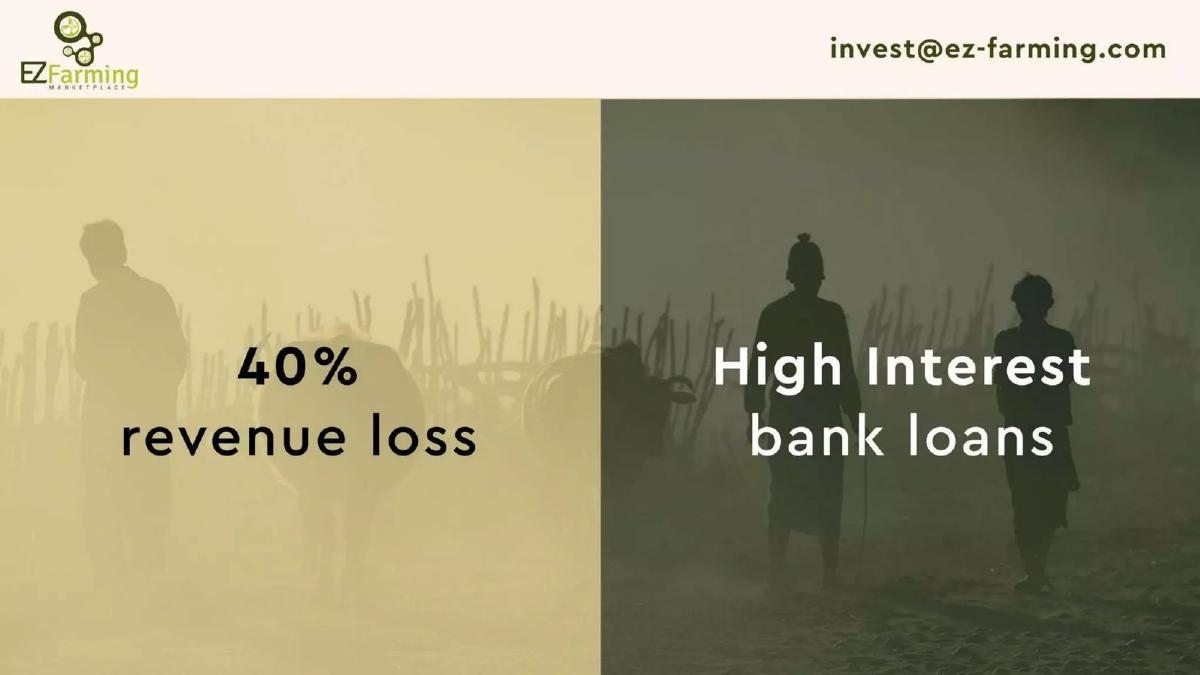
Slide 4 uses high-contrast visuals to highlight two systemic issues: 40% revenue loss and High Interest bank loans . The imagery of farmers in a dusty, low-tech environment reinforces the 'revenue loss' point, which in AgTech usually refers to post-harvest spoilage or the inability to reach markets before produce rots. The mention of high-interest loans sets the stage for the 'Lend' portion of their marketplace solution.
Slide 5: The Four-Pillar Solution
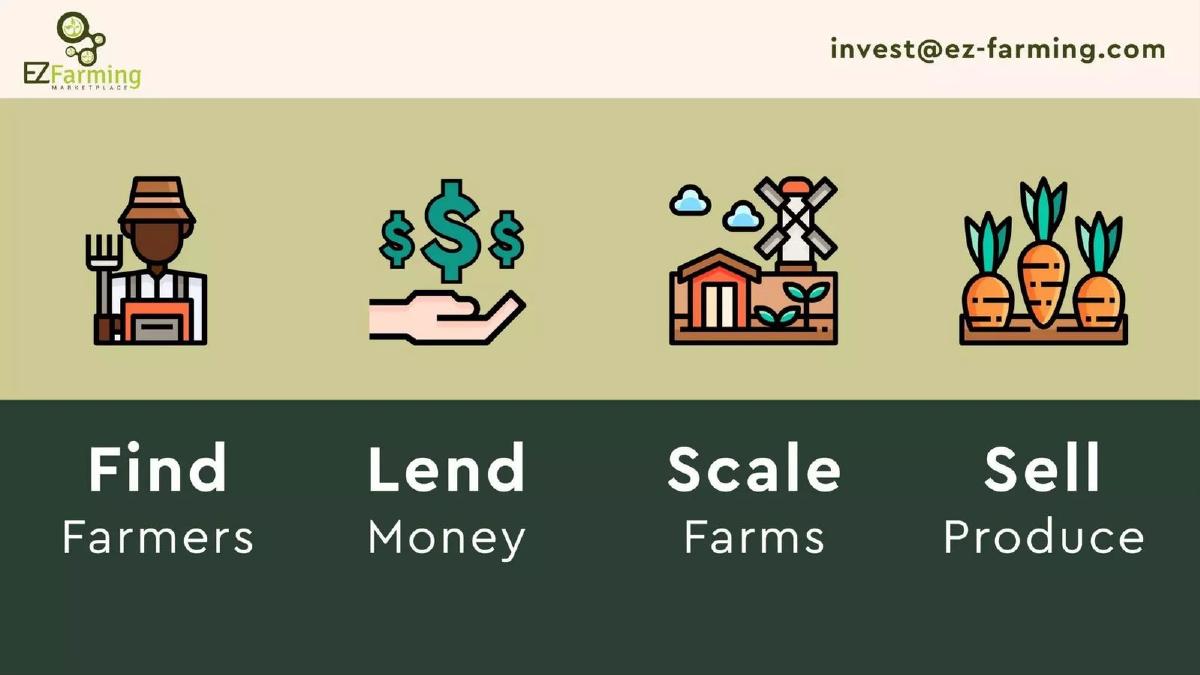
This slide uses simple iconography to explain the business model: Find Farmers , Lend Money , Scale Farms , and Sell Produce . This flow explains how the company intervenes at every stage of the agricultural lifecycle. It isn't just a lending platform; it is a full-stack partner that manages the growth and eventual sale of the crop.
Slide 6: The Buyer Interface
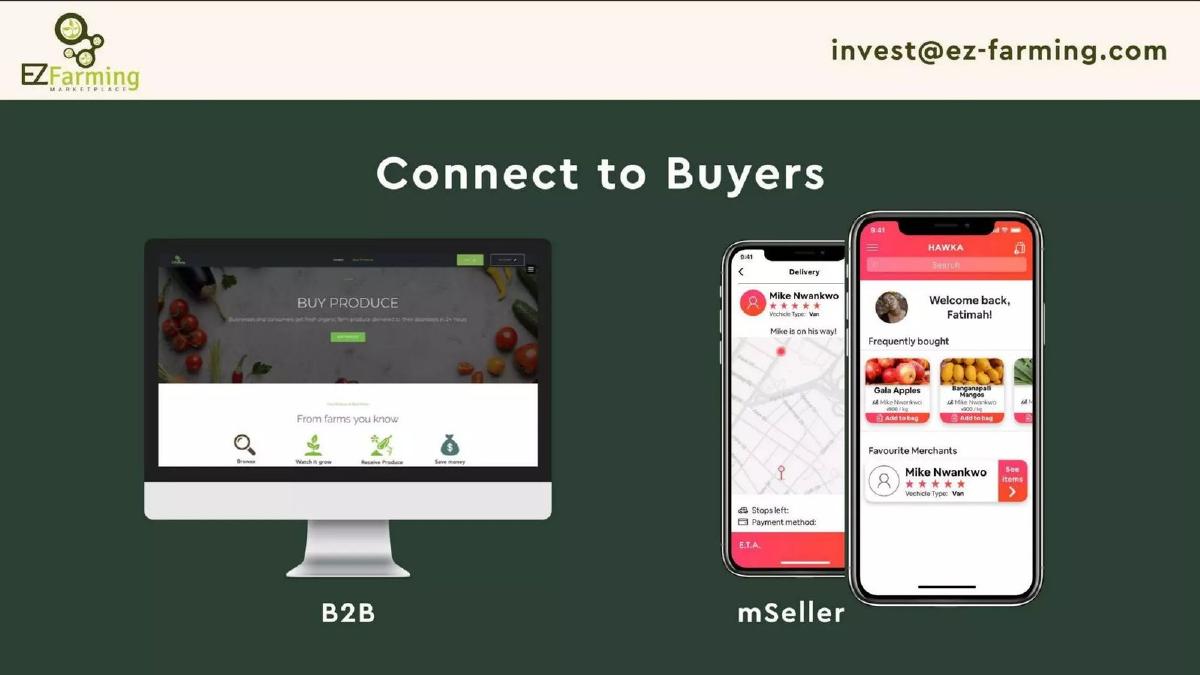
To prove the 'Sell Produce' claim, Slide 6 shows mockups of the B2B web interface and the 'mSeller' mobile app. The mobile app screen shows a user named 'Fatimah' and a delivery driver named 'Mike Nwankwo,' adding a layer of localization and realism. The features listed—'Watch it grow' and 'Receive Produce'—suggest a level of transparency that is often missing in traditional agricultural supply chains.
Slide 7: The 'Accelerator' Concept
Slide 7 is a transition slide with the text 'The Accelerator for Farmers.' This is a clever bit of branding. By framing a farm as a startup that needs an 'accelerator,' EZ Farming speaks the language of venture capital. It implies that with the right inputs (capital and tech), these farms can achieve exponential growth.
Slide 8: The Investor Value Proposition
This is the 'hook' for the lending side of the marketplace. It outlines a three-step process: Invest in insured farms , wait for Farms selected by experts to produce, and receive 20% Returns in a year . The mention of 'insured farms' is critical here, as it addresses the primary objection of any agricultural investor: crop failure risk.
Slide 9: The Team and Pedigree
This is arguably the strongest slide in the deck. CEO Adewale Oparinde is highlighted for his Ph.D. in Agricultural Economics from Cambridge University . The presence of Dr. Howarth Bouis , a 2016 World Food Prize Laureate, as an advisor provides massive institutional credibility. The slide is crowded with high-value logos including MIT, Deloitte, J-PAL, and IFPRI , signaling that the team has deep roots in both academia and global consulting.
Slide 10: The Personal Narrative
Slide 10 introduces 'J.O. Oparinde,' the CEO's father. It notes that he lacked money, market access, and technology, and thus 'remained a smallholder farmer all his life.' This adds an emotional 'founder-market fit' narrative to the deck. It shows that the CEO isn't just an academic; he has a personal stake in solving these specific problems.
Slide 11: The Vision of Success
This slide contrasts with Slide 4. It shows smiling farmers and two bold claims: Scale Farms 20X and Make Money $$$ . It is a simple, aspirational slide intended to show the 'after' state of the EZ Farming intervention.
Slide 12: The Closing and The Ask
The final slide repeats the traction metrics from Slide 2 but adds a new data point: 121 Farmers . This confirms that the $800,000 GMV was generated by a relatively small group of farmers, suggesting high revenue per farm and significant room for expansion. The slide provides a contact email but notably lacks a specific dollar amount for the 'Ask,' though catalogue data confirms the round was $250,000.
What Works in This Deck
Metric-First Approach: By putting the $800K GMV on Slide 2, the founders immediately prove that their model works. In a sector like AgTech, where many ideas never leave the pilot phase, this is a powerful differentiator.
Credibility Markers: The team slide is exceptional. For a $250k seed round, having a Cambridge PhD and a World Food Prize Laureate involved is 'overkill' in the best way possible. It reduces the perceived execution risk for investors who may not understand the Nigerian agricultural market.
Simplified Business Model: The 'Find, Lend, Scale, Sell' framework on Slide 5 takes a very complex logistical business and makes it understandable in five seconds. This is essential for generalist investors.
What Is Missing
Unit Economics: The deck mentions a 20% return for investors, but it does not explain EZ Farming's take rate. How much does the platform keep? What are the margins on the produce sales? Without this, it is hard to judge the long-term profitability of the startup itself versus the returns for the lenders.
Competition: There is no competitive landscape slide. Agriculture in Africa is a crowded space with players like Hello Tractor or Twiga Foods (though some may have launched later). Investors want to know why EZ Farming’s marketplace model is superior to traditional microfinance or government programs.
Use of Funds: The deck ends with an email address but no 'Ask' slide. A standard pitch deck should outline how the investment will be spent (e.g., 40% engineering, 30% operations, 30% marketing) and what milestones that money will buy.
What a Founder Should Copy
The 'Personal Why' Slide: Slide 10 (the CEO's father) is a perfect example of how to use a personal story to build trust. It explains the founder's motivation without being overly sentimental, focusing on the specific lack of 'Money, Market, and Technology.'
Visual Consistency: The deck uses a consistent color palette of greens and earth tones, which reinforces the agricultural theme without looking dated. The use of high-quality icons and clear, bold text makes the deck easy to read on a mobile device or a projector.
The 'Accelerator' Framing: Founders in traditional industries (farming, construction, logistics) should copy the way EZ Farming used tech-industry terminology ('Accelerator', 'MoM Growth', 'SAM') to make their business feel familiar to Silicon Valley-style investors.
Conclusion EZ Farming’s deck succeeded because it combined a massive, underserved market with undeniable early-stage traction and a top-tier team. While it leaves some financial questions unanswered, it does exactly what a seed deck should do: it proves the problem is real, the solution is working, and the people running it are the smartest ones for the job.
Frequently asked questions
- What is the core business model of EZ Farming?
- EZ Farming operates as a multi-sided marketplace. It connects smallholder farmers with lenders (investors) to provide capital and with buyers (B2B and mobile sellers) to ensure produce is sold. The platform manages the end-to-end process, from farm selection and insurance to supply chain management, taking a role in the value chain to reduce risk for both the investor and the farmer.
- How does the platform attract investors?
- The deck highlights a specific financial incentive: a 20% annual return on investment. By positioning itself as an 'Accelerator for Farmers,' EZ Farming allows individuals to invest in 'insured farms' that have been vetted by experts. This reduces the perceived risk of agricultural investment in emerging markets while offering a yield significantly higher than traditional savings accounts.
- What are the primary problems EZ Farming solves for farmers?
- According to the deck, the two biggest pain points are a 40% revenue loss (often due to post-harvest waste or poor market access) and the burden of high-interest bank loans. By providing lower-cost capital through its lending marketplace and guaranteed off-take through its buyer network, EZ Farming helps farmers scale their operations up to 20x.
- Who is the target audience for the produce sold on the platform?
- The deck identifies two primary buyer segments: B2B customers and 'mSellers.' The B2B side likely includes food processing companies and manufacturing firms, while the 'mSeller' (mobile seller) app, shown on Slide 6, targets individual retailers or consumers who can track deliveries and purchase fresh produce directly from 'farms they know.'
- Why was the team slide particularly effective in this deck?
- The team slide (Slide 9) uses high-authority logos like Cambridge, MIT, Deloitte, and the World Food Prize to build immediate credibility. Given the complexities of African agriculture and fintech, having a CEO with a PhD from Cambridge and a World Food Prize Laureate as an advisor signals to investors that the founders possess the deep domain expertise necessary to navigate the sector.