Faception’s 11-slide deck from 2014 is a masterclass in high-impact, low-detail storytelling. By opening with the 2015 Paris attacks and claiming to have classified 9 out of 11 terrorists, the company immediately establishes a high-stakes value proposition for homeland security. The deck is light on technical architecture but heavy on validation, citing a $750,000 purchase order and a 93% accuracy rate in specific application tests. While it lacks traditional financial projections, a business model, or a competitive landscape, it relies on the 'world-class' credentials of its team—including a…
Key takeaways
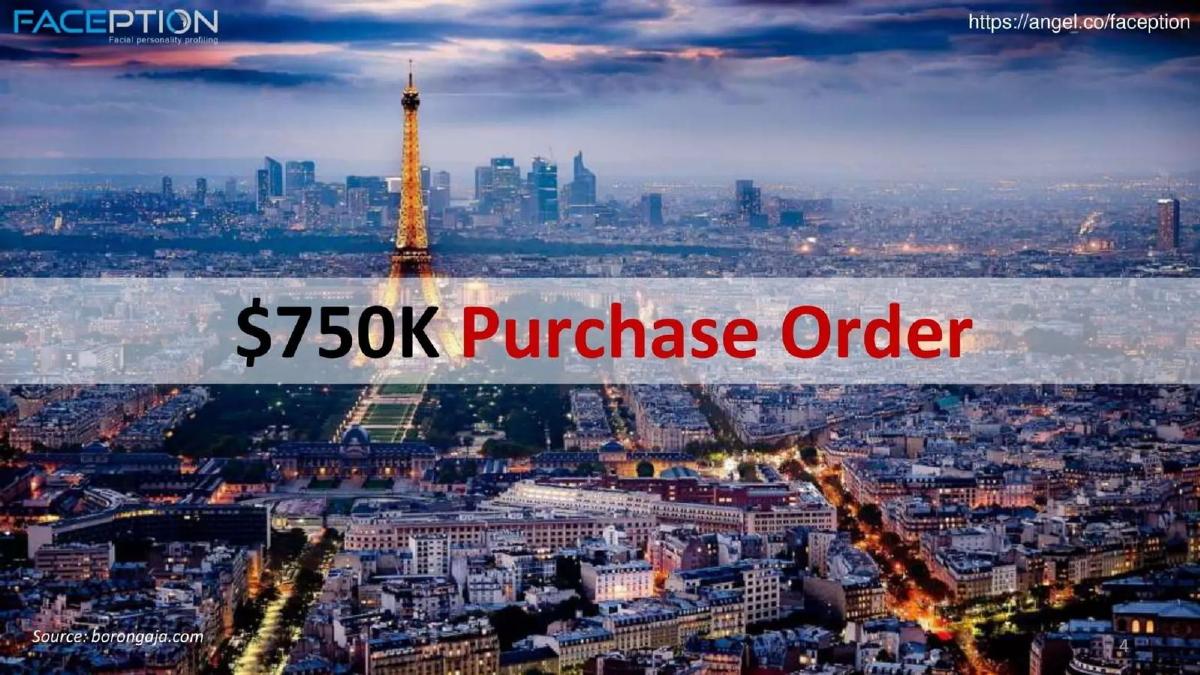
- The deck leads with a massive traction milestone: a $750,000 purchase order displayed on slide 4.
- Faception claims a high predictive accuracy of 93% (25/27) in application tests on slide 9.
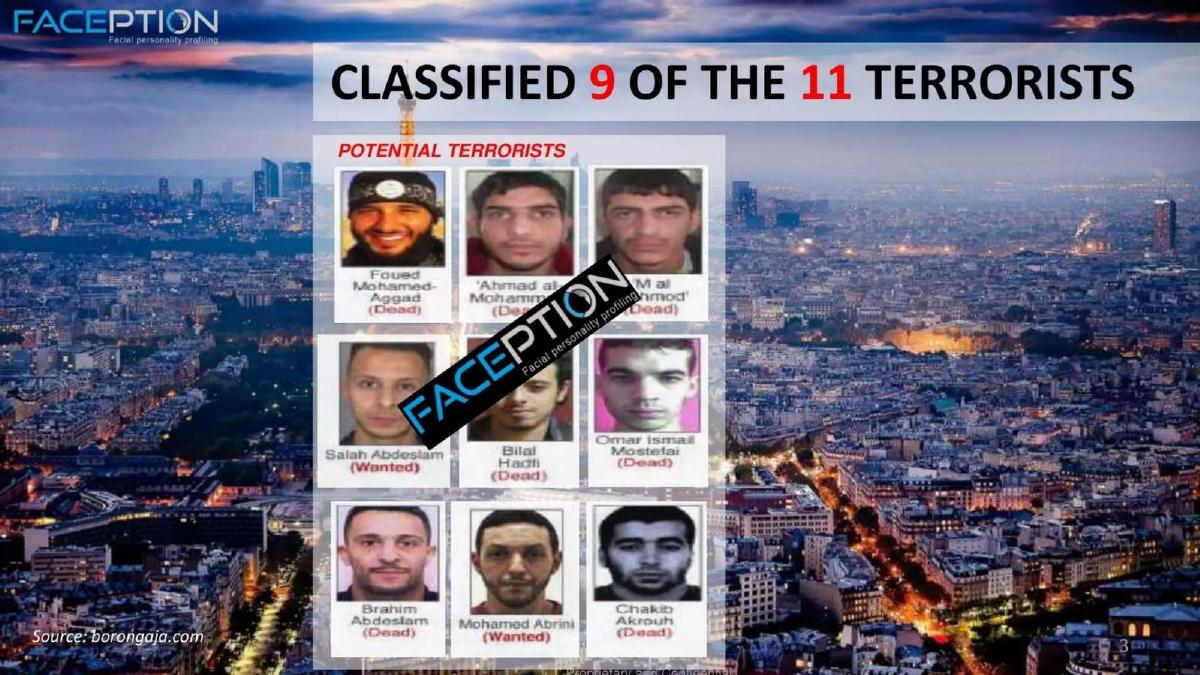
- The technology is positioned as a security tool, claiming to have classified 9 of the 11 terrorists from the Paris November 2015 attacks on slide 3.
- The team slide (10) highlights significant experience, including a CEO with 6 startups and 2 exits, and a CTO with 32 years in computer vision.
- The deck uses a 'Wow Me!' interface preview on slide 8 to show diverse profiling categories like MMA fighters and white-collar offenders.
- Specific personality metrics shown on slide 7 include 'High IQ', 'Extrovert', and 'Brand Promoter' on a -5 to 5 scale.
- The deck completely omits a formal 'Ask' slide, financial forecasts, and a breakdown of the business model.
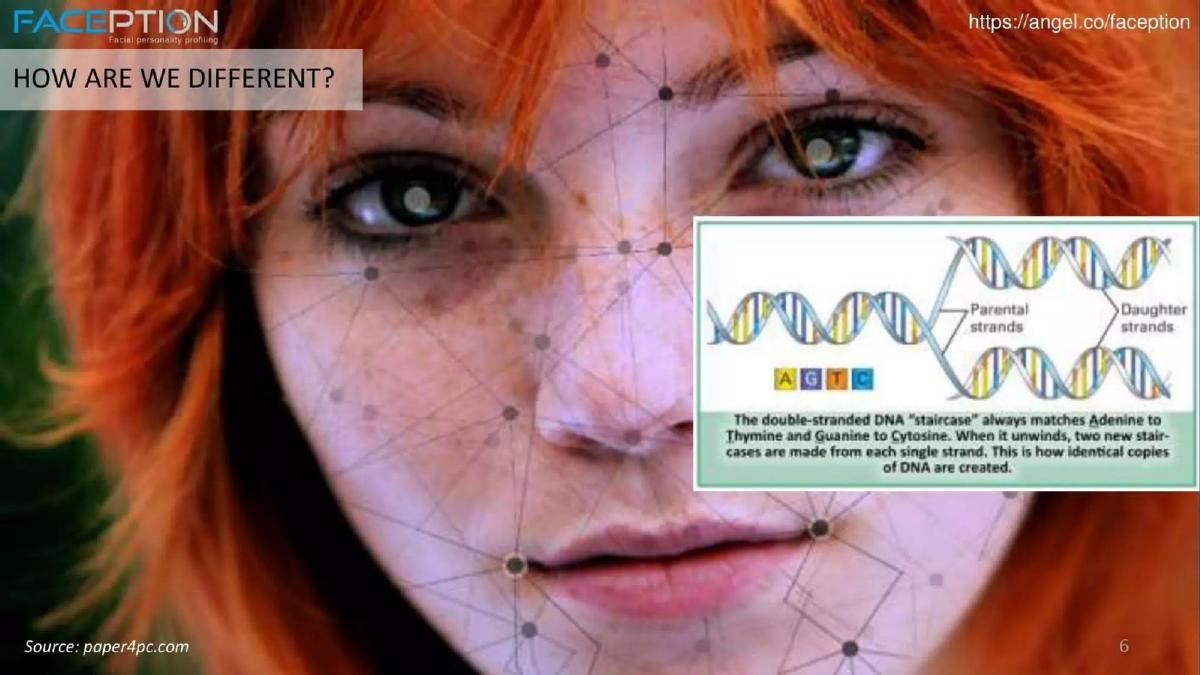
- Scientific backing is implied via a DNA diagram on slide 6, though the specific biological link to facial features is not explained in detail.
The High-Stakes Narrative of Faception
Faception’s 2014 pitch deck is a provocative document that prioritizes emotional impact and high-level validation over technical granularities. Operating in the controversial space of facial personality profiling, the company uses its 11 slides to argue that character traits are encoded in facial geometry. The deck is structured to move from a shocking problem (terrorism) to a validated solution (purchase orders and accuracy rates) to a credible team. It is a lean deck that relies on the strength of its claims rather than the breadth of its data.
Slide 1: The Hook
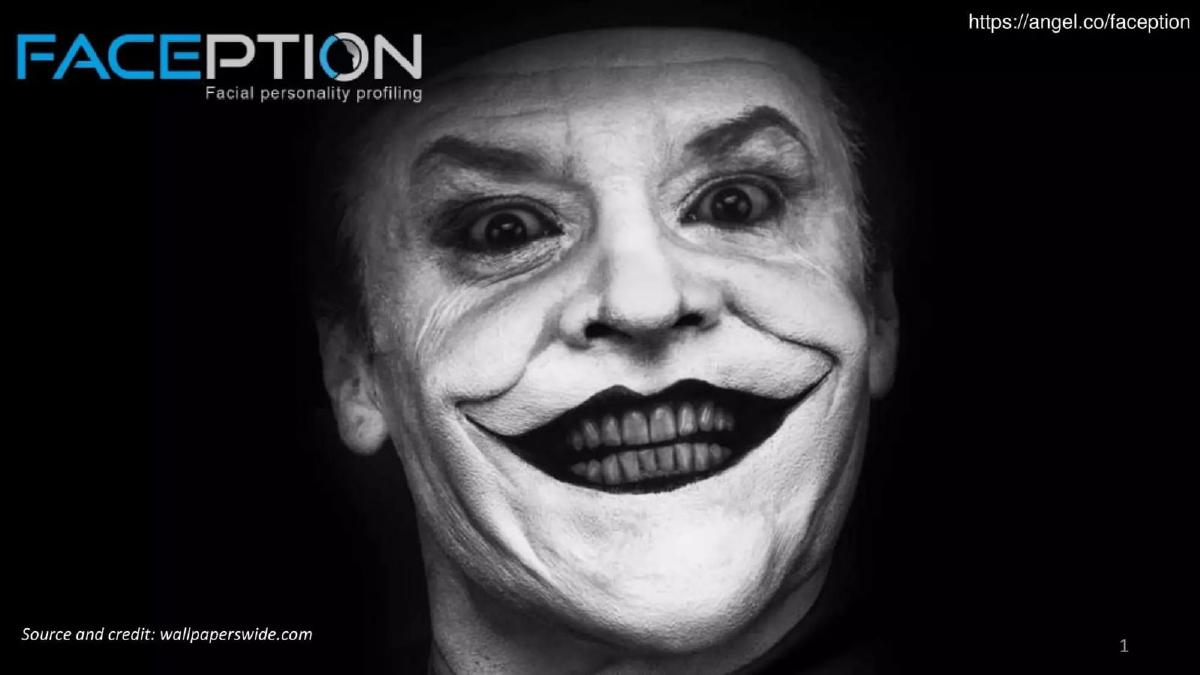
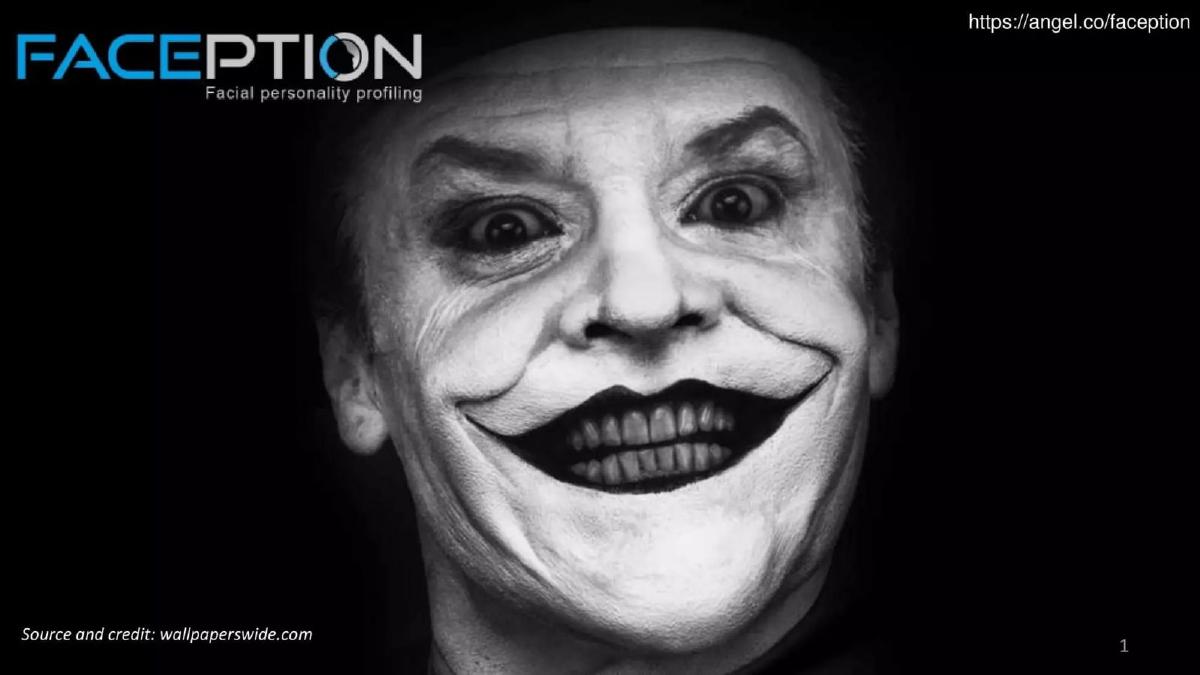
The cover slide features a high-contrast, black-and-white image of Jack Nicholson as the Joker. The branding is clear: 'FACEPTION: Facial personality profiling.' By using a famous cinematic villain, the company immediately leans into the idea that faces reveal internal character. It is a bold, if slightly dark, aesthetic choice that sets the tone for a technology focused on unmasking hidden traits.
Slides 2-4: The Security Validation
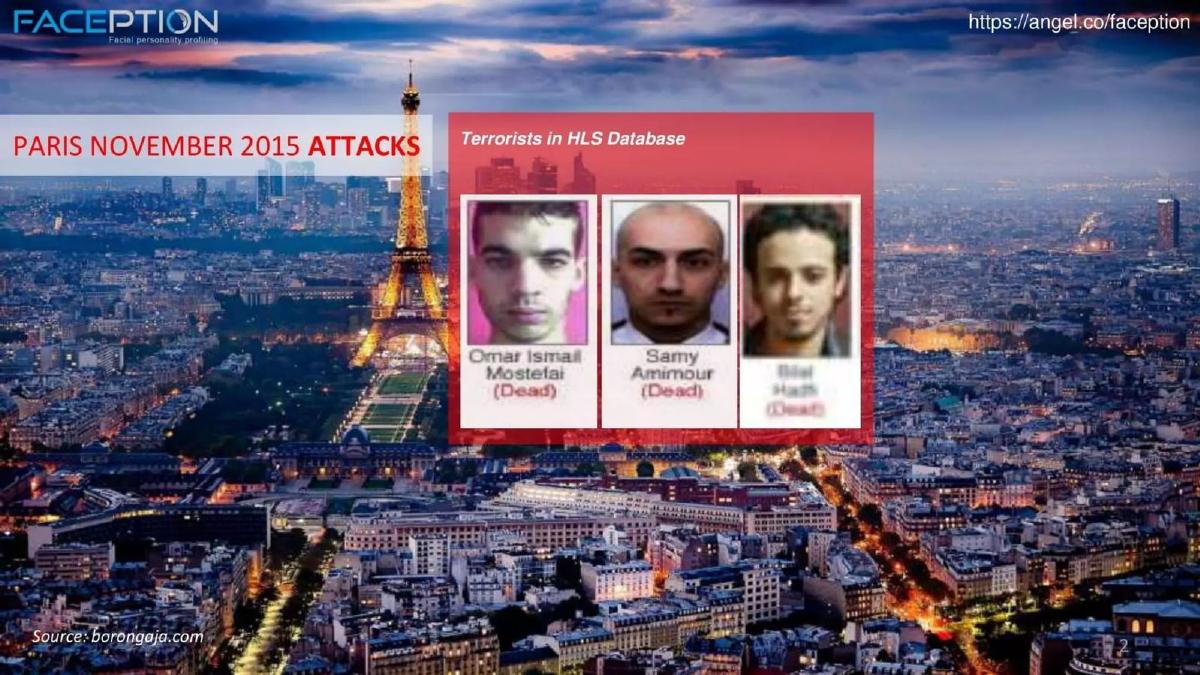
Slide 2 introduces the 'Paris November 2015 Attacks,' showing the Eiffel Tower and photos of three terrorists from an 'HLS Database' marked as 'Dead.' This immediately grounds the technology in a real-world, high-stakes problem. Slide 3 follows up with the claim that Faception 'Classified 9 of the 11 terrorists.' This is the deck's most significant 'traction' claim, suggesting that their algorithm could have identified these individuals as 'Potential Terrorists' based on their facial features alone. Slide 4 provides the commercial counterpoint to this security claim: a massive, centered text block announcing a '$750K Purchase Order.' This slide serves to prove that government or enterprise entities are already willing to pay for this capability, effectively de-risking the investment for a Series-A participant.
Slides 5-7: The Underlying Logic
Slide 5 states the core thesis: 'Our face reflects our personality.' Slide 6 attempts to provide a scientific foundation, showing a DNA double-helix diagram and a face overlaid with a geometric mesh. The implication is that facial structure is a phenotypic expression of DNA, which in turn dictates personality. Slide 7 shows the output of the software. It displays three metrics—'HIGH IQ', 'EXTROVERT', and 'BRAND PROMOTER'—on a color-coded scale from -5 to 5. For the example shown, the subject is rated as a 2.5 for IQ, a -4 for Extroversion, and a 1 for Brand Promoter. This slide is crucial because it shows the product's UI and the specific, actionable data points it generates.
Slides 8-9: Product and Field Testing
Slide 8 shows a screenshot of the Faception interface, titled 'Reveal Personality from Facial Images.' The 'Wow Me!' button suggests a demo-heavy sales process. The tabs at the top of the interface reveal the breadth of their classifiers: Researchers, Pro Poker Players, MMA Fighters, White-Collar Offenders, HLS, Terrorist, Demographic, and Features Analysis. This slide demonstrates that the technology is a platform, not just a single-use tool. Slide 9, titled 'Field Tested & Approved,' provides two specific data points: a '93% Accuracy (25/27)' in a '500 Application Test' and a claim that they 'Predicted 2 out of 3 winners' in a '500 Poker Tournament.' These small-sample-size successes are used to extrapolate the reliability of the machine learning model.
Slide 10: The Team
The team slide is exceptionally strong for a Series-A startup. It lists six key figures, each with a specific 'archetype' label: Entrepreneur, Innovator, Communicator, High IQ, Technologist, and Researcher. CEO Shai Gilboa is credited with 6 startups and 2 exits. CTO Itzik Wilf, Ph.D., brings 32 years of experience in computer vision and machine learning. Most notably, the inclusion of Dr. Michal Kosinski, a Stanford Professor and 'psychology and organizational behavior expert,' provides the necessary academic veneer to a technology that might otherwise be dismissed as physiognomy.
Slide 11: The Vision
The final slide shows a blurred crowd of people with digital bounding boxes around their heads, similar to facial recognition software. The Faception logo and an AngelList URL are the only text. This slide reinforces the 'real-time' and 'mass-scale' nature of the technology, suggesting a future where every person in a crowd can be instantly profiled for risk or potential.
What Works in the Faception Deck
Immediate Stakes: By leading with the Paris attacks, Faception bypasses the 'why does this matter?' question. They position their tool as a matter of national security, which justifies the controversial nature of the technology. Clear Commercial Traction: The $750k purchase order on slide 4 is the strongest slide in the deck. It proves market fit and willingness to pay before the investor even sees the team or the tech. Team Credibility: The founders understood that 'facial profiling' would be met with skepticism. By highlighting a CTO with three decades of experience and a Stanford professor, they address the 'is this real?' objection head-on.
What is Missing from the Faception Deck
The Business Model: There is no mention of how Faception makes money. Is it a per-scan fee? A SaaS license? A hardware-software bundle for HLS? The lack of a business model slide is a significant omission for a Series-A deck. Competitive Landscape: The deck operates as if Faception has no competitors. In 2014, facial recognition was already a crowded field. Failing to differentiate from standard biometric companies is a missed opportunity. The Ask: The most glaring omission is the lack of a funding request. The deck ends without stating how much money is being raised, the valuation, or the milestones the new capital will fund. Financial Projections: There are no charts showing projected revenue growth, burn rate, or headcount expansion.
What a Founder Should Copy
The 'Traction First' Approach: If you have a significant purchase order or a high-profile pilot, put it on its own slide early in the deck. It changes the way investors view every subsequent slide. Archetype Labeling: Labeling team members by their role (e.g., 'The Innovator', 'The Technologist') helps investors quickly categorize the talent and see where the gaps are—or aren't. Visual Proof of Concept: Slide 7, which shows the actual scores for IQ and Extroversion, is excellent. It turns an abstract concept (personality profiling) into a concrete data product. Founders should always show the 'output' of their technology as clearly as possible.
Conclusion
Faception’s deck is a high-conviction document that relies on the 'wow factor' of its technology and the pedigree of its team. While it ignores many of the standard requirements of a pitch deck—like financials and a clear ask—it succeeds in creating a compelling narrative of a breakthrough technology with immediate, high-value applications. For a company raising $625,000 in 2014, this deck was likely a conversation starter designed to lead to a live demo, where the 'Wow Me!' functionality could do the heavy lifting of the sale.
Frequently asked questions
- What is the primary value proposition of Faception?
- Faception proposes that facial features are a direct reflection of personality and DNA. According to slides 5 and 6, their technology uses computer vision to analyze these features and reveal traits in real-time. The primary use case demonstrated in the deck is security and public safety, specifically identifying 'potential terrorists' or individuals with specific behavioral tendencies before they act.
- How does the company validate its technology's accuracy?
- Validation is presented through two main lenses: historical back-testing and live field tests. Slide 3 claims the software correctly classified 9 out of 11 terrorists involved in the Paris attacks. Slide 9 cites a '500 Application Test' with 93% accuracy and a poker tournament where it successfully predicted 2 out of 3 winners based on facial profiling.
- Who are the key members of the Faception team?
- The team, detailed on slide 10, includes CEO Shai Gilboa (6 startups, 2 exits), CTO Itzik Wilf (32 years in computer vision), and Chief Profiler David Gavriel (30 years in non-verbal communication). It also features Dr. Michal Kosinski, a Stanford Professor and expert in psychology and organizational behavior, providing academic weight to the profiling claims.
- What market sectors is Faception targeting?
- While the deck leans heavily on Homeland Security (HLS) and public safety, slide 8 suggests a broader range of applications. The interface shown includes tabs for 'Pro Poker Players', 'MMA Fighters', 'White-Collar Offenders', and 'Brand Promoters'. This indicates a target market spanning security, professional sports, recruitment, and marketing analytics.
- What critical information is missing from this pitch deck?
- The deck is missing several standard Series-A components. There is no slide detailing the business model (how they charge), no competitive analysis, and no financial projections. Most notably, there is no 'Ask' slide specifying how much capital they are raising or how the funds will be allocated, which is unusual for a fundraising document.