Fakespot’s 2016 Series A deck is unconventional for its brevity, consisting of only five slides. It eschews traditional venture capital staples like market sizing (TAM/SAM/SOM), revenue charts, traction metrics, and a specific funding ask. Instead, the deck relies on a clear problem statement regarding 'fake activity and information on the Internet' and a product-centric demonstration of their Chrome Extension. By highlighting integrations with major retailers like Amazon and Walmart, and positioning itself against competitors like Honey and Wikibuy, the deck emphasizes utility over business…
Key takeaways
- The deck contains zero financial data, revenue figures, or user growth metrics across its 5 slides.
- Slide 2 presents a broad, single-sentence problem statement: 'There is a massive amount of fake activity and information on the Internet.'
- The solution is defined on Slide 3 as a Chrome Extension that provides 'real-time eCommerce fraud protection.'
- Fakespot identifies its primary utility as detecting fake reviews and recommending 'better sellers' (Slide 3).
- The company explicitly compares its 'Fakespot Guardian' feature to Honey and Wikibuy on Slide 4.
- Major marketplace integrations listed on Slide 3 include Amazon, eBay, Best Buy, Sephora, and Walmart.
- The team slide (Slide 5) highlights technical pedigree, including a lead backend engineer from Shutterstock and a Data Science Lead from NYU.
- There is no 'Ask' slide or use of funds breakdown anywhere in the presentation.
The Five-Slide Series A: Fakespot's Minimalist Pitch
Fakespot’s 2016 pitch deck is an anomaly in the world of Series A fundraising. Typically, by the time a company reaches a Series A, investors expect a deep dive into unit economics, churn rates, cohort analysis, and a clear roadmap for the next 18 to 24 months. Fakespot ignores these conventions entirely, delivering a five-slide presentation that focuses exclusively on the problem, the product, and the people. This teardown examines how a company can raise capital by focusing on a visceral consumer pain point: the erosion of trust in online shopping.
Slide 1: Title Slide
The deck opens with a clean, minimalist title slide. It features the Fakespot logo—a blue checkmark inside a circle—and the text "Investor Presentation." There are no taglines or mission statements here. The branding is professional and suggests a focus on verification and security, which aligns with the product's core function.
Slide 2: The Problem
Slide 2 is perhaps the most minimalist problem slide in the history of fundraising. It contains a single sentence: "There is a massive amount of fake activity and information on the Internet."
While most decks use this space to quantify the problem with statistics (e.g., the dollar amount lost to eCommerce fraud or the percentage of fake reviews on Amazon), Fakespot relies on the investor’s personal experience. By 2016, the 'fake review' problem was a well-known frustration for anyone using major eCommerce platforms. The simplicity of the slide suggests that the founders believe the problem is so self-evident it requires no further proof.
Slide 3: The Fakespot Solution
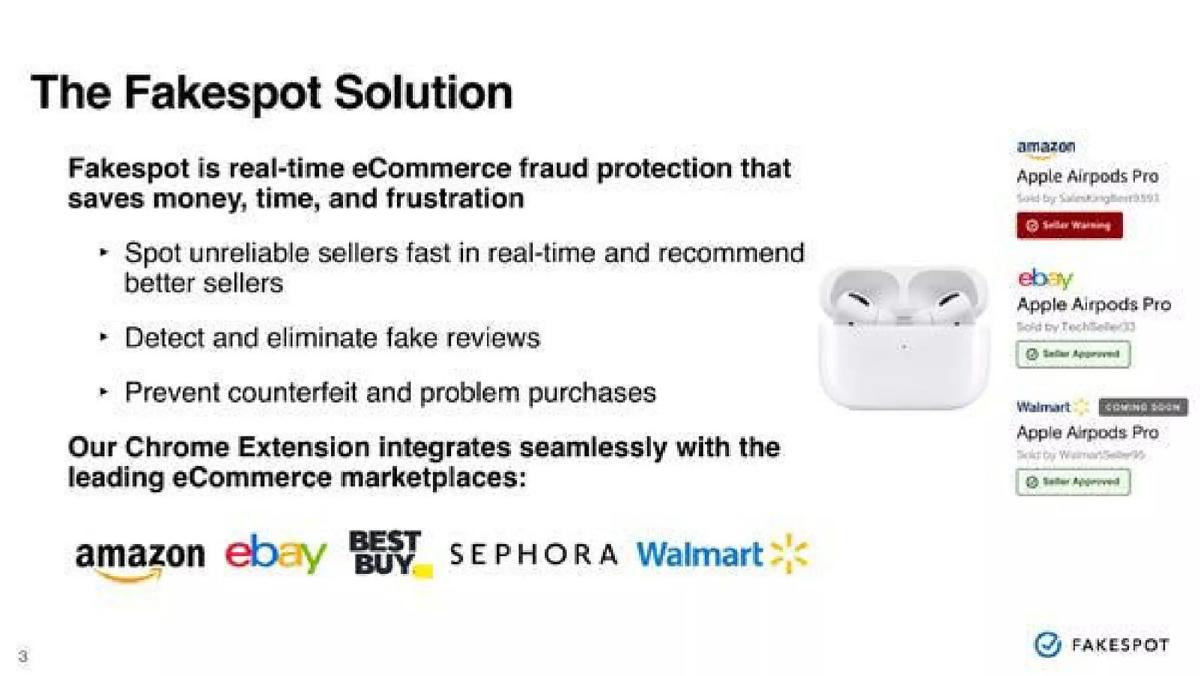
This slide introduces the product as "real-time eCommerce fraud protection that saves money, time, and frustration." It breaks the solution down into three bullet points:
Spot unreliable sellers fast in real-time and recommend better sellers · Detect and eliminate fake reviews · Prevent counterfeit and problem purchases
The slide also introduces the delivery mechanism: a Chrome Extension . This is a critical detail because it explains how Fakespot inserts itself into the user's existing workflow. Rather than requiring users to visit a separate website, the tool lives on the marketplaces they already use. The slide lists five major partners/targets: Amazon, eBay, Best Buy, Sephora, and Walmart. A visual of Apple Airpods Pro with different 'Seller Warning' and 'Seller Approved' badges provides a clear 'before and after' look at the product in action.
Slide 4: Competitive Differentiation
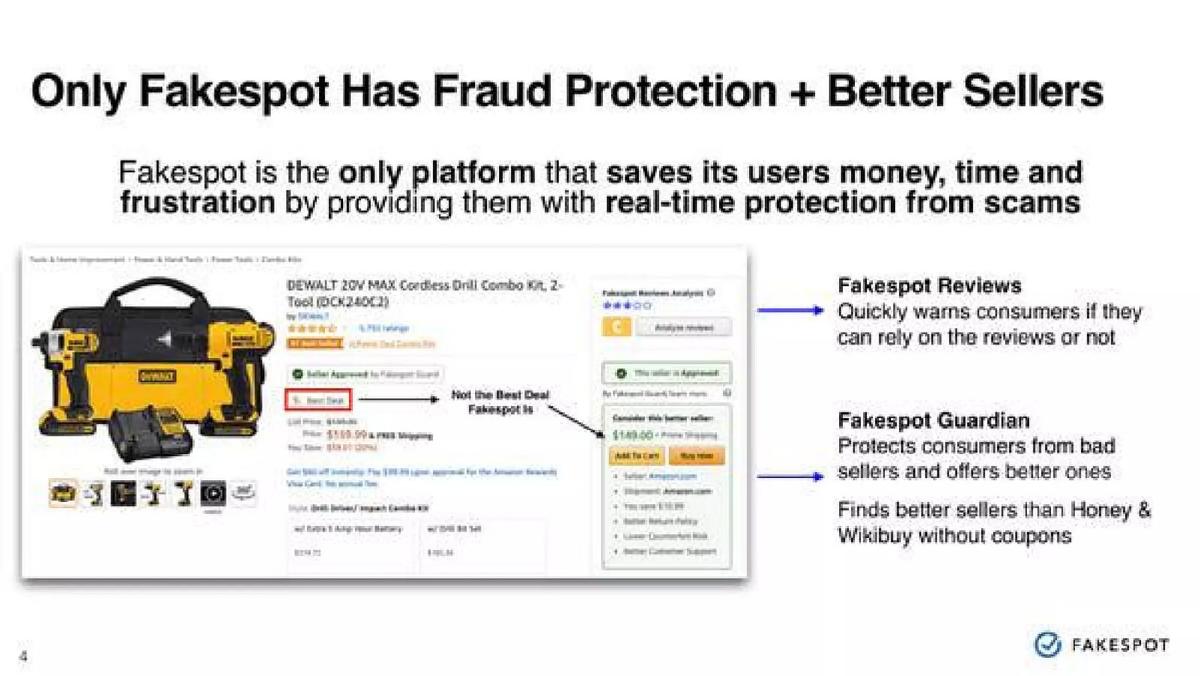
Slide 4 is the most information-dense slide in the deck. Titled "Only Fakespot Has Fraud Protection + Better Sellers," it attempts to carve out a unique market position. It uses a screenshot of a DeWalt drill listing on Amazon to show two specific features:
Fakespot Reviews: A grade (in this case, a 'C') that warns consumers if they can rely on the reviews. · Fakespot Guardian: A sidebar that suggests a 'better seller' with a lower price ($149.00 vs the original price).
The most important text on this slide is the claim that Fakespot "Finds better sellers than Honey & Wikibuy without coupons." This is a direct shot at the dominant players in the browser extension space at the time. By positioning itself as a 'Guardian' rather than just a coupon scraper, Fakespot frames its value proposition as one of safety and integrity, not just discounts.
Slide 5: The Core Team
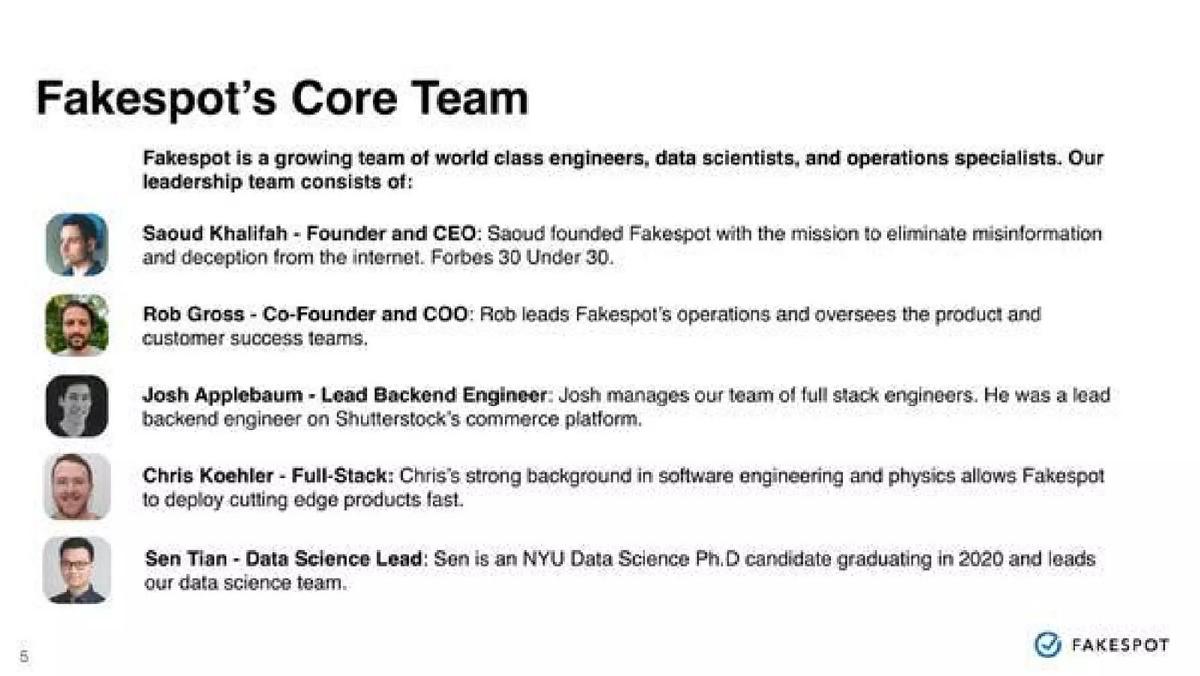
The final slide introduces the five key members of the team. In a deck lacking metrics, the team slide has to do the heavy lifting to prove the company can execute. The highlights include:
Saoud Khalifah (Founder and CEO): Noted as a Forbes 30 Under 30 honoree. · Rob Gross (Co-Founder and COO): Oversees product and customer success. · Josh Applebaum (Lead Backend Engineer): Formerly a lead backend engineer for Shutterstock’s commerce platform. · Chris Koehler (Full-Stack): Background in software engineering and physics. · Sen Tian (Data Science Lead): An NYU Data Science Ph.D. candidate graduating in 2020.
The emphasis here is clearly on technical talent. With a lead from Shutterstock and a Ph.D. candidate leading data science, the deck signals that while the interface is a simple browser extension, the 'engine' under the hood is built by high-level engineers.
What Works in This Deck
Clarity of Purpose: Within 30 seconds of opening this deck, an investor knows exactly what Fakespot does. It fixes the 'fake review' problem via a Chrome extension. In an era of over-engineered 'AI-powered' pitches, this level of clarity is refreshing.
Visual Proof: Slide 4 does an excellent job of showing, rather than telling. The screenshot of the Amazon interface with Fakespot overlays makes the product's utility immediately obvious. It answers the question, "What does the user actually see?"
Strategic Comparison: By mentioning Honey and Wikibuy, Fakespot gives investors a mental model for their growth potential. Honey was eventually acquired by PayPal for $4 billion; by placing themselves in that same category but with a 'trust' angle, Fakespot suggests a similar scale of opportunity.
What Is Missing from This Deck
Traction and Growth: This is the most glaring omission for a Series A deck. There are no mentions of total downloads, active users (MAU/WAU), or retention rates. Investors typically want to see that a product has 'legs' before committing Series A capital.
Business Model: How does Fakespot make money? The deck doesn't say. If they are redirecting users to 'better sellers,' are they taking an affiliate cut? Is there a premium version? The lack of a business model slide is a major red flag in a standard pitch process.
Market Size (TAM): There is no attempt to quantify the 'Trust Economy.' While the problem is obvious, the size of the addressable market for a browser extension that filters reviews is not defined. This leaves the investor to do the math on how big this business can actually become.
The Ask: The deck ends abruptly with the team slide. There is no slide stating how much money is being raised, what the valuation expectations are, or what the milestones for the next round will be.
What a Founder Should Copy
The 'One-Sentence Problem': If your product solves a problem that everyone has experienced, don't over-explain it. Fakespot’s Slide 2 is a masterclass in brevity. If you are solving a 'hair on fire' problem, a single sentence can be more powerful than a page of charts.
Technical Pedigree: If you lack revenue, highlight your 'talent density.' Fakespot leans heavily on the credentials of its engineering and data science leads. For a technical product, showing that you have the right people to build the 'black box' is essential.
Direct Competitive Comparison: Don't be afraid to name names. By explicitly stating how they differ from Honey, Fakespot avoids being pigeonholed as 'just another coupon app.' They define their own category: Fraud Protection.
Conclusion
The Fakespot deck is a 'teaser' deck. It is designed to secure a meeting, not to close a deal on its own. While it lacks the rigour expected of a Series A presentation, its focus on a massive, unaddressed consumer pain point and a high-quality technical team clearly resonated in the 2016 market. Founders should view this as a lesson in how to pitch a 'utility' product: focus on the user's frustration and show exactly how you alleviate it.
Frequently asked questions
- How does Fakespot generate revenue according to the deck?
- The deck does not explain Fakespot's business model or revenue streams. While it mentions saving users money and recommending better sellers, it omits details on affiliate commissions, subscription fees, or data licensing. This is a significant omission for a Series A deck, suggesting the presentation was likely a high-level teaser or a supplement to a more detailed data room.
- What is the specific 'fraud' Fakespot claims to protect against?
- According to Slide 3, the platform focuses on three specific areas: spotting unreliable sellers in real-time, detecting and eliminating fake reviews, and preventing counterfeit or 'problem' purchases. Slide 4 further clarifies that the 'Fakespot Reviews' feature warns consumers about review reliability, while 'Fakespot Guardian' redirects users to more trustworthy sellers.
- Who are Fakespot's main competitors?
- Slide 4 identifies Honey and Wikibuy as competitors. Fakespot differentiates itself by stating it finds better sellers 'without coupons,' implying that while Honey and Wikibuy focus on price via discounts, Fakespot focuses on price and safety via seller verification and review analysis.
- Is there any mention of the technology or AI used?
- Slide 5 mentions that the team includes 'data scientists' and that Sen Tian, the Data Science Lead, is an NYU Ph.D. candidate. However, the deck does not describe the underlying algorithms, proprietary datasets, or the specific machine learning techniques used to identify fake reviews.
- What stage of the company does this deck represent?
- According to the catalogue facts, this deck was used for a Series A round in 2016. Despite the Series A designation, the content is more reminiscent of a Seed-stage 'vision' deck due to the lack of historical performance data or scaling metrics.