Fantasy Life’s 14-slide deck is a masterclass in leveraging individual celebrity to anchor a multi-vertical business model. By positioning Matthew Berry as the 'face' of the enterprise (Slide 3), the company successfully bridged the gap between traditional sports media and the high-growth sectors of sports betting and fantasy gaming. The deck highlights a diversified revenue strategy, moving from content licensing on platforms like LG and Roku (Slide 9) to direct-to-consumer gaming through the acquisition of Guillotine Leagues (Slide 5). While the deck is light on specific financial projectio…
Key takeaways
- The company positions Matthew Berry's 2+ million social following and NBC presence as their primary competitive advantage (Slide 3).
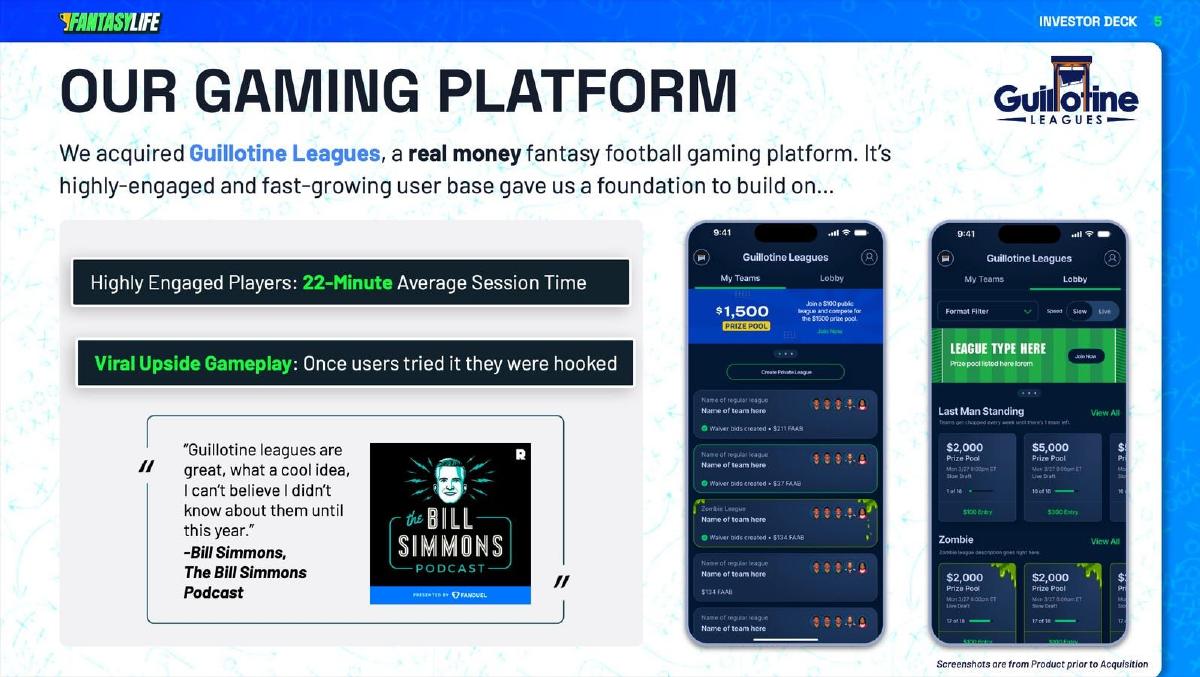
- Fantasy Life utilizes an acquisition strategy, specifically highlighting the purchase of Guillotine Leagues to provide a foundation for real-money gaming (Slide 5).
- User engagement is a core metric, with the gaming platform boasting a 22-minute average session time (Slide 5).
- The business model is multi-faceted, combining brand partnerships with Mike's Hard Lemonade and DraftKings (Slide 8) with content licensing (Slide 9).
- Content reach is significant, claiming access to over 112.8M households through partners like LG, Roku, and SiriusXM (Slide 9).
- The team grew from 11 to 23 full-time employees in 2024, led by CEO Eliot Crist (Slide 11).
- The deck omits specific financial performance data, revenue figures, or a detailed breakdown of the $7M raise amount, opting for 'details available upon inquiry' (Slide 13).
- High-profile athlete and industry backing is emphasized, citing investors like Joe Burrow and advisors like Maverick Carter (Slides 10 and 12).
The Power of the Personal Brand in Media Fundraising
Fantasy Life’s pitch deck is a clear example of 'Founder-Market Fit' taken to the extreme. The company, as reported by Business Insider, raised a $7M Series A in 2024. The deck itself is less about complex software architecture and more about the gravitational pull of Matthew Berry, arguably the most recognizable name in fantasy sports. By anchoring the entire business on Berry’s existing audience and industry relationships, the company reduces the perceived risk of customer acquisition—a major hurdle for most media and gaming startups.
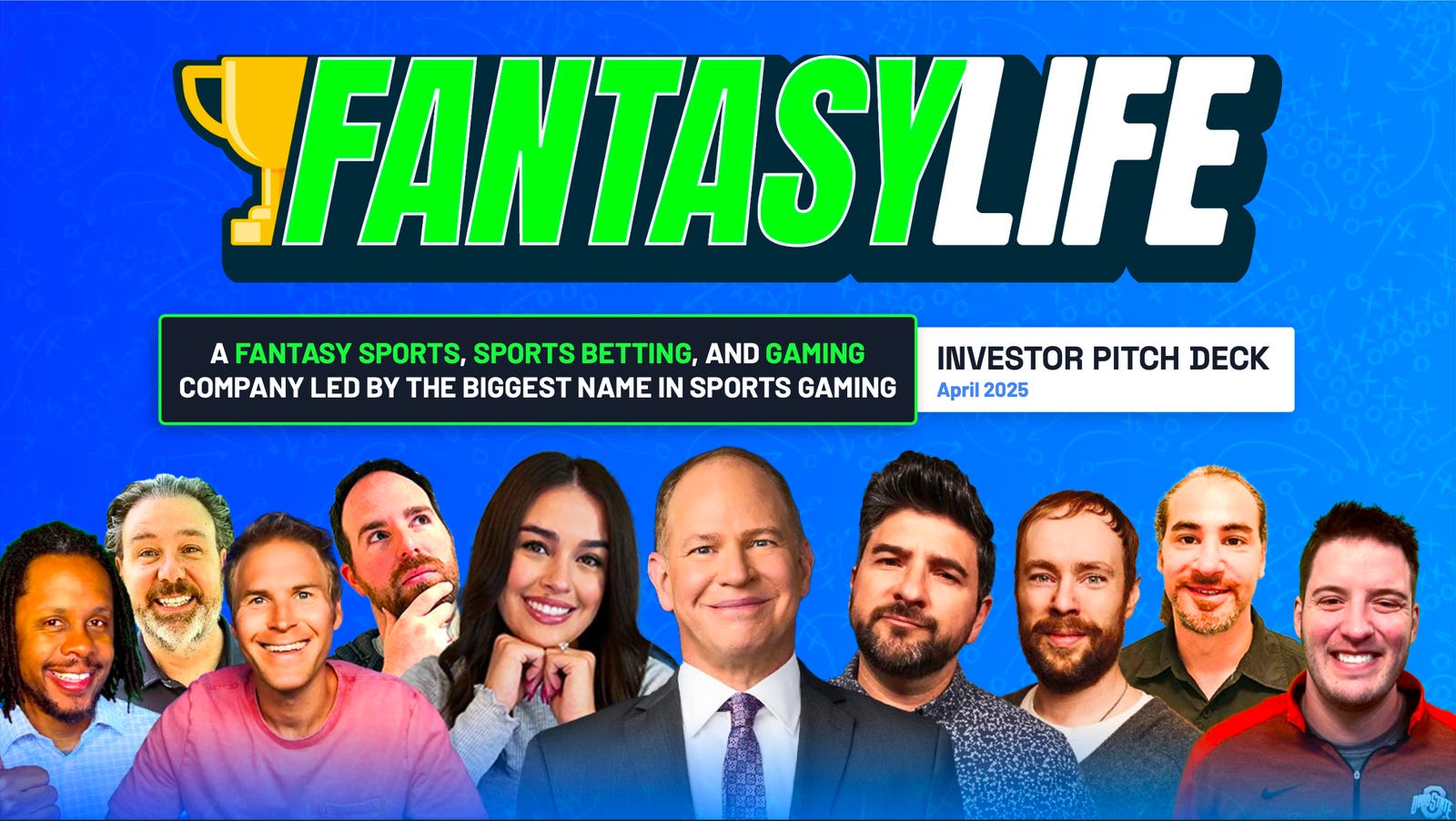
Slide 1: The Hook
The cover slide immediately establishes the company's identity: a fantasy sports, sports betting, and gaming company. It prominently features Matthew Berry and a diverse lineup of on-air talent. The sub-headline, 'Led by the biggest name in sports gaming,' sets the tone for the rest of the presentation. It is a personality-driven pitch from the first second.
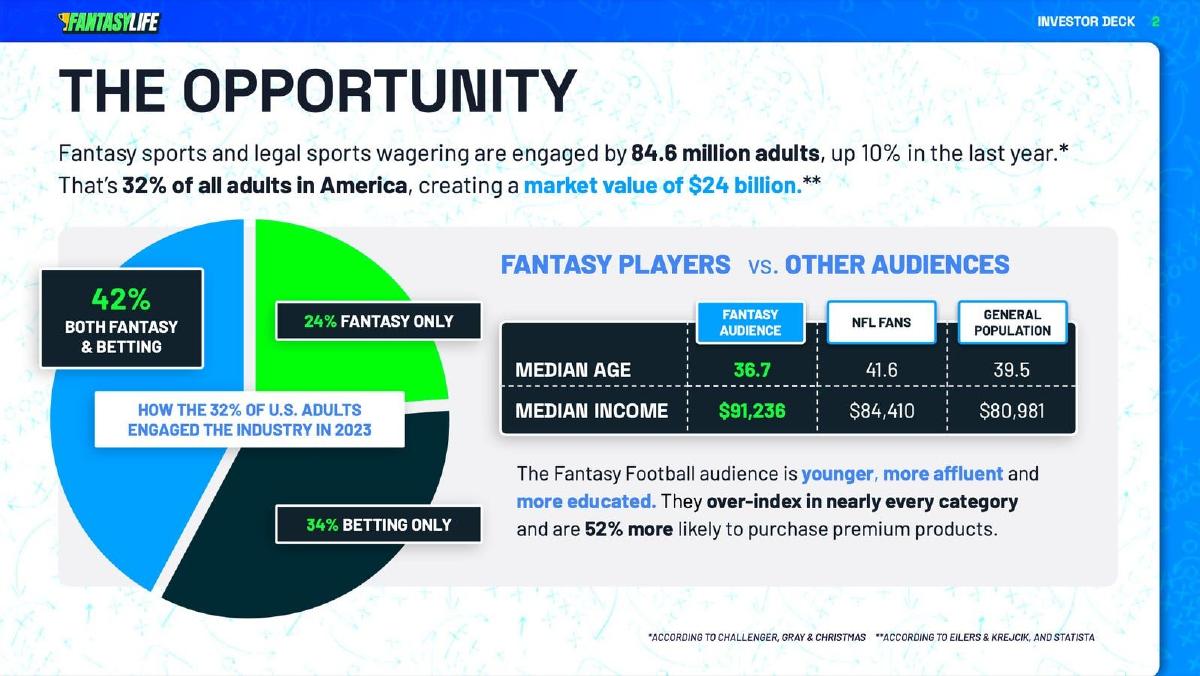
Slide 2: The Opportunity
Slide 2 addresses the market convergence of fantasy sports and sports betting. It outlines the company's intent to appeal to both demographics. While the slide text is brief, the strategic implication is clear: Fantasy Life aims to be the top-of-funnel content engine that drives users toward high-value gaming and betting actions.
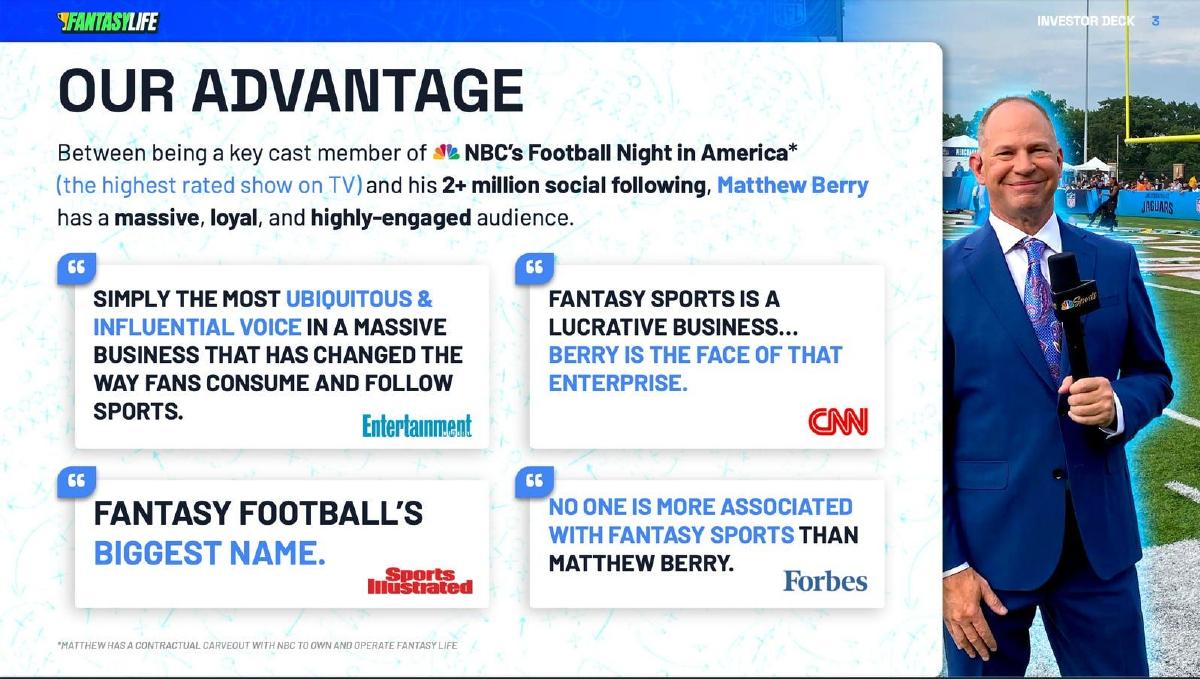
Slide 3: The Unfair Advantage
This is the 'Why Us' slide. It highlights Matthew Berry’s role on NBC’s Football Night in America and his 2+ million social media followers. The slide includes quotes from CNN, Forbes, and Sports Illustrated, all reinforcing the idea that Berry is the 'face' of the industry. Crucially, a small footnote mentions that Berry has a 'contractual carveout with NBC to own and operate Fantasy Life,' which addresses a major potential legal/conflict-of-interest concern for investors.
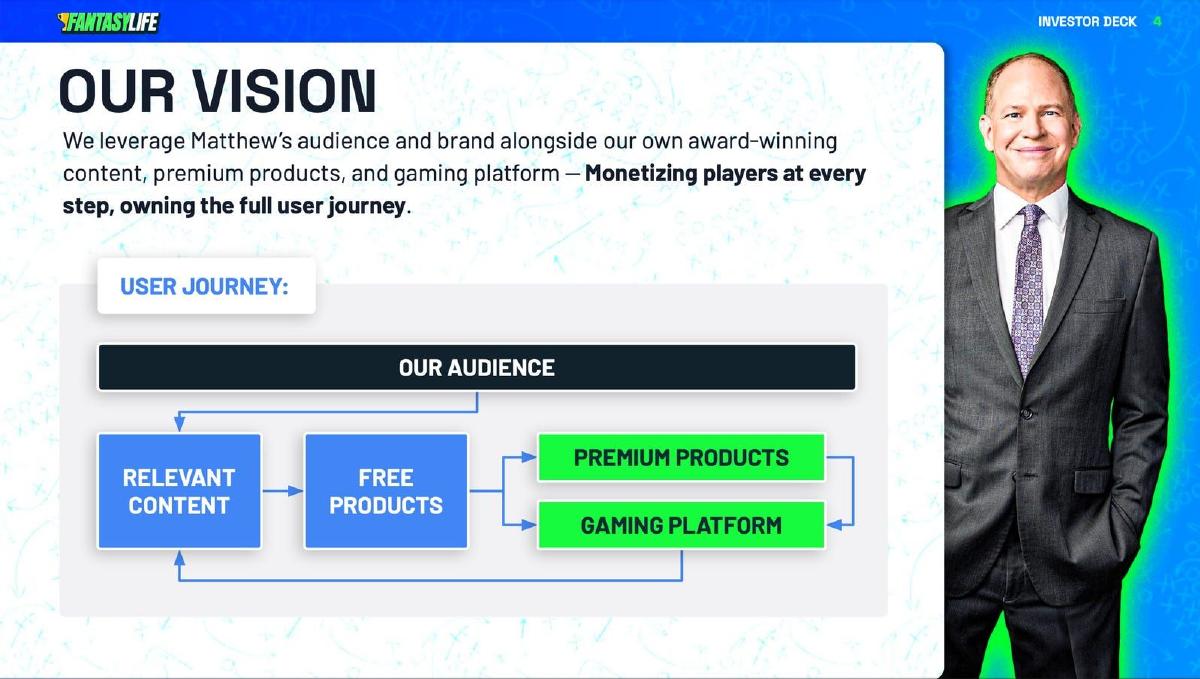
Slide 4: The Vision
The vision slide connects the dots between content and platform. The strategy is to engage the audience with 'relevant content' and 'free products' to eventually migrate them into the proprietary gaming platform. This is a classic 'Content-to-Commerce' funnel, common in modern media companies like Barstool Sports or The Athletic.
Slide 5: The Gaming Platform (Guillotine Leagues)
Slide 5 introduces the company's first major move into 'real money' gaming through the acquisition of Guillotine Leagues. The slide provides two key metrics: a 22-minute average session time and a testimonial from Bill Simmons. The inclusion of the Simmons quote serves as additional social proof from a titan in the sports media space. The screenshots show a mobile-first interface, though a disclaimer notes these are 'from Product prior to Acquisition.'
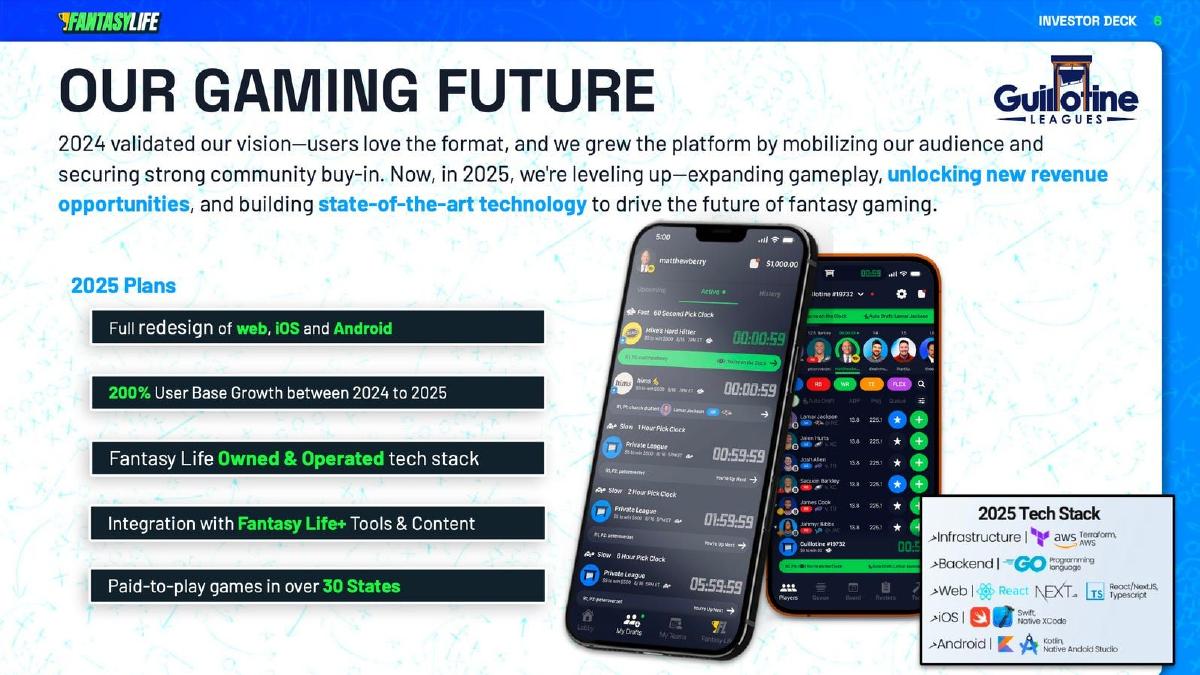
Slide 6: The Future of Gaming
This slide transitions from the current acquisition to future growth. It mentions 'unlocking new revenue opportunities' and building 'state-of-the-art tech.' While vague on technical specifics, it signals to investors that Fantasy Life does not intend to remain just a content site; they want to own the underlying technology and the user data that comes with it.
Slide 7: The Premium Product (FantasyHQ)
Slide 7 introduces 'FantasyHQ,' a premium toolset launching in June. The slide highlights a 'significant partnership with Mike’s Hard Lemonade' and mentions that the company is the 'exclusive official tools partner of NBC Sports.' This is a critical slide because it demonstrates that the company can already monetize its tools through both B2B (NBC) and B2C (subscriptions/sponsorships) channels.
Slide 8: Brand Partnerships
This slide lists high-tier sponsors including Mike’s Hard Lemonade, DraftKings, and Verizon. For a media company, the quality of its sponsors is a proxy for the quality of its audience. Having DraftKings and Verizon on the list suggests that Fantasy Life’s audience is highly coveted by major advertisers.
Slide 9: Content Licensing and Reach
Slide 9 provides the most impressive scale metrics in the deck. It claims a reach of over 112.8M households. Specific wins include being the 3rd most-watched sports FAST channel on LG in 2024 and having the #1 fantasy show on iHeartRadio with 50K+ weekly downloads. The mention that 'all major partners [are] renewing for 2025' provides a signal of stability and recurring revenue.
Slide 10: Investor Pedigree
The deck highlights a 'who's who' of sports and entertainment investors. Names like Casey Wasserman, Tony Khan (owner of AEW and son of the Jaguars owner), and NFL QB Joe Burrow are listed. This slide isn't just about the money; it's about the network these individuals provide for future partnerships and distribution.
Slide 11: The Management Team
Slide 11 introduces the operators behind the scenes. CEO Eliot Crist and CSO Dan Kaufman (formerly of The Athletic) bring the necessary startup and editorial experience to complement Berry’s celebrity. The slide also notes the company was recognized as a 'Best Place to Work in Sports' in 2024, which speaks to the internal culture and ability to attract talent.
Slide 12: Board of Advisors
The advisory board continues the theme of high-level industry access, featuring Maverick Carter (LeBron James’ business partner) and Austin Rief (co-founder of Morning Brew). This reinforces the idea that the company is being built with the guidance of people who have successfully scaled media and athlete-led businesses.
Slide 13: Use of Funds
The final substantive slide outlines the use of funds for the 'seed round' (though the publisher reports this specific raise as a $7M Series A). The capital is allocated to the Guillotine League acquisition, technology development, marketing, and the premium product. Notably, it states 'Details on raise available upon inquiry,' omitting the specific valuation or amount from the slide itself.
Slide 14: Conclusion
The deck ends with a simple thank you slide, maintaining the blue and green branding seen throughout the presentation.
What Works in This Deck
Leveraging Authority: The deck does a phenomenal job of selling Matthew Berry as a moat. In a crowded media landscape, having a 'ubiquitous and influential voice' (Slide 3) is a shortcut to trust and distribution. Investors are buying into a person who has already won in this category at ESPN and NBC.
Diversified Revenue: The deck clearly shows three distinct revenue streams: advertising/sponsorships, content licensing, and direct-to-consumer gaming/subscriptions. This reduces the risk of being overly dependent on a single market fluctuation.
Social Proof: From the Bill Simmons quote to the list of celebrity investors and blue-chip advisors, the deck is dripping with social proof. It creates a sense of inevitability—that the biggest names in sports are already on board, so the investor should be too.
What Is Missing
Unit Economics: There is no mention of Customer Acquisition Cost (CAC) or Lifetime Value (LTV). While they mention a 22-minute session time, they don't explain how that translates into specific dollar amounts per user.
Financial Projections: The deck is entirely focused on the 'what' and 'who,' but completely ignores the 'how much.' There are no charts showing historical revenue growth or projected earnings for the next 3-5 years.
Competitive Landscape: The deck operates as if Fantasy Life exists in a vacuum. There is no mention of competitors like Yahoo Fantasy, ESPN, or newer entrants like Sleeper. A slide explaining why users would choose Fantasy Life over these established giants would have strengthened the case for the 'Premium Product.'
What a Founder Should Copy
The 'Face' Strategy: If your startup has a high-profile founder or advisor, make them the centerpiece. Use quotes from reputable third-party sources (like the CNN and Forbes quotes on Slide 3) to validate their expertise rather than just stating it yourself.
Clear Verticalization: Group your business activities into clear buckets. Fantasy Life uses 'Content,' 'Gaming,' and 'Premium Product.' This helps investors understand a complex business model by breaking it down into digestible parts.
Focus on Reach: If you are in the media space, emphasize your distribution network. Slide 9 is the strongest slide for a growth investor because it shows the massive scale (112.8M households) that the company can tap into without having to build its own hardware or cable network.
Frequently asked questions
- How does Fantasy Life monetize its content?
- Monetization occurs through three primary channels: brand partnerships with companies like Verizon and DraftKings (Slide 8), licensing content to platforms such as LG and SiriusXM (Slide 9), and a premium subscription product offering personalized tools and advice (Slide 7).
- What is the significance of the Guillotine Leagues acquisition?
- Guillotine Leagues serves as the company's entry into real-money gaming. It provides an established user base and a 'viral' gameplay format where one team is eliminated weekly, which Fantasy Life intends to use as a foundation for future proprietary technology (Slide 5).
- Who are the key people leading Fantasy Life?
- While Matthew Berry is the face of the brand, the day-to-day operations are led by CEO Eliot Crist (formerly of FTN) and Chief Strategy Officer Dan Kaufman, who previously served as Editorial Director at The Athletic (Slide 11).
- What is the company's current reach?
- Through licensing partnerships with LG, Roku, Fubo, and SiriusXM, Fantasy Life claims a combined reach of over 112.8 million households. Their LG channel is cited as the 3rd most-watched sports FAST channel in 2024 (Slide 9).
- What was the purpose of the funding round described in the deck?
- According to Slide 13, the funds were earmarked for the Guillotine League acquisition, developing proprietary 'state-of-the-art' technology, paid marketing efforts, and the development of their premium consumer product.