Farm Cloud addresses the fragmentation of livestock management systems by providing a 'FarmConnector' gateway that bridges legacy on-farm controllers with a centralized cloud platform. The deck, dated March 2017, highlights a significant market opportunity in the pig and poultry sectors, estimating a combined potential of 456 million Euros per year based on a 500 Euro ARPU. The company seeks a 750,000 Euro seed investment to scale their integration to 30 models and 18 countries. While the deck provides a granular look at their cap table and public funding incentives, it lacks specific unit ec…
Key takeaways
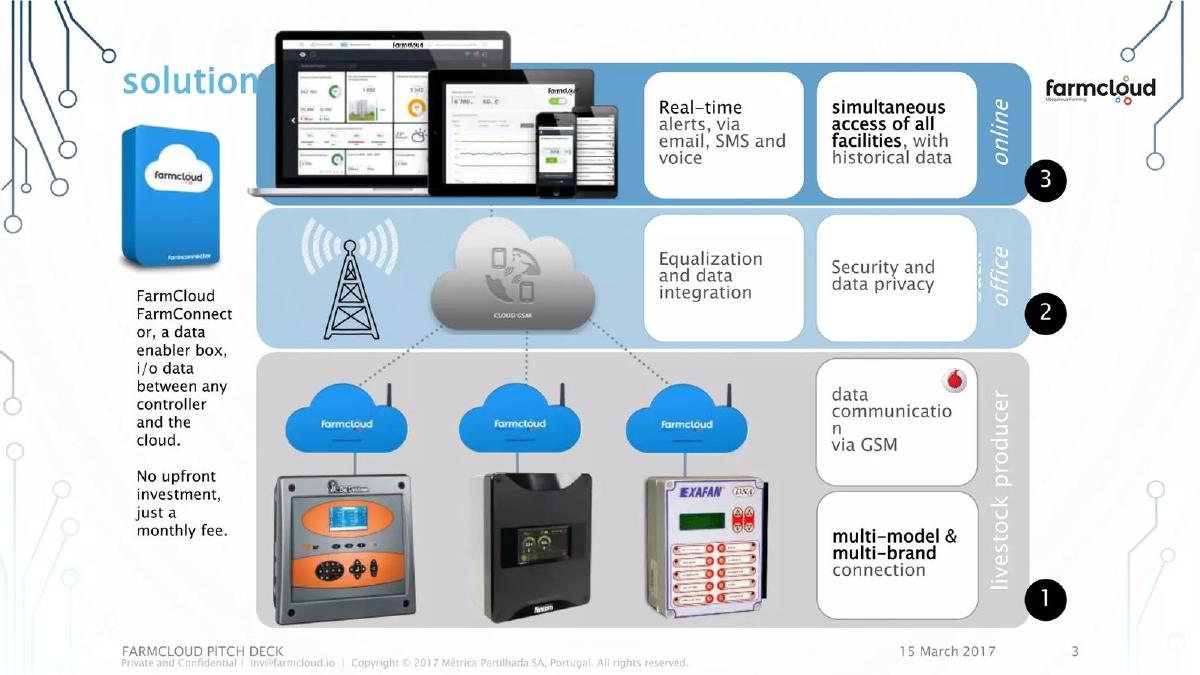
- The FarmConnector acts as a data enabler box between legacy livestock controllers and the cloud, requiring no upfront investment from farmers (Slide 3).
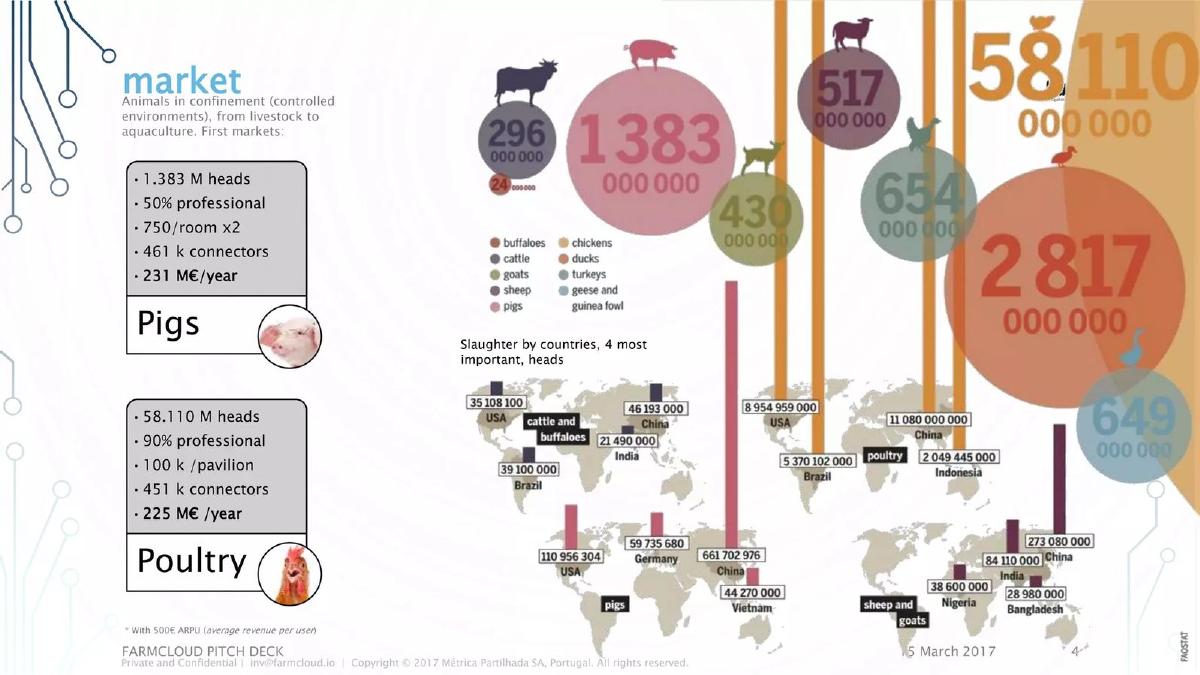
- Farm Cloud identifies a 231 million Euro annual market for pigs and a 225 million Euro market for poultry based on professional farm headcounts (Slide 4).
- The company secured 492,500 Euros in public financing from Portugal 2020, consisting of a loan and grant (Slide 8).
- The seed round ask is 750,000 Euros, with 54% of proceeds allocated to Marketing & Sales and 33% to product development (Slide 8).
- Traction includes a first manufacturer partner and commercial client in Brazil, alongside an official launch in Germany (Slide 7).
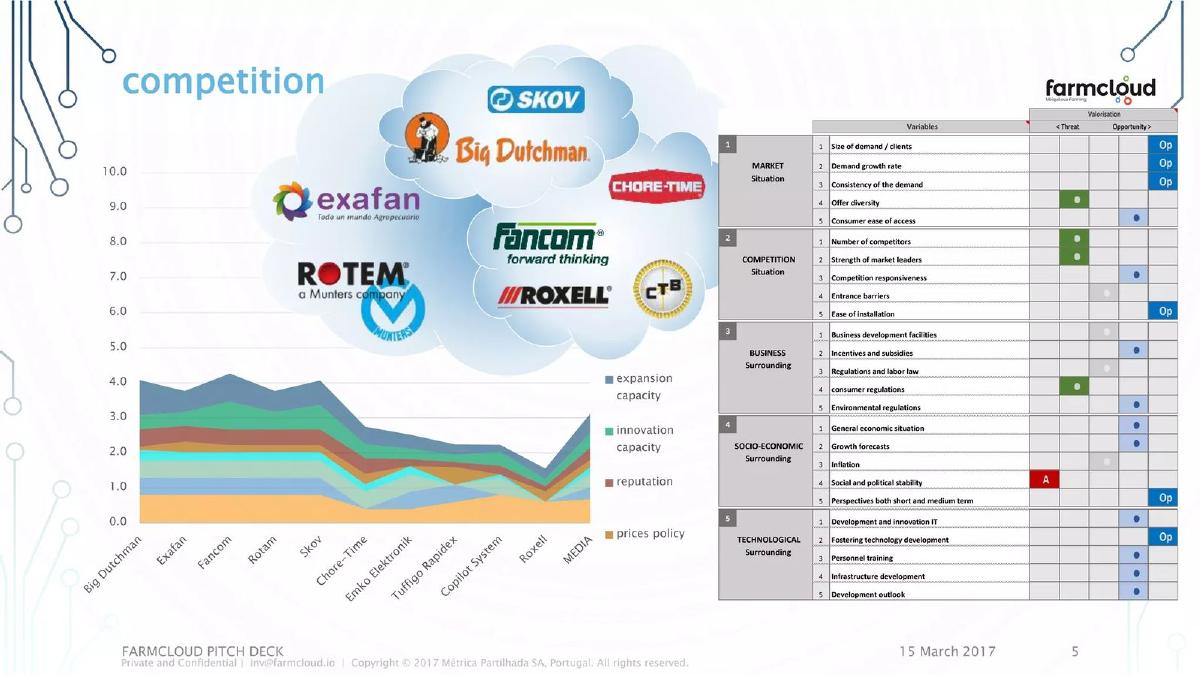
- The competitive landscape is dominated by incumbents like Big Dutchman and SKOV, which Farm Cloud positions as 'closed systems' (Slide 2 and 5).
- The cap table shows four co-founders with equity stakes ranging from 12.5% to 28.1% as of April 2016 (Slide 8).
- The product roadmap targets the integration of 30 different controller models over an 18-month period (Slide 8).
Farm Cloud Pitch Deck Analysis
Farm Cloud presents a classic 'middleware' solution for the agricultural sector. By focusing on the livestock industry—specifically pigs and poultry—they aim to solve the problem of data silos created by proprietary hardware manufacturers. The deck, dated March 15, 2017, serves as a bridge between their early public funding success and a professional seed round.
Slide 1: Title and Vision
The cover slide introduces the brand 'Farm Cloud' with the tagline 'Ubiquitous Farming.' It immediately establishes the value proposition: 'enable livestock farmers to control with only one monitor.' A circular graphic on the right side of the slide outlines a lifecycle from 'Concept Development' to 'Execution & Scaling,' suggesting a structured approach to product management. The slide also notes the inclusion of third-party data from sources like the FAO, BCG, and McKinsey, signaling a research-backed approach.
Slide 2: The Problem
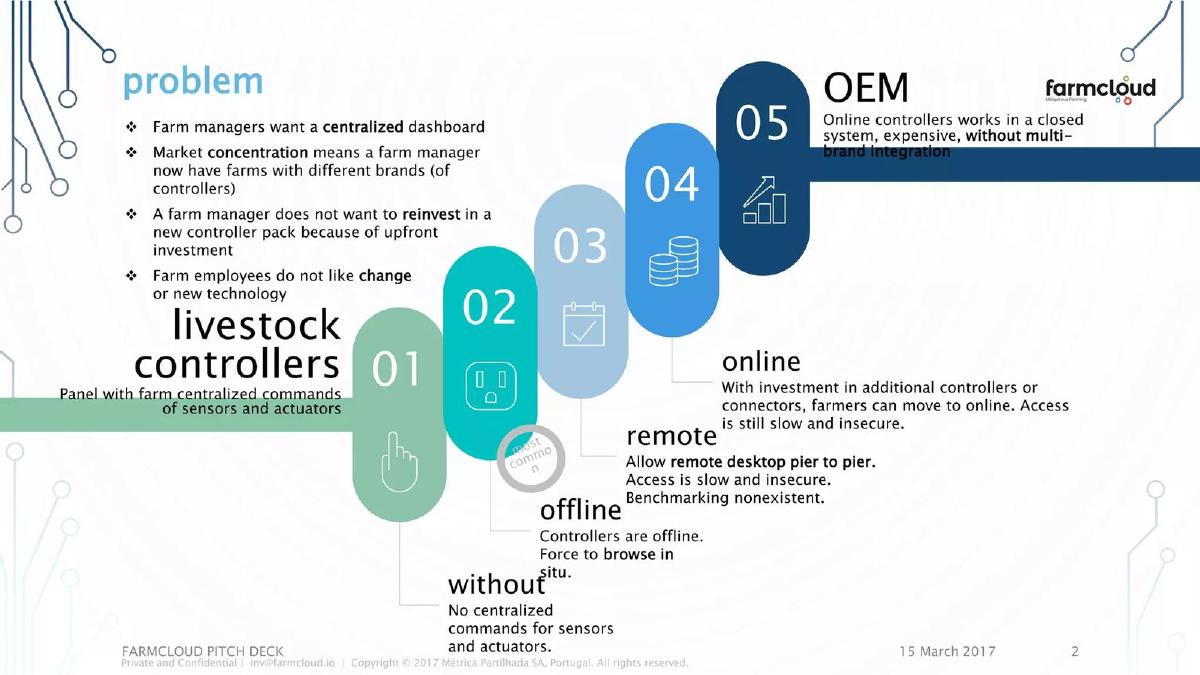
Farm Cloud identifies five key pain points in the current livestock management landscape. First, managers want a centralized dashboard. Second, market concentration has led to farms using multiple, incompatible brands of controllers. Third, high upfront costs prevent farmers from reinvesting in new, unified systems. Fourth, employees are resistant to complex new technologies. Finally, the slide categorizes existing solutions as 'offline,' 'remote' (but slow/insecure), 'online' (but expensive), or 'OEM' (closed systems without multi-brand integration). This slide effectively sets up the 'FarmConnector' as the necessary bridge.
Slide 3: The Solution
The solution is presented as a three-tier architecture. At the 'Livestock Producer' level (Tier 1), the FarmConnector hardware integrates with various brands like Big Dutchman, Fancom, and Exafan via GSM. The 'Office' level (Tier 2) handles data integration and privacy. The 'Online' level (Tier 3) provides the end-user interface with real-time alerts (SMS, email, voice) and historical data. Crucially, the slide notes a 'no upfront investment, just a monthly fee' business model, which lowers the barrier to entry for farmers.
Slide 4: Market Opportunity
This slide is data-heavy, utilizing FAOSTAT figures to quantify the livestock market. It focuses on 'Animals in confinement.' For the pig sector, it cites 1.383 billion heads and a 231 million Euro annual market. For poultry, it cites 58.110 billion heads and a 225 million Euro annual market. These calculations are based on an assumed 500 Euro ARPU. A global map highlights slaughter volumes in key regions like China, Brazil, and the USA, providing a sense of the total addressable market (TAM).
Slide 5: Competition
The competitive analysis uses two distinct formats. On the left, a bubble chart and a stacked area graph compare incumbents like Big Dutchman, Exafan, and Roxell across metrics like expansion capacity, innovation, reputation, and price policy. On the right, a 'Valorisation' table rates these variables as either threats or opportunities. Farm Cloud identifies 'Ease of installation' and 'Fostering technology development' as their primary opportunities against the established 'threats' of market leaders.
Slide 6: Team and Organization
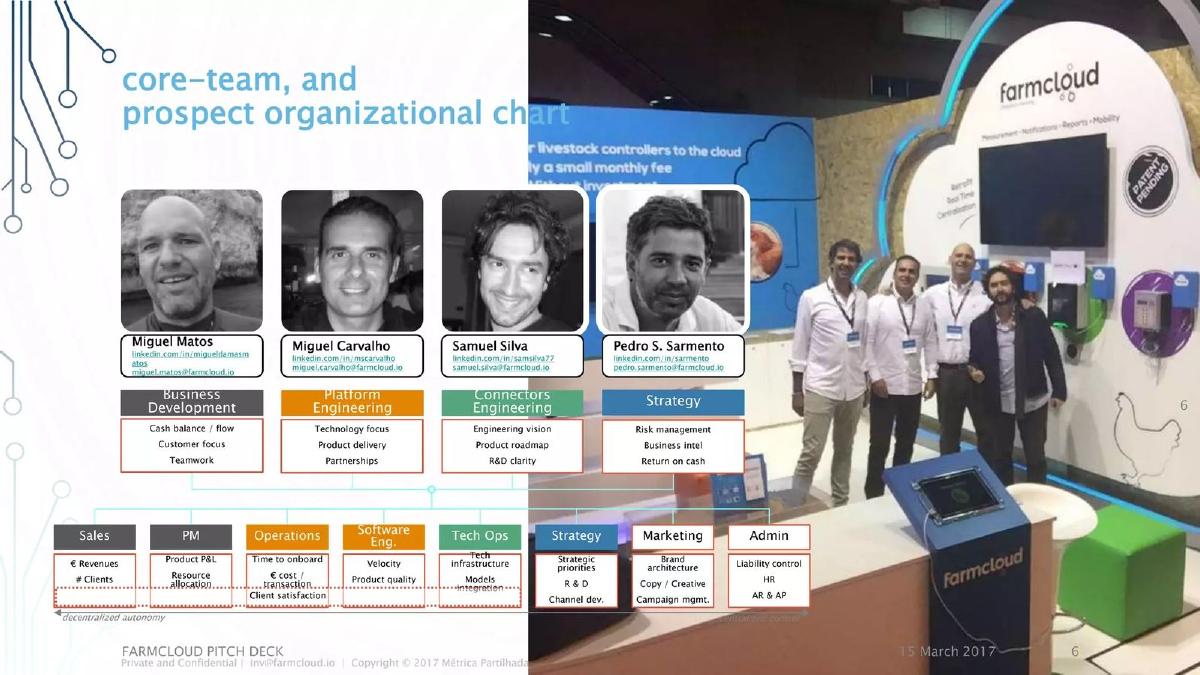
The core team consists of four individuals: Miguel Matos (Business Development), Miguel Carvalho (Platform Engineering), Samuel Silva (Connectors Engineering), and Pedro S. Sarmento (Strategy). The slide includes their LinkedIn handles and professional photos. Below the leadership, a 'prospect organizational chart' outlines the company's functional departments, including Sales, PM, Operations, Software Engineering, Tech Ops, Strategy, Marketing, and Admin. A photo of the team at a trade show booth adds a layer of real-world presence.
Slide 7: Ongoing Traction
Traction is displayed on a 3D timeline. Key milestones include incorporation in April 2016, product development, and securing EU funds. More recent achievements include a prototype, beta testers in Brazil and Spain, and an official launch in Germany. The slide highlights a '1st manufacturer as key partner' and '1st commercial client,' both in Brazil. Logos for industry events like EuroTier and Figan are included to show active market engagement.
Slide 8: Key Fund-raising Figures
Current Cap Table: Shows a 2016 investment of 75,000 Euros on a 25,000 Euro pre-money valuation, totaling a 100,000 Euro post-money valuation. · Incentives: Details 492,500 Euros in financing from Portugal 2020 (a mix of loan and grant). · Seed Capital Ask: 750,000 Euros. · Use of Proceeds: 54% for Marketing & Sales, 33% for Product Development (specifically model integration), and 13% for other needs. · Milestones: Integration of 30 models, expansion to 18 countries, and 3,000 units of production within 18 months. · Exit Strategy: Mentions a 6 million Euro Series A as the next step.
Slide 9: Contact and Closing
The final slide provides contact information for 'Investor Relations' via a dedicated email and links to AngelList and Crunchbase. It also lists their Lisbon office address and social media presence. A small diagram reiterates the FarmConnector's capabilities, such as energy failure alarms and inputs for feed and water measurement.
What Farm Cloud Does Well
The deck is exceptionally transparent regarding its cap table and public funding. Most early-stage decks hide these details, but Farm Cloud uses them to demonstrate fiscal responsibility and existing validation from government bodies. The 'Problem' slide is also well-structured, moving from high-level management desires to specific technical limitations of current OEM systems. By positioning themselves as a 'data enabler' rather than a hardware competitor, they avoid the 'rip and replace' objection that plagues many AgTech startups.
What is Missing from the Deck
The most significant omission is a detailed breakdown of unit economics. While they mention a 500 Euro ARPU and a monthly fee model, they do not disclose the cost to manufacture the FarmConnector or the Customer Acquisition Cost (CAC). Furthermore, while they list '30 models integration' as a milestone, they don't explain the technical difficulty or time required for each new integration. The 'Competition' slide is also somewhat subjective; the 'Valorisation' table uses dots to indicate threats and opportunities without providing the underlying data that justifies those ratings.
Founder's Guide: What to Copy
Founders should look at Slide 8 as a template for 'Key Figures.' It manages to pack a cap table, funding history, use of proceeds, and future milestones into a single, readable view. This gives investors an immediate sense of the company's financial health and trajectory. Additionally, the way Farm Cloud categorized their competition by 'closed' vs 'open' systems (Slide 2) is a powerful way to frame a startup as a market disruptor without needing to claim their technology is 'better' in every single category—it just needs to be more compatible.
Frequently asked questions
- What is the core technology behind Farm Cloud?
- Farm Cloud utilizes a hardware gateway called the 'FarmConnector.' This device connects to existing on-farm livestock controllers (sensors and actuators) and transmits data via GSM to a cloud-based dashboard. This allows farmers to monitor multiple brands of equipment through a single interface without replacing their existing infrastructure.
- How does Farm Cloud plan to generate revenue?
- According to Slide 3, the company operates on a 'no upfront investment, just a monthly fee' model. Slide 4 further clarifies their financial assumptions by citing a 500 Euro ARPU (Average Revenue Per User) across their target pig and poultry markets.
- What is the current funding status of the company in this deck?
- As of March 2017, the company had a post-money valuation of 100,000 Euros from an initial 75,000 Euro investment in 2016. They also secured nearly 500,000 Euros in non-dilutive/public funding from the Portugal 2020 program and were seeking a 750,000 Euro seed round.
- Which geographic markets is Farm Cloud targeting?
- The deck shows a global ambition with specific traction in Brazil (first partner and client) and Germany (official launch). Slide 4 maps out slaughter statistics for cattle, pigs, and poultry across the USA, China, Brazil, India, and various European and Southeast Asian nations.
- Who are the competitors mentioned in the deck?
- Farm Cloud lists several major agricultural equipment manufacturers as competitors, including Big Dutchman, SKOV, Fancom, Roxell, and Rotem. They argue these incumbents operate 'closed systems' that lack multi-brand integration, which is the primary gap Farm Cloud intends to fill.