Farm Bazaar presents a logistics-heavy solution to the fragmented Indian agricultural supply chain, specifically targeting the Bangalore market. The deck relies on primary survey data from 65 retailers to justify a shift from traditional morning market visits to a technology-enabled direct procurement model. By removing middlemen, the company claims to capture significant margins—30% on vegetables and 60% on fruits and exotics. The business flow transitions from farmers through collection centers and warehouses to 'FarmBazaar-Hubs' before reaching the end customer. While the deck outlines a c…
Key takeaways
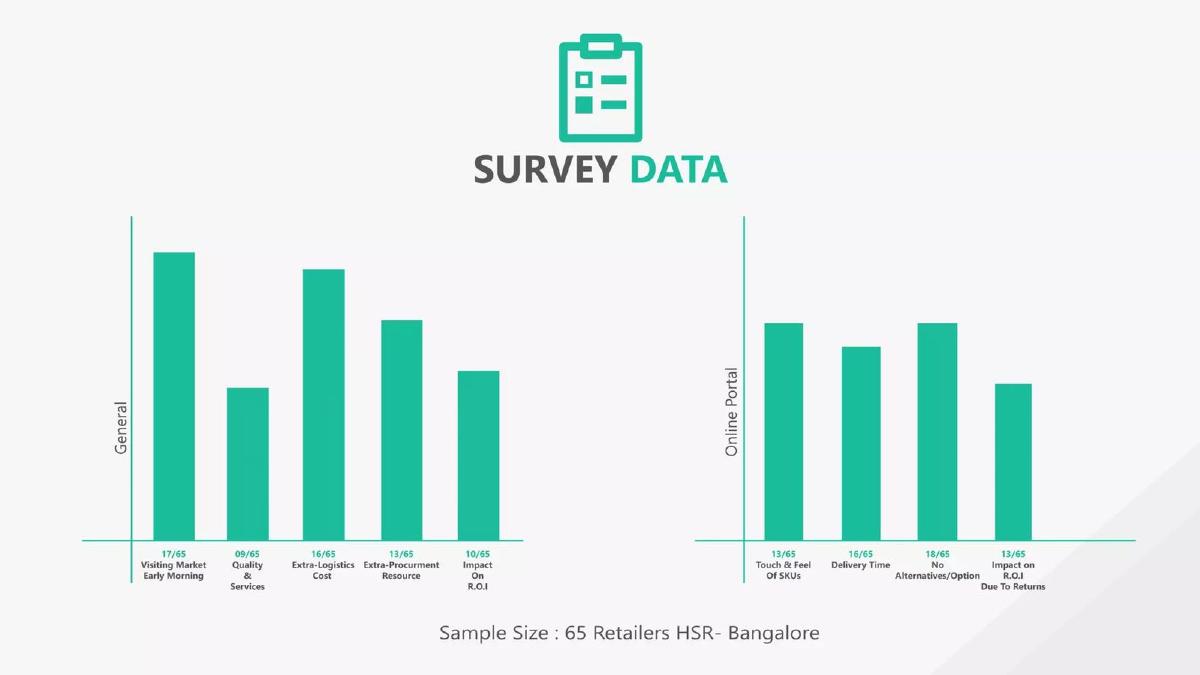
- The company bases its problem statement on a survey of 65 retailers in the HSR layout of Bangalore (Slide 2).
- The revenue model relies on a fulfillment fee charged to retailers while removing multiple layers of middlemen (Slide 4).
- Farm Bazaar claims high gross margins of 30% for vegetables and 60% for fruits and exotics (Slide 4).
- The supply chain involves five distinct stages: Farmers, Collection Centers, Warehouses, FarmBazaar-Hubs, and Customers (Slide 5).
- The mobile application interface includes features for order tracking and historical order management (Slide 6).
- Tonnage projections show a steep growth curve, rising from 15 tonnes in Q1 2019 to 189 tonnes by Q3 2020 (Slide 7).
- The operational roadmap targets a scale-up to 18 hubs by Q2 2020 (Slide 8).
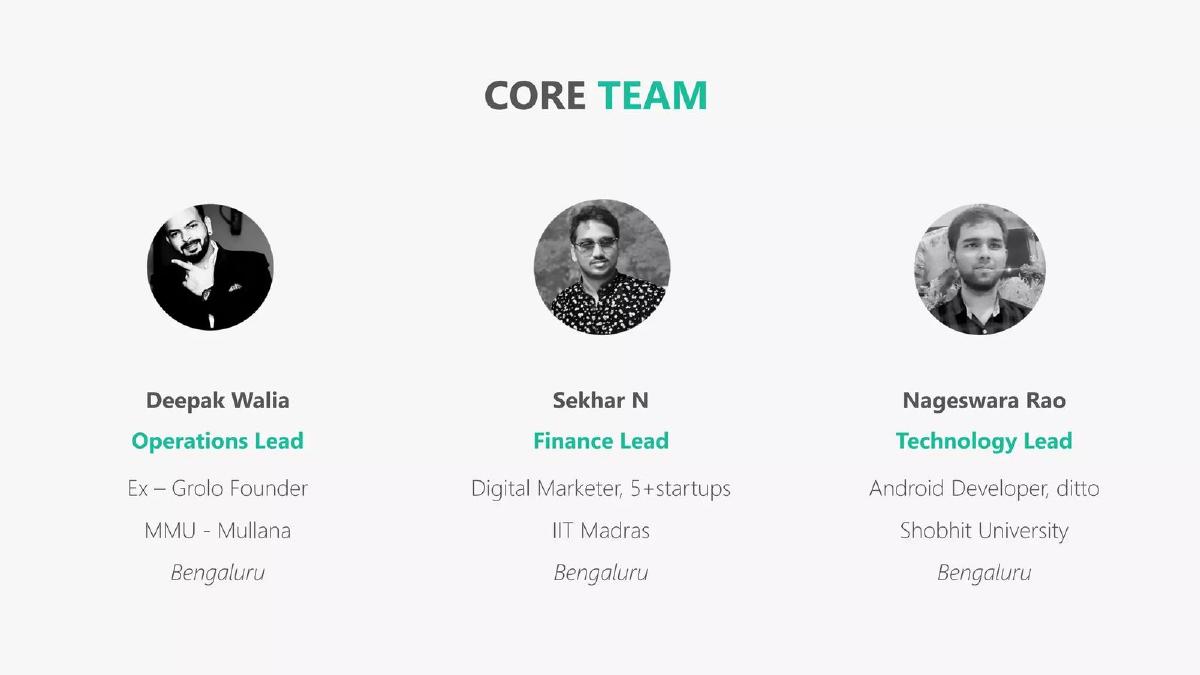
- The deck omits a team slide, financial burn rates, and a specific investment request.
Farm Bazaar: Modernizing the Agri-Supply Chain
Farm Bazaar is a B2B agricultural technology startup focused on the Indian market, specifically targeting the inefficiencies between the farm gate and the urban retailer. The deck focuses heavily on operational flow and primary market research conducted in Bangalore. While the visual presentation is clean and consistent, the deck functions more as an operational overview than a complete investment case, as it lacks several fundamental slides required for a professional fundraise.
Slide 1: Title Slide
The deck opens with a minimalist title slide featuring the Farm Bazaar logo—a stylized leaf/drop icon in shades of green and teal. The subtitle is simply "PITCH-DECK." There is no tagline or mission statement present on the cover, which is a missed opportunity to immediately define the company's value proposition (e.g., "Direct-from-farm logistics for urban retailers").
Slide 2: Survey Data
This slide provides the empirical foundation for the company's existence. It presents data from a sample size of 65 Retailers in HSR-Bangalore . The data is split into two categories: "General" (traditional market issues) and "Online Portal" (shortcomings of existing digital competitors).
Key pain points identified in the traditional market include:
17/65: Visiting Market Early Morning · 16/65: Extra-Logistics Cost · 13/65: Extra-Procurement Resource
Regarding existing online portals, retailers cited 18/65 for "No Alternatives/Option" and 16/65 for "Delivery Time." This slide is effective because it shows the founders have done local ground research, though the sample size is relatively small for a city the size of Bangalore.
Slide 3: The Solution
The solution slide is brief, stating that current online portals fail to cater to traditional retailers. Farm Bazaar proposes an "ADVANCED OPERATIONAL MODEL" that uses "TECHNOLOGY & ANALYTICS" to serve businesses in their traditional way. This phrasing suggests the company aims to fit into the retailer's existing workflow rather than forcing a radical behavioral change, which is a common hurdle in the Indian retail sector.
Slide 4: Revenue Model
Slide 4 outlines how the company makes money. The core mechanism is a "FULFILMENT FEE" charged to each retailer. The slide emphasizes the removal of "multiple layers of middle men," which allows both farmers and retailers to get better pricing. The most striking figures on this slide are the margins the company claims to capture:
These are high margins for a logistics-heavy business, and an investor would likely require a detailed breakdown of how these are calculated (gross vs. net) and whether they account for wastage, which is typically high in perishable supply chains.
Slide 5: Business Flow
This slide visualizes the supply chain. It is a linear five-step process:
Farmers: The point of origin. · Collection Center: Where produce is first gathered. · Warehouse: Centralized storage and sorting. · FarmBazaar-Hub: Localized distribution points. · Customers: The end retail point.
This confirms that Farm Bazaar is a full-stack logistics player, owning or managing the touchpoints of the produce throughout the journey. This model is capital-intensive compared to pure marketplace models but offers better control over quality and wastage.
Slide 6: App Flow
The deck includes three screenshots of the Farm Bazaar mobile application. The interface appears clean and functional. The first screen shows a product list with prices (e.g., Orange Rs23/1kg, Broccoli Rs18/1kg ). The second screen shows an order management system with order IDs (e.g., ID: F628569 ) and status updates. The third screen is a simple "Order Success" confirmation. This slide proves the technology exists, though it doesn't highlight any proprietary "analytics" mentioned in the solution slide.
Slide 7: Projections (In Tonnes)
Rather than projecting revenue in currency, Farm Bazaar projects volume in tonnes. This is a common metric in agri-logistics to demonstrate scale and capacity utilization. The growth trajectory is as follows:
2019 Q1: 15.0 Tonnes · 2019 Q2: 33.0 Tonnes · 2019 Q3: 36.0 Tonnes · 2019 Q4: 48.0 Tonnes · 2020 Q1: 82.5 Tonnes · 2020 Q2: 135.0 Tonnes · 2020 Q3: 189.0 Tonnes
The projection shows a significant acceleration starting in 2020, implying that the model reaches a tipping point once a certain number of hubs are operational.
Slide 8: Roadmap
The final slide provided is a chronological roadmap for hub expansion. It correlates directly with the tonnage projections on the previous slide:
Q1 2019: Pilot – 2 Hubs · Q2 2019: Pilot – 3 Hubs · Q3 2019: Optimizing First 3 Hubs · Q4 2019: Launching 6 Hubs · Q1 2020: Launching 12 Hubs · Q2 2020: Launching 18 Hubs
This roadmap is clear and measurable, giving investors a specific set of milestones to track against the company's performance.
What Works and What is Missing
What Works: The deck is highly focused on the operational reality of the business. By citing specific survey data from a known neighborhood (HSR, Bangalore), the founders demonstrate a "boots on the ground" approach. The business flow and roadmap are logical and easy to follow, providing a clear picture of how the company intends to scale physically.
What is Missing: The deck is incomplete by modern venture capital standards. The most glaring omission is the Team Slide . In early-stage agri-tech, the ability to manage complex logistics and rural relationships is paramount; without knowing who is running the company, an investor cannot assess execution risk. Also missing is a Competitive Landscape slide. The Indian agri-tech space is crowded with well-funded players like Ninjacart, DeHaat, and Crofarm. Farm Bazaar needs to explain why their "Hub" model is superior to these incumbents. Finally, there is no Financial Ask . The deck describes a capital-intensive expansion (18 hubs) but does not state how much capital is required to reach that goal or how the funds will be allocated between technology, infrastructure, and marketing.
Founder Takeaways
Focus on Unit Economics: If you are claiming 30-60% margins in agriculture, you must back that up with a slide on unit economics. Investors will be skeptical of these figures given the high rates of spoilage and transportation costs inherent in the industry. Show the "take rate" after all operational costs are considered.
Define the 'Hub': The roadmap relies entirely on the successful launch of "Hubs." A founder should include a slide detailing what a hub actually is—is it a rented storefront, a refrigerated container, or a dark store? What is the CAPEX required to launch one, and how long does it take to reach break-even?
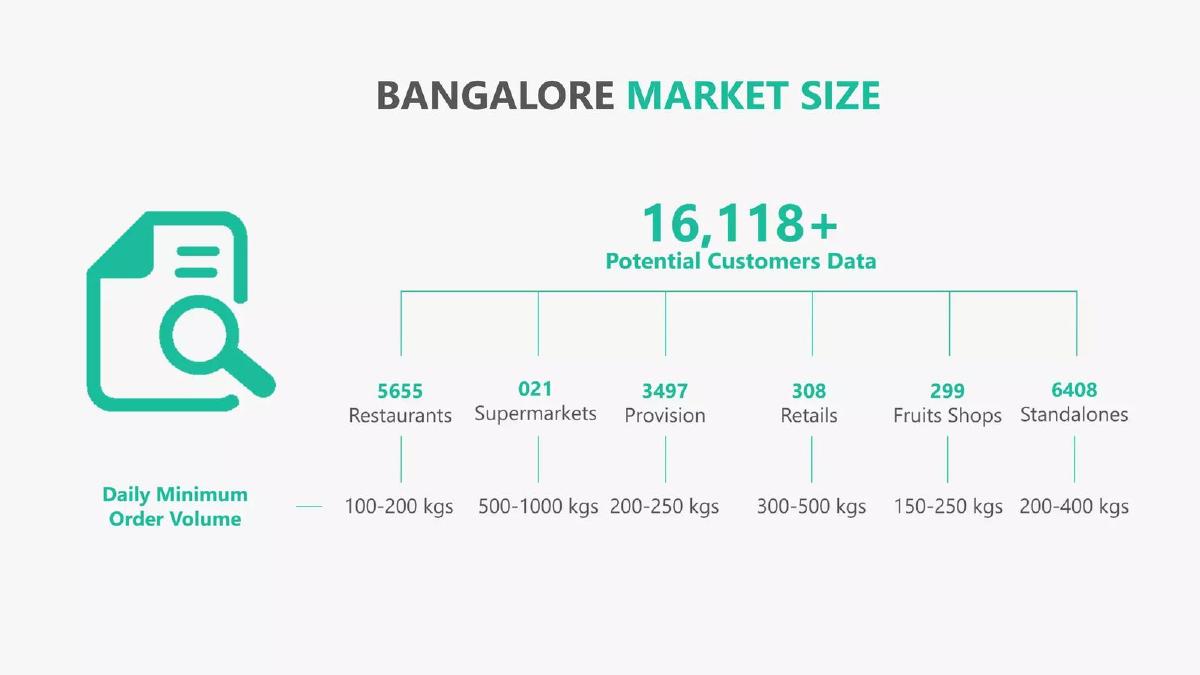
Contextualize the Market: While the HSR survey is a good start, the deck lacks a "Market Size" (TAM/SAM/SOM) slide. Investors need to see that the Bangalore success can be replicated across other Tier-1 and Tier-2 cities in India to justify a venture-scale valuation.
Frequently asked questions
- What is the primary problem Farm Bazaar is solving?
- Farm Bazaar addresses the inefficiencies of traditional retail procurement in India. According to Slide 2, retailers face issues with early morning market visits, high extra-logistics costs, and a lack of alternatives in current online portals. The company proposes an 'advanced operational model' that uses technology and analytics to cater to these traditional businesses more effectively than existing solutions.
- How does Farm Bazaar generate revenue?
- The company operates on a direct-procurement model. As stated on Slide 4, retailers buy directly from farmers through the Farm Bazaar platform. The company charges a fulfillment fee to the retailer. By eliminating middlemen, they claim to capture significant value, specifically 30% on vegetables and 60% on fruits and exotic produce.
- What does the physical infrastructure of the business look like?
- Farm Bazaar is not a 'light' software platform; it is an operationally intensive business. Slide 5 illustrates a business flow that requires physical assets, including collection centers for farmers, centralized warehouses, and localized 'FarmBazaar-Hubs' that facilitate the final delivery to customers.
- What are the growth targets for the company?
- The company projected aggressive scaling in 2019 and 2020. Slide 7 shows a goal to increase tonnage from 15 tonnes in Q1 2019 to 189 tonnes by Q3 2020. This growth is tied to the hub expansion roadmap on Slide 8, which moves from a 2-hub pilot to an 18-hub network over the same period.
- What critical information is missing from this pitch deck?
- The deck is missing several standard investor requirements. There is no 'Team' slide to verify the founders' expertise in logistics or agriculture. There is no 'Competition' slide to explain how they differ from players like Ninjacart or WayCool. Most importantly, there is no 'Ask' slide detailing how much money they are raising or the valuation they are seeking.