The Fast pitch deck is a 15-slide presentation that leans heavily on product vision and social validation rather than hard financial data. At the time of this Series B, the company focused on the friction of online commerce, presenting '1-Click Checkout' and 'Zero-click Checkout' as the primary solutions. The deck is notable for what it lacks: there are no slides dedicated to revenue, GMV, burn rate, or specific growth metrics. Instead, it leverages the pedigree of its founders—Domm Holland and Allison Barr Allen—and a 'Strong Backing' slide featuring Stripe and Index Ventures. The narrative…
Key takeaways
- The deck contains zero financial metrics, revenue figures, or growth charts across its 15 slides.
- Product functionality is the core focus, with five slides (3, 4, 5, 6, and 9) dedicated to the user interface and checkout flows.
- Fast positions itself as 'Platform Agnostic,' claiming compatibility with every site, platform, and device on slide 7.
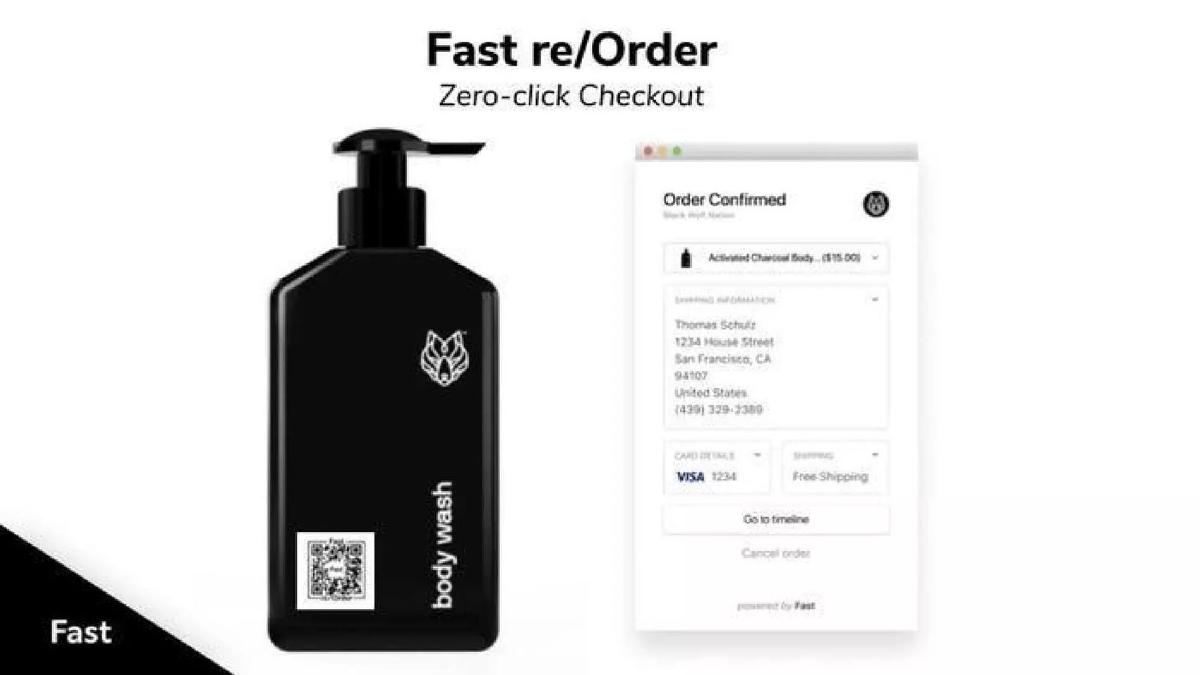
- The 'Fast re/Order' feature introduces a 'Zero-click Checkout' concept via physical QR codes on slide 6.
- Team pedigree is a central pillar, highlighting Allison Barr Allen’s experience scaling Uber from 2k to 26k employees on slide 11.
- The competitive analysis on slide 12 explicitly names PayPal, Shopify, Bolt, and Apple Pay as primary rivals.
- Social proof is used as a proxy for traction, with slides 14 and 15 featuring 11 different tweets from industry observers.
- Security is addressed through association, listing Stripe, Very Good Security, and Google Cloud as partners on slide 10.
The Narrative-First Series B
The Fast pitch deck is an anomaly in the world of Series B fundraising. Typically, by this stage, investors expect a 'data room in a slide deck'—detailed cohorts, CAC/LTV ratios, and clear revenue bridges. Fast, however, opted for a minimalist, high-design approach that sells a future state of the internet. The deck is less about where the company is and more about the inevitability of its success based on its backers and its product's simplicity.
Slides 1-2: The Hook and the Hype
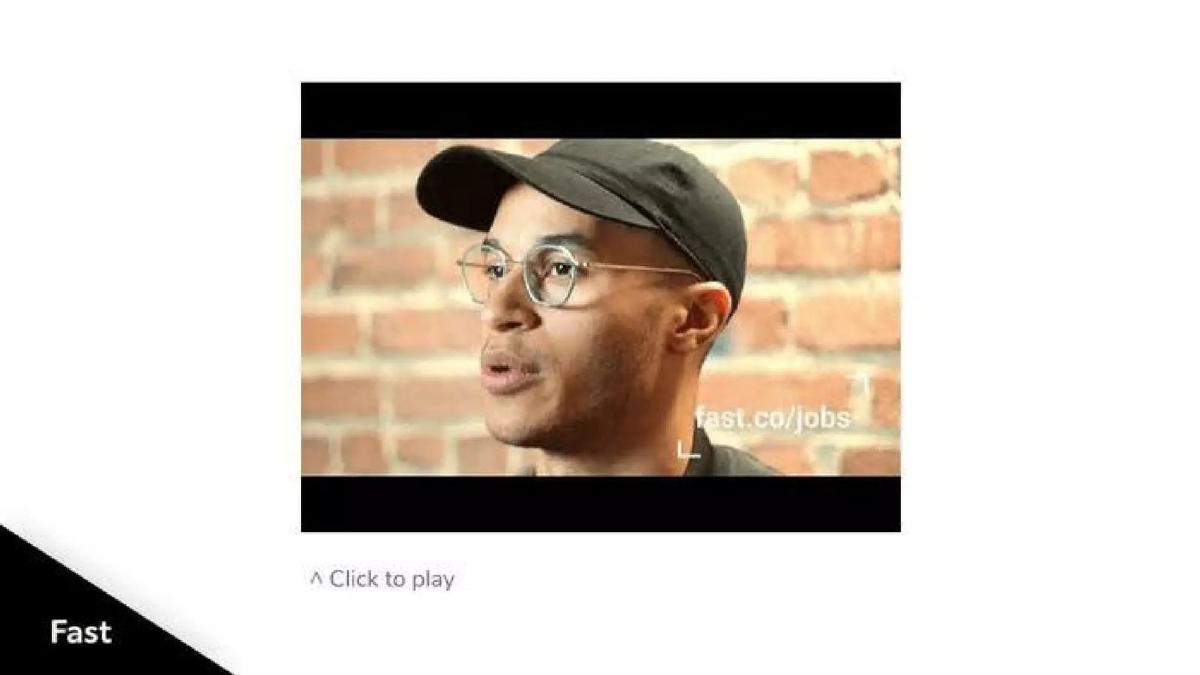
Slide 1 is a stark black title slide with the word 'Fast' in white. It establishes the brand's minimalist aesthetic immediately. Slide 2 features a video placeholder with the text '^ Click to play' and a link to 'fast.co/jobs.' This suggests the deck was intended for a live presentation or a platform that supports embedded media, emphasizing a dynamic, tech-forward persona rather than a static document.
Slides 3-6: The Product Experience
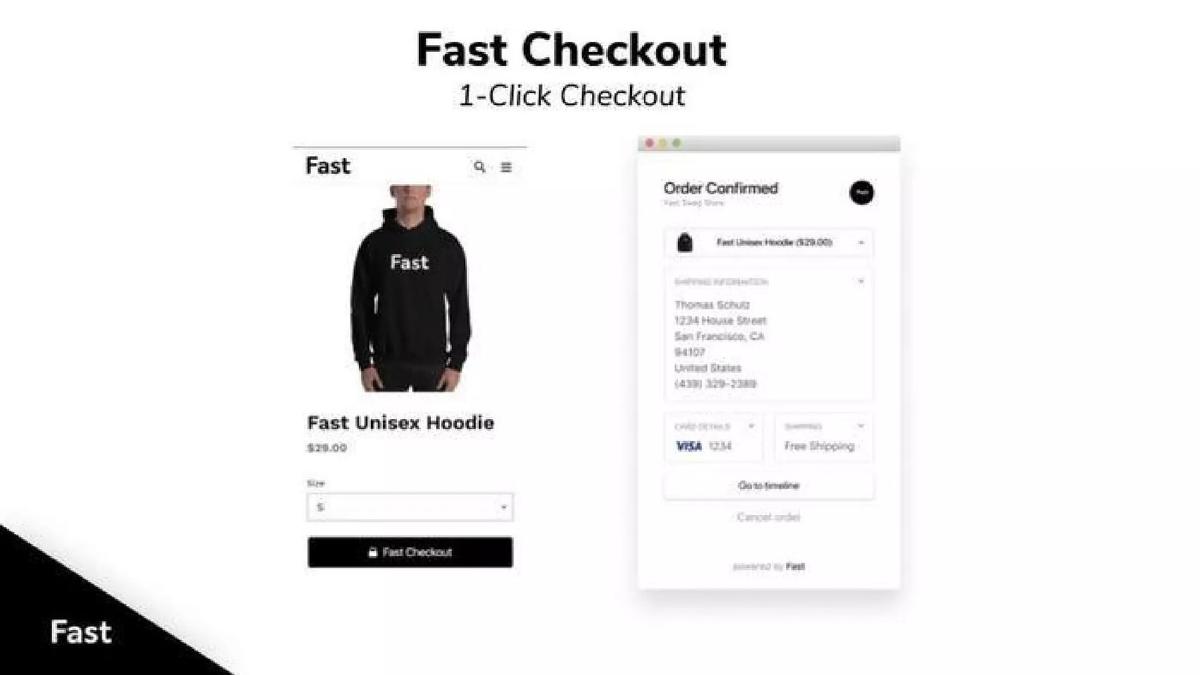
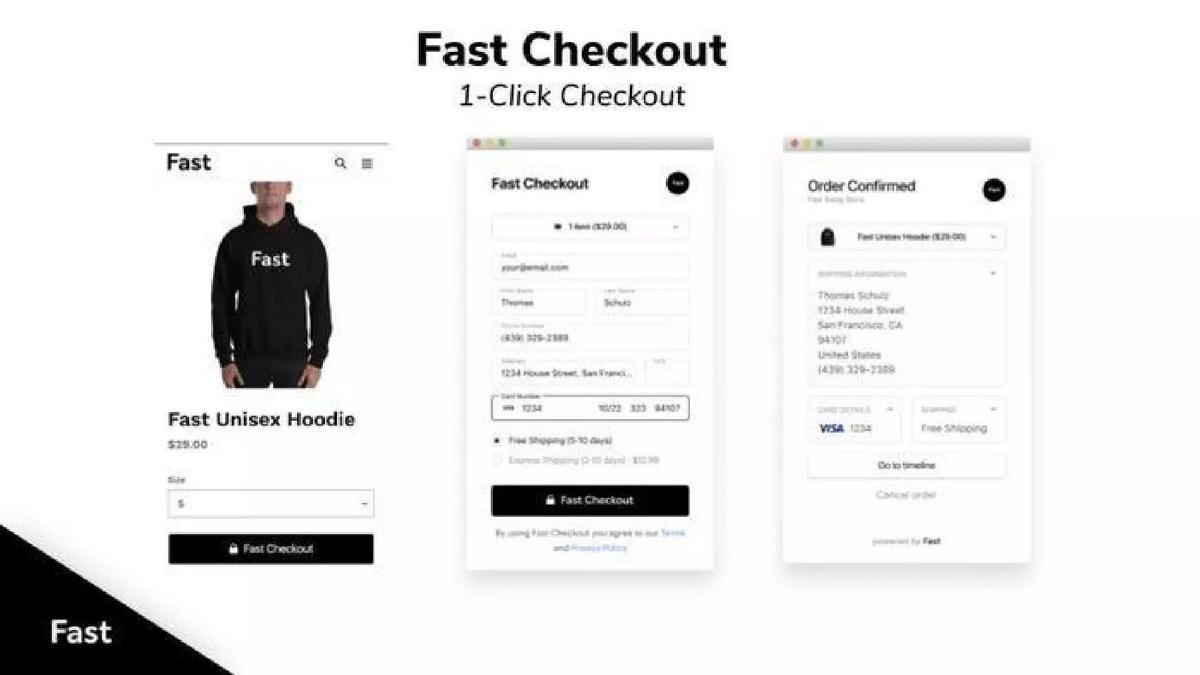
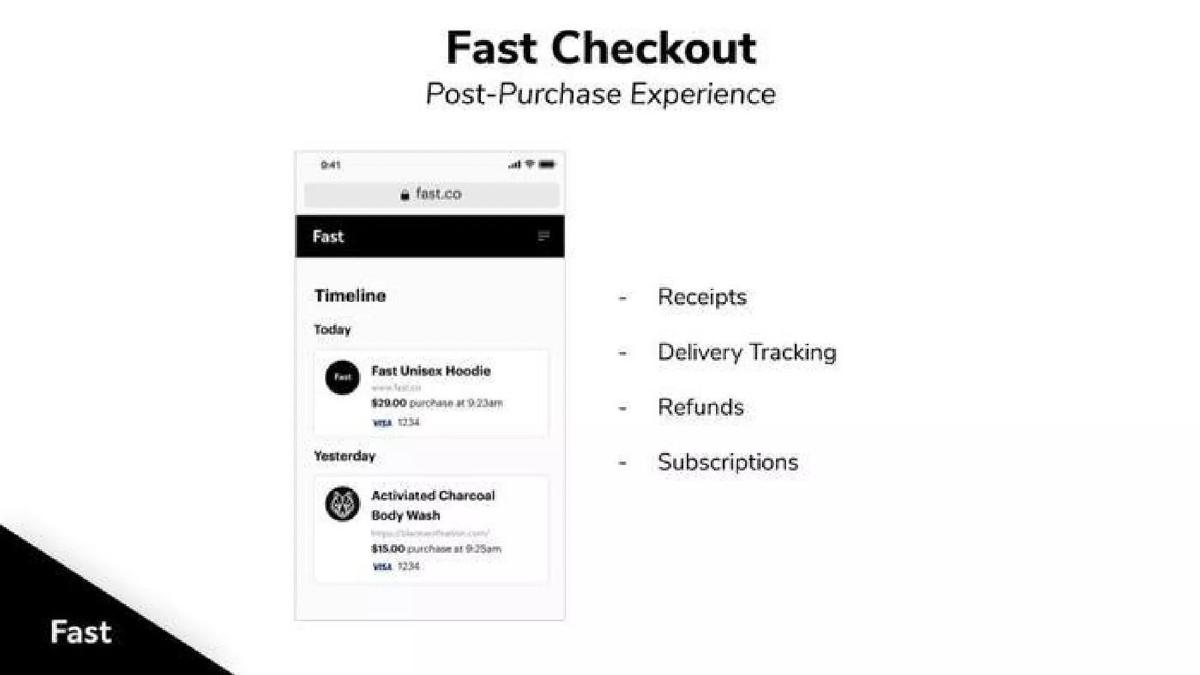
The core of the deck is a walkthrough of the user experience. Slide 3 and Slide 4 demonstrate 'Fast Checkout' and '1-Click Checkout.' The visuals show a 'Fast Unisex Hoodie' priced at $29.00. The transition between these slides illustrates the removal of forms; the user goes from a product page to an 'Order Confirmed' screen with minimal friction. Slide 5 expands this to the 'Post-Purchase Experience,' listing Receipts, Delivery Tracking, Refunds, and Subscriptions as part of a unified 'Timeline.' This is a strategic move to show that Fast isn't just a button, but a relationship manager for the consumer.
Slide 6 introduces 'Fast re/Order,' which it labels 'Zero-click Checkout.' This slide features a bottle of 'Activated Charcoal Body Wash' with a QR code. This is the only mention of a physical-to-digital bridge in the deck, suggesting an omnichannel ambition that goes beyond standard e-commerce.
Slides 7-9: Distribution and Integration
Slide 7 uses the headline 'Every site, platform, device' to claim universal utility. It shows the product rendered on a laptop, tablet, and smartphone. Slide 8 reinforces this by displaying the logos of major e-commerce platforms: Magento, Salesforce, SAP, Shopify, WooCommerce, and BigCommerce. The 'Easy Install' claim is a direct appeal to merchant concerns regarding technical debt. Slide 9 pivots to 'Fast Login,' showing a simple email-based authentication screen. This positions Fast as a competitor to 'Sign in with Google' or 'Sign in with Apple,' expanding their moat from payments to identity.
Slides 10-11: Security and The Team
Slide 10 , titled 'Serious About Security,' uses a 'security by association' tactic. It brackets Stripe, Very Good Security, and Google Cloud together to imply that Fast inherits the security posture of these giants. There are no specific details on encryption or compliance, just a visual alignment with trusted brands.
Slide 11 is perhaps the most important slide for a pre-revenue or low-revenue Series B. It profiles the 'world class team.' It notes that Domm Holland led a company transacting $50M in 4 years. It highlights Allison Barr Allen’s role at Uber, specifically scaling the team from 2k to 26k employees. It also mentions Jason Alderman’s 9-year tenure at Visa. Below the founders, it lists 'top talent' from companies like Square, Postmates, and Wish, signaling that the company has successfully 'hired for scale.'
Slides 12-15: Competition and Social Proof
Slide 12 addresses 'Competitors' directly. It lists PayPal, Bolt, Shopify, and Apple Pay. The 'Why Fast will win' section lists four points: Platform Agnostic, Consumer Centric, Login/Payments/Identity integration, and Distribution. Notably, it claims Fast will have the 'largest distribution amongst merchants,' though it provides no data to support how this will be achieved.
Slide 13 displays 'Strong Backing' with logos from Stripe, Index Ventures, Susa Ventures, KPCB (Kleiner Perkins), GFC, and Rocket Internet. This is a 'who's who' of venture capital, designed to trigger FOMO (fear of missing out) in other investors. Finally, Slides 14 and 15 are titled 'An army of supporters.' They consist entirely of screenshots of tweets. Quotes like 'This could be one of the most important companies in the world one day' from Jeff Morris Jr. and 'one of the next real unicorns' from Steve McLaughlin are used to substitute for traditional traction metrics.
What Works in This Deck
1. Visual Clarity: The deck is incredibly easy to digest. By using large product mocks and minimal text, the founders ensure that the '1-Click' value proposition is felt, not just read. 2. Founder-Market Fit: The team slide is exceptionally strong. For a payments company, having a former Visa VP and an Uber Money operations lead provides immediate credibility that offsets the lack of financial data. 3. The Identity Play: By including 'Fast Login' (Slide 9), the company moves from being a commodity payment button to a strategic identity layer, which justifies a higher 'tech' valuation rather than a 'fintech' valuation.
What is Missing
1. Financials and Metrics: There is a total absence of GMV (Gross Merchandise Volume), number of active merchants, user growth rates, or revenue. For a Series B, this is highly unusual and suggests the round was raised on momentum and vision. 2. Go-To-Market (GTM) Strategy: While Slide 8 shows platform logos, there is no explanation of how Fast intends to displace incumbent checkout options or what their merchant acquisition cost (CAC) looks like. 3. Business Model: The deck never explains how Fast makes money. While a per-transaction fee is implied in the industry, the lack of a slide on unit economics or take-rates is a significant omission.
What a Founder Should Copy
1. Use Social Proof as a Proxy: If you are in a high-growth phase where your 'vibe' and market sentiment are ahead of your revenue, use the 'Army of Supporters' (Slides 14-15) technique. It proves that people are talking about the problem you are solving. 2. Focus on the 'Post-Purchase': Most checkout startups only show the button. Fast’s inclusion of the 'Timeline' (Slide 5) shows they understand the full customer lifecycle, which is a more defensible business model. 3. Lead with Your Best 'Who': If you have a lead investor like Stripe, put them on multiple slides (Slides 10 and 13). In venture capital, the lead investor's brand is often the strongest signal of quality.
Frequently asked questions
- How did Fast raise $124.5M without showing revenue in the deck?
- Fast relied on 'narrative-market fit.' By focusing on a massive problem (checkout friction) and showcasing a team with deep operational experience at companies like Uber and Visa, they sold the potential of the platform. The inclusion of Stripe as a lead investor and partner provided the institutional credibility necessary to bypass early-stage revenue requirements.
- What is the 'Zero-click Checkout' mentioned in the deck?
- Slide 6 introduces 'Fast re/Order,' which uses QR codes on physical products. The concept is that a user can scan a code on a bottle of body wash, for example, and the system triggers an immediate reorder using saved credentials, bypassing the digital cart entirely.
- Who are the key team members highlighted?
- The deck focuses on CEO Domm Holland (serial entrepreneur), COO Allison Barr Allen (formerly Uber Money Team), and CCO Jason Alderman (9 years at Visa). This combination of entrepreneurial hustle, hyper-growth scaling experience, and deep fintech regulatory knowledge was a major selling point.
- How does Fast differentiate itself from Shopify or PayPal?
- According to slide 12, Fast claims to win by being 'Platform Agnostic' and 'Consumer Centric.' While Shopify is a closed ecosystem and PayPal is often seen as a payment-only layer, Fast argues it combines login, payments, and identity into a single universal layer that works anywhere.
- What is missing from this pitch deck?
- The deck is missing almost all standard Series B requirements: a business model/unit economics slide, a go-to-market strategy, historical growth data, a formal 'Ask' or use of funds, and a financial roadmap. It is a pure vision and product deck.