Faye’s Series A pitch deck presents a compelling case for disrupting the travel insurance industry by addressing systemic consumer distrust and legacy inefficiencies. As a full-stack Managing General Agent (MGA) with claims authority, Faye controls the entire customer journey, from product design to instant payments via the Faye Wallet. The deck highlights rapid execution, reaching 48 U.S. states in under a year and achieving millions in sales. By positioning travel insurance as a high-growth, short-term risk category compared to home or auto insurance, Faye argues for superior unit economics…
Key takeaways
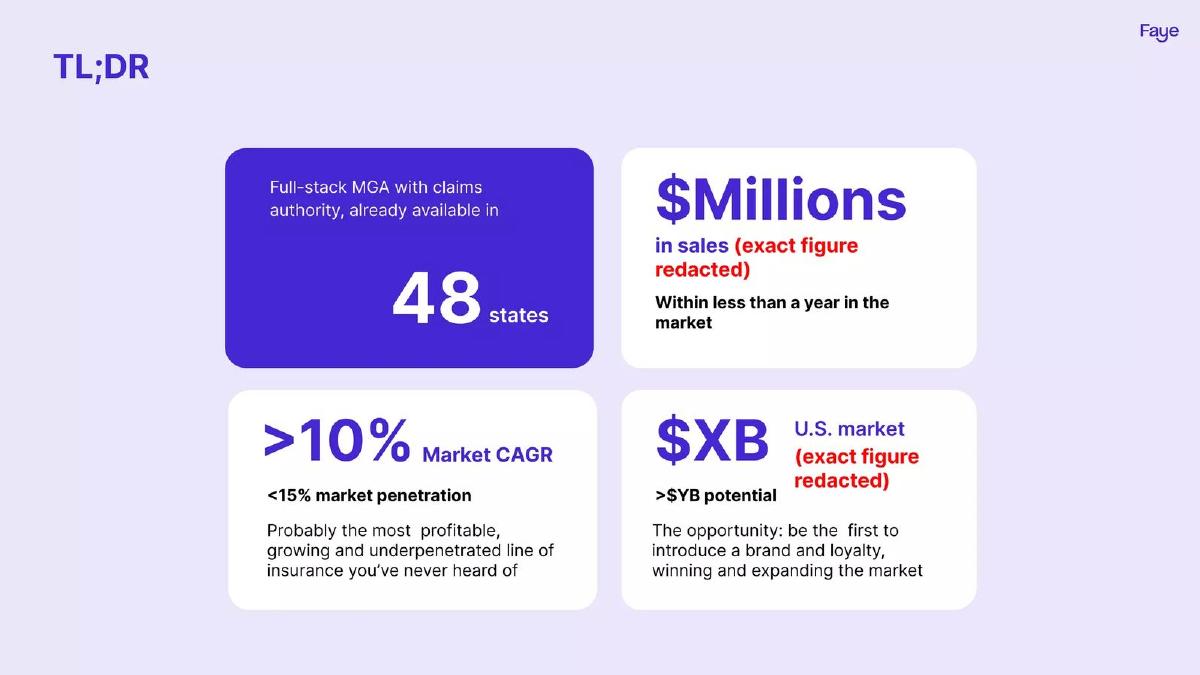
- Faye operates as a full-stack MGA with claims authority, already available in 48 states at the time of the deck (Slide 2).
- The company identifies a market opportunity in a sector growing at >10% CAGR with less than 15% market penetration (Slide 2).
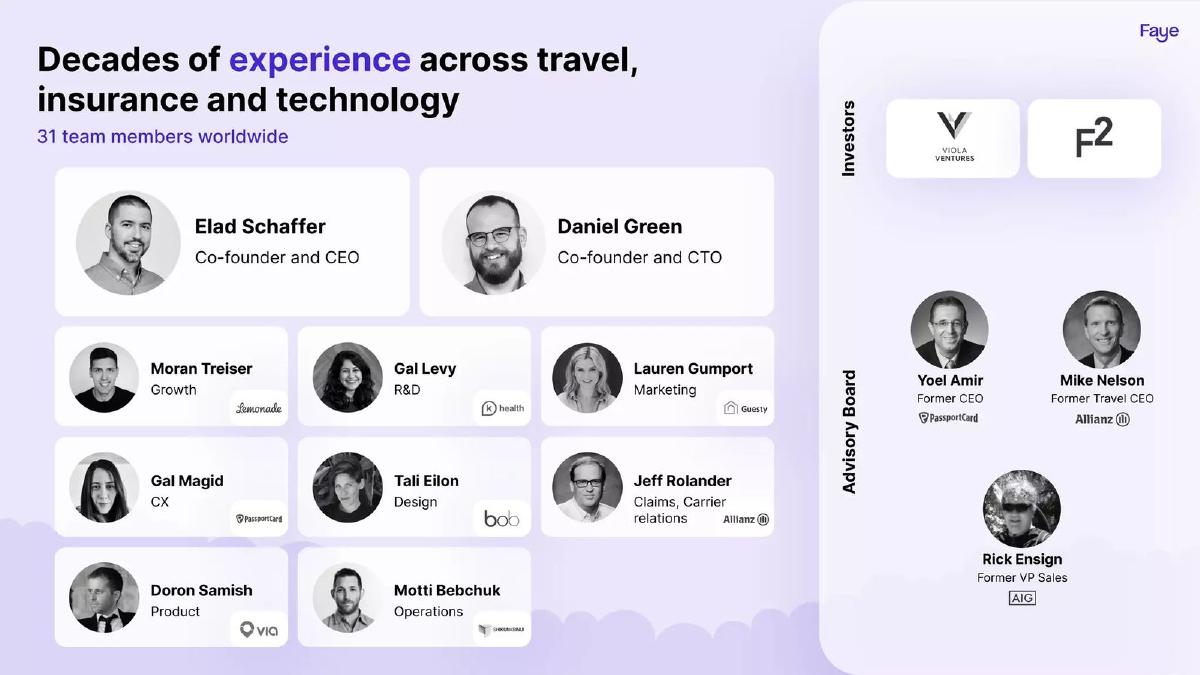
- The team includes 31 members worldwide with experience from Lemonade, Allianz, and AIG (Slide 3).
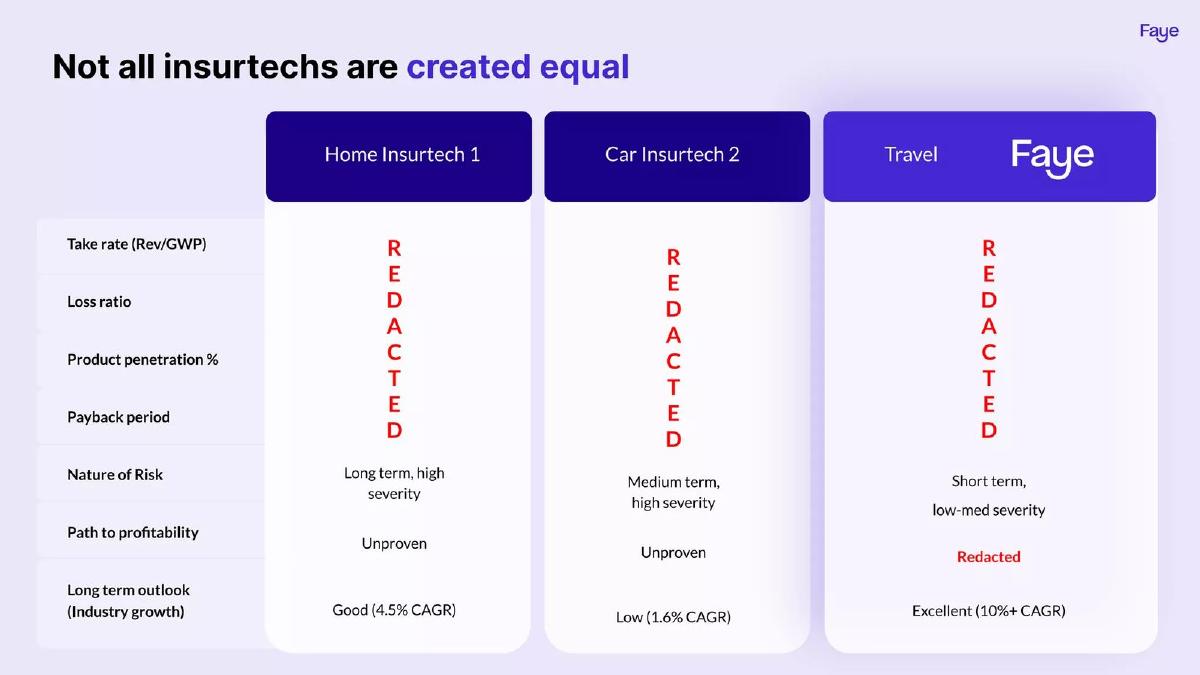
- Faye differentiates itself from other insurtechs by focusing on short-term, low-to-medium severity risk, which they claim leads to a faster path to profitability (Slide 6).
- The product includes a 'Faye Wallet' that allows approved claims to be paid in seconds, avoiding out-of-pocket expenses for travelers (Slide 11).
- Go-to-market strategy relies on a mix of organic sales, travel agency partnerships, and embedded distribution (Slide 12).
- Customer retention is a core focus, with 94% of customers stating they will buy their next coverage with Faye (Slide 15).
- The Series A ask is for $10 million to provide 24-30 months of runway and reach milestones like a 50-state rollout and a corporate plan (Slide 17).
Executive Summary and Team
Slide 1: Title Slide
The deck opens with a minimalist title slide featuring the company name, Faye , and the tagline: "Travel insurance as it was meant to be." The branding is clean, using a deep purple background that persists throughout the deck. A small date stamp in the corner indicates the deck is from 2023.
Slide 2: TL;DR
This slide serves as a high-level summary of the company's status and market opportunity. It notes that Faye is a "Full-stack MGA with claims authority," and is already available in 48 states . Financial metrics are partially redacted, but the slide claims "$Millions in sales" within less than a year in the market. It highlights a ">10% Market CAGR" and " framing the U.S. market as a multi-billion dollar opportunity where Faye can be the first to build brand loyalty.
Slide 3: Team and Advisors
Faye presents a team of 31 members worldwide . Co-founders Elad Schaffer (CEO) and Daniel Green (CTO) lead the group. The slide highlights key hires with experience from notable companies: Moran Treiser (Growth) from Lemonade, Lauren Gumport (Marketing) from Guesty, and Jeff Rolander (Claims) from Allianz. The advisory board includes former CEOs and VPs from PassportCard, Allianz, and AIG . Existing investors Viola Ventures and F2 are also displayed.
The Problem and Market Opportunity
Slide 4: The Problem
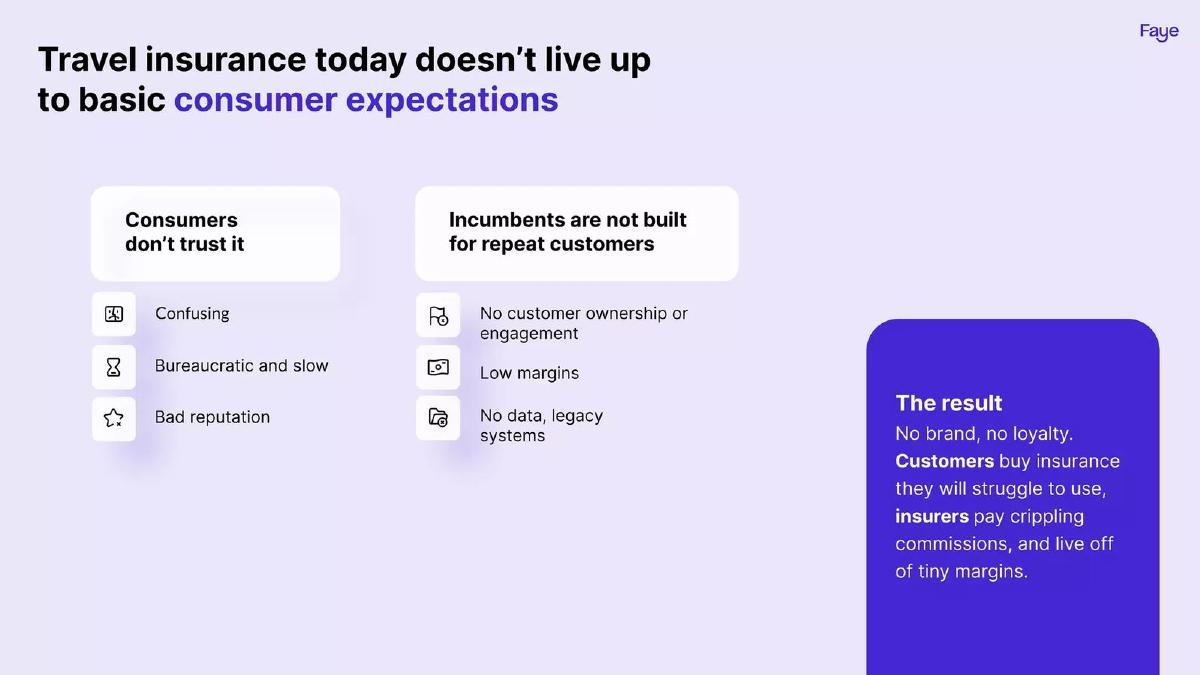
The deck argues that travel insurance today fails consumer expectations. It lists two main pillars: "Consumers don't trust it" (citing confusion, bureaucracy, and bad reputation) and "Incumbents are not built for repeat customers" (citing lack of customer ownership, low margins, and legacy systems). The stated result is a market with no brand loyalty where customers struggle to use the product they bought.
Slide 5: Market Potential
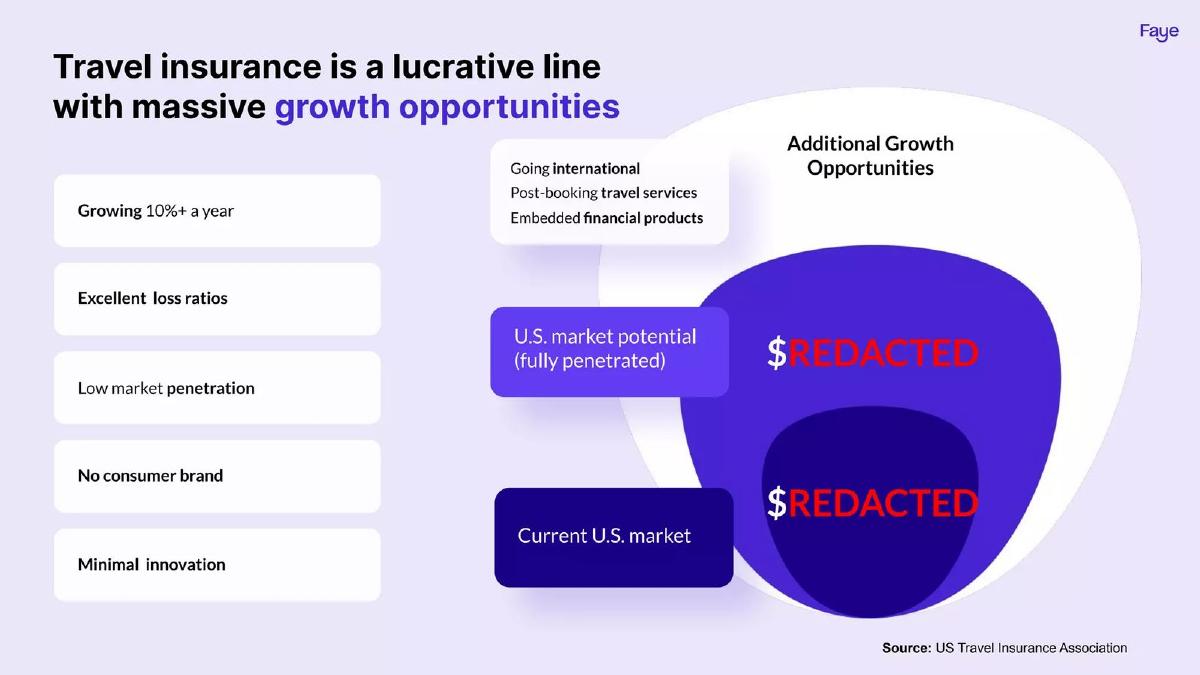
This slide visualizes the growth opportunity. It reiterates the 10%+ annual growth and excellent loss ratios of the travel insurance line. A nested circle diagram shows the "Current U.S. market" versus the "U.S. market potential (fully penetrated)," though the specific dollar amounts are redacted. Growth levers mentioned include international expansion, post-booking services, and embedded financial products.
Slide 6: Competitive Advantage (Insurtech Comparison)
Faye differentiates itself from the broader insurtech space by comparing travel insurance to home and car insurance. The slide claims that "Home Insurtech 1" and "Car Insurtech 2" deal with long-term, high-severity risks with unproven paths to profitability. In contrast, Faye characterizes travel insurance as "Short term, low-med severity" risk with an "Excellent (10%+ CAGR)" outlook and a redacted (but presumably positive) path to profitability.
Product and Technology
Slide 7: Introducing Faye
This slide provides a visual overview of the mobile app. It labels Faye as a "Technology driven, full-stack MGA" and uses checkmarks to indicate they handle Product Design, Distribution, Administration, Claims, and Payments . The app screenshots show a user-friendly interface for trip planning and coverage details.
Slide 8: Coverage Scope
Faye lists its "person-first, proactive and holistic coverage." The grid includes standard items like trip cancellation and baggage loss, but also modern additions like COVID-19 , Pet care , Vacation rental damage , and Adventure & extreme sports . It also mentions a "Cancel for any reason" option.
Slide 9: User Experience
The deck emphasizes speed and ease of use, claiming it takes "60 seconds to get covered." Features include modular coverage "worded for humans," in-app travel assistance, and intuitive claims filing. The slide also introduces "Speedy payments to the Faye Wallet."
Slide 10: Proactive Protection
This slide focuses on the "proactive" nature of the service. It mentions "Active trip monitoring" and alerts for "COVID-19, flights and security." The core philosophy is stated as "Solutions > Money," suggesting the app helps solve travel problems in real-time rather than just paying out after a loss.
Slide 11: The Faye Wallet
The Faye Wallet is presented as a "revolution in claim payments." It allows approved claims to be paid in seconds to a digital card that can be added to Apple Wallet . This enables users to pay for emergencies using Faye's funds instead of paying out-of-pocket and waiting for reimbursement.
Go-To-Market and Traction
Slide 12: GTM Strategy
The strategy is based on three principles: building a strong brand , meeting customers across the entire journey , and creating a diverse mix of revenue channels . A pie chart shows a distribution of revenue between Organic, Direct, Brand partnerships, Embedded, and Travel Agencies . A list of press logos (Forbes, WSJ, TechCrunch) supports the brand-building claim.
Slide 13: Growth Metrics
Traction is shown through two charts. The first is a bar chart of "Monthly growth" from April to December, showing a consistent upward trend. The second is a line chart for "Improving profitability per purchase," indicating that for every dollar spent on acquisition, net revenue is increasing. Specific figures for GWP and net revenue are redacted.
Slide 14: Volume Growth
This slide shows a line chart for "Purchases" and the "# of Insured Travelers." The gap between the lines indicates "1.5 Faye travelers per purchase." The growth curve accelerates significantly in the final quarter of the year shown.
Slide 15: Customer Satisfaction
Faye highlights its 4.7 Trustpilot score , comparing it to competitors who score 3.9 and 1.4. It also claims a "Growth from returning customers" (shown in a line chart) and states that "94% of our customers say they will buy their next coverage with Faye."
Slide 16: Competitive Landscape
The landscape is divided into Traditional insurers (Allianz, Generali, AIG, AXA), Distributors (Amex, United, Expedia), and Innovators (PassportCard, Pattern, Battleface, Hopper). Faye positions itself as the only player combining a consumer brand, proactive data-driven care, holistic coverage, and a mobile-first approach .
The Ask and Future Milestones
Slide 17: Raising Series A
The company is seeking a "$10m capital raise" to provide "24-30 months of runway." A large redacted box covers the 2-year budget details. Milestones for this round include reaching "hundreds of thousands of customers," achieving "Availability in 50 states," and launching a "Family plan" and "Corporate plan."
Slide 18: Social Proof
This slide features several 5-star customer testimonials from Trustpilot. Quotes emphasize that claims were "handled with care" and that the service is "fast, helpful, knowledgeable."
Slide 19: Closing
The final slide features the Faye logo and the closing tagline: "Powering positive adventures worldwide," along with the company website.
What Works Well
Clear Differentiation: The deck does an excellent job of explaining why travel insurance is a better venture bet than home or auto insurance (Slide 6). This addresses a common investor concern regarding the long tail and high severity of traditional insurtech. · Product-Led Story: The inclusion of the Faye Wallet (Slide 11) provides a tangible "aha" moment. It moves the product from a passive financial instrument to an active travel tool. · Execution Proof: Reaching 48 states and achieving millions in sales within the first year (Slide 2) demonstrates high operational velocity, which is critical for a Series A company. · Visual Consistency: The deck is professionally designed with a consistent color palette and clean typography, which reinforces the brand's focus on "modernizing" a legacy industry.
What Is Omitted
Unit Economics Details: While Slide 13 mentions "improving profitability per purchase," the actual numbers are redacted. A teardown of the LTV/CAC ratio would be essential for a Series A investor to understand the scalability of the GTM strategy. · Loss Ratio Data: For an insurance company, the loss ratio is the most critical metric. While Slide 5 claims "Excellent loss ratios," no historical data or specific percentages are provided to back this up. · Reinsurance Structure: As an MGA, Faye relies on fronting carriers and reinsurers. The deck does not name their insurance partners or explain the risk-sharing structure, which is vital for understanding their long-term stability and margin potential. · Detailed Use of Funds: Slide 17 has a large redacted section for the budget. While we know the milestones, we don't see the allocation between engineering, marketing, and operations.
Founder Takeaways
The "Category Comparison" Slide: If you are in a crowded space (like insurtech), use a slide like Slide 6 to explain why your specific sub-sector has better fundamentals than the ones investors might be wary of. · Solve the "Out of Pocket" Problem: In any industry where reimbursement is the norm, finding a way to provide instant funds (like the Faye Wallet) is a massive competitive advantage and a great talking point for a pitch. · Focus on Velocity: Highlighting how quickly you went from launch to near-national coverage (48 states in <1 year) is one of the strongest signals of a high-performing team. · Leverage Advisory Boards: If your team is young, showing industry veterans from legacy giants (Allianz, AIG) on your advisory board (Slide 3) helps mitigate the perceived risk of disrupting a highly regulated industry.
Frequently asked questions
- What is Faye's business model?
- Faye operates as a full-stack Managing General Agent (MGA). This means they have claims authority and control the product design, distribution, administration, and payments. By owning the entire stack rather than just acting as a distributor, they aim to improve margins and provide a better consumer experience, specifically through proactive trip monitoring and rapid claims processing.
- How does Faye compare to other insurtech companies?
- Slide 6 explicitly compares Faye to home and car insurtechs. Faye argues that travel insurance is superior because it involves short-term, low-to-medium severity risk, whereas home and auto insurance involve long-term, high-severity risks. This difference supposedly leads to a clearer path to profitability and higher industry growth (10%+ CAGR for travel vs. 1.6% for car insurance).
- What are the key features of the Faye product?
- The product is mobile-first and includes 60-second coverage, 24/7 travel assistance, and proactive alerts for flight changes or COVID-19 requirements. A standout feature is the Faye Wallet, a digital payments card that allows the company to pay out approved claims in seconds so travelers don't have to pay for emergencies out-of-pocket.
- What is Faye's growth trajectory according to the deck?
- While exact revenue figures are redacted, Slide 13 shows a steep monthly growth curve in Gross Written Premium (GWP) and net revenue from April to December. Slide 14 shows a similar upward trend in the number of insured travelers, noting an average of 1.5 travelers per purchase. They also highlight a 4.7 Trustpilot score to prove market fit.
- What are the primary uses for the $10 million Series A funds?
- The funds are intended to provide 24-30 months of runway. Specific milestones include expanding to all 50 U.S. states, launching a family plan and a corporate plan, improving ROI per purchase, and scaling the customer base to 'hundreds of thousands' of users.