The February 2015 investor presentation for Falco Resources (TSXV: FPC) serves as a technical progress report and strategic roadmap for the Horne Mine project in Quebec. The deck focuses heavily on geological validation, leveraging over 80 years of data archives and 4,386 historic drill holes to establish a maiden resource estimate. Falco positions itself as a dominant player in the Southern Abitibi Greenstone Belt, controlling 740 square kilometers of land with 13 former mines. The narrative is driven by a confirmatory drilling program costing $3.7M, aimed at increasing tonnage by over 30%.…
Key takeaways
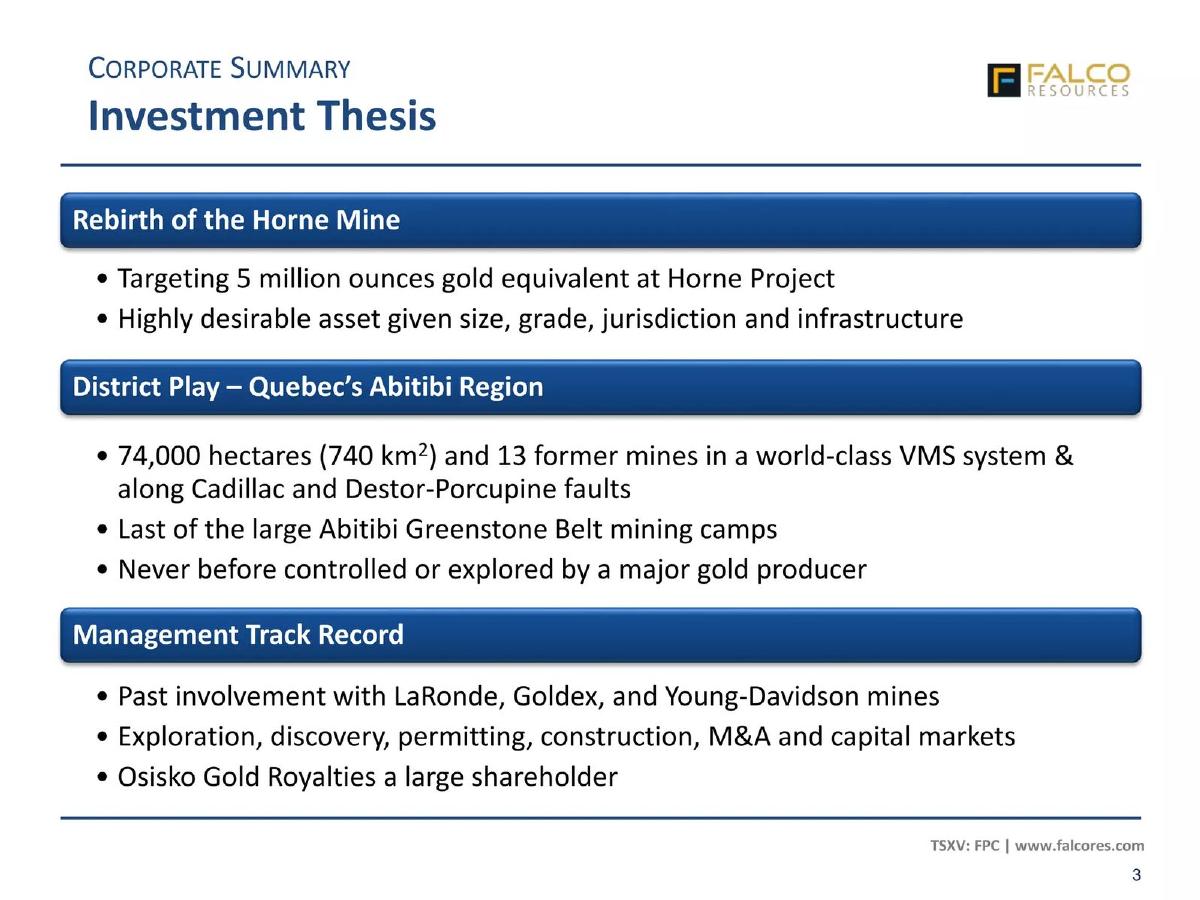
- The company controls a dominant land package of 740 square kilometers in the Rouyn-Noranda camp, including 13 former mines (Slide 7).
- Falco utilizes a massive historical dataset including 80 years of archives and 305,000 meters of historic drilling (Slide 10).
- A $3.7M confirmatory drilling program was scheduled for completion by H2 2015 to upgrade resources from Inferred to Indicated (Slide 13).
- The Horne 5 deposit is benchmarked against modern bulk mines, claiming higher grades than Goldex and Young-Davidson (Slide 16).
- Exploration upside is highlighted through the Lac Herve and Rimo properties, which show similar geological signatures to the Horne Complex (Slides 19, 22).
- The management team features significant experience from major players like Osisko Mining, IAMGOLD, and Agnico-Eagle (Slide 25).
- Regional M&A activity is used to justify valuation, citing 11 transactions between 2011 and 2015, including the $3.49B Osisko Mining acquisition (Slide 28).
- Discovery costs for the Horne project are estimated at less than $0.25 per ounce of gold (Slide 10).
Presentation Overview
The Falco Resources deck from February 2015 is a technical and strategic document intended for institutional investors and mining analysts. It focuses on the Horne Mine project in Quebec, positioning it as a brownfield redevelopment opportunity with significant scale. The presentation moves from regional geological context to specific project metrics, exploration upside, and finally, the management team and market environment.
Slide 1: Title Slide
The cover slide establishes the core theme: "Rediscovering the Rouyn-Noranda Mining District" and the "Rebirth of the Horne Mine." It features the company logo and a night-time landscape shot of the mining district, emphasizing the industrial heritage of the area. The TSXV ticker (FPC) is clearly displayed in the footer.
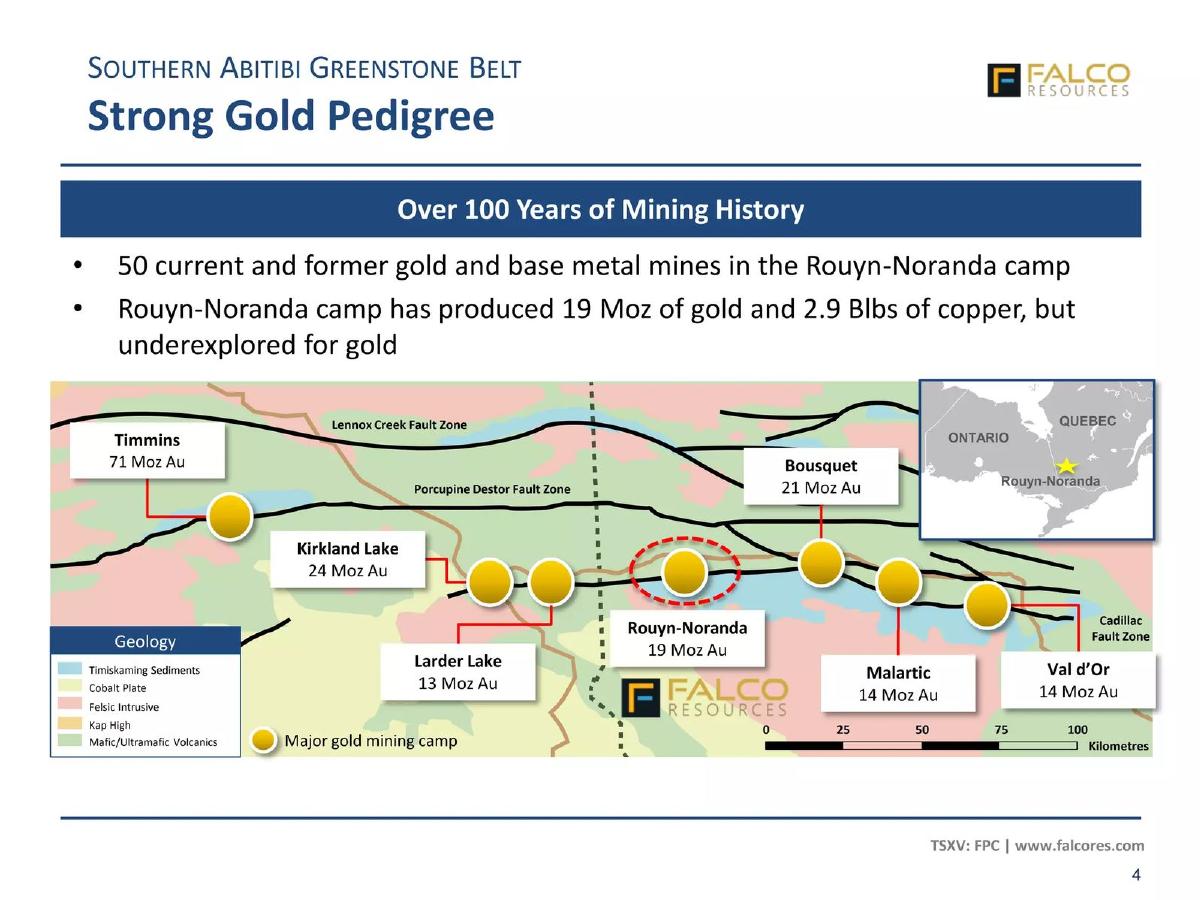
Slide 4: Southern Abitibi Greenstone Belt
This slide provides the macro geological context. It highlights the "Strong Gold Pedigree" of the region, noting over 100 years of mining history. Key metrics include the production of 19 Moz of gold and 2.9 Blbs of copper from the Rouyn-Noranda camp. A map illustrates the proximity of major gold mining camps like Timmins (71 Moz Au) and Kirkland Lake (24 Moz Au), positioning Falco's project in a world-class gold corridor.
Slide 7: Land Package and Dominant Position
Falco emphasizes its control over the region with a map showing a contiguous land package. The slide states the company holds 740 square kilometers of property containing 13 former mines. The most critical asset mentioned is the "Over 80 years of data archives," which serves as the foundation for their exploration strategy. The map differentiates between gold and base metal deposits, showing a high density of past producers on Falco's land.
Slide 10: Horne Project Maiden Resource Estimate
This is a data-heavy slide detailing the maiden resource estimate for the Horne 5 deposit. It includes a vertical cross-section of the orebody, showing the Upper and Lower H orebodies extending down to 2,300 meters. Key technical points include a 1km strike length and discovery costs of less than $0.25/oz Au. The slide notes the project was extensively developed from the 1930s to 1960s, providing a massive head start in terms of infrastructure and data (4,386 drill holes).
Slide 13: Confirmatory Drill Program
Falco outlines its immediate operational plan: a 16,000m drilling program consisting of 9 holes from the surface. The slide lists three primary objectives: upgrading the resource to "Indicated," confirming metallurgy, and validating silver grades. The financial and timeline targets are explicit: a $3.7M cost with completion by H2 2015. They also set a public benchmark for success, targeting a tonnage increase of over 30%.
Slide 16: Good Grades for Bulk Mining
This slide serves as a competitive benchmarking tool. A bar chart compares the Horne 5 deposit to other modern bulk underground mines. It specifically highlights that Horne 5 has a higher grade than the Goldex and Young-Davidson mines. The chart plots "Contained AuEq" against "Grade AuEq," placing Falco among established producers like Agnico Eagle (AEM) and AuRico Gold (AUQ).
Slide 19: Lac Herve - VMS Large Anomaly
To show that the company is not a "one-trick pony," this slide introduces the Lac Herve property. It describes a large anomaly identified 15km northeast of Rouyn-Noranda. The slide mentions that a single hole intersected 3.8m of sulphide stringer zone material. It concludes with a forward-looking statement regarding drilling planned for Q1 2015, providing investors with a near-term catalyst.
Slide 22: Riviere Mouilleuse (Rimo) - VMS
Similar to the Lac Herve slide, this focuses on the Rimo property. It claims a "Similar Signature as Horne" based on lithogeochemical characteristics. The slide notes that Falco has identified numerous near-surface conductors and has completed 3 drill holes with pulse-EM. This reinforces the narrative of a target-rich environment beyond the primary Horne 5 deposit.
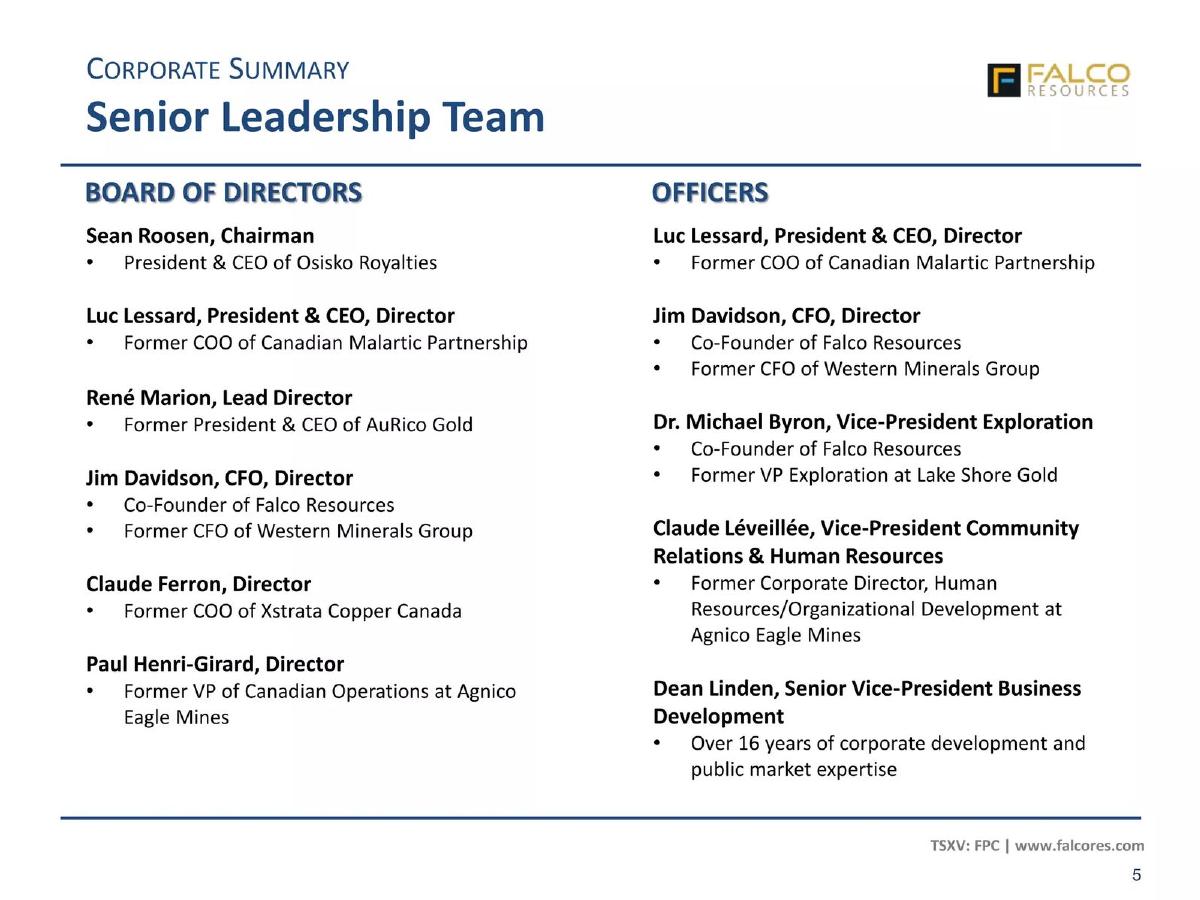
Slide 25: Senior Leadership Team - Management
The team slide is structured with professional headshots (omitted in this version but implied by layout) and detailed bullet points for six key executives. The focus is on "mine building" experience. Luc Lessard (CEO) is credited with 25 years of experience, including roles at Osisko and IAMGOLD. The inclusion of Paul-Henri Girard, who was instrumental in developing the LaRonde mine, adds significant technical credibility to the project's feasibility.
Slide 28: Regional Gold M&A Transactions
The final content slide provides a table of 11 regional M&A transactions in the Abitibi Greenstone Belt from 2011 to 2015. It lists acquirors (e.g., Goldcorp, Yamana, Hecla), targets, equity values, and EV/AuEq multiples. By showing equity values ranging from $58M to $3.49B, Falco illustrates the potential valuation ceiling for successful developers in the region, effectively creating a "fear of missing out" for investors.
What Falco Resources Does Well
The deck excels at leveraging historical data to lower perceived risk. By emphasizing the 80 years of archives and the thousands of existing drill holes, Falco makes a compelling case that they aren't just guessing; they are validating a known quantity. The use of specific, measurable targets for their 2015 drill program (e.g., ">30% tonnage increase") gives investors a clear yardstick for performance. Furthermore, the M&A table on Slide 28 is a masterclass in establishing market relevance, showing that the biggest players in mining are actively buying assets exactly like the ones Falco owns.
What is Missing from the Deck
While the technical data is robust, the deck is light on specific financial projections beyond exploration costs. There is no detailed capital expenditure (CAPEX) estimate for actually bringing the Horne Mine back into production, nor is there a projected timeline for the first gold pour. The deck also lacks a clear "Ask" slide—while it is an investor presentation, it does not explicitly state how much capital they are currently seeking or the specific terms of a raise. Additionally, environmental and social governance (ESG) factors, which are critical for mining in Quebec, are only briefly touched upon via the "Community Relations" title in the management slide.
Founder Takeaways: Lessons from Falco
1. Contextualize your location: If you are in a "hot" geography, prove it. Falco didn't just say they were in Quebec; they mapped out every major mine nearby and listed every major acquisition in the region to prove the neighborhood's value. 2. Use benchmarks: The comparison chart on Slide 16 is effective because it doesn't compare Falco to failures; it compares them to successful, producing mines. This helps investors understand where the company fits in the ecosystem. 3. Quantify your data advantage: If you have proprietary data or a unique historical advantage, put a number on it. Stating "305,000m of historic drilling" is far more powerful than saying "we have a lot of old records." 4. Build a "Mine-Builder" team: For capital-intensive industries, investors don't just want explorers; they want operators. Falco highlighted executives who had actually built and sold mines in the same region, which significantly de-risks the execution phase.
Frequently asked questions
- What is the primary focus of the Falco Resources deck?
- The primary focus is the 'Rebirth of the Horne Mine' located in the Rouyn-Noranda Mining District of Quebec. The deck aims to prove the economic viability of reopening and expanding this historic site by using modern drilling techniques to validate and grow a massive historical resource base.
- How does Falco Resources use historical data to its advantage?
- Falco highlights that it possesses over 80 years of data archives. This includes records from 4,386 historic drill holes totaling 305,000 meters. By digitizing and modeling this data, they achieved a maiden resource estimate with discovery costs of less than $0.25/oz Au, significantly lower than traditional exploration costs.
- What are the specific goals of the 2015 confirmatory drill program?
- The $3.7M program had three main objectives: upgrading the resource category from Inferred to Indicated, confirming metallurgical parameters to improve payability, and confirming historic silver grades of over 15 g/t. Success was defined as increasing tonnage by >30% and AuEq to >3.5 Moz.
- Who are the key members of the leadership team?
- The team is led by Luc Lessard (President & CEO), formerly of Osisko Mining and IAMGOLD. Other key figures include Dr. Michael Byron (VP Exploration), a co-founder of Falco, and Paul-Henri Girard, a consulting engineer who was previously VP of Canadian Operations for Agnico Eagle Mines.
- What market context does the deck provide for investors?
- The deck provides a detailed list of regional M&A transactions in the Abitibi Greenstone Belt to show the strategic value of the area. It cites major deals like Goldcorp's acquisition of Probe Mines ($437M) and Yamana/Agnico Eagle's acquisition of Osisko Mining ($3.49B) to demonstrate the exit potential for developers in this jurisdiction.