Forta’s 14-slide deck, used to secure a $55M Series A in 2024, addresses the critical supply-demand gap in Autism Spectrum Disorder (ASD) therapy. The narrative centers on the scarcity of Board Certified Behavior Analysts (BCBAs), visualized through a dense heat map of the United States. Forta’s solution involves 'upskilling non-medical personnel'—specifically parents—using AI-enabled tools and automated medical records. The deck highlights a significant clinical advantage: a 70% therapy utilization rate compared to 28% in traditional models. While the deck is light on specific financial proj…
Key takeaways
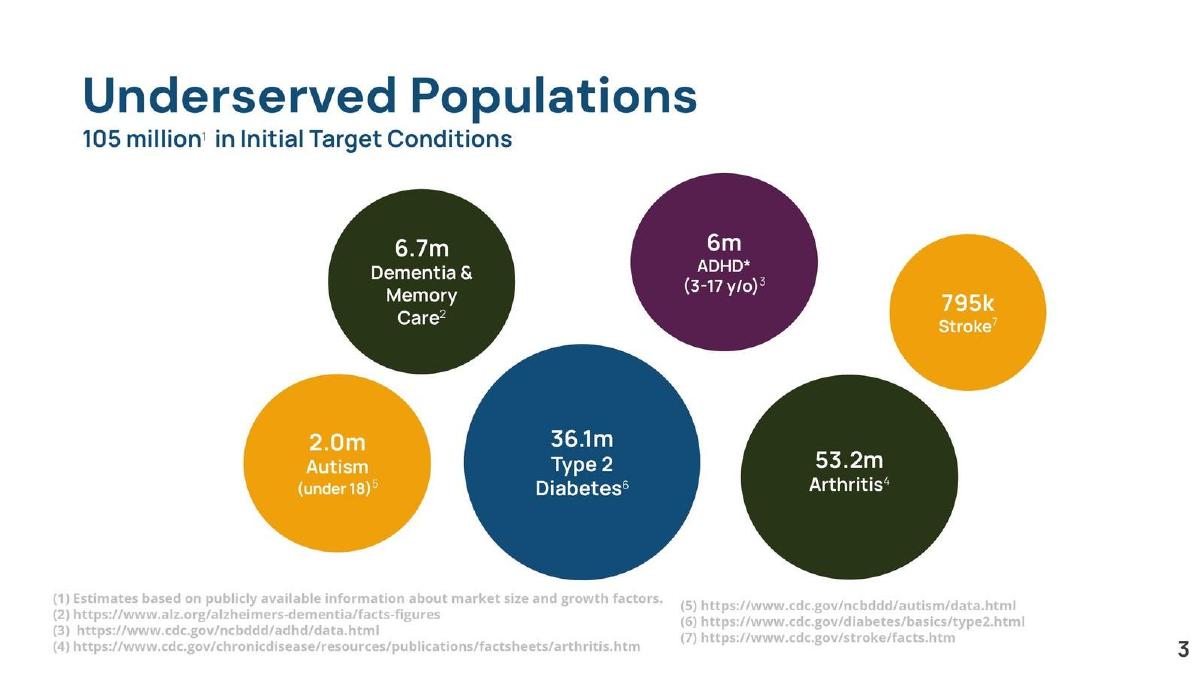
- The deck identifies a total of 105 million people across initial target conditions, including 2.0m for Autism and 36.1m for Type 2 Diabetes (Slide 3).
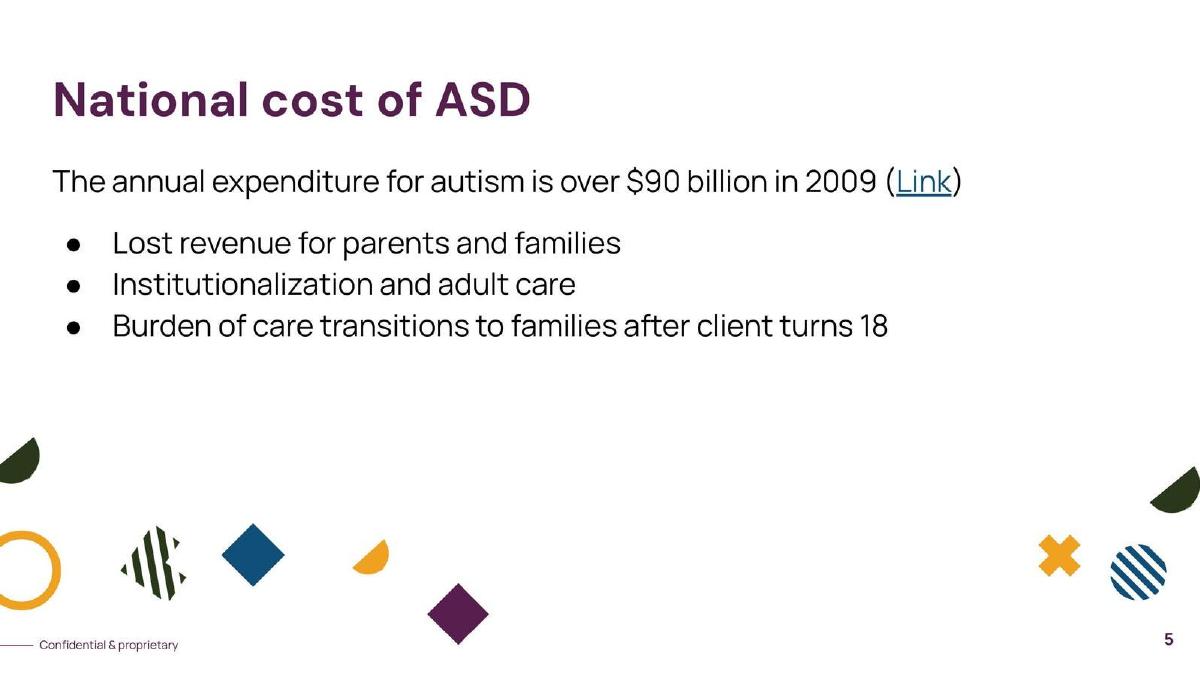
- National expenditure for autism is cited as over $90 billion based on 2009 data (Slide 5).
- A geographic heat map illustrates the extreme shortage of BCBAs, with many U.S. counties showing zero access (Slide 7).
- Forta defines four core competencies: consumer-friendly EHR/RPA, upskilling non-medical personnel, clinical-grade AI, and FDA approval for billing codes (Slide 9).
- Therapy hours delivered showed exponential quarterly growth through 2023, including a 1,000% jump in Q1 2023 (Slide 11).
- Clinical data from 30 clients suggests parent-led ABA is 2.5 times more likely to reach a 'full dose' of therapy than traditional models (Slide 13).
- The definition of a 'full dose' of ABA is explicitly defined as 80% or more of clinically prescribed hours (Slide 13).
- The deck omits a traditional 'Team' slide and a specific 'Ask' or use-of-funds breakdown.
Executive Summary: Solving the Clinical Supply Constraint
Forta’s pitch deck is a masterclass in identifying a massive supply-side bottleneck and proposing a technology-driven bypass. In the healthcare sector, specifically Autism Spectrum Disorder (ASD) therapy, the bottleneck is the human provider. By focusing on the shortage of Board Certified Behavior Analysts (BCBAs) and the high cost of traditional care, Forta justifies its $55M Series A as a necessary infrastructure play for the future of parent-led, AI-assisted medicine.
Slides 1-2: Brand and Positioning
The deck opens with a minimalist title slide featuring the Forta logo and the tagline "AI Enabled Care." The visual language is clean and professional, utilizing a dark blue and white color palette with geometric accents. These initial slides establish the brand identity but offer no immediate data, serving primarily as a transition into the problem statement.
Slide 3: The 105 Million Person Opportunity
Slide 3, titled "Underserved Populations," immediately expands the company's scope beyond autism. It identifies a total of 105 million people across "Initial Target Conditions." The slide uses a bubble chart to visualize the scale of these markets: 53.2m for Arthritis, 36.1m for Type 2 Diabetes, 6.7m for Dementia, 6m for ADHD, 2.0m for Autism (under 18), and 795k for Stroke. By leading with these figures, Forta signals to investors that while they are starting with ASD, their underlying technology is a platform for chronic disease management at scale.
Slides 4-5: The Economic Burden of ASD
Slide 5 focuses on the "National cost of ASD," citing a 2009 figure of $90 billion in annual expenditure. The slide lists three primary drivers of this cost: lost revenue for families, institutionalization, and the burden of care transitions after a patient turns 18. This slide frames the problem not just as a clinical one, but as a macroeconomic issue that affects labor participation and long-term state spending.
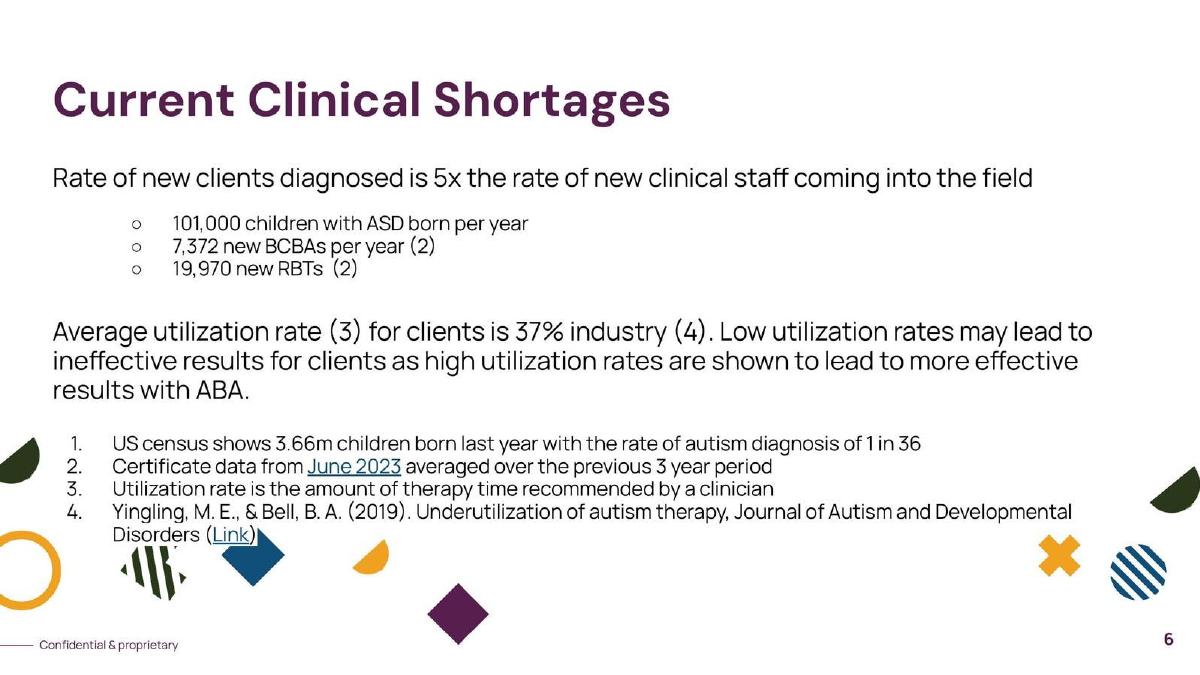
Slides 6-7: The Provider Shortage Crisis
Slide 7 is perhaps the most critical slide in the deck. It features a map of the United States titled "Number of Children with ASD Per BCBA (July 2021)." The map is heavily shaded in red and orange, indicating high ratios of children to providers, with vast gray areas labeled "No BCBA." This visual evidence proves that the traditional model of care is physically impossible to scale to meet demand, creating a vacuum that Forta intends to fill.
Slides 8-9: The Solution and Core Competencies
Slide 9 outlines Forta's "Core Competencies," which serve as the pillars of their business model. These include: 1) Consumer-friendly EHR, RPA, and RCM for automating billing; 2) Upskilling non-medical personnel (parents) through training and monitoring; 3) Clinical-grade AI algorithms to ensure care quality; and 4) Pursuing FDA approval for billing codes to expand margins. This slide explains how they solve the provider shortage: by turning parents into the primary care delivery mechanism, supported by an AI "co-pilot."
Slides 10-11: Traction and Growth Metrics
Slide 11 provides the "Therapy Hours" growth chart. It shows a steep upward trajectory from Q4 2022 through Q4 2023. The growth percentages are highlighted in gold: 1,000% in Q1 2023, 500% in Q2, 150% in Q3, and 138% in Q4. While the Y-axis lacks absolute numbers (labeled only as "Therapy hours delivered"), the relative growth suggests a rapid market adoption and a successful pilot phase.
Slides 12-13: Clinical Validation
Slide 13, "Clinical Data of Parent-led ABA," addresses the skepticism surrounding non-professional care. It presents data from 30 Forta clients, showing that 70% of their patients receive a "full dose" of therapy (defined as 80%+ of prescribed hours), whereas traditional models only achieve 28%. The slide also notes that 35 of 40 analyzed cohorts showed "at least moderately strong improvements." This data is crucial for convincing healthcare investors that the model is not just cheaper, but clinically superior due to higher adherence.
Slide 14: Closing
The final slide is a simple closing slide. Notably, the deck does not include a team slide with biographies, a detailed financial projection, or a specific breakdown of the $55M Series A use of funds. These elements were likely handled in a separate data room or supplemental document, as is common in high-profile Series A rounds.
What Forta Does Well
Supply-Side Focus: Most healthcare decks focus on the patient (demand). Forta correctly identifies that the bottleneck in autism care is the provider (supply). By visualizing the BCBA shortage on Slide 7, they make the need for their solution feel inevitable.
Platform Potential: By including Slide 3 with 105 million potential patients across multiple conditions, Forta avoids being pigeonholed as a "niche" autism app. They position themselves as a new category of AI-enabled clinical infrastructure.
Utilization as a North Star: In healthcare, "utilization" is a proxy for efficacy. If a child isn't getting the hours, they aren't getting better. By showing a 2.5x increase in utilization over traditional models (Slide 13), Forta provides a compelling reason for payers (insurance companies) to prefer their model.
What is Missing from the Deck
The Team: There is no mention of the founders, their clinical backgrounds, or their technical expertise. For a $55M round, the pedigree of the team is usually a primary driver, yet it is absent here.
Unit Economics: While Slide 9 mentions "margin expansion," there is no data on the cost to acquire a family, the cost to train a parent, or the lifetime value of a patient. Investors would typically want to see the LTV/CAC ratio for a Series A.
Regulatory Path: Slide 9 mentions FDA approval for billing codes, but there is no timeline or specific regulatory strategy provided. Given the complexity of healthcare reimbursement, this is a significant omission for a public-facing teardown.
Founder Takeaways
Use Maps to Prove Scarcity: If your business relies on a shortage of something, show a map. Forta’s Slide 7 is the most persuasive slide in the deck because it visually proves that the current system is broken and cannot be fixed by simply "hiring more people."
Define Your Metrics: Forta doesn't just say they have "better results." They define exactly what a "full dose" means (80% of prescribed hours) in a footnote on Slide 13. This precision builds trust with clinical and institutional investors.
Start Specific, Think Broad: Forta is an autism company today, but Slide 3 tells the story of a chronic care giant. Founders should always show the "wedge" (the current product) and the "mountain" (the total addressable market) to justify venture-scale valuations.
Frequently asked questions
- What is Forta's primary value proposition?
- Forta aims to solve the shortage of autism care providers by using AI to train and support parents to deliver Applied Behavior Analysis (ABA) therapy. This 'parent-led' model is designed to increase therapy utilization and lower the national cost burden of ASD, which the deck notes was $90 billion annually as of 2009.
- How does Forta use AI in its clinical model?
- According to slide 9, Forta uses 'clinical-grade AI algorithms' to help non-medical personnel exceed the standard of care. This is paired with automated medical records (EHR) and robotic process automation (RPA) to streamline billing and monitoring, ultimately aiming for FDA-approved billing codes to expand margins.
- What evidence of growth does the deck provide?
- Slide 11 features a bar chart of 'Therapy Hours' delivered from Q4 2022 to Q4 2023. It shows consistent quarter-over-quarter growth, specifically noting a 1,000% increase in Q1 2023, followed by 500%, 150%, and 138% in subsequent quarters.
- Does the deck mention conditions other than autism?
- Yes. Slide 3 lists 'Initial Target Conditions' totaling 105 million people. These include Arthritis (53.2m), Type 2 Diabetes (36.1m), Dementia & Memory Care (6.7m), ADHD (6m), and Stroke (795k), suggesting the platform is intended to be a multi-condition care engine.
- What are the clinical outcomes cited in the deck?
- Slide 13 reports that in a study of 30 clients, 70% received a 'full dose' of therapy compared to only 28% in traditional models. Additionally, 35 out of 40 analyzed cohorts showed 'at least moderately strong improvements' across all age groups and plan intensities.