Forent’s ExCAMP deck is a masterclass in visual emotional resonance, using a 'show, don't tell' approach to highlight the friction of modern Japanese camping. By contrasting crowded public sites with serene, private land, the founders immediately establish the value proposition. The deck identifies a substantial market of 8.4 million annual campers and a 250 billion yen light outdoor industry. However, from a fundraising perspective, the deck is remarkably thin on the 'how.' It lacks a clear revenue model, unit economics, or a specific financial ask. While the Instagram traction (10,000 follo…
Key takeaways
- The problem is framed through visual contrast between urban crowding (Slide 2) and overcrowded public campsites (Slide 4).
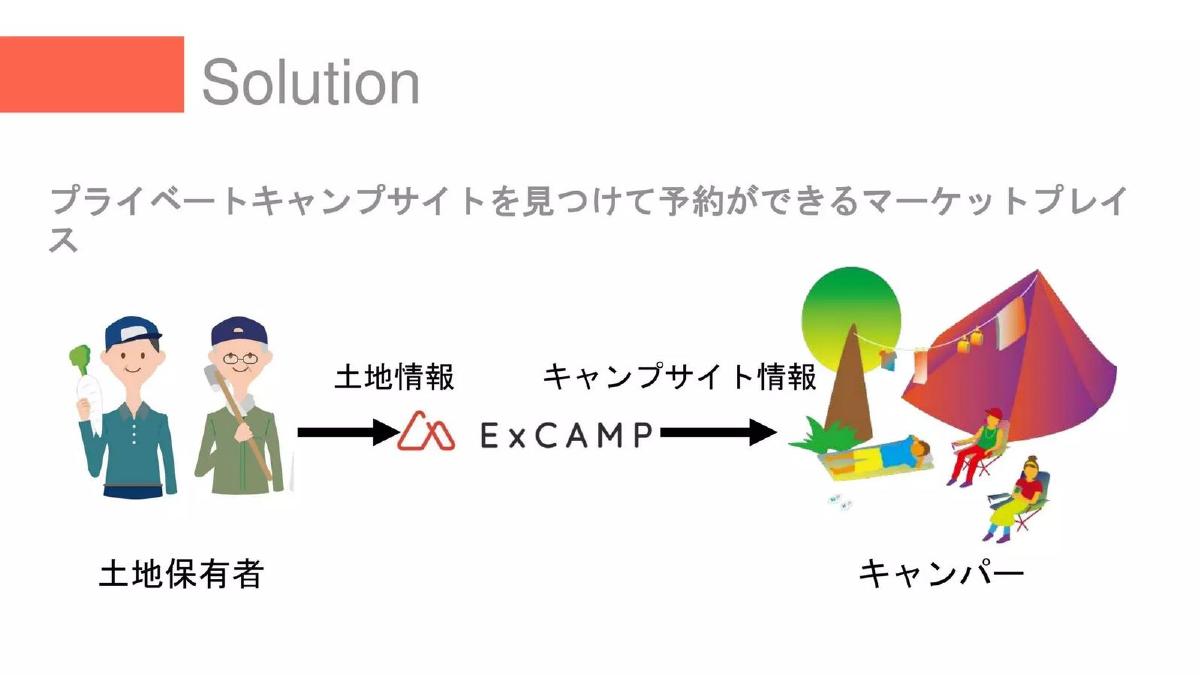
- The solution is a marketplace connecting landowners (farmers/foresters) with campers for private site bookings (Slide 6).
- ExCAMP targets a 'Light Outdoor Market' valued at 250 billion yen (Slide 11).
- The platform addresses a user base of 8.4 million annual campers in Japan (Slide 11).
- Early traction is demonstrated through a social media distribution channel with 10,000 Instagram followers (Slide 16).
- The product interface includes search, map-based selection, and a booking flow for private sites (Slides 13-15).
- The founding team consists of a CEO and CTO with backgrounds from the University of Tsukuba (Slide 17).
- The deck completely omits financial projections, business model details, and a specific funding ask.
Executive Summary: The Visual Pitch for Private Nature
Forent's pitch deck for ExCAMP, produced in 2018, is a 19-slide presentation that leans heavily on the 'Airbnb for X' narrative. In this case, the 'X' is private camping land in Japan. The deck is characterized by high-quality, full-bleed photography and a minimalist design that prioritizes emotional impact over data density. While it successfully identifies a cultural friction point—the overcrowding of public spaces in Japan—it leaves many professional investor questions unanswered regarding the mechanics of the business.
Slides 1-4: Establishing the Emotional Need
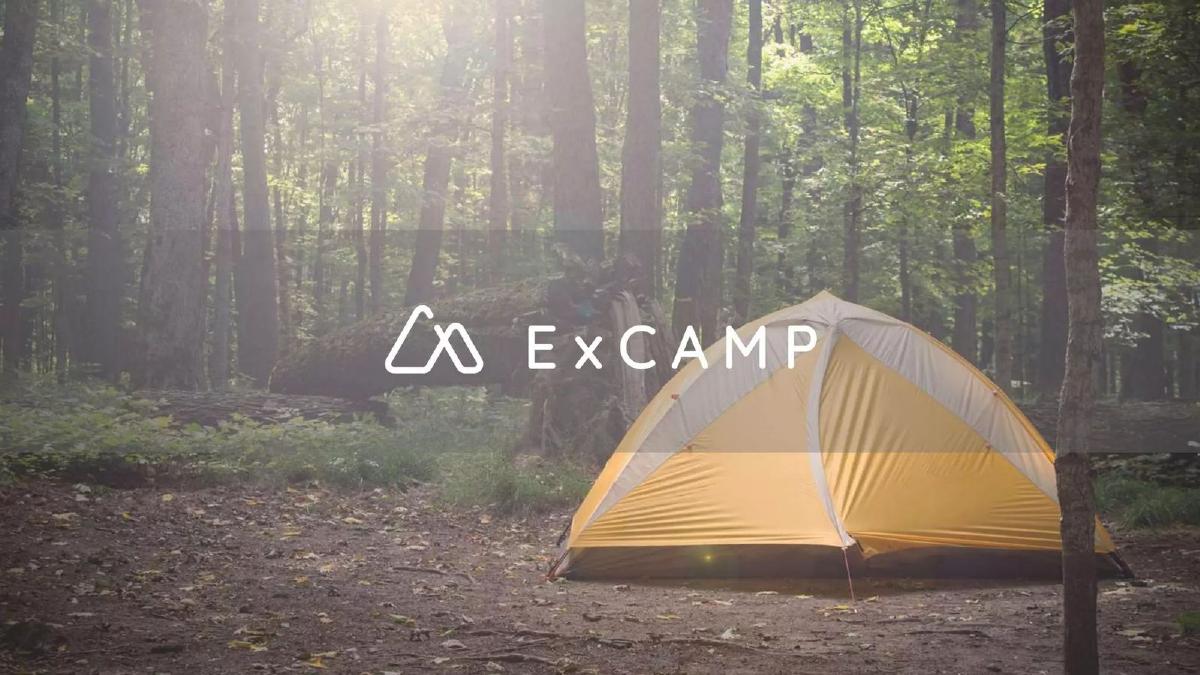
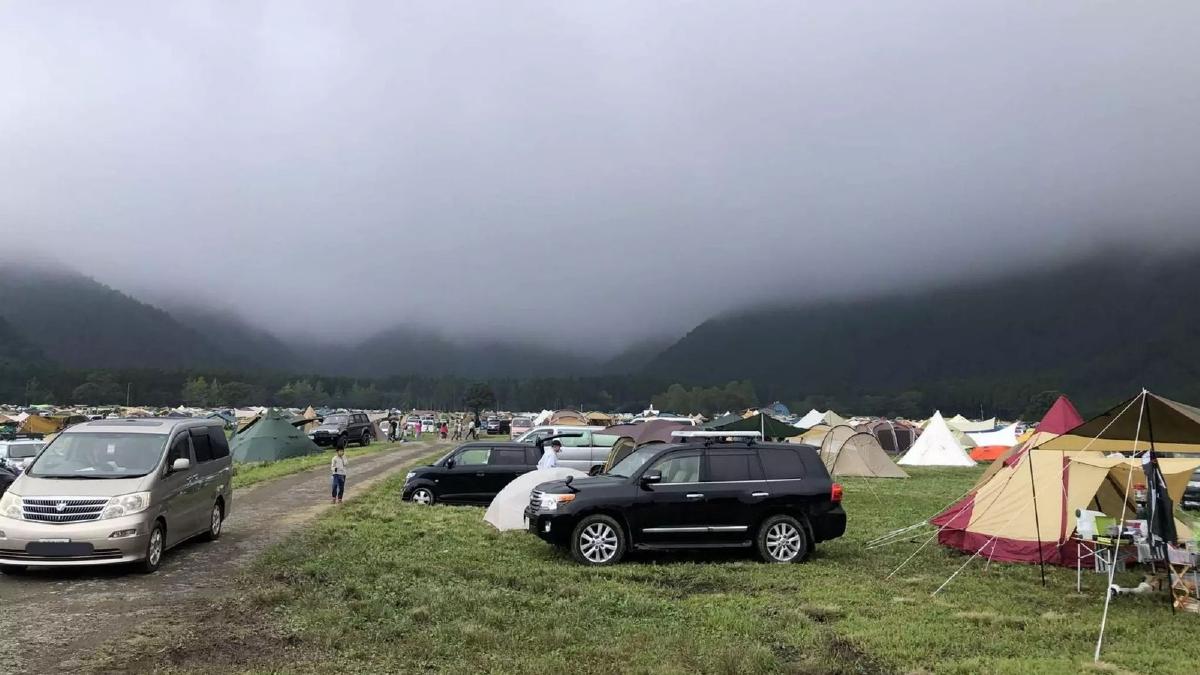
The deck opens with a title slide (Slide 1) featuring the ExCAMP logo over a serene forest camping scene. This is immediately followed by a jarring contrast: Slide 2 is a full-bleed photo of a packed Japanese commuter train. There is no text on this slide, but the implication is clear—urban life is suffocatingly crowded. Slide 3 returns to the 'Solution' imagery, showing a middle-aged couple enjoying a quiet, private campsite. Slide 4 then presents the 'False Promise' of current camping: a photo of a public campsite so crowded with cars and tents that it resembles a parking lot more than a wilderness retreat. This four-slide sequence effectively builds a narrative arc before a single word of the 'Problem' is written.
Slides 5-6: The Problem and Marketplace Solution
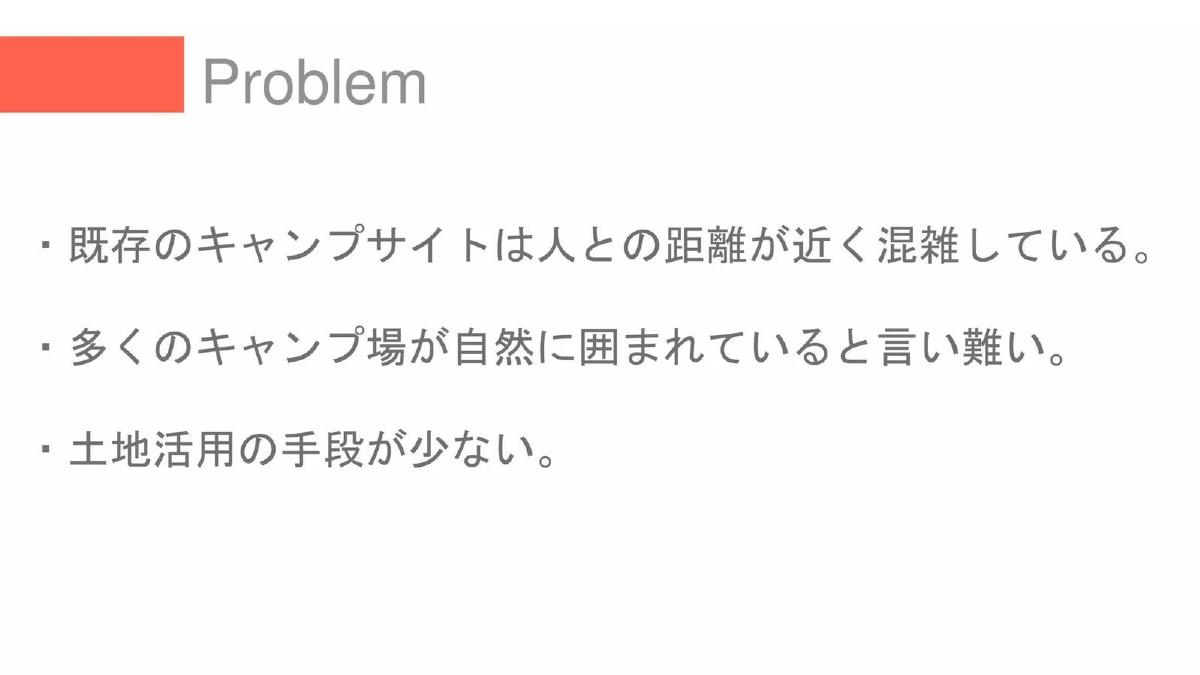
Slide 5 explicitly lists the problems: existing sites are crowded, they lack true nature, and land use options are limited. Slide 6 introduces the marketplace model. It uses simple icons to show 'Landowners' (farmers and foresters) providing land information to ExCAMP, which then delivers campsite information to 'Campers.' This is a classic marketplace diagram, positioning ExCAMP as the essential intermediary that unlocks underutilized private land for a frustrated consumer base.
Slides 7-10: Geographic Proof of Concept
These four slides serve as a gallery of the types of locations ExCAMP aims to offer. Each slide features a high-quality photo with a geographic label in Japanese: Nasu (Slide 7), Hokkaido (Slide 8), Yamanashi (Slide 9), and Wakayama (Slide 10). By showing diverse landscapes—from dense forests and rolling pastures to coastal cliffs and luxury cabins—the deck demonstrates that the 'private campsite' concept isn't limited to one region or one type of camping. It suggests a national scale for the platform.
Slides 11-12: Quantifying the Opportunity
Slide 11 provides the core market data. It cites a 'Light Outdoor Market' of 250 billion yen and states there are 8.4 million annual campers in Japan. The slide references the Japan Auto-Camping Association and the Japan RV Association, providing necessary credibility to these figures. Slide 12 is a 'Testimonial' slide, though it notably lacks text. It features two photos of campers in secluded spots, presumably intended to represent the user experience that leads to the market demand described on the previous slide.
Slides 13-15: Product Walkthrough
The deck moves into the UI/UX of the platform. Slide 13 shows the search interface, which includes filters for pets, starry skies, hiking, and fishing. Slide 14 demonstrates the 'Select' phase, showing a map of the Tsukuba area with pins for various sites, including a 'Private Site' priced at 8,000 yen per group and a public site at 210 yen per person. This price comparison is the only hint at unit economics in the entire deck, suggesting that private sites can command a significant premium. Slide 15 shows the final 'Booking' page, featuring high-quality imagery of the specific site and a clear call-to-action button.
Slides 16-19: Traction, Team, and Press
Slide 16 highlights the company's primary distribution channel: Instagram. It claims 10,000 followers for the @excamp account, showcasing a grid of aesthetic outdoor photography. This is a vital slide as it proves the founders understand how to reach their 'Light Outdoor' target audience. Slide 17 introduces the team, CEO Kohei Tsukazaki and CTO Daichi Miura, highlighting their academic credentials from the University of Tsukuba. Slide 18 displays logos from 'Trendy,' 'Go Out,' and 'The Bridge,' indicating early press coverage and industry recognition. The deck concludes on Slide 19 with a simple contact email.
What Works in the ExCAMP Deck
Visual Storytelling: The use of Slide 2 (the crowded train) and Slide 4 (the crowded campsite) is a brilliant way to build empathy for the user's pain point without using a single bullet point. It makes the 'Problem' feel visceral.
Clear Value Proposition: The contrast between the 210 yen public site and the 8,000 yen private site on Slide 14 clearly illustrates why this is a viable business. It shows that users are willing to pay a massive premium for privacy and exclusivity.
Social Proof: For a 2018 Seed deck, having 10,000 Instagram followers (Slide 16) and mentions in major Japanese tech and outdoor publications (Slide 18) provides strong evidence of product-market fit and brand resonance.
What is Missing from the ExCAMP Deck
Business Model Specifics: While we can infer it is a marketplace, the deck never states the take rate. Does ExCAMP take 10%? 20%? Is there a listing fee for landowners? This is a critical omission for investors calculating potential ROI.
Financial Projections: There are no charts showing projected growth, revenue targets, or break-even points. Investors are left in the dark regarding the company's financial ambitions.
The 'Ask': The deck does not state how much money the company is looking to raise, what the valuation is, or what the specific milestones are for the next 18 months. A pitch deck without an 'Ask' slide is essentially just a brochure.
Competitive Analysis: The deck ignores other booking platforms or the threat of incumbents like Airbnb expanding into the 'outdoor' category. It assumes ExCAMP is operating in a vacuum.
Lessons for Founders: What to Copy
Use High-Quality Imagery: If your product is experiential (travel, outdoors, real estate), your deck must look the part. ExCAMP uses professional-grade photography that makes the viewer want to use the product. This is far more effective than a wall of text describing 'nature.'
Identify a Cultural Friction Point: ExCAMP doesn't just sell 'camping'; it sells 'escape from the crowd.' By identifying a specific cultural nuance of Japanese life—the lack of private space—they make their solution feel necessary rather than just 'nice to have.'
Leverage Niche Distribution: Showing a dedicated Instagram following for a specific niche (Slide 16) is a great way to prove you have a 'moat' in customer acquisition. It shows you own the conversation in your specific category.
Keep the UI Simple: The product walkthrough (Slides 13-15) is clean and focuses on the user's journey (Search, Select, Book). It avoids over-complicating the technology and focuses on the ease of the transaction.
Frequently asked questions
- What is the core business model of ExCAMP?
- Based on Slide 6, ExCAMP operates as a two-sided marketplace. Landowners (depicted as farmers and elderly residents) provide 'Land Information' to the platform, which ExCAMP then converts into 'Campsite Information' for campers to book. While the deck implies a transaction-based fee model typical of marketplaces like Airbnb, it does not explicitly state commission rates or fee structures.
- How does the company acquire users?
- Slide 16 identifies Instagram as a primary distribution channel, noting that the @excamp account had reached 10,000 followers at the time of the deck. The slide features a grid of high-quality outdoor photography, suggesting a content-led growth strategy that leverages the visual nature of camping to attract the 'Light Outdoor' demographic.
- What specific problems in the Japanese camping market is ExCAMP solving?
- Slide 5 outlines three primary pain points: existing campsites are overcrowded with little distance between people, many sites are not truly 'surrounded by nature' despite their labels, and there are few ways for landowners to effectively utilize their property. The deck uses Slide 4 to visually reinforce the 'overcrowding' problem with a photo of a field packed with cars and tents.
- What is the background of the founding team?
- Slide 17 introduces CEO Kohei Tsukazaki and CTO Daichi Miura. Both founders are associated with the University of Tsukuba. The CTO also has ties to the National Institute of Technology, Matsue College, and the CEO is linked to Tokyo Metropolitan Industrial Technology College. The slide emphasizes their personal connection to the outdoors with photos of them in camping gear.
- Is there a clear exit strategy or financial roadmap in this deck?
- No. The deck is focused almost entirely on the vision, the problem/solution fit, and early social traction. It lacks a slide on competition, a five-year financial forecast, a breakdown of how the seed funding will be spent, or any mention of potential exit opportunities for investors. It functions more as a 'Product Vision' deck than a 'Business Case' deck.