Finjan Holdings' February 2015 investor deck serves as a strategic roadmap for a company transitioning from a traditional cybersecurity product firm to an intellectual property (IP) licensing powerhouse. Trading under NASDAQ: FNJN, the company leverages a portfolio of over 40 patents to secure settlements and licensing agreements from major tech players like Microsoft and Websense. The deck is notably transparent about its litigation-heavy model, dedicating significant space to enforcement timelines and judicial 'best practices.' While it lacks traditional startup metrics like CAC or LTV, it…
Key takeaways
- Finjan operates a dual-track business model where 80% of income is targeted through licensing and 20% through enforcement (Slide 11).
- The company maintains a robust IP portfolio with 22 issued U.S. patents and priority dates reaching back to 1996 (Slide 7).
- Finjan reported a strong balance sheet for a microcap, citing approximately $20 million in cash and $0 in debt (Slide 17).
- The management team is heavily weighted toward IP veterans, including a CEO with experience at IP Navigation Group and Rembrandt IP (Slide 15).
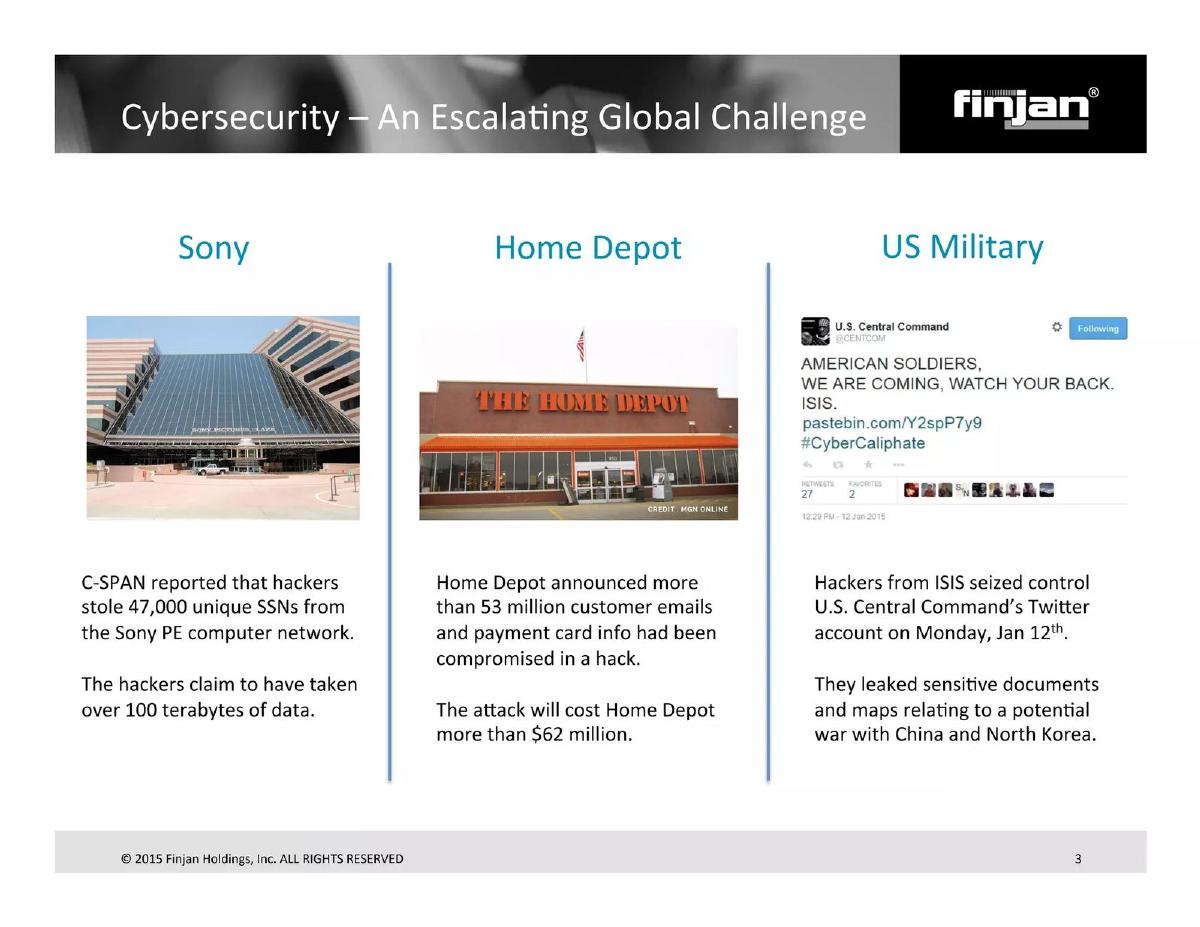
- The deck uses high-profile breaches at Sony and Home Depot to validate the ongoing relevance of their behavior-based threat detection patents (Slide 3).
- A detailed litigation timeline tracks active cases against major firms like FireEye, Blue Coat, and Symantec through 2016 (Slide 13).
- The company explicitly commits to 'Licensing Best Practices' to differentiate itself from 'patent trolls,' focusing on technology providers rather than end users (Slide 9).
- Historical R&D investment is cited at $65 million, providing a valuation floor for the underlying technology (Slide 5).
The IP Monetization Strategy of Finjan Holdings
The February 2015 investor presentation for Finjan Holdings (NASDAQ: FNJN) provides a rare look into the mechanics of a publicly traded intellectual property licensing firm. Unlike typical startup decks that focus on user growth or market share, Finjan’s deck is a study in legal assets, R&D legacy, and enforcement schedules. The company positions itself not just as a holder of patents, but as the foundational architect of modern behavior-based cybersecurity.
Slide 1: Title and Corporate Identity
The cover slide establishes Finjan Holdings, Inc. as a NASDAQ-listed entity (FNJN). The imagery of heavy industrial gears suggests a 'machine' or a foundational component, aligning with their slogan 'Advancing Innovation.' The date, February 1, 2015, marks a period when the company was actively transitioning its legacy technology into a structured licensing business.
Slide 3: The Global Cybersecurity Challenge
Finjan utilizes the 'Problem' slide to establish urgency. Rather than abstract threats, they cite three specific, high-profile breaches: Sony (47,000 SSNs stolen), Home Depot (53 million customer emails compromised, costing over $62 million), and the US Military (CENTCOM Twitter hack). This slide serves to validate the massive market need for the security technologies Finjan claims to have pioneered.
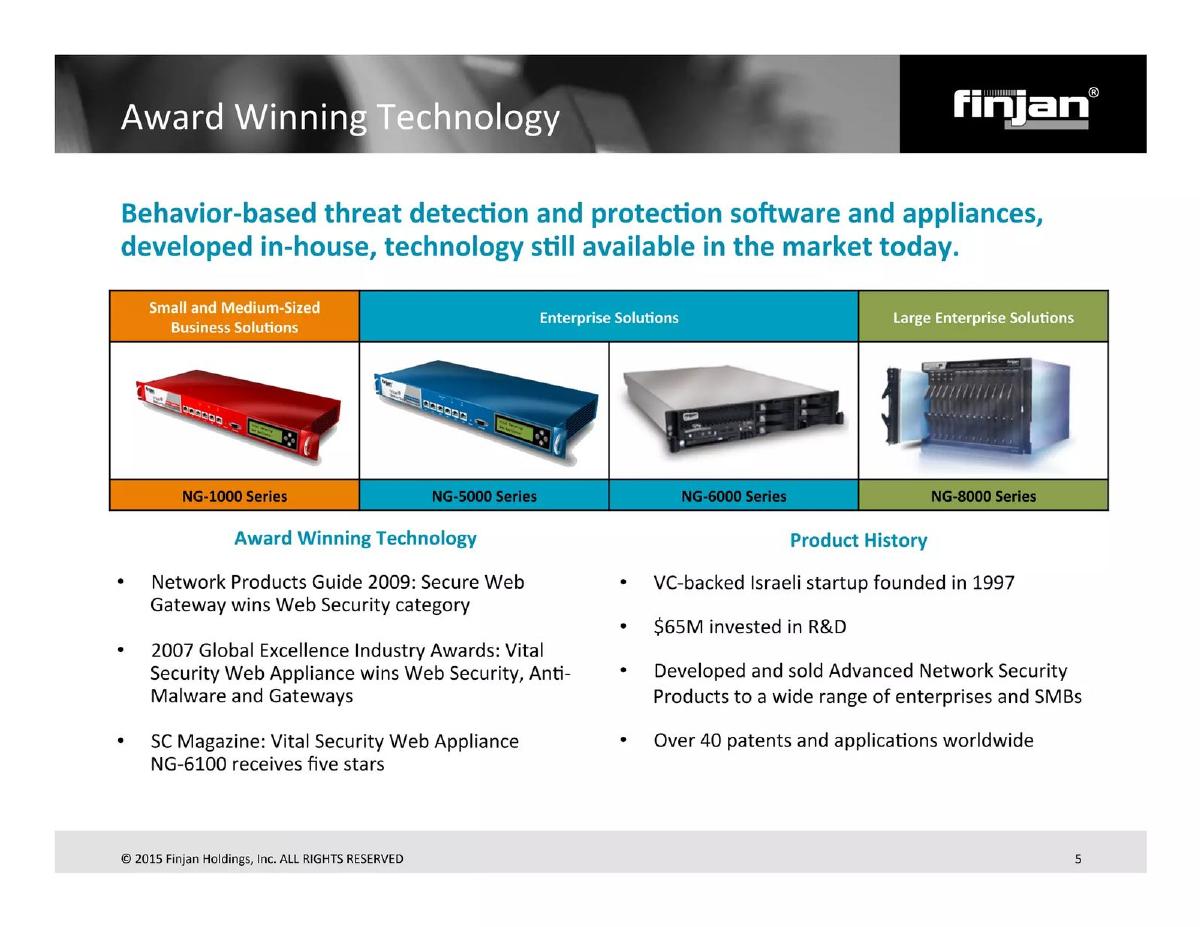
Slide 5: Award Winning Technology and History
This slide bridges the gap between a 'patent house' and a 'technology company.' It showcases their hardware legacy, including the NG-1000 through NG-8000 Series appliances. Key facts include:
Founded in 1997 as a VC-backed Israeli startup. · $65M invested in R&D to develop behavior-based threat detection. · Over 40 patents and applications worldwide. · Multiple industry awards from 2007 to 2009, including SC Magazine and Global Excellence Industry Awards.
Slide 7: Intellectual Property Portfolio
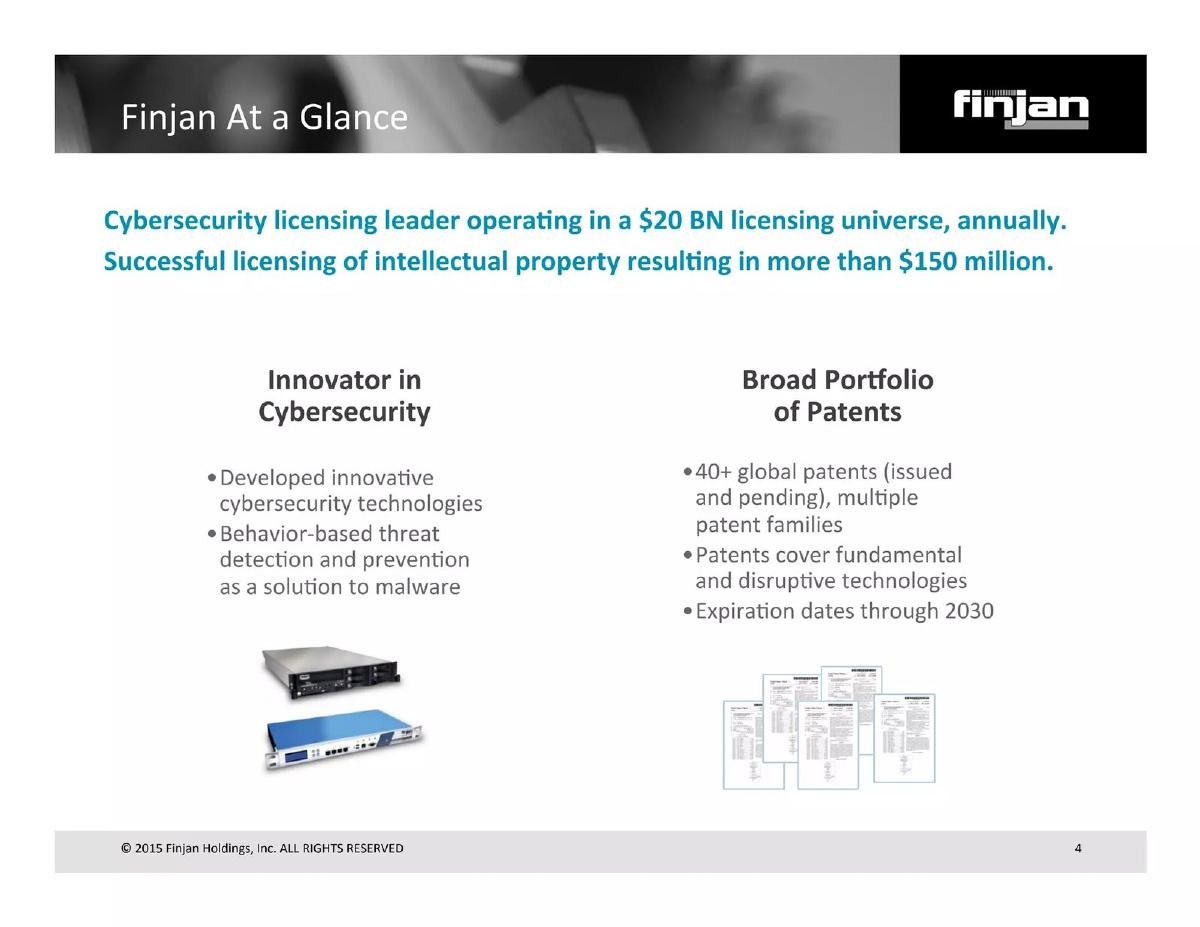
This is the 'Asset' slide. Finjan maps out a global footprint of 40+ issued and pending patent assets . The breakdown includes 22 issued U.S. patents and 11 issued foreign patents. Crucially, they note that their earliest priority dates go back to 1996 and expiration dates extend to 2030 and beyond . This suggests a long-term revenue tail for their current portfolio.
Slide 9: Commitment to Licensing Best Practices
Finjan addresses the 'patent troll' stigma head-on. They list seven core values, including a commitment to pursue technology providers and not end users . By emphasizing 'Judicial efficiency' and 'Fair value licenses,' they are pitching themselves as a professionalized, ethical participant in the IP market, which is vital for maintaining investor confidence and avoiding regulatory scrutiny.
Slide 11: Business Model Focused on Licensing
This slide quantifies the strategy. They split their activity into Licensing (80%) and Enforcement (20%) . They list a history of successful outcomes:
Licensing/Settlements (80%): Microsoft (2005), M86 Security (2009), Trustwave (2012), and Websense (2014). · Judgments (20%): Secure Computing (2007).
The arrow indicates a flow from enforcement actions toward settlements, which they claim 'reduces the binary risk of trial outcomes.'
Slide 13: Patent Enforcement Timeline
For a company like Finjan, the 'Product Roadmap' is actually a 'Litigation Roadmap.' This slide provides a detailed table of six concurrent litigations against FireEye, Blue Coat, Proofpoint, Sophos, Symantec, and Palo Alto Networks . It lists filing dates, specific courts (mostly NDCA), and upcoming milestones like Markman hearings and Trial dates through Q1 2016. This level of transparency allows investors to model potential 'catalyst' events.
Slide 15: Management Team
The team is built for IP warfare. Phil Hartstein (CEO) is described as a 'seasoned IP veteran' with experience at IP Navigation Group and Rembrandt IP. Michael Noonan (CFO) is credited with helping a former company earn more than $140M in licensing revenues. The presence of two VPs dedicated to Legal Operations and IP Licensing (Julie Mar-Spinola and Ivan Chaperot) reinforces that the company's core competency is legal and strategic, not just technical.
Slide 17: Investor Information and Recent News
This slide provides the hard data required for public market investors:
Shares Outstanding: 22,443,552. · Cash: ~$20 Million. · Debt: $0. · Recent News: A $5 million Q3 licensing revenue report and the sale of a subsidiary for $675,000.
This paints a picture of a well-capitalized microcap with significant upside if their pending litigations result in settlements.
Slide 19: Contact Information
The deck concludes with direct contact info for the CFO, Michael D. Noonan, based in Menlo Park, CA. This is standard for an investor relations deck intended for institutional or sophisticated individual investors.
What Finjan Does Well
Finjan excels at de-risking a controversial business model . By framing patent enforcement as a 'best practice' and providing a clear timeline of legal milestones, they turn speculative litigation into a structured business process. They also successfully leverage their $65M R&D history to prove they aren't just buying patents to sue, but are protecting their own 'in-house' innovations. The financial transparency—specifically the $0 debt and $20M cash position—provides a 'margin of safety' argument for investors.
What is Missing from the Deck
The deck is missing forward-looking revenue guidance . While they list the companies they are suing, they do not provide estimated settlement ranges or royalty rates, likely for legal reasons. There is also a lack of competitive analysis regarding other IP firms or defensive patent aggregators (like RPX) that might oppose their efforts. Finally, while they mention 'behavior-based threat detection,' there is very little technical detail on how their 1996-era patents actually apply to 2015-era cloud security, which is the core of their legal arguments.
Founder Takeaways: The IP Playbook
Founders can learn two major lessons from this deck. First, IP is a balance sheet asset . Even if your product fails, a $65M R&D investment can be recovered through a disciplined licensing strategy if your patents are foundational. Second, transparency builds trust . If your business model involves litigation or other 'binary' risks, providing a clear schedule of events (as seen on Slide 13) helps investors manage their expectations and stay committed through long cycles. Finjan shows that you don't have to hide the 'ugly' parts of a business model if you can wrap them in a professional, ethical framework.
Frequently asked questions
- What is Finjan's primary source of revenue according to the deck?
- Finjan's revenue model is centered on intellectual property. Slide 11 indicates that 80% of their focus is on licensing agreements, while 20% is on enforcement. They list successful past licensing or settlements with companies such as Microsoft (2005), M86 Security (2009), and Trustwave (2012). The deck frames this as a way to reduce the 'binary risk' of trial outcomes.
- How does Finjan justify the value of its patent portfolio?
- The company points to its history as a pioneer in behavior-based threat detection. Slide 5 notes that the company was founded in 1997 as a VC-backed Israeli startup and invested $65 million in R&D. By highlighting that their technology is 'still available in the market today,' they argue that modern cybersecurity infrastructure relies on their early innovations.
- Who are the key competitors Finjan is currently litigating against?
- Slide 13 provides a 'Patent Enforcement Timeline' listing active litigations. As of the presentation date, Finjan had filed lawsuits against FireEye, Blue Coat, Proofpoint, Sophos, Symantec, and Palo Alto Networks. The slide tracks these cases through various stages, including Markman hearings and scheduled trial dates in 2015 and 2016.
- What are the 'Licensing Best Practices' mentioned in the deck?
- Finjan dedicates Slide 9 to its commitment to ethical licensing. These practices include pursuing technology providers instead of end users, conducting reasonable diligence, maintaining transparency of intent, and offering fair value settlements. This is a strategic inclusion intended to signal to investors that they are a 'legitimate' IP house rather than a predatory litigator.
- What is the financial status of the company at the time of this deck?
- According to Slide 17, Finjan was a member of the Russell Microcap index with 22,443,552 shares outstanding. They reported approximately $20 million in cash and zero debt. The 52-week stock price range was $1.97 to $6.04, and they had recently reported $5 million in Q3 licensing revenue.