Quambase is positioning itself as a specialized infrastructure layer for high-complexity education, specifically targeting 'Hard Tech' and sciences. Their MMMAP (Multi Model Multi Agent Engine) is described as a proprietary Edge AI knowledge delivery system intended to lower the barrier to entry for fields like Quantum Mechanics and Drug Interaction. The deck focuses heavily on the Indian market, citing a projected growth in the Learning Management System (LMS) sector from USD 490 Million in 2021 to USD 2931 Million by 2030. While the vision is expansive, the deck relies on high-level concept…
Key takeaways
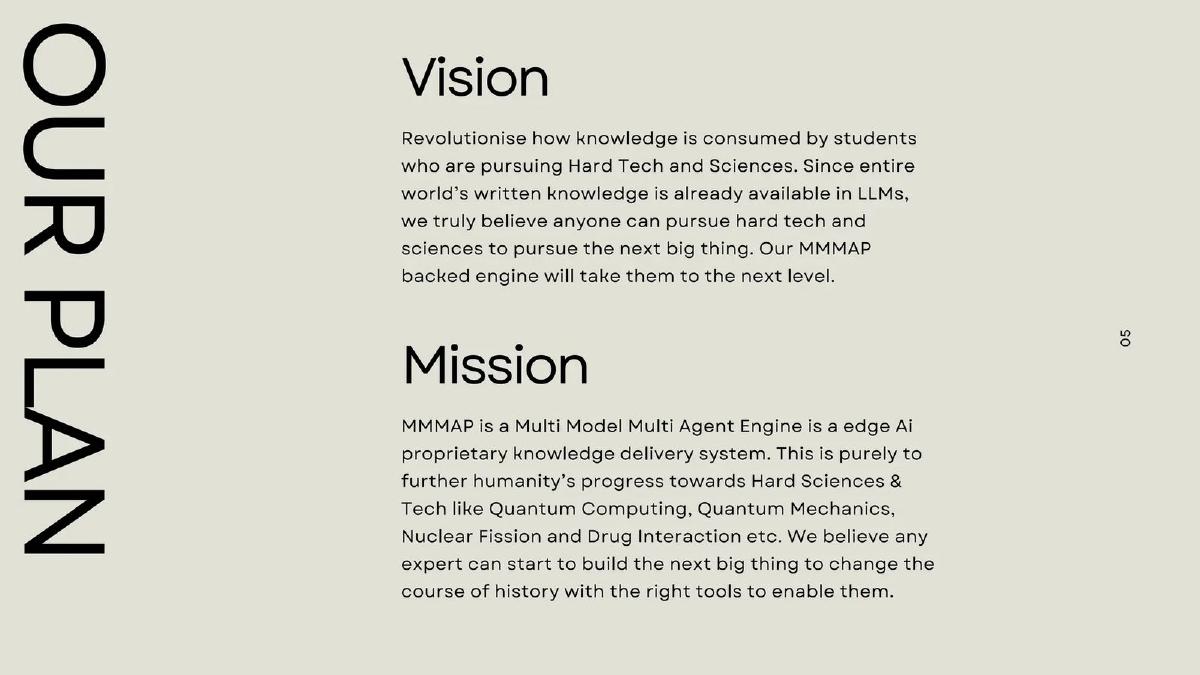
- The company defines MMMAP as a Multi Model Multi Agent Engine and a proprietary edge AI knowledge delivery system (Slide 05).
- Quambase targets high-complexity subjects including Quantum Computing, Nuclear Fission, and Drug Interaction (Slide 05).
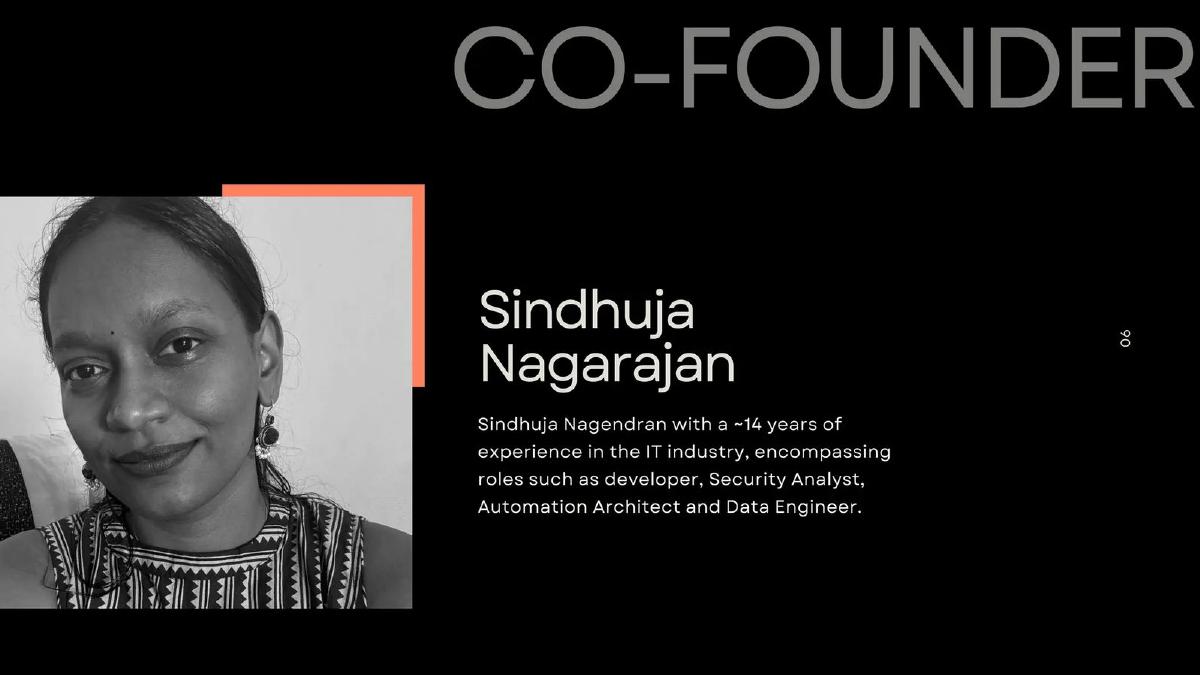
- Co-founder Hemanathan Bhoopathi brings approximately 10 years of IT experience, including roles as QA Lead and Test Automation Architect (Slide 07).
- The business model includes subscription pricing for mobile/web apps and custom contract-based pricing for backend cloud deployment (Slide 11).
- A hardware component is mentioned for schools and colleges, featuring customized hardware with projector capabilities (Slide 11).
- The Indian LMS market is projected to grow at a CAGR of 21.66% from 2021 to 2030 (Slide 13).
- The market size for Indian LMS is expected to reach USD 2931 Million by 2030, up from USD 490 Million in 2021 (Slide 13).
- The deck omits a specific funding ask, current valuation, or existing revenue metrics (Slides 01-15).
Executive Summary: The Edge AI Play for Hard Tech
Quambase enters the crowded AI education space with a very specific angle: the democratization of 'Hard Tech.' While most AI tutors focus on general K-12 or language learning, Quambase's MMMAP engine is built for the highest levels of scientific inquiry. The deck, dated 2025 on the title slide, reflects a post-LLM-hype world where the founders acknowledge that 'entire world’s written knowledge is already available in LLMs' (Slide 05) and argue that the value now lies in the delivery and consumption engine rather than just the data itself.
Slide 01: Title and Branding
The deck opens with a minimalist black background featuring the text 'MMMAP Intelligence Delivery Engine.' It includes the URL www.quambase.com and the year 2025. The branding is stark, positioning the company more as a technical infrastructure provider than a consumer ed-tech brand. The use of the word 'Engine' immediately signals a B2B or platform-as-a-service (PaaS) orientation.
Slide 03: The Value Proposition
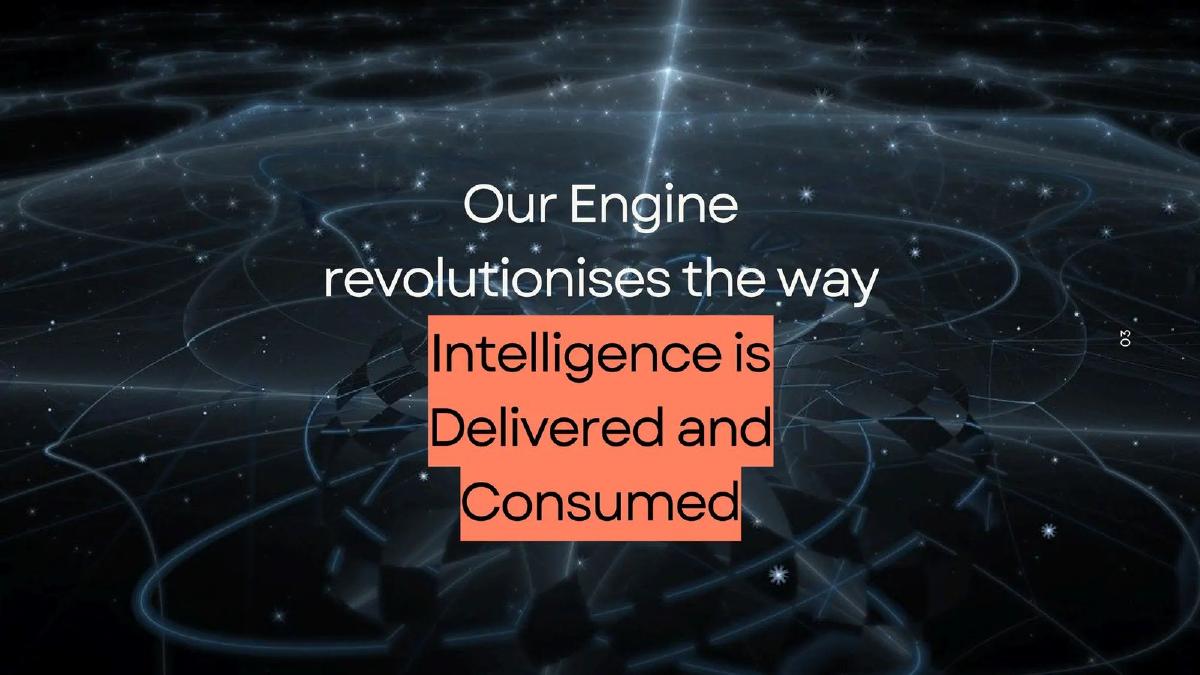
Slide 03 uses a high-level conceptual image of a network or neural web. The central claim is that the engine 'revolutionises the way Intelligence is Delivered and Consumed.' This is a bold claim that lacks immediate supporting evidence on this slide, serving instead as a thematic bridge to the vision and mission statements that follow. It sets the stage for a shift from static learning to dynamic 'intelligence delivery.'
Slide 05: Vision and Mission
This is the most text-heavy and informative slide regarding the company's core philosophy. The vision is to empower students in 'Hard Tech and Sciences.' A key insight is shared here: because LLMs have already indexed global knowledge, the barrier to entry for complex fields is no longer the availability of information, but the ability to process it. The mission defines MMMAP as a 'Multi Model Multi Agent Engine' and an 'edge Ai proprietary knowledge delivery system.' The slide explicitly lists target verticals: Quantum Computing, Quantum Mechanics, Nuclear Fission, and Drug Interaction. This specificity is a strength, as it carves out a niche far away from generic AI assistants.
Slide 07: The Team
The deck introduces Co-Founder Hemanathan Bhoopathi. His profile highlights 10 years of experience in IT, specifically as a QA Lead, Developer, and Test Automation Architect. While this establishes technical competency in software delivery and quality assurance, the slide does not mention specific experience in AI research, physics, or the 'Hard Tech' sectors the company aims to serve. In a full pitch, investors would likely look for complementary founders with academic or deep-tech backgrounds in the sciences mentioned on Slide 05.
Slide 09: The Challenge
The 'Challenge' slide identifies four key points. First, it notes that India's growing economy requires innovative, high-speed knowledge delivery. Second, it points out that 'Hard Tech learning costs has never been higher,' positioning MMMAP as a cost-reduction tool. Third, it reiterates the 'Edge AI' nature of the product, claiming it can be deployed anywhere, including for internal employee training. Finally, it mentions that the architecture leverages open-source tooling, which provides 'flexibility and customisation.' This slide attempts to solve two problems at once: the high cost of specialized education and the deployment friction of AI in enterprise environments.
Slide 11: Product and Pricing
Quambase outlines a four-pronged product strategy. The mobile app is for 'quick accessibility,' while the web app offers 'additional capability on choosing the right model right agent and tools.' Both use subscription pricing. The third prong is the backend architecture, which can be deployed on client cloud servers via 'Custom Contract Based Pricing.' Interestingly, the fourth prong is a hardware play: 'customized hardware with projector capabilities' for schools and colleges. This suggests a hybrid model that isn't purely software-based, which could impact margins and scalability but provides a physical moat in traditional educational institutions.
Slide 13: Market Opportunity
The deck focuses exclusively on the Indian Learning Management Systems (LMS) market. Citing Straits Research, the slide shows a bar chart with a clear upward trajectory. The market is valued at USD 490 Million in 2021 and is projected to reach USD 2931 Million by 2030. The CAGR of 21.66% is healthy, but the slide doesn't explicitly explain how much of this market is 'Hard Tech' vs. general corporate training or K-12, which are very different buyers.
Slide 15: Conclusion
The deck ends with a simple 'Thank you' slide, repeating the URL and the 2025 date. There is no call to action, no contact information for the founders beyond the website, and no summary of the investment opportunity.
What Quambase Does Well
The primary strength of this deck is its niche focus . By explicitly naming Quantum Computing and Nuclear Fission, Quambase moves away from the 'AI for everything' trap that many startups fall into. They are identifying a specific pain point: high-level technical knowledge is hard to parse, even with a standard LLM. Their focus on the Indian market is also strategic, as it is one of the largest and fastest-growing education markets globally. The inclusion of a multi-tiered pricing model (Slide 11) shows they have thought about different customer segments, from individual students to large-scale institutional deployments.
What is Missing from the Deck
The most glaring omission is traction . There are no mentions of pilot programs, user numbers, or partnerships with the universities or 'Hard Tech' companies they aim to serve. Furthermore, the product itself is never shown . There are no screenshots of the mobile app, the web interface, or the 'customized hardware' mentioned on Slide 11. For a 2025 deck, investors would expect to see at least a prototype or a demonstration of how the 'Multi Agent Engine' actually delivers a complex concept like nuclear fission differently than a standard ChatGPT prompt. Finally, there is no 'Ask' slide . We do not know how much money they are raising, what the milestones are, or how the funds will be allocated.
Founder Recommendations
If you are building a similar 'Intelligence Engine,' take note of how Quambase defines its architecture (Multi-Model, Multi-Agent, Edge AI). This technical specificity is better than just saying 'AI-powered.' However, to improve this deck, a founder should: 1. Show, don't just tell. Include a slide with a UI walkthrough that demonstrates the 'agent' workflow. 2. Align the team to the mission. If you are targeting Quantum Mechanics, you need a physicist or a subject matter expert on the team slide to provide credibility. 3. Quantify the 'Hard Tech' market. The LMS market is broad; showing the specific spend on technical training or specialized engineering education would make the case stronger. 4. Include a clear roadmap. Since this is a 2025 deck, a timeline showing the transition from software to the hardware/projector phase would help explain the capital requirements.
Frequently asked questions
- What exactly is the MMMAP engine?
- According to slide 05, MMMAP stands for Multi Model Multi Agent Engine. It is described as a proprietary Edge AI knowledge delivery system. The goal of this engine is to revolutionize how knowledge is consumed, specifically for students pursuing 'Hard Tech' and sciences. It leverages open-source tooling to allow for flexibility and customization in how intelligence is delivered to either employees or customers.
- Which specific industries or subjects does Quambase target?
- The deck identifies a niche focus on 'Hard Sciences & Tech.' Slide 05 specifically lists Quantum Computing, Quantum Mechanics, Nuclear Fission, and Drug Interaction. The overarching mission is to enable experts and students to build the 'next big thing' by providing them with advanced tools to master these complex subjects with a minimum barrier to entry.
- How does Quambase plan to generate revenue?
- Slide 11 outlines a multi-tiered pricing strategy. They offer subscription-based pricing for their mobile and web applications. For enterprise clients, they offer custom contract-based pricing for deploying the MMMAP backend architecture on the client's cloud servers. Additionally, they propose a subscription model for schools and colleges that includes customized hardware with projector capabilities.
- What market data supports the Quambase business case?
- Quambase focuses on the Indian education technology sector. Slide 13 provides a market forecast from Straits Research, showing the Indian Learning Management Systems (LMS) market growing from USD 490 Million in 2021 to nearly USD 3 Billion by 2030. This represents a 21.66% CAGR, suggesting a rapidly expanding environment for digital education tools.
- Who is leading the company according to the deck?
- Slide 07 introduces Hemanathan Bhoopathi as a Co-Founder. His background includes roughly 10 years in the IT industry. His specific technical expertise is listed as being a QA Lead, Developer, and Test Automation Architect. The deck does not provide details on other co-founders or the broader management team in the provided slides.