The Forethought deck from 2018 is a concise 8-slide presentation that successfully navigated the transition from a broad 'information retrieval' vision to a specific, high-value use case in customer support. Despite its brevity, the deck provides a comprehensive view of why the company was investable at the time: an elite technical team with backgrounds at Palantir, Facebook, and LinkedIn, and impressive early traction including seven paid pilots within just four months. The deck avoids the common pitfall of over-explaining AI mechanics, instead focusing on the '30% decrease in time to resolu…
Key takeaways
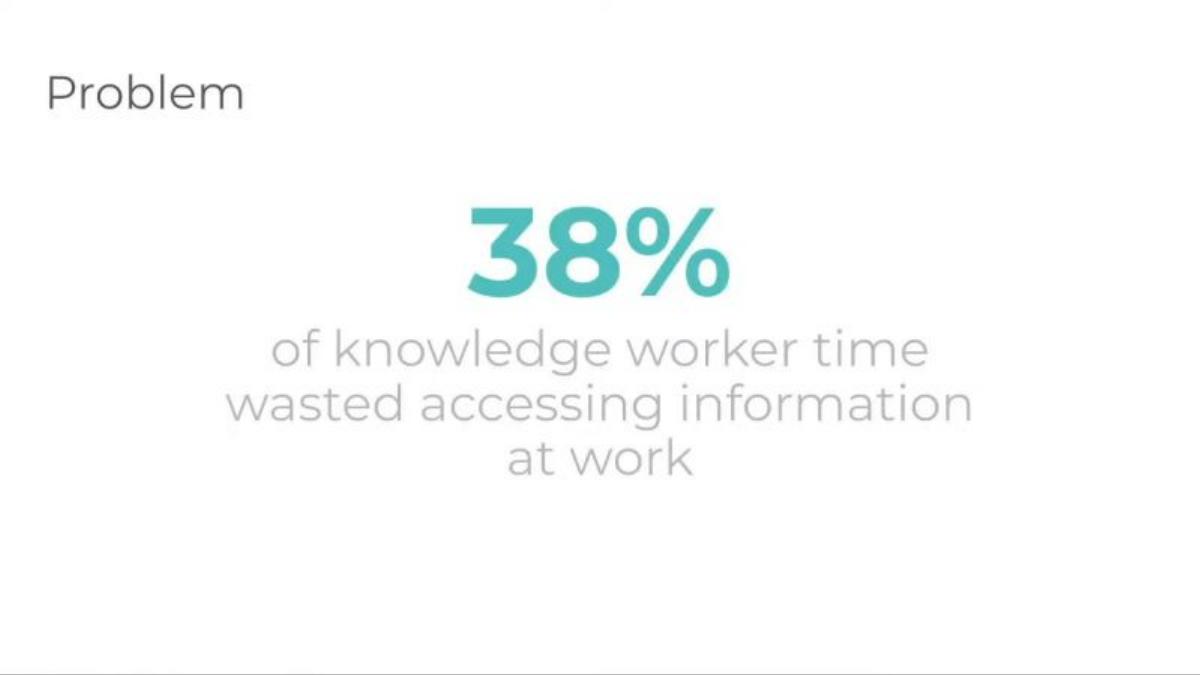
- The deck identifies a massive productivity gap, stating on slide 3 that 38% of knowledge worker time is wasted accessing information.
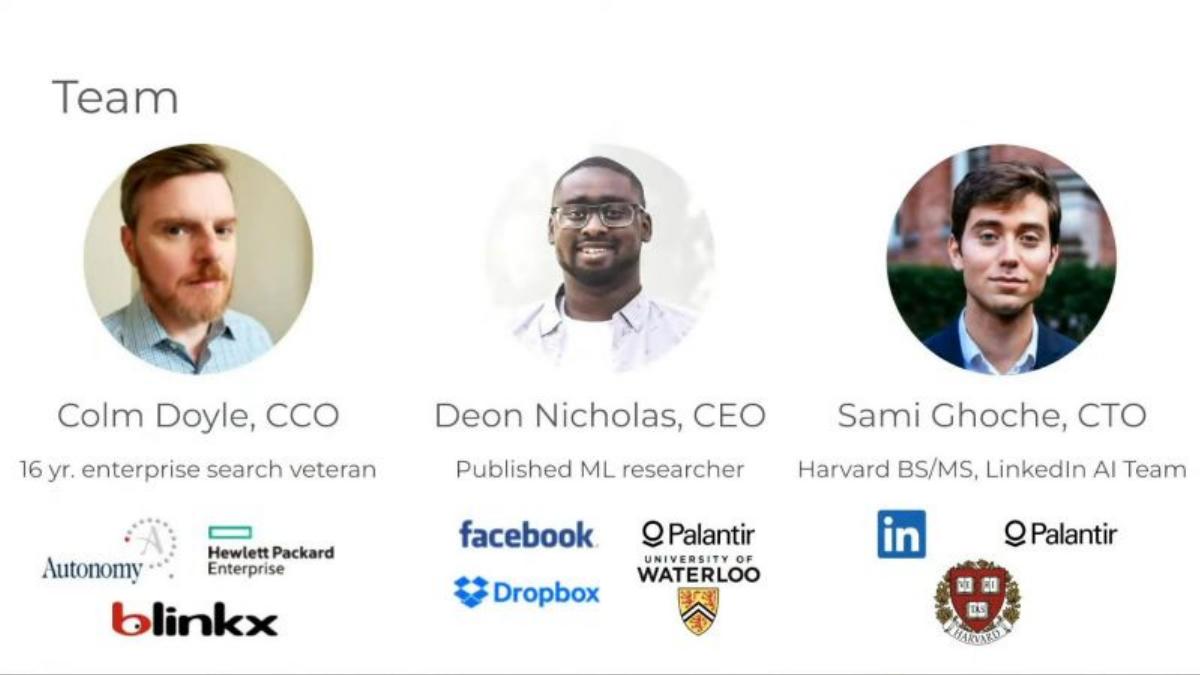
- The team slide (slide 2) leverages significant brand equity, featuring logos from Facebook, Palantir, LinkedIn, and Harvard to establish technical credibility.
- Forethought narrows its broad vision of 'information retrieval' to a specific first application: customer support organizations (slide 5).
- Traction is quantified through a pipeline of 20+ customers representing $9M+ in potential ARR deal value (slide 6).
- The startup achieved a 100% conversion rate of eligible pilots into annual customers within its first four months (slide 6).
- Product efficacy is proven via double-blind A/B tests showing a 30% decrease in time to resolution (slide 7).
- The deck completely omits a financial ask, competition slide, or detailed business model, focusing entirely on product-market fit indicators.
- The product, branded as 'Agatha Answers,' is positioned as a layer that connects to all enterprise data sources and integrates with Zendesk and Salesforce (slide 5).
The Power of Brevity: Forethought’s 8-Slide Traction Deck
The 2018 Forethought deck is a study in efficiency. At only eight slides—one of which is a title slide and another a promotional slide for a third-party site—the core pitch is delivered in just six slides. For a company operating in the complex world of Artificial Intelligence and enterprise search, the temptation to dive into neural network architectures or data ingestion protocols is high. Forethought resisted this, choosing instead to focus on the three things that matter most to early-stage investors: a team that can build it, a problem worth solving, and data proving that customers will pay for it.
Slide 1: The Vision Statement
The title slide introduces the company name and a clear, one-sentence value proposition: "Information retrieval embedded into employee workflows." This is a high-level vision that suggests a platform play, rather than a single-feature tool. The branding is clean, using a teal background that carries through the rest of the presentation.
Slide 2: The Pedigree Slide
Forethought places its team slide immediately after the title. This is a strategic move often used by founders with 'blue chip' backgrounds. The slide features three principals: Colm Doyle (CCO) , a 16-year enterprise search veteran; Deon Nicholas (CEO) , a published ML researcher with stints at Facebook, Palantir, and Dropbox; and Sami Ghoche (CTO) , a Harvard graduate and former member of the LinkedIn AI Team. By showcasing logos from Palantir, Facebook, Dropbox, and Harvard , the company establishes immediate technical credibility before even defining the problem.
Slide 3: Quantifying the Pain
The problem slide is minimalist. It features a single large statistic: "38% of knowledge worker time wasted accessing information at work." This slide serves to anchor the investor in the scale of the inefficiency Forethought intends to solve. It doesn't list multiple pain points; it focuses on the primary cost driver: lost time.
Slide 4: The Architectural Vision
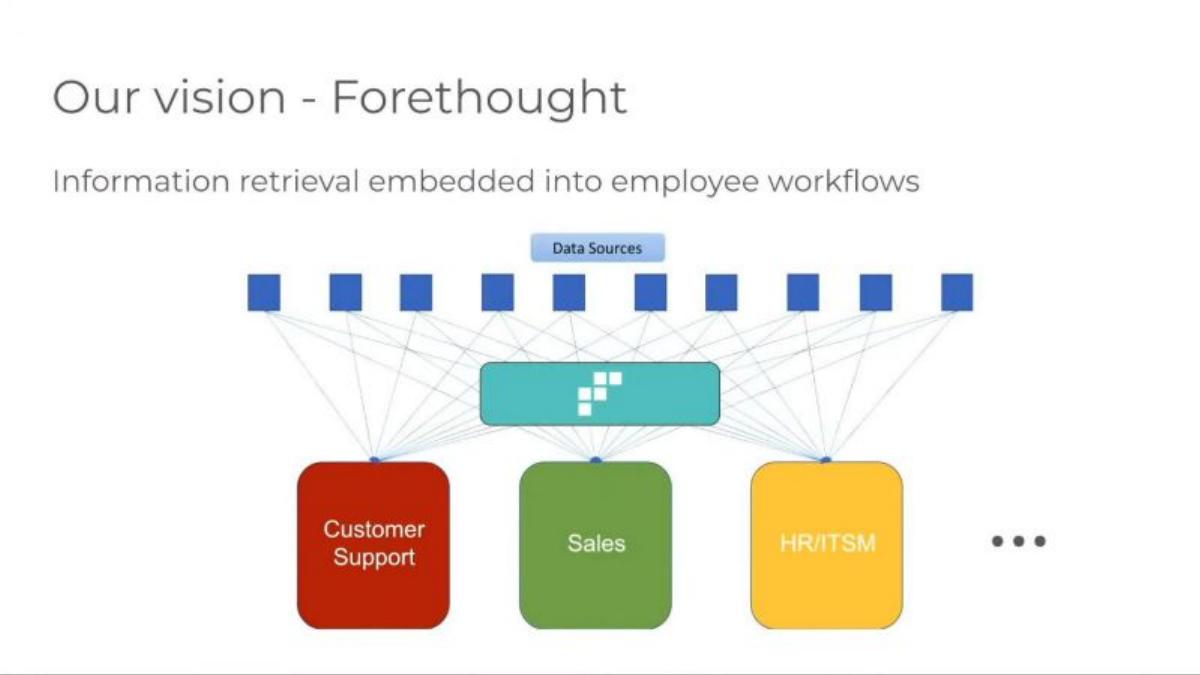
Slide 4, titled "Our vision - Forethought," uses a diagram to explain how the product sits between data sources and various business units. The diagram shows multiple blue squares (Data Sources) feeding into a central Forethought engine, which then outputs to Customer Support, Sales, and HR/ITSM . This slide communicates that while they are starting in one area, the technology is horizontally scalable across the entire enterprise.
Slide 5: The First Use Case (Agatha Answers)
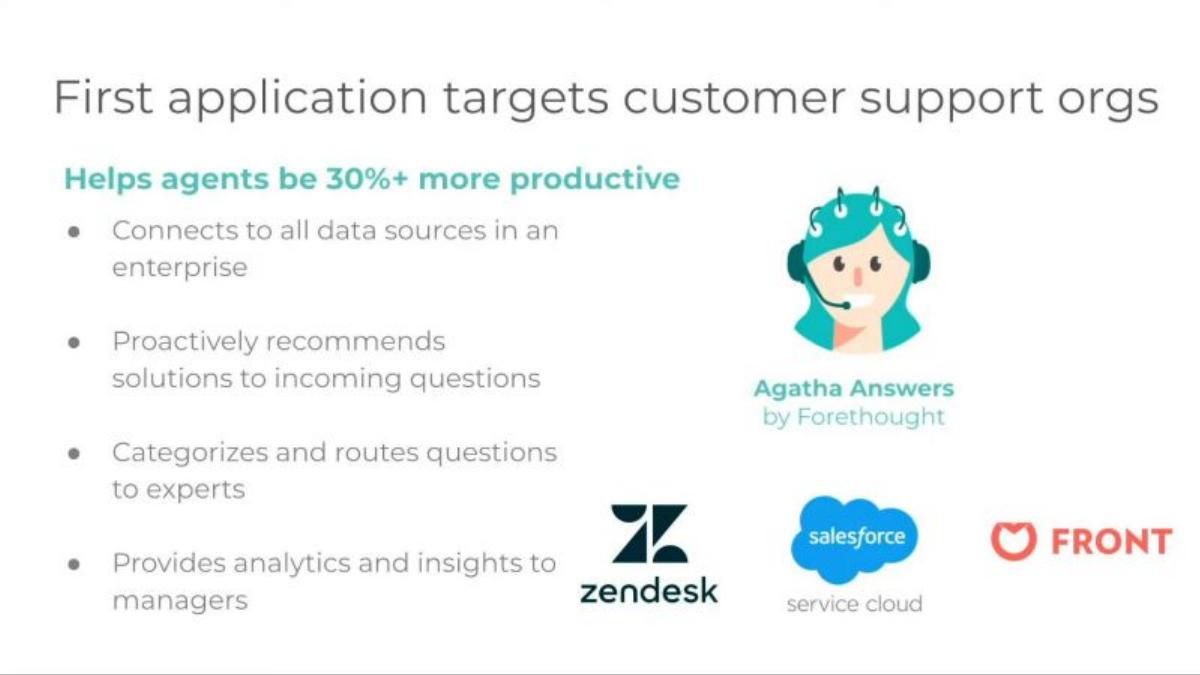
This slide transitions from the broad vision to the specific product: "First application targets customer support orgs." It introduces "Agatha Answers by Forethought," claiming it "Helps agents be 30%+ more productive." The slide lists four key features: connecting to all data sources, proactively recommending solutions, categorizing/routing questions, and providing analytics. Crucially, it displays logos for Zendesk, Salesforce Service Cloud, and Front , signaling that the product is built to live within the tools support agents already use.
Slide 6: The Traction Proof Point
This is arguably the most important slide in the deck. It breaks down the company's early momentum into four categories:
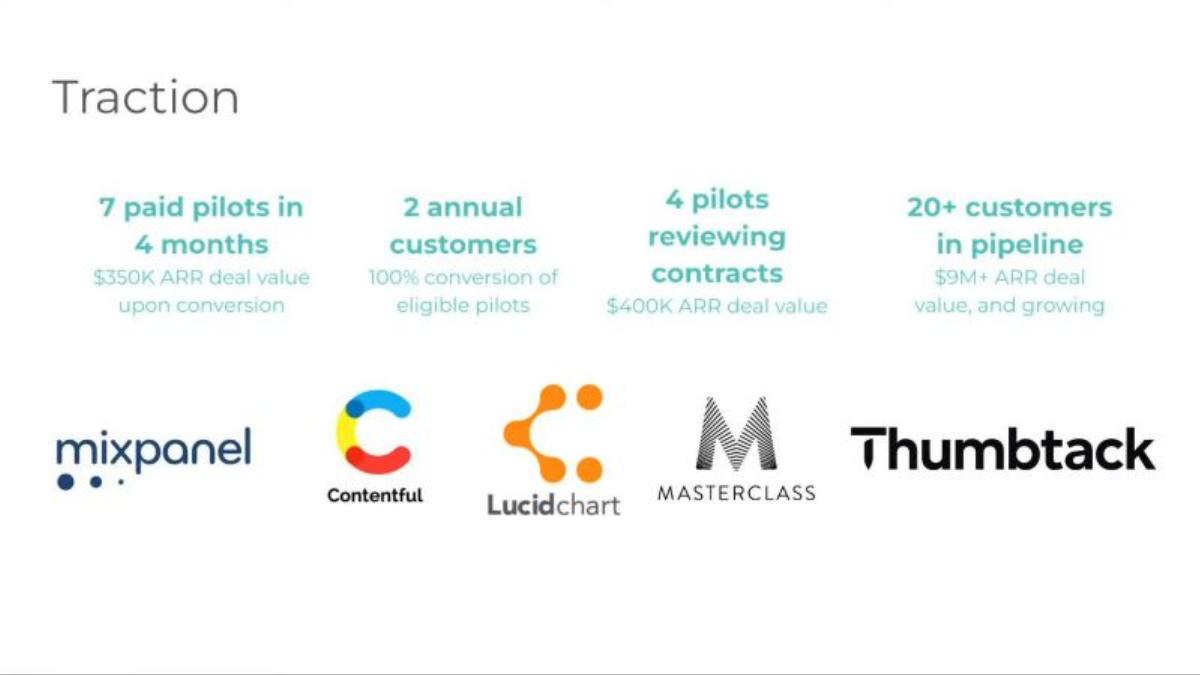
7 paid pilots in 4 months: $350K ARR deal value upon conversion. · 2 annual customers: 100% conversion of eligible pilots. · 4 pilots reviewing contracts: $400K ARR deal value. · 20+ customers in pipeline: $9M+ ARR deal value, and growing.
The slide also features logos of recognizable early adopters like Mixpanel, Contentful, Lucidchart, Masterclass, and Thumbtack . This level of traction for a seed-stage AI company is exceptional and likely did the heavy lifting for the fundraise.
Slide 7: The Efficacy Data
Titled "By the numbers," this slide provides the results of double-blind A/B tests. It lists four specific improvements: a 30% decrease in Time to Resolution , a 41% Exact Answer Usage Rate , a 7.6% decrease in Ticket Reopens , and a 10% increase in 1-touch tickets . These are the specific KPIs that customer support leaders are measured on, proving that the product delivers a clear ROI.
Slide 8: External Promotion
The final slide in this specific version of the deck is a promotional slide for bestpitchdeck.com and does not contain company information.
What Forethought Did Right
The strength of this deck lies in its specificity . Many AI startups fail by being too academic. Forethought, however, translated their machine learning expertise into a concrete business outcome: making support agents 30% more productive. They also used their Team Slide as a shield; by showing they had veterans from Palantir and Facebook, they bypassed the need to explain their underlying technology in depth. The Traction Slide (Slide 6) is a masterclass in showing momentum, specifically the '100% conversion of eligible pilots' metric, which is a powerful indicator of product-market fit.
What Is Missing from the Deck
While successful, this deck is missing several components typically expected in a Series A or even a late Seed round:
Competition: There is no mention of existing enterprise search players or other AI support tools. · Business Model: The deck mentions 'ARR deal value' but does not explain the pricing structure (e.g., per seat, per resolution, or tiered). · Market Size: There is no TAM (Total Addressable Market) analysis to show how big the company could become if they expand beyond customer support. · The Ask: The deck does not state how much capital is being raised or how it will be allocated.
The omission of these slides suggests this deck may have been used as a 'teaser' or as a visual aid for a presentation where the founders provided the missing context verbally.
Founder Takeaway: Focus on the 'So What?'
Founders should copy Forethought's approach to outcome-based metrics . Instead of saying 'our AI is faster,' they said '30% decrease in time to resolution.' They also demonstrated a clear path from a broad vision (Slide 4) to a narrow, high-traction entry point (Slide 5). For early-stage companies, proving you can win a specific niche is often more valuable than claiming you will win every market simultaneously. Finally, the use of social proof —both through team logos and customer logos—creates a sense of inevitability that is highly attractive to investors.
Frequently asked questions
- What is the primary value proposition of Forethought according to the deck?
- The primary value proposition is increasing employee productivity by embedding information retrieval into existing workflows. On slide 5, the company claims its first application, Agatha Answers, helps customer support agents become 30% more productive by proactively recommending solutions and categorizing incoming questions based on all existing enterprise data sources.
- How does the deck establish the technical capability of the founders?
- The deck uses slide 2 to highlight an 'elite' team. CEO Deon Nicholas is noted as a published ML researcher with experience at Facebook, Palantir, and Dropbox. CTO Sami Ghoche holds a Harvard BS/MS and worked on the LinkedIn AI Team. CCO Colm Doyle is described as a 16-year enterprise search veteran from Autonomy and HP. This combination of research depth and industry experience is a core pillar of the pitch.
- What specific metrics are used to prove the product works?
- Slide 7, titled 'By the numbers,' cites four key metrics based on early pilots and double-blind A/B tests: a 30% decrease in time to resolution, a 41% exact answer usage rate, a 7.6% decrease in ticket reopens, and a 10% increase in '1-touch' tickets. These metrics directly address the pain points of customer support managers.
- Is there a clear go-to-market strategy in this deck?
- The GTM strategy is implied rather than explicitly detailed. Slide 5 shows integrations with major platforms like Zendesk, Salesforce Service Cloud, and Front. Slide 6 demonstrates a 'land and expand' or pilot-heavy approach, showing that they successfully converted 100% of eligible pilots into annual customers, suggesting a focus on high-touch enterprise sales.
- What essential pitch deck components are missing from this presentation?
- This is a very lean deck. It lacks a 'Competition' slide, a 'Business Model' slide (pricing is not mentioned), a 'Market Size' (TAM/SAM/SOM) slide, and a 'The Ask' slide detailing how much money they are raising and what the milestones will be. It functions more as a traction and team highlight reel than a full business plan.