Paid Pilot Slides: Pilot Price and Conversion in 6 Real
How founders show what a paid pilot cost and whether it became a contract: six real pitch deck slides, what each one actually states.
How to Show a Paid Pilot's Price and Its Conversion to a Contract
Six slides from real pitch decks that put a price on a pilot or report what happened after it. We record what each slide states and what it leaves out.
TL;DR
An investor reading a pilot slide wants four numbers: what the customer paid for the pilot, how long it ran, what contract followed, and how many pilots converted out of how many that finished. Only Paramark states both a pilot fee and the signed contract that followed it, for two unnamed customers. Forethought states a conversion count. The others give one piece: a price with no outcome (Blurbiz), a total with no split (Globe Keeper), a rate with no count (Gable), or a forecast labelled as the result of success (Chatter Research).
None of the six slides states how long a pilot ran or what the pilot had to achieve to count as a success. If you have those facts, they are the part of this slide that most decks leave out.
Paid pilot slides from real pitch decks
Each example shows the exact page from the original public deck above its analysis and links to the full teardown. Figures are the companies' own and have not been verified. Page numbers are PDF pages.
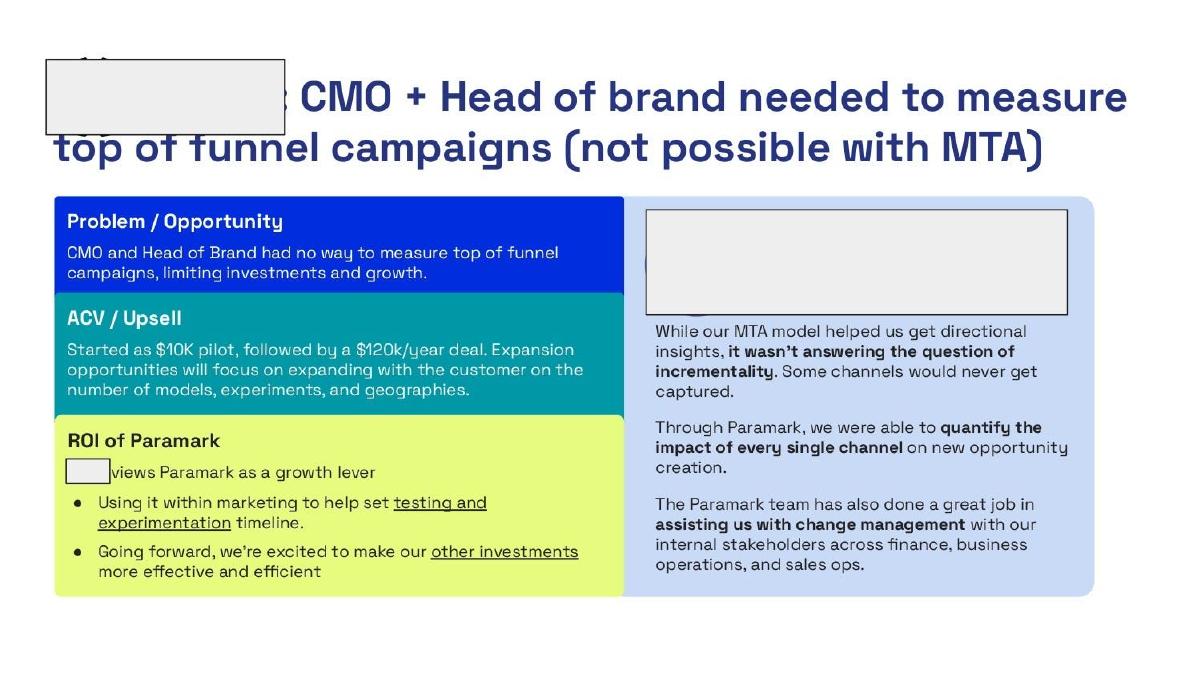
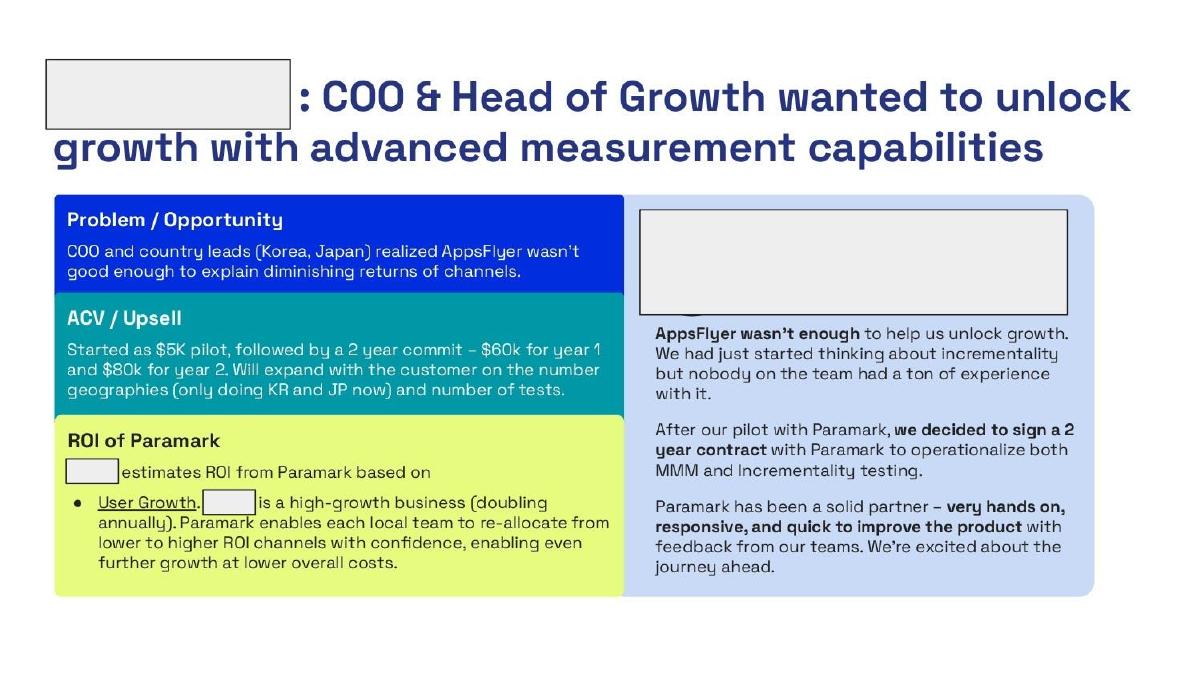
Paramark traction slide — slides 30–31
Marketing measurement software. Two customer case slides; customer names are redacted in the published deck.
Paramark deck, slide 30. Exact stored slide matched to this analysis.Paramark deck, slide 31. Exact stored slide matched to this analysis.
Our analysis: It is the only example here that states both what the customer paid for the pilot and the signed contract that followed, so the step from pilot to contract (by our calculation, the first year's contract value is 12 times the pilot fee in both cases) can be read directly.
Evidence and limitation: Neither slide says how long the pilot lasted, what it had to show, or how many other pilots did not convert. Two chosen cases are not a conversion rate.
What a founder can adapt: For each converted pilot, give the pilot fee, the contract value and its term on one line, and let a customer quote confirm the contract was signed.
Supporting analysis
What the deck claims: Slide 30, "ACV / Upsell": "Started as $10K pilot, followed by a $120k/year deal." Slide 31: "Started as $5K pilot, followed by a 2 year commit - $60k for year 1 and $80k for year 2." A customer quote on slide 31: "After our pilot with Paramark, we decided to sign a 2 year contract."
Presentation choice: It is the only example here that states both what the customer paid for the pilot and the signed contract that followed, so the step from pilot to contract (by our calculation, the first year's contract value is 12 times the pilot fee in both cases) can be read directly.
When it does not fit: Neither slide says how long the pilot lasted, what it had to show, or how many other pilots did not convert. Two chosen cases are not a conversion rate.
AI customer-support software. The teardown is labelled as its seed deck.
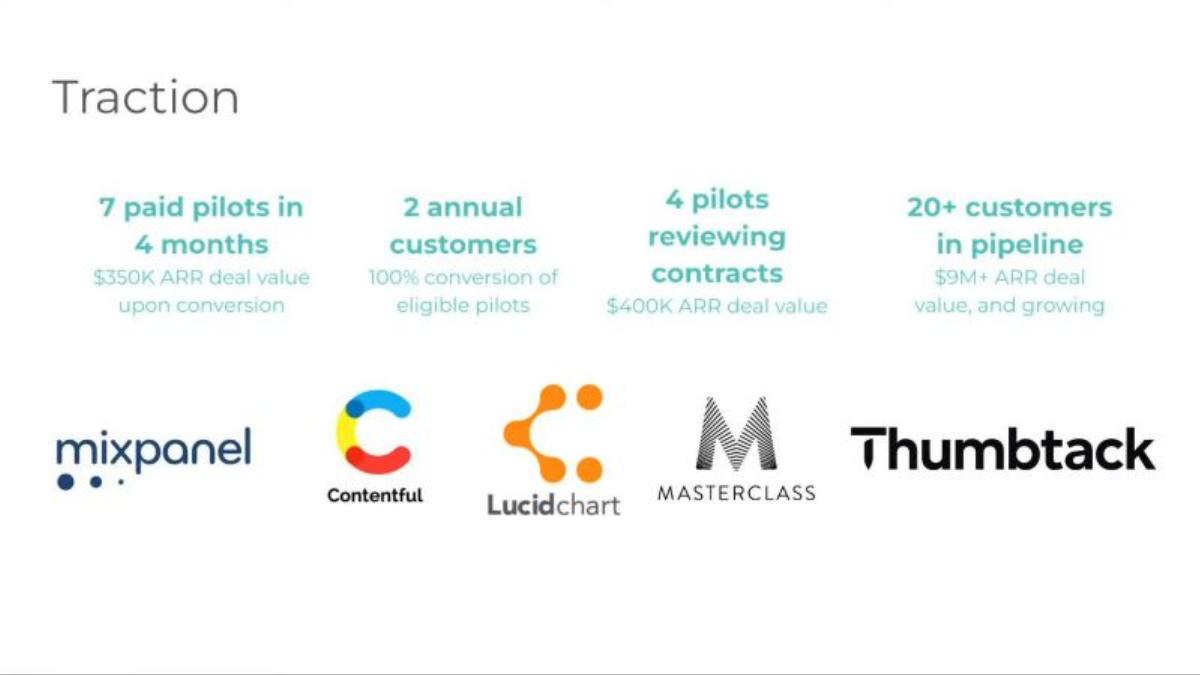
Forethought deck, slide 6. Exact stored slide matched to this analysis.
Our analysis: It gives conversion as counts at each stage, so a reader can see that 2 of 7 pilots have converted and 4 are undecided, rather than a single flattering rate.
Evidence and limitation: "Eligible" is not defined, the pilot fee is not stated, and the ARR figures are deal values on conversion, not signed contracts. The "4 months" is the period in which pilots were won, not the length of a pilot.
What a founder can adapt: Show the funnel with counts: pilots started, pilots finished, contracts signed, still deciding.
Supporting analysis
What the deck claims: "7 paid pilots in 4 months ($350K ARR deal value upon conversion)"; "2 annual customers (100% conversion of eligible pilots)"; "4 pilots reviewing contracts ($400K ARR deal value)"; "20+ customers in pipeline ($9M+ ARR deal value, and growing)".
Presentation choice: It gives conversion as counts at each stage, so a reader can see that 2 of 7 pilots have converted and 4 are undecided, rather than a single flattering rate.
When it does not fit: "Eligible" is not defined, the pilot fee is not stated, and the ARR figures are deal values on conversion, not signed contracts. The "4 months" is the period in which pilots were won, not the length of a pilot.
Video software sold as a subscription. Eight-page deck.
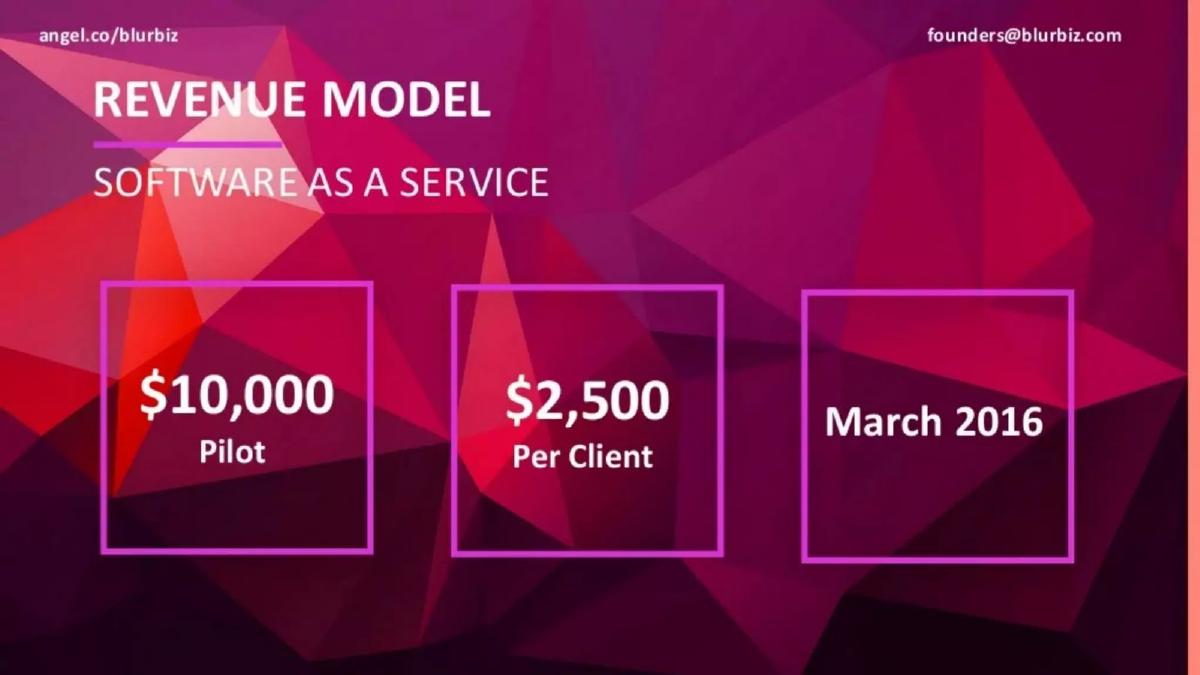
Blurbiz deck, slide 6. Exact stored slide matched to this analysis.
Our analysis: It puts a price on the pilot, which most decks do not. But it is a price list: nothing says any customer has paid it.
Evidence and limitation: "$2,500 per client" has no period (month? year?), "March 2016" has no label, and without a period the $10,000 pilot fee cannot be compared with the per-client price. A listed price is not a paid pilot.
What a founder can adapt: If you charge for pilots, state the fee and what the customer pays afterwards, with the billing period.
Supporting analysis
What the deck claims: "Revenue model — Software as a service" with three boxes: "$10,000 Pilot", "$2,500 Per Client", "March 2016".
Presentation choice: It puts a price on the pilot, which most decks do not. But it is a price list: nothing says any customer has paid it.
When it does not fit: "$2,500 per client" has no period (month? year?), "March 2016" has no label, and without a period the $10,000 pilot fee cannot be compared with the per-client price. A listed price is not a paid pilot.
Mapping and incident software for public safety agencies.
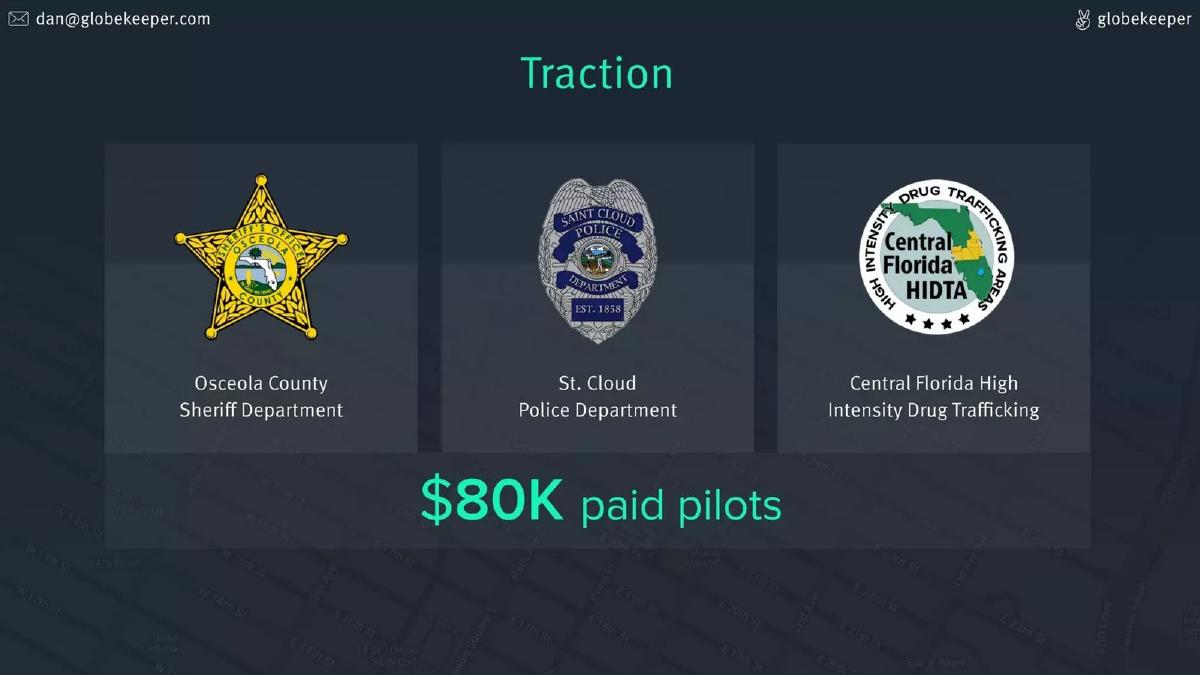
Globe Keeper deck, slide 15. Exact stored slide matched to this analysis.
Our analysis: Named government buyers and a paid total make this stronger than logos alone.
Evidence and limitation: $80K across three agencies does not tell a reader what one pilot costs. There is no length, success test or contract that followed.
What a founder can adapt: Split the total by customer, or at least give the number of pilots and the range of fees.
Supporting analysis
What the deck claims: "Traction": Osceola County Sheriff Department, St. Cloud Police Department and Central Florida High Intensity Drug Trafficking, above "$80K paid pilots".
Presentation choice: Named government buyers and a paid total make this stronger than logos alone.
When it does not fit: $80K across three agencies does not tell a reader what one pilot costs. There is no length, success test or contract that followed.
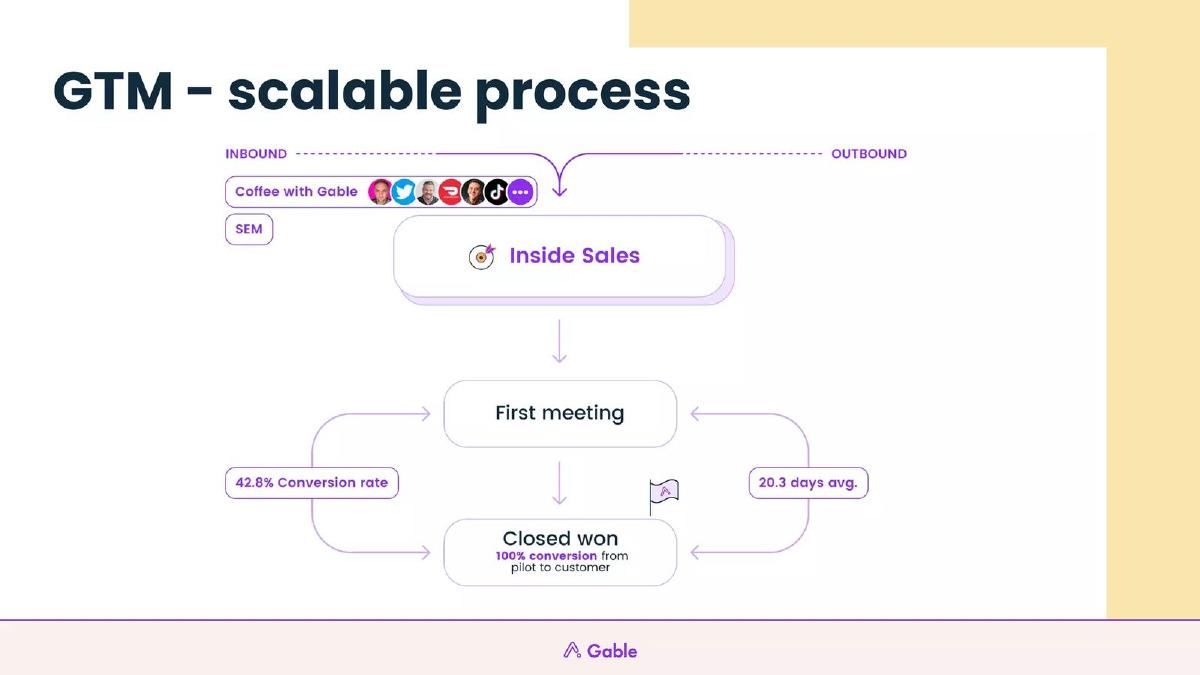
Gable deck, slide 18. Exact stored slide matched to this analysis.
Our analysis: Placing pilot conversion inside the sales process shows where pilots sit in the path to revenue.
Evidence and limitation: The 100% has no base, the pilot fee and length are not stated, and the 20.3 days describes first meeting to close, not pilot length. The diagram does not say whether the pilot is paid.
What a founder can adapt: Next to any conversion rate, give the count: how many pilots, how many converted.
Supporting analysis
What the deck claims: A sales flow: inbound and outbound to Inside Sales, First meeting, Closed won. Labels: "42.8% Conversion rate", "20.3 days avg.", and under Closed won: "100% conversion from pilot to customer".
Presentation choice: Placing pilot conversion inside the sales process shows where pilots sit in the path to revenue.
When it does not fit: The 100% has no base, the pilot fee and length are not stated, and the 20.3 days describes first meeting to close, not pilot length. The diagram does not say whether the pilot is paid.
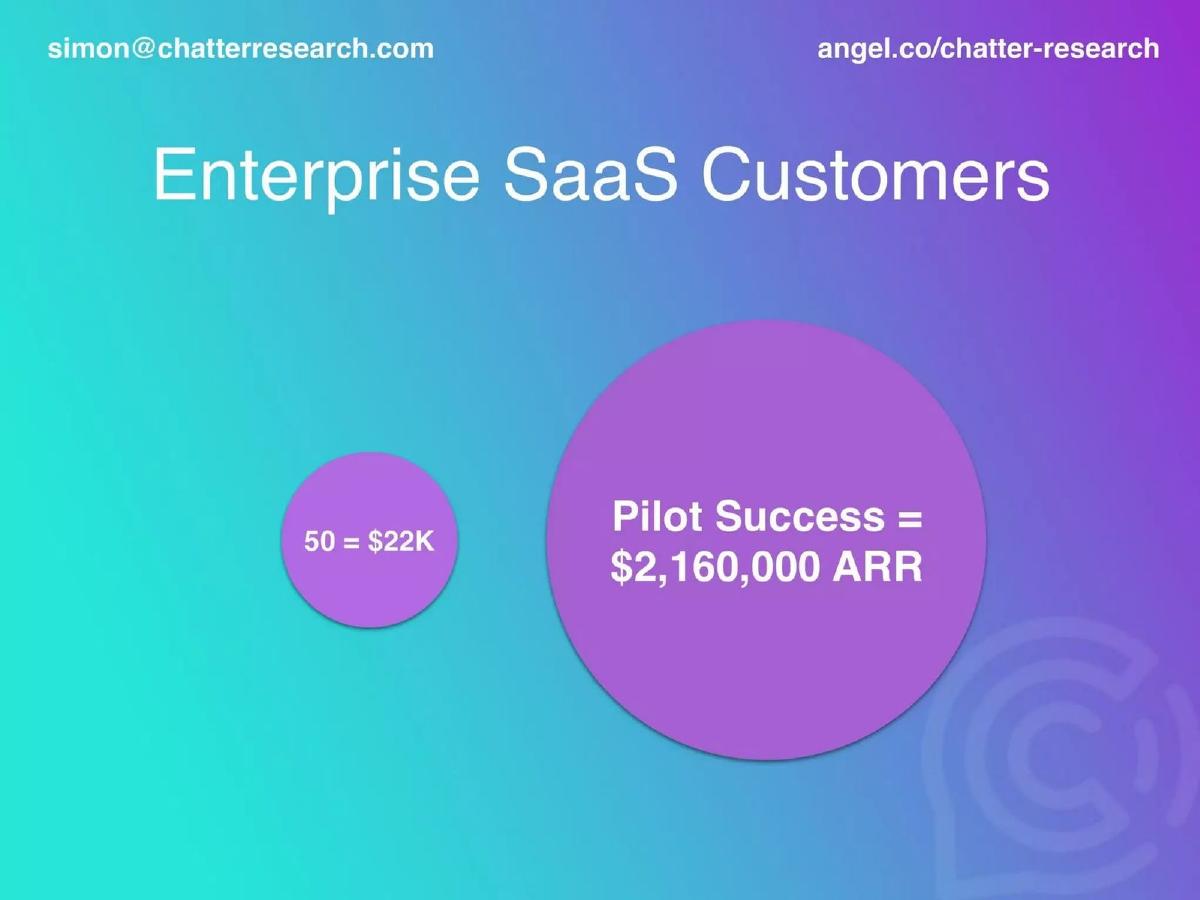
Chatter Research deck, slide 14. Exact stored slide matched to this analysis.
Our analysis: It shows the size of the prize if pilots convert, which is the question investors ask.
Evidence and limitation: "50 = $22K" is unexplained (50 what?), and $2.16M ARR is a forecast conditional on success, not revenue. No pilot count, fee, length or success test is given.
What a founder can adapt: Label a projected contract value as a projection and show the arithmetic (customers × price) behind it.
Supporting analysis
What the deck claims: A small circle: "50 = $22K"; a large circle: "Pilot Success = $2,160,000 ARR".
Presentation choice: It shows the size of the prize if pilots convert, which is the question investors ask.
When it does not fit: "50 = $22K" is unexplained (50 what?), and $2.16M ARR is a forecast conditional on success, not revenue. No pilot count, fee, length or success test is given.
Each cell reports only what the slide itself states. "Not stated" means the page gives no figure.
Example
Pilot fee
Pilot length / success test
Contract after pilot
Conversion
Paramark
$10K; $5K (two customers)
Not stated
$120k/year; 2-year $60k + $80k (signed)
Two chosen cases; no rate
Forethought
Not stated
Not stated
$350K ARR deal value on conversion (forecast)
2 annual customers of 7 pilots; 4 in review
Blurbiz
$10,000 (list price)
Not stated
$2,500 per client, period not stated
Not stated
Globe Keeper
$80K total across three agencies
Not stated
Not stated
Not stated
Gable
Not stated
Not stated
Not stated
100%, count not stated
Chatter Research
Not stated
Not stated
$2.16M ARR if pilots succeed (forecast)
Not stated
Key Takeaways
Pair the pilot fee with the contract that followed it. Paramark: "Started as $10K pilot, followed by a $120k/year deal" and "$5K pilot, followed by a 2 year commit - $60k for year 1 and $80k for year 2".
Give conversion as a count with its base. Forethought reports 2 annual customers from 7 paid pilots and says the rest are still in review; "100% of eligible pilots" only makes sense next to those counts.
A percentage with no count hides the sample. Gable's "100% conversion from pilot to customer" could describe one pilot or fifty.
A total across customers is not a pilot price. Globe Keeper's "$80K paid pilots" across three agencies does not say what any one agency paid.
Label forecasts as forecasts. Chatter Research's "Pilot Success = $2,160,000 ARR" is what the company expects if pilots succeed, not revenue it has.
Write your pilot line
One line per pilot or per cohort of pilots. Leave a field blank rather than guess.
Fee. What did the customer pay for the pilot?
Length. How many weeks did it run?
Success test. What measurable result decided whether they signed?
Contract. What did they sign, for how much, over what term?
Conversion. Of pilots finished, how many signed?
Copyable framework: [Customer type]: $[fee] pilot over [weeks] weeks, judged on [result] → signed $[value] over [term]. [x] of [y] finished pilots converted.
Illustrative example 1 — written by us
Before: 100% pilot conversion
After: 3 of 3 finished pilots signed annual contracts; 2 pilots still running
What improved: Gives the base, so the rate can be weighed.
What this slide has to prove
A paid pilot is evidence that a customer spent budget, which is stronger than a letter of intent or a logo. Its value to an investor depends on what came after: did the customer sign, for how much, and how often does that happen?
The pre-revenue traction guide covers pilots as one kind of early evidence. This page is narrower: the pilot's price, its length, its success test and its conversion to a contract.
Four facts to state, and what counts as each
Pilot fee: the amount the customer paid for the pilot itself, per customer. A combined total across customers or a list price is not the fee a customer paid.
Duration and success test: how long the pilot ran and the measurable result that decided the outcome. None of the six slides here states either.
Contract: the signed value that followed, with its term. A deal value "upon conversion" or "on success" is a forecast until signed.
Conversion: pilots converted out of pilots finished, with the counts. A logo, a letter of intent or a percentage without a base does not show conversion.
What Paramark's two conversions show, and what they leave out
Source facts: one customer paid a $10K pilot and then signed a $120k-a-year deal; another paid a $5K pilot and then committed to two years at $60k and $80k. Our calculations: the second customer's two-year commitment totals $140,000, 28 times its pilot fee, and its second-year amount is a third higher than its first.
What the slides do not state: how long either pilot ran, what result decided the purchase, and how many other Paramark pilots did not convert. Two successful cases show the step from pilot to contract; they do not show a conversion rate.
Reading Forethought's counts
Source facts: 7 paid pilots, 2 annual customers described as "100% conversion of eligible pilots", and 4 pilots reviewing contracts. Our calculation: 7 − 2 − 4 leaves one pilot the slide does not account for. The slide does not define "eligible", so the 100% refers to a base it does not state, apparently the two pilots that had reached a decision.
The slide values the seven pilots at $350K ARR "upon conversion" and the four under review at $400K ARR. Taken at face value, four of the seven pilots are worth more than all seven; that could mean the four are different pilots, that values were updated, or that contracts include more than the pilot scope. The slide does not say, so this is missing information rather than a proven contradiction. Both figures are values if signed, not signed revenue.
Totals, list prices and forecasts
Globe Keeper's $80K is a total across three named agencies. If it were split evenly, each would have paid about $26,700 (our calculation, under an assumption the slide does not support or rule out). The slide does not give each agency's fee, the pilot length or whether any agency went on to a contract.
Chatter Research shows "50 = $22K" next to "Pilot Success = $2,160,000 ARR". Our calculation: the larger figure is about 98 times the smaller. The slide does not say what the 50 counts or what "success" requires, so the $2.16M is a forecast of what conversion could be worth.
Blurbiz lists a $10,000 pilot and $2,500 per client with no period attached to the per-client price, so the two cannot be compared, and nothing on the slide says a customer paid either. Gable places "100% conversion from pilot to customer" after a 42.8% conversion rate and a 20.3-day average; the slide does not say how many pilots finished or whether the 20.3 days includes the pilot.
What your pilot line should let an investor work out
Recommendation: give enough for a reader to compute three things without guessing. First, the fee one customer paid and for how long. Second, the signed contract that followed, with its term, so the ratio of contract value to pilot fee can be calculated. Third, the conversion count: pilots finished, pilots converted, pilots still running and pilots lost.
Label every value that depends on a future signature as a forecast. If you have one strong conversion, present it as a case with its figures, as Paramark does, rather than as a rate.
Common mistakes
A rate with no count. "100% conversion" means little without how many pilots finished.
A total instead of a fee. Combined pilot revenue across customers hides what one customer pays.
A price list presented as traction. A pilot price no customer has paid is a business model, not evidence.
Deal value as if signed. Value "upon conversion" or "on success" is a forecast; say so.
No length or success test. Without them, an investor cannot tell whether the pilot was a real test or a courtesy.
Diagnostic checklist
The pilot fee is per customer and was actually paid.
The pilot's length and success test are stated, or left out knowingly.
Any contract value says whether it is signed, with its term.
Conversion is given as a count of pilots finished, not only a percentage.
Forecast values are labelled as forecasts.
Frequently asked questions
How should I show pilots that have not finished yet?
Count them separately from pilots that reached a decision. Forethought's slide does this in part: 2 annual customers and 4 pilots reviewing contracts. A reader can then judge conversion only on the pilots that have finished, and treat the rest as pipeline. If a pilot ended without a contract, include it in the count; leaving it out, as the unexplained seventh Forethought pilot may be, makes the rate look better than the record supports.
Can I add up pilot fees and call it revenue?
Pilot fees that customers paid are revenue, but a total hides the fee per customer and whether any customer continued. Globe Keeper's $80K across three agencies is stated as paid, yet a reader cannot tell what one agency paid or whether any agency signed a contract afterwards. Give the per-customer fee and the outcome next to the total.
Should I charge for a pilot?
These slides cannot answer that. They show that when a deck states a paid pilot fee next to the signed contract that followed (Paramark), the reader can see the step from pilot to contract directly.
Is a letter of intent the same as a converted pilot?
No. A letter of intent is not a signed contract, and a logo is not evidence of either. This guide counts conversion only where a slide states a signed contract or a converted customer.
How we chose these examples
Search (2026-09-30): the durable corpus index (docs/seo/artifacts/corpus-search, 70,729 unique pages across every deck page, deduplicated by deck-file sha256 + page) was searched for pilot fees, lengths, success criteria, conversion and post-pilot contracts with varied wording; 639 pages mention "pilot".
Seven pages were rendered from the original public deck files and read against the text: Forethought 6, Paramark 30 and 31, Blurbiz 6, Globe Keeper 15, Gable 18, Chatter Research 14. All are founder pitch decks from public sources recorded in our deck inventory (Forethought: BestPitchDeck; Paramark: Business Insider; Blurbiz, Globe Keeper, Chatter Research: PitchDeckHunt; Gable: SlideShare).
Left out: roadmap or plan pages that mention pilots without a price or result (Fireside 9, Apteo 8, iSmartAfrica 10), pilot-plant costs in mining and manufacturing decks, and Chekkit 26 (potential revenue per pilot, a forecast with no paid pilot).
None of these six slides states a pilot length or success criteria. Elsewhere in the collection, Lumigo 12 (4-week proof of concept, one customer) and Deep Render 35 (paid proof of concept up to 6 months) state a length; they are covered in the sales-cycle guide. No slide found states pilot success criteria. How we built this: drafted and checked with AI assistance (editorial model review against the original slide images); no human editor has reviewed this guide.