Pre-Revenue Traction Slides: Real Pitch Deck Examples
How early startups show traction before meaningful revenue: pilots, signed and pending contracts, pipeline, sign-ups and technical results.
Pre-Revenue Traction Slides: Real Pitch Deck Examples
Seven traction slides from companies with little or no revenue, shown in full, compare what founders use as evidence instead: pilots, signed and pending contracts, pipeline, sign-ups and technical results.
TL;DR
Before revenue, a traction slide has to show evidence that customers will pay, not just that people are interested. The strongest examples below separate what is signed from what is pending, measure a pilot's result, or show how pilots have converted to contracts. Sign-up counts, follower numbers and pipeline without stages are weaker, because they don't show commitment.
Early traction slides from real pitch decks
Each example shows the exact stored slide above its analysis and links to the full teardown. Figures and customer names are the companies' own and have not been verified. Stage and year are not recorded in our collection for these decks unless stated.
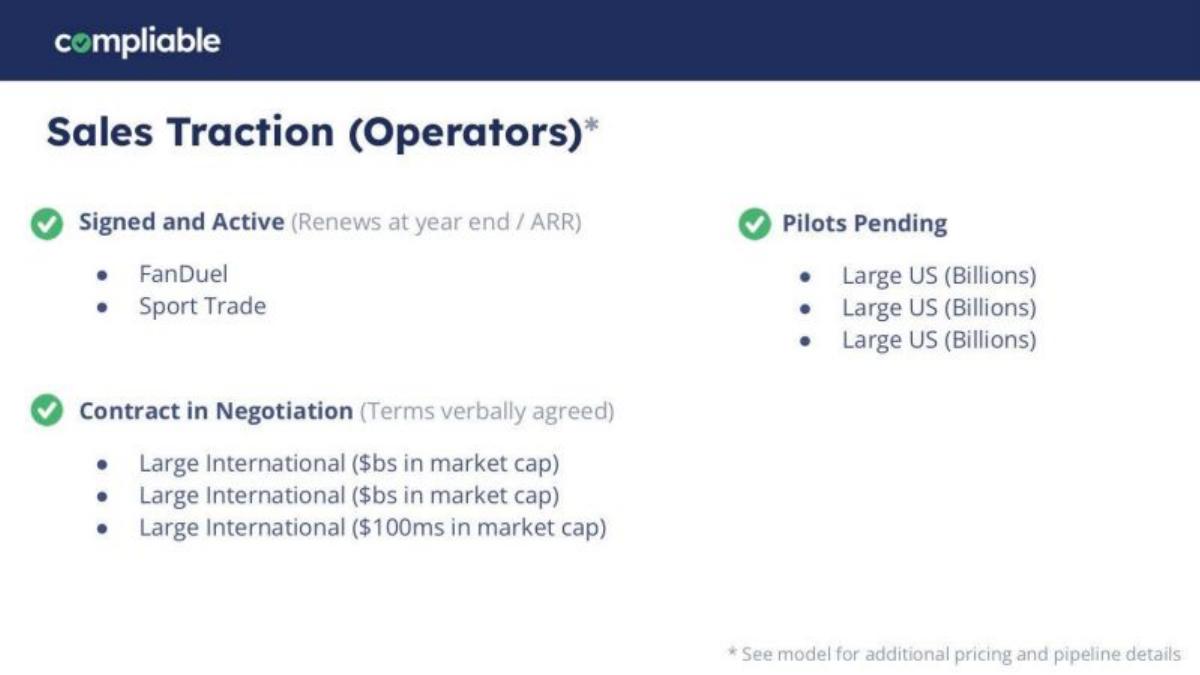
Compliable traction slide — slide 2
Compliance software for gaming and sports-betting operators. Stage and year not recorded.
Compliable deck, slide 2. Exact stored slide matched to this analysis.
Our analysis: Sorting customers by how firm the commitment is gives an investor an honest read of the pipeline, and two named signed customers anchor the rest.
Evidence and limitation: The unnamed operators can't be checked, and there are no contract values. If names are confidential, give values or timing instead.
What a founder can adapt: Use three groups (signed, negotiating, pilot/pending) and put names in the signed group.
Supporting analysis
What the deck claims: "Sales traction (operators)" in three groups: signed and active (renews at year end / ARR): FanDuel, Sport Trade; contract in negotiation (terms verbally agreed): three large international operators (by market cap); pilots pending: three large US operators. A footnote points to the model for pricing and pipeline details.
Presentation choice: Sorting customers by how firm the commitment is gives an investor an honest read of the pipeline, and two named signed customers anchor the rest.
When it does not fit: The unnamed operators can't be checked, and there are no contract values. If names are confidential, give values or timing instead.
Software for police report writing. Stage and year not recorded.
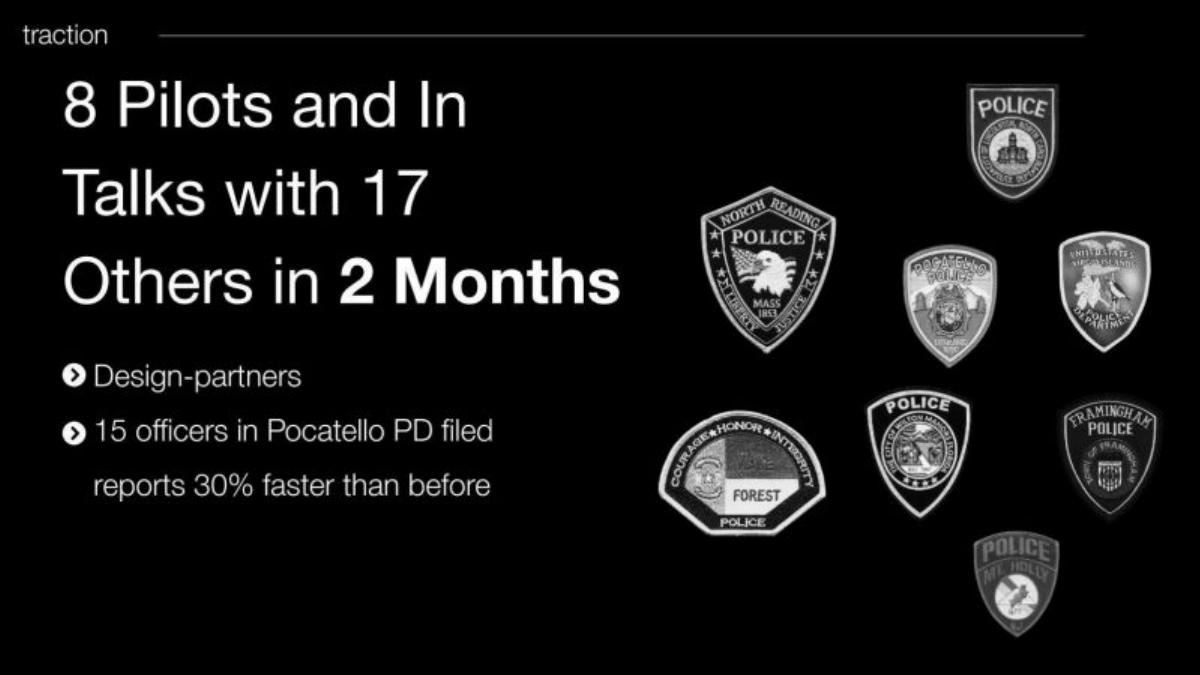
Code Four deck, slide 5. Exact stored slide matched to this analysis.
Our analysis: It pairs pilot volume with one measured outcome from a named department, which is the kind of evidence a pilot is meant to produce. "In 2 months" shows pace.
Evidence and limitation: The badges aren't labelled, so we can't tell which are pilots and which are talks. The 30% figure has no stated method or sample period.
What a founder can adapt: Report at least one pilot result as a before-and-after number, with who achieved it.
Supporting analysis
What the deck claims: "8 pilots and in talks with 17 others in 2 months". Bullets: design partners; "15 officers in Pocatello PD filed reports 30% faster than before". Police department badges fill the right side.
Presentation choice: It pairs pilot volume with one measured outcome from a named department, which is the kind of evidence a pilot is meant to produce. "In 2 months" shows pace.
When it does not fit: The badges aren't labelled, so we can't tell which are pilots and which are talks. The 30% figure has no stated method or sample period.
AI customer-support software. The teardown is labelled as its seed deck.
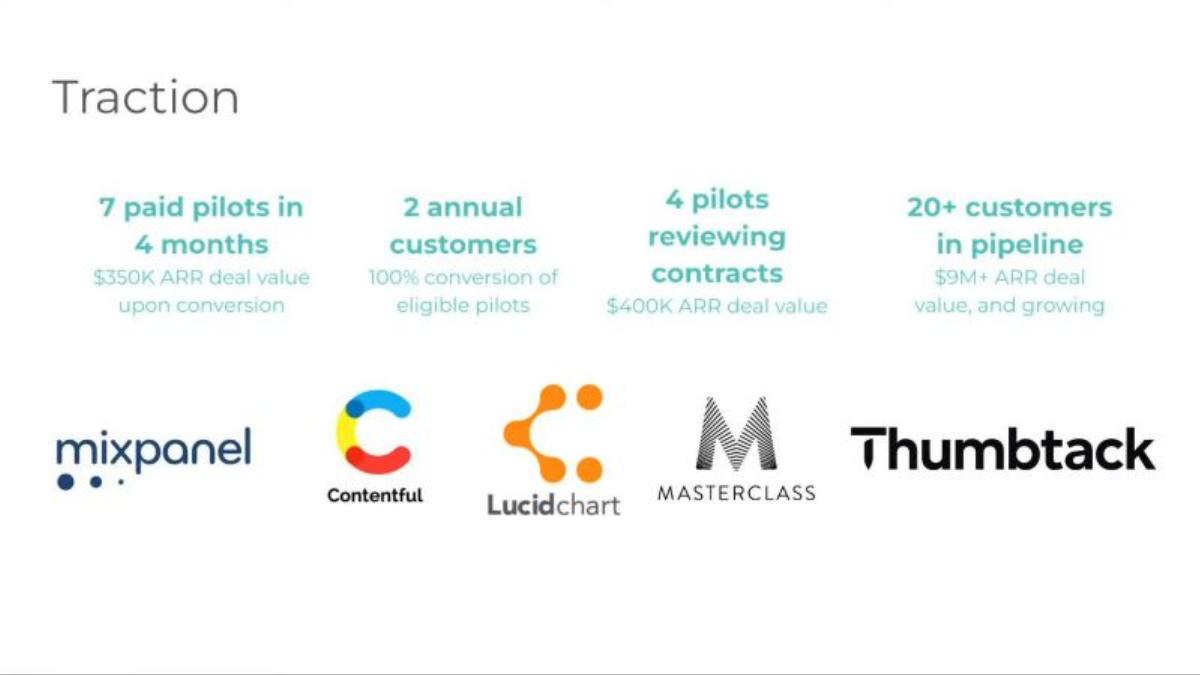
Forethought deck, slide 6. Exact stored slide matched to this analysis.
Our analysis: It reads as a funnel from pipeline to paid pilot to annual contract, with a value at each stage. Paid pilots show willingness to pay before full revenue.
Evidence and limitation: "100% of eligible pilots" is two customers and doesn't define eligible. The logos aren't matched to stages, and pipeline value is the least reliable figure on the slide.
What a founder can adapt: Lay out pilot → contract → pipeline with counts and deal values, and state your pilot conversion rate.
Supporting analysis
What the deck claims: "Traction" in four stages: 7 paid pilots in 4 months ($350K ARR deal value upon conversion); 2 annual customers (100% conversion of eligible pilots); 4 pilots reviewing contracts ($400K ARR deal value); 20+ customers in pipeline ($9M+ ARR deal value, and growing). Logos: Mixpanel, Contentful, Lucidchart, MasterClass, Thumbtack.
Presentation choice: It reads as a funnel from pipeline to paid pilot to annual contract, with a value at each stage. Paid pilots show willingness to pay before full revenue.
When it does not fit: "100% of eligible pilots" is two customers and doesn't define eligible. The logos aren't matched to stages, and pipeline value is the least reliable figure on the slide.
Lithium extraction technology. The slide refers to 2022.
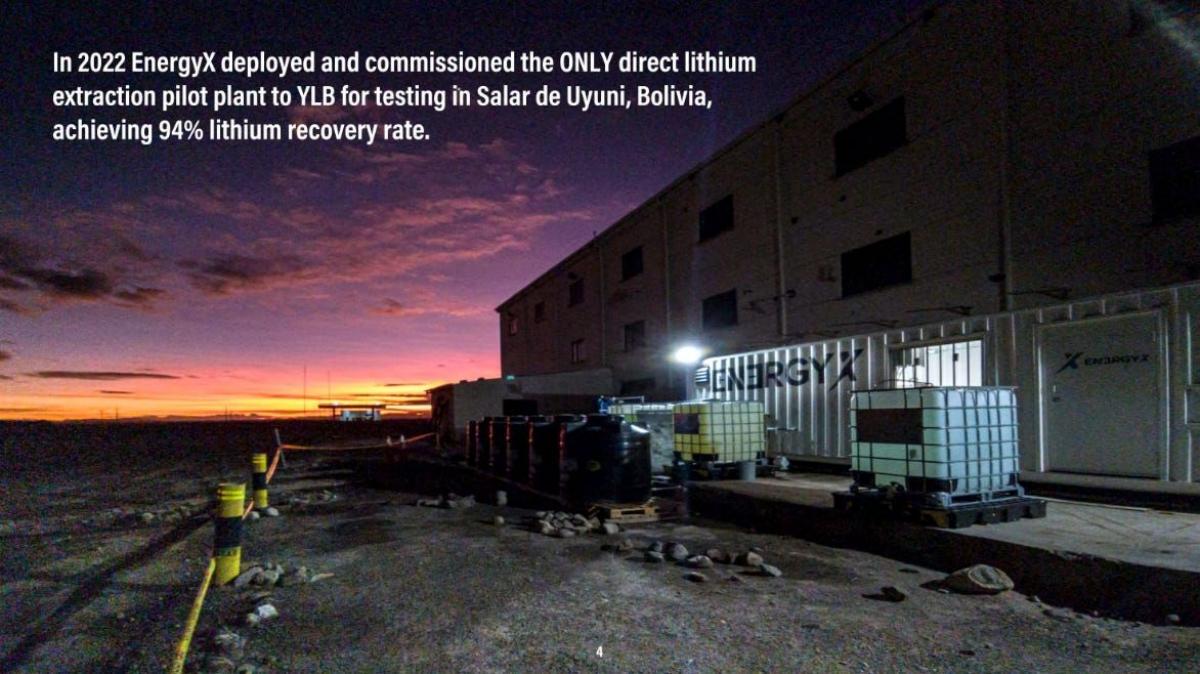
EnergyX deck, slide 4. Exact stored slide matched to this analysis.
Our analysis: For deep tech, a technical result from a real-world pilot with a named partner (YLB) is the relevant traction. The photo shows the pilot exists physically.
Evidence and limitation: "The ONLY" is a company claim we have not verified, and the recovery rate lacks test conditions or duration. A single photo slide leaves the commercial path unstated.
What a founder can adapt: If you sell hardware or process technology, lead with one field-test result, where it ran and with whom.
Supporting analysis
What the deck claims: A full-bleed photo of a site with EnergyX-branded containers, captioned: "In 2022 EnergyX deployed and commissioned the ONLY direct lithium extraction pilot plant to YLB for testing in Salar de Uyuni, Bolivia, achieving 94% lithium recovery rate."
Presentation choice: For deep tech, a technical result from a real-world pilot with a named partner (YLB) is the relevant traction. The photo shows the pilot exists physically.
When it does not fit: "The ONLY" is a company claim we have not verified, and the recovery rate lacks test conditions or duration. A single photo slide leaves the commercial path unstated.
B2B relationship software. Stage and year not recorded.
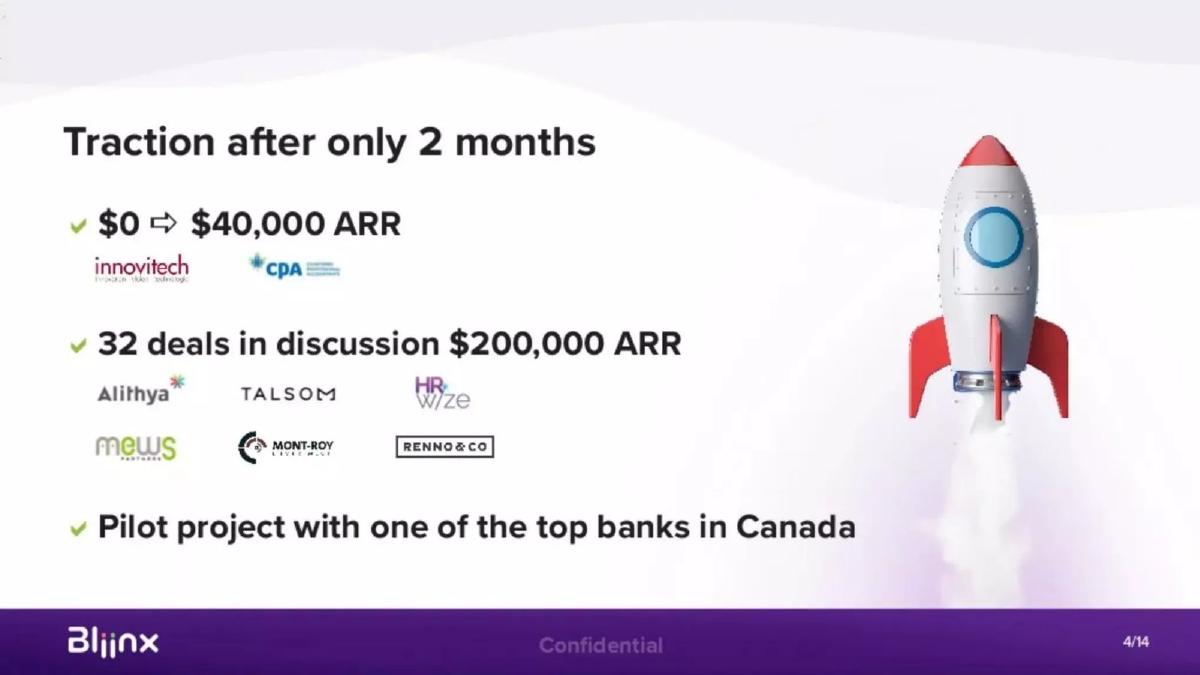
Bliinx deck, slide 4. Exact stored slide matched to this analysis.
Our analysis: It shows the step from zero to first revenue, then pipeline and a strategic pilot, in three lines with logos beside each.
Evidence and limitation: The bank is unnamed, "in discussion" isn't defined, and the rocket adds nothing. $200K ARR across 32 deals implies small contracts; say so rather than leave the maths to investors.
What a founder can adapt: When you have just started earning, show first revenue next to pipeline value, each with named customers.
Supporting analysis
What the deck claims: "Traction after only 2 months": $0 → $40,000 ARR (logos: Innovitech, CPA); 32 deals in discussion, $200,000 ARR (logos including Alithya, Talsom, Mews); pilot project with one of the top banks in Canada. A rocket illustration fills the right.
Presentation choice: It shows the step from zero to first revenue, then pipeline and a strategic pilot, in three lines with logos beside each.
When it does not fit: The bank is unnamed, "in discussion" isn't defined, and the rocket adds nothing. $200K ARR across 32 deals implies small contracts; say so rather than leave the maths to investors.
Online M&A marketplace for small businesses. Stage and year not recorded.
M&A Nexus deck, slide 4. Exact stored slide matched to this analysis.
Our analysis: Included as a contrast. It has a real number (sign-ups) and a growth rate, which is more than many early slides.
Evidence and limitation: Accelerators and finished development are inputs, not traction. Sign-ups with no activity measure, and a weekly growth rate without a time span, are hard to interpret.
What a founder can adapt: If sign-ups are your evidence, add what share become active or complete a key action.
Supporting analysis
What the deck claims: "Traction" as four lines of text: finished two accelerators (including Palo Alto); platform finished development; 1,937 businesses signed up and growing at a 250% average weekly growth rate; building initial sales cycle with a 26 million US business database.
Presentation choice: Included as a contrast. It has a real number (sign-ups) and a growth rate, which is more than many early slides.
When it does not fit: Accelerators and finished development are inputs, not traction. Sign-ups with no activity measure, and a weekly growth rate without a time span, are hard to interpret.
Workplace conflict-resolution app. Stage and year not recorded.
Spatz deck, slide 4. Exact stored slide matched to this analysis.
Our analysis: It is honest about being pre-pilot and shows the product exists. For very early decks, that candour is better than dressing up interest as traction.
Evidence and limitation: Followers and "interest" aren't evidence of demand, and none of the listed items is a KPI despite the heading. Rename the slide "Progress" if there are no metrics yet.
What a founder can adapt: If you are pre-pilot, list the next pilot, who it is with and what you will measure.
Supporting analysis
What the deck claims: "3. Traction — KPI metrics & milestones" with the quote "We are almost ready for a pilot test...". Bullets: MVP completed (Android and iOS); admin dashboard in testing with Slack integration; trial agreements pending with a university team for an internal pilot; 300+ LinkedIn followers and early adopter interest. Four app screenshots sit below.
Presentation choice: It is honest about being pre-pilot and shows the product exists. For very early decks, that candour is better than dressing up interest as traction.
When it does not fit: Followers and "interest" aren't evidence of demand, and none of the listed items is a KPI despite the heading. Rename the slide "Progress" if there are no metrics yet.
Lead with the most committed evidence you have and put the rest beneath it.
Evidence
Why it counts
Example
What to add
Paid pilots converting to contracts
Customers have paid and renewed
Forethought
Define conversion; match logos to stages
Signed customers + negotiations
Commitment is written down
Compliable
Values or timing
Measured pilot result
Shows the product works in use
Code Four; EnergyX
Method, sample, duration
First revenue + pipeline
Shows willingness to pay
Bliinx
Name customers; define pipeline stages
Sign-ups
Shows reach
M&A Nexus
Activation rate
Progress and interest
Shows the product exists
Spatz
The next pilot and its measure
Key Takeaways
Group evidence by commitment. Compliable sorts customers into "signed and active", "contract in negotiation" and "pilots pending", so an investor can see how firm each item is.
Measure what a pilot achieved. Code Four reports that officers in one police department filed reports 30% faster; EnergyX states a 94% lithium recovery rate from its pilot plant. A result says more than a pilot count.
Show conversion, not just volume. Forethought reports 7 paid pilots, 2 converted to annual customers ("100% conversion of eligible pilots") and deal values at each stage.
Name customers where you can. Unnamed "large US" operators (Compliable) or "one of the top banks in Canada" (Bliinx) are harder to weigh than a named design partner.
Be honest about being early, but add something measurable. Spatz says it is "almost ready for a pilot test"; the candour helps, but LinkedIn followers are not evidence of demand.
Rank your evidence before you design the slide
List everything you might show, then sort it by commitment. Lead with the top line.
Signed. Which customers have signed or paid anything, and for how much?
In progress. Which pilots or contracts are under way, and when do they decide?
Results. What has a pilot measurably changed for a customer?
Reach. What sign-ups or waitlist do you have, and what share are active?
Copyable framework: [n] signed ([names], [value]). [n] pilots running, deciding by [date]. At [customer], [metric] improved [x]%. [n] sign-ups, [y]% active weekly.
Illustrative example 1 — written by us
Before: Strong interest from leading companies. 500+ sign-ups. Pilots coming soon.
After: 2 paid pilots ([names], [value] each), decisions by [month]. At [customer], [task] took [x]% less time. 500 sign-ups, [y]% active in the last 30 days.
What improved: Our illustrative rewrite, not any company's text. It replaces interest with commitments, a measured result and an activity rate; bracketed values are placeholders.
What counts as traction before revenue
Without revenue, investors look for evidence that is costly for the customer to give: a signed pilot, a paid pilot, a contract under negotiation, time spent by a design partner, or a measured result. Free sign-ups and interest are cheaper to give, so they count for less.
The general traction guide covers companies with revenue charts. This page focuses on the evidence available before that point.
Common mistakes
Interest shown as traction. Followers, meetings and "interest" are not commitments.
Pilots with no result. Report what each pilot measured, not just that it exists.
Unstaged pipeline. Say which deals are signed, negotiating or early.
Unlabelled logos. Match each logo to its status.
Inputs as traction. Accelerators and finished development are progress, not demand.
Diagnostic checklist
Most committed evidence comes first.
Signed, pending and early items are visibly separated.
At least one pilot result is measured.
Customer names or values are given where possible.
Any conversion rate states its base.
Next milestone and decision dates are shown.
Frequently asked questions
How we chose these examples
Corpus: published pitch deck teardowns on StartupFundraising.com. Founder-uploaded private decks are excluded.
Selection (2026-09-24): we searched extracted text of slides 2–6 for traction, validation or progress language combined with pilot, LOI, waitlist, pre-order, beta or signed, where a stored slide image exists; inspected eight candidates; chose seven. Slingshot slide 6 was not selected (a credit-card affiliate product; kept out to avoid the running fintech experiment's scope).
Review: all seven stored slide images were inspected on 2026-09-24 and matched to company, deck and slide number (editorial model review). No person has yet completed an editorial review of this page.
Figures, customer names and claims such as EnergyX's "only" are shown as the companies state them and have not been independently verified. We make no claim that any slide caused a fundraising outcome.