EnergyX’s corporate presentation is a dense, technical validation of their Direct Lithium Extraction (DLE) technology. Rather than relying on typical SaaS metrics, the deck leans heavily on industrial proof points, such as a 94% lithium recovery rate achieved at their Salar de Uyuni pilot plant (Slide 4). The narrative is anchored by scientific authority, specifically their partnership with Nobel Prize winner Dr. John Goodenough (Slide 10), and a clear three-pronged revenue model encompassing licensing, consumables, and offtake (Slide 22). By showcasing a footprint reduction from 20,000 acres…
Key takeaways
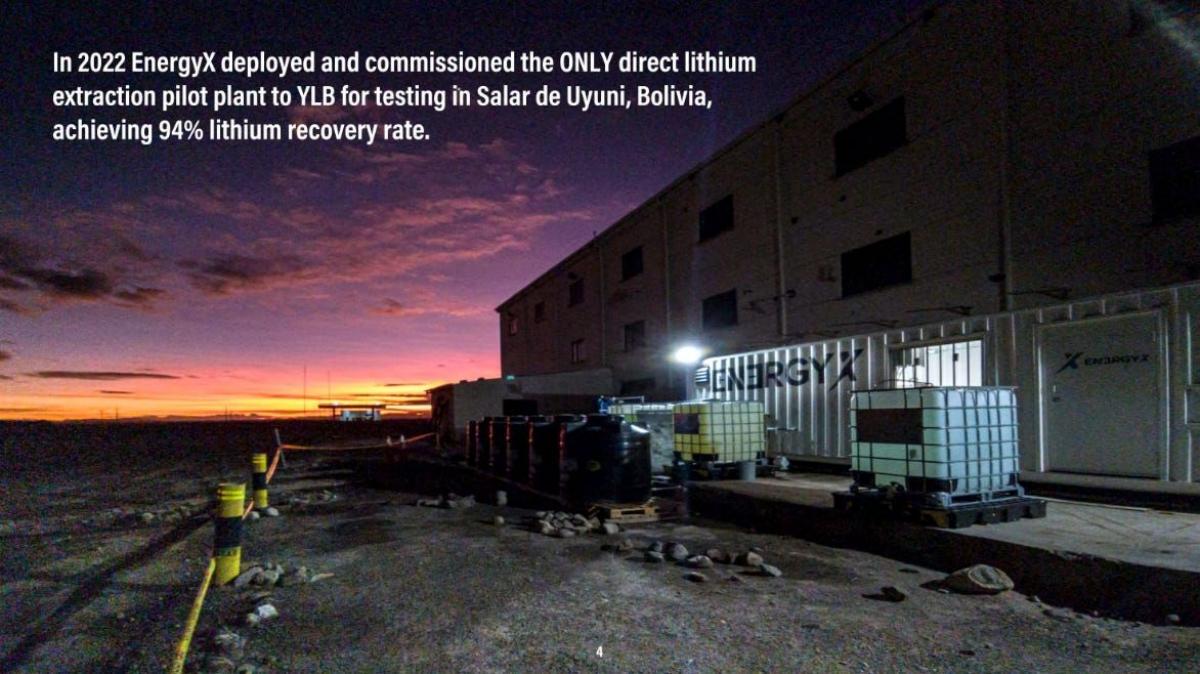
- The deck highlights a specific technical achievement of 94% lithium recovery at a pilot plant in Bolivia (Slide 4).
- A detailed historical timeline traces the company's IP roots back to 2014 research at Monash University (Slide 7).
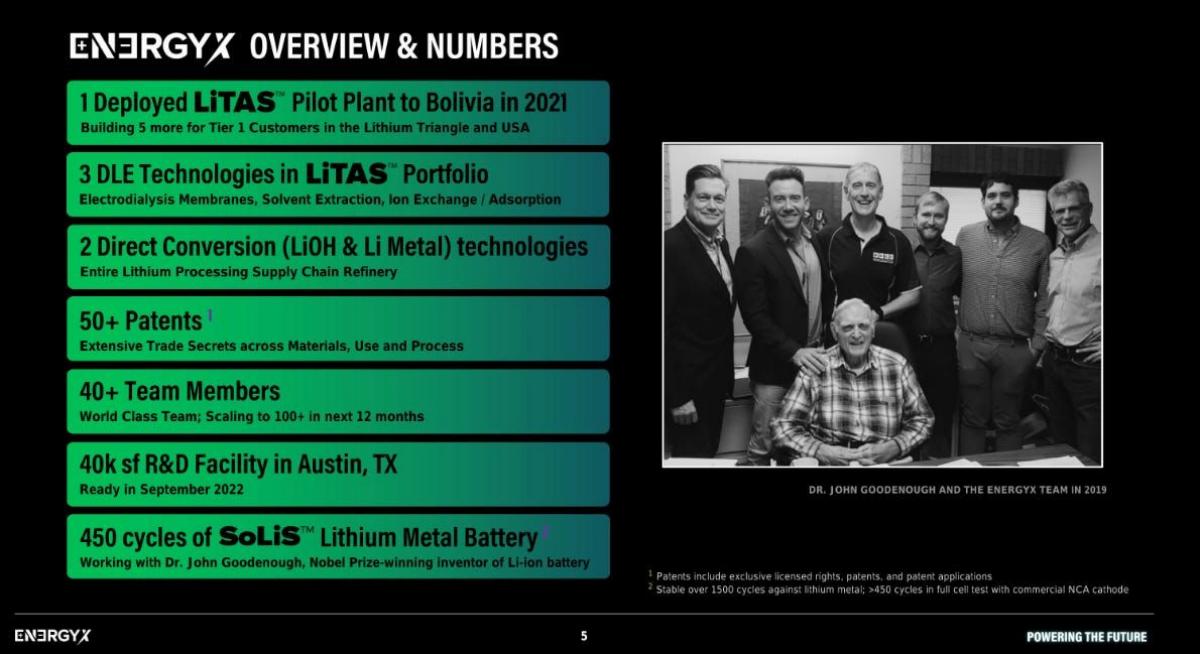
- The company leverages high-profile scientific validation through a partnership with Nobel laureate Dr. John Goodenough (Slide 10).
- EnergyX claims a significant cost advantage, stating their system costs 1/15th of competitors (Slide 13).
- The business model is diversified across technology licensing, recurring membrane replacement, and lithium offtake (Slide 22).
- Sustainability metrics emphasize a massive land-use reduction, comparing 20,000 traditional acres to 10 acres using LiTAS technology (Slide 25).
- The deck identifies pilot or testing agreements with 5 of the top 10 major Tier 1 lithium producers (Slide 16).
- Pilot systems are described as containerized units capable of 3-150 tons of LCE production per annum (Slide 19).
Introduction: The Industrial Scale of EnergyX
EnergyX operates in the high-stakes world of battery supply chains. As reported by Business Insider, the company raised $450M in a 2024 growth round. This teardown analyzes the 27-slide deck from July 2022 that laid the groundwork for that massive capitalization. The deck is a departure from the standard Silicon Valley software pitch; it is a technical, industrial, and scientific document designed to prove that a complex chemical process can work at scale in the real world.
Slide 1-3: Branding and Positioning
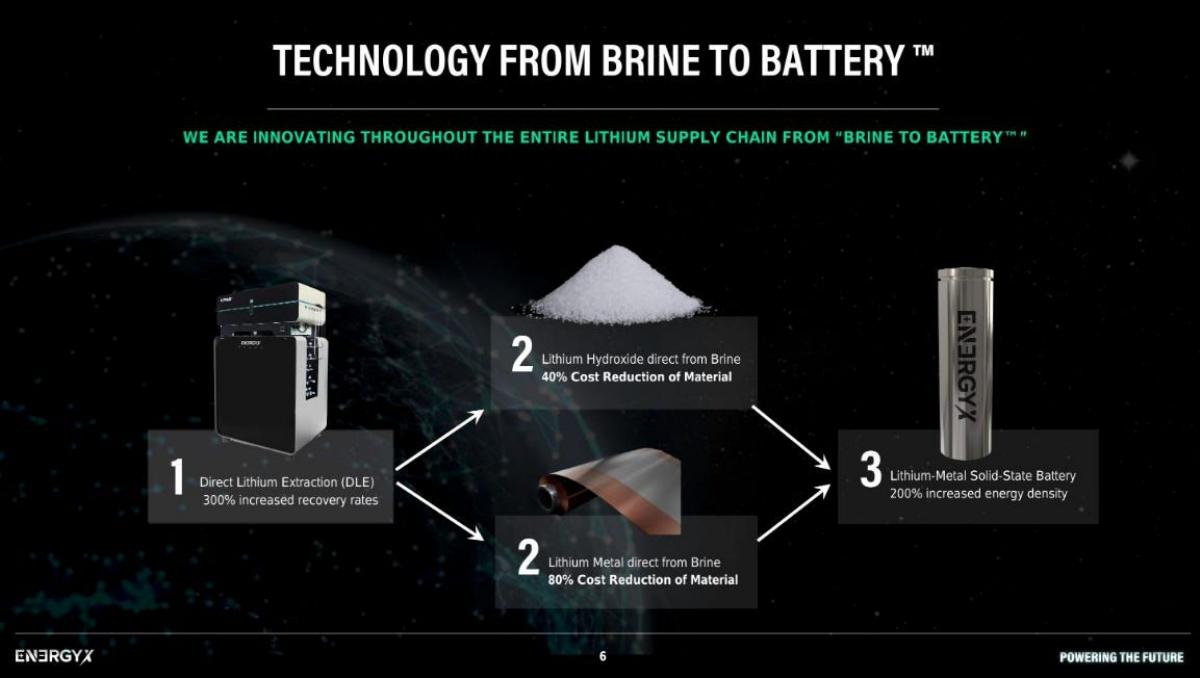
The opening slides establish the brand identity. The tagline 'From Brine to Battery' (Slide 1) immediately communicates the company's scope. It isn't just a mining company or a battery company; it is the connective tissue between the raw resource and the finished energy storage product. The visual language is dark, industrial, and high-tech, signaling a 'hard tech' focus.
Slide 4: The Proof of Concept
Slide 4 is perhaps the most important slide for a hardware company. It shows a photo of a physical pilot plant in Salar de Uyuni, Bolivia. The text is explicit: EnergyX achieved a 94% lithium recovery rate . In an industry where traditional evaporation ponds often recover less than 50%, this figure is a powerful validator of their technical claims. By leading with a real-world deployment at a specific location (YLB), they move past theoretical science into industrial application.
Slide 7: The Historical Timeline
The 'Historical Timeline & Significant Milestones' slide is dense but necessary. It traces the IP back to 2014 at Monash University and highlights a $10MM Department of Energy grant in 2018. For investors, this timeline proves that the technology wasn't invented overnight; it has nearly a decade of academic and governmental vetting. Key corporate milestones include the Series A in April 2021 ($10 Million) and a Joint Development Agreement with DuPont in March 2022. This slide builds a 'moat' of credibility around their intellectual property.
Slide 10: Scientific Pedigree
Slide 10 focuses entirely on Dr. John Goodenough . By associating the company with the Nobel Prize-winning inventor of the lithium-ion battery, EnergyX borrows immense authority. The slide mentions his laboratory at the University of Texas and his role in advising EnergyX on next-generation batteries. For a growth-stage investor, this reduces 'science risk'—the fear that the underlying physics of the product are flawed.
Slide 13: Competitive Advantage
This slide breaks down the 'why us' into four pillars. Most notable is the claim that their system costs 1/15th of competitors . They benchmark traditional extraction methods at an estimated $550M-$800M investment for a 20,000-ton-per-year project. By positioning their technology as 'scalable, modular, commercial units,' they promise a +30% IRR for their customers (miners and producers). This shifts the conversation from 'cool science' to 'superior economics.'
Slide 16: Customer Relationships
EnergyX segments its market into three categories: Lithium Producers, Battery Manufacturers, and Automotive Companies. The slide claims they have signed pilot or testing agreements with 5 of the top 10 major Tier 1 Lithium Producers . This is a crucial metric for growth rounds, as it demonstrates that the incumbents in the industry—who have the most to lose—are actually betting on EnergyX’s LiTAS technology.
Slide 19: Pilot and Commercialization
Slide 19 provides the specifications for their '21st Century Direct Lithium Extraction' units. These are containerized systems capable of 3-150 tons of LCE production per annum . The emphasis on 'Real Field Conditions' and '3-6 months of Continuous Testing' addresses the primary concern of industrial investors: durability. It shows the product is no longer a lab bench experiment but a ruggedized piece of field equipment.
Slide 22: The Revenue Model
The business model is a 'triple threat' of revenue streams. First, a Technology Licensing Fee based on production volume. Second, a Recurring Membrane Replacement model (estimated every 1-2 years), which provides the 'razor-and-blade' recurring revenue that investors love. Third, Lithium Offtake and Sale , where EnergyX acts as a merchant, buying the raw lithium and selling it to final customers. This diversified approach mitigates the risk of relying solely on capital equipment sales.
Slide 25: Sustainability and Footprint
In the ESG-conscious world of 2024, Slide 25 is a closing argument. It compares the land footprint of traditional mining (20,000 acres) to the LiTAS system ( 10 acres ). It also claims a reduction of 134,432 tons of CO2 for every metric ton of lithium utilized in batteries. These numbers provide the 'impact' narrative that many institutional funds require for large-scale growth investments.
What EnergyX Does Well
EnergyX excels at authority signaling . Between the Nobel laureate partnership, the DuPont collaboration, and the Department of Energy grants, the deck makes it very difficult for an investor to dismiss the technology as 'unproven.' They also do an excellent job of translating complex chemical engineering into clear economic benefits, such as the 1/15th cost comparison and the 30% IRR for customers. The use of real photography of their Bolivian pilot plant (Slide 4) provides a 'ground truth' that renders the rest of the technical claims more believable.
What is Missing from the Deck
Despite its technical depth, the deck is light on detailed financial projections . While it mentions a $10M Series A (Slide 7), it does not provide a clear P&L or a breakdown of how the next round of capital will be deployed across specific R&D vs. CAPEX vs. OpEx categories. There is also no Team Slide included in this specific selection of images, which is a significant omission for a teardown, as the execution risk in hardware is largely dependent on the engineering leadership. Finally, while they mention 5 of the top 10 producers, they do not name them (likely due to NDAs), which leaves a gap in verifiable social proof.
Founder Takeaways: Copy This
Lead with the Pilot: If you are a hardware founder, show the machine in the dirt. Slide 4’s photo of the Bolivian plant is worth more than ten slides of CAD drawings. · Benchmark the Incumbent: EnergyX doesn't just say they are 'cheap'; they cite the $550M-$800M cost of a traditional 20k-ton project (Slide 13). Always give your price context. · The Razor-and-Blade Model: Even for heavy hardware, find the 'consumable.' The recurring membrane replacement (Slide 22) makes the business much more attractive to VCs who usually prefer SaaS. · Leverage Academic Moats: If your tech started in a university, show the lineage. The timeline on Slide 7 builds a narrative of 'inevitable' progress rather than a sudden startup idea. · Quantify the ESG: Don't just say you are 'green.' Compare 20,000 acres to 10 acres (Slide 25). Specificity wins in sustainability.
Frequently asked questions
- What is the core technology EnergyX is pitching?
- EnergyX pitches a portfolio of Direct Lithium Extraction (DLE) technologies, specifically their LiTAS system. According to Slide 13, this includes membranes, solvents, ion exchange, and sorbents. The goal is to provide a 'Brine to Battery' vertical integration that extracts lithium more efficiently than traditional evaporation ponds.
- How does EnergyX demonstrate market traction?
- Traction is shown through industrial partnerships rather than revenue figures. Slide 16 notes that 5 of the top 10 Tier 1 lithium producers have signed pilot or testing agreements. Additionally, Slide 7 details a Joint Development Agreement with DuPont and a pilot technology agreement at the world's largest lithium reserve (YLB).
- What are the primary revenue streams for the company?
- As detailed on Slide 22, the business model has three pillars: 1) Technology licensing fees based on metric tons produced, 2) Recurring revenue from membrane replacements every 1-2 years, and 3) Opportunistic lithium offtake and resale where EnergyX buys extracted lithium to sell to final customers.
- What is the 'Goodenough' connection mentioned in the deck?
- Slide 10 is dedicated to Dr. John Goodenough, the Nobel Prize-winning inventor of the lithium-ion battery. EnergyX highlights their partnership with his laboratory at the University of Texas, using his industry 'legend' status to provide scientific credibility to their next-generation battery initiatives.
- How does the company compare its costs to competitors?
- On Slide 13, EnergyX claims its system costs 1/15th of its competitors. They contrast their approach against traditional methods that require an estimated $550M-$800M investment for a 20,000-ton-per-year project, positioning their modular units as a lower-CAPEX alternative.