Ensembl's 19-slide pitch deck is a visually driven presentation that targets the intersection of premium cookware and urban space constraints. The company identifies a $350 billion market opportunity (Slide 3) driven by a shift toward smaller homes and at-home living. By focusing on a patented removable handle system (Slide 9), Ensembl claims to save 70% more space than traditional products while maintaining professional-grade quality. The deck excels at defining its 'Muse'—a high-earning, design-savvy urban professional (Slide 16)—and provides evidence of early traction, including 6x growth…
Key takeaways
- The housewares market is valued at $350 billion but suffers from stagnant product design (Slide 3).
- Ensembl's core product, the Stackware Collection, uses custom patented removable handles to save 70% more space than traditional cookware (Slide 9).
- The company positions itself in a 'white space' opportunity between traditional premium brands like All-Clad and modern space-saving brands like T-fal (Slide 7).
- Early traction is demonstrated by 6x growth in Q4 and sales spanning multiple international markets including the USA, Canada, and Israel (Slide 13).
- The product features high-performance specs: 3.5 mm fully-clad stainless steel and aluminum, induction compatibility, and dishwasher safety (Slide 10).
- Ensembl has secured a Canadian patent and has filings in the USA, Europe, Japan, Korea, China, and Australia (Slide 13).
- The target customer is defined as an urban professional earning $200k+ who values logic and functionality over superfluous detailing (Slide 16).
- The deck lists a comprehensive appendix of 10 sections, including COG breakdown and financial projections, available upon request (Slide 18).
Introduction: Rethinking the $350 Billion Housewares Market
Ensembl’s pitch deck is a masterclass in aesthetic consistency and targeted positioning. Founded in 2017, the company enters a housewares market that it characterizes as stagnant and ill-suited for modern urban life. The deck uses 19 slides to bridge the gap between high-performance culinary tools and the practical constraints of small-space living. By focusing on a specific 'Muse' and a patented mechanical innovation, Ensembl attempts to carve out a premium niche in a crowded sector.
The Problem and Market Opportunity
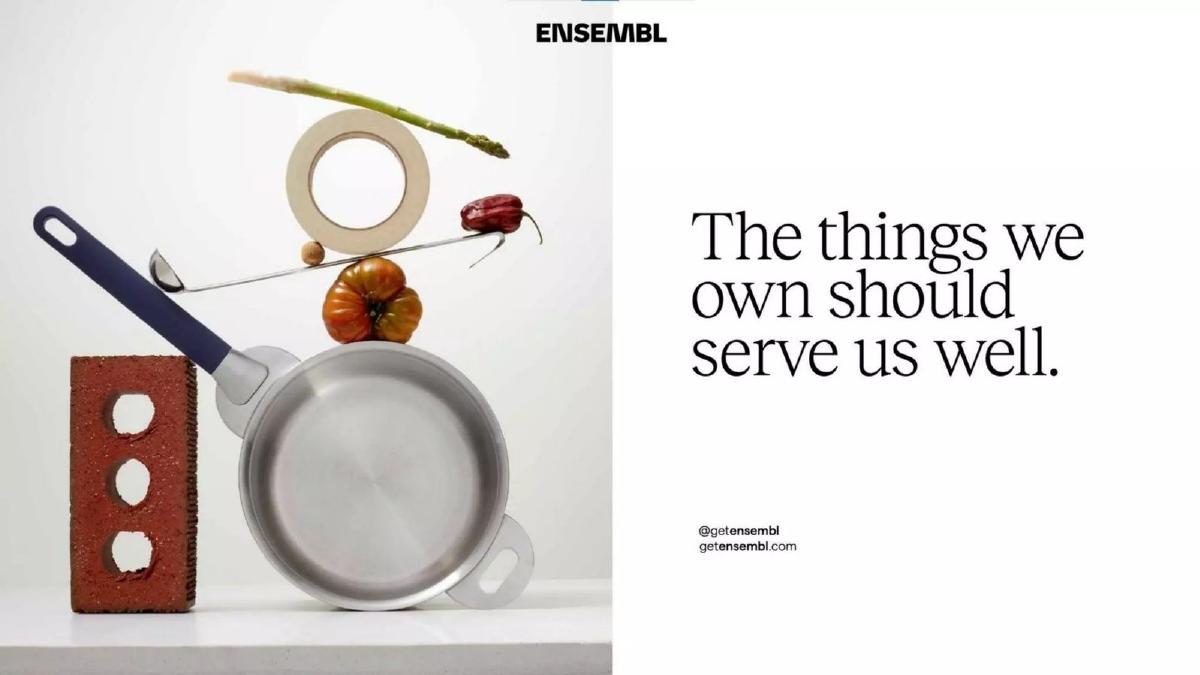
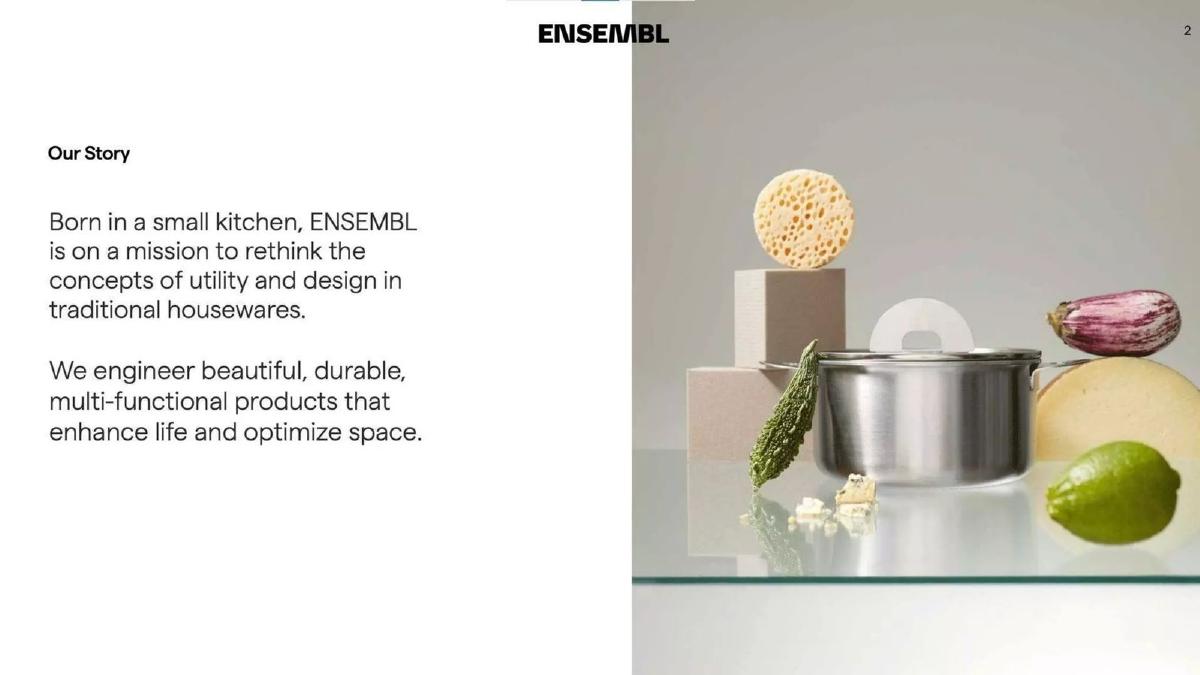
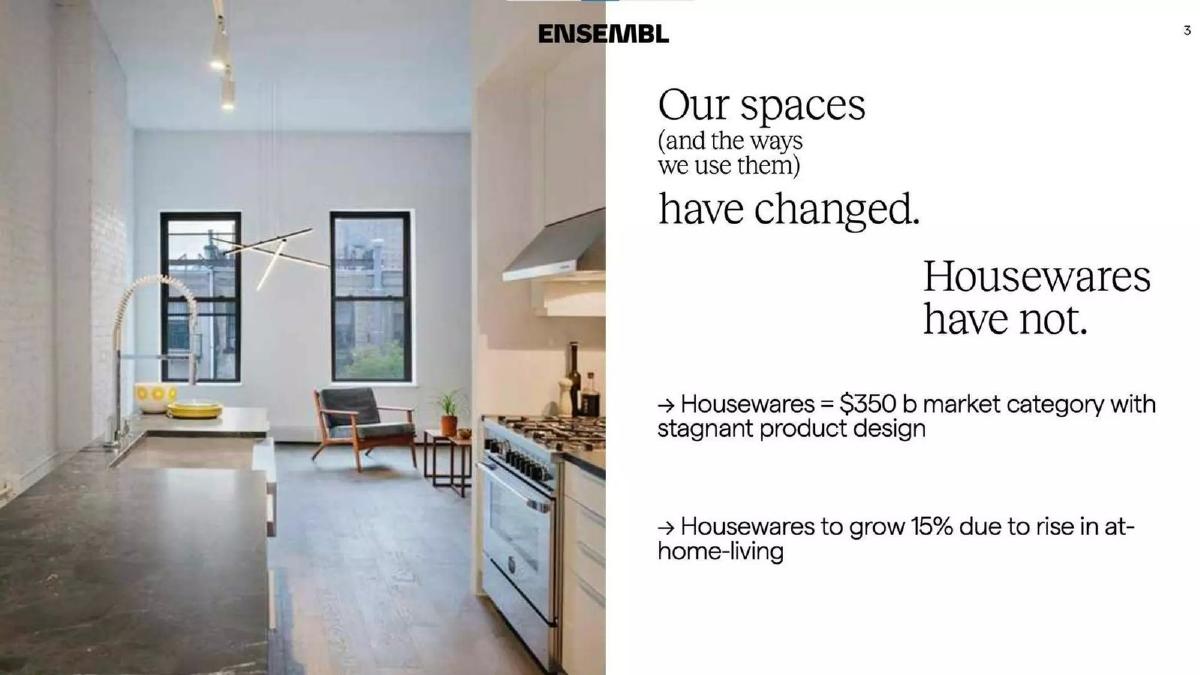
Slide 1 to Slide 4 set the stage by contrasting the evolution of living spaces with the stagnation of housewares. Slide 1 introduces the brand with the hook, "The things we own should serve us well." Slide 2 defines the mission: rethinking utility and design in traditional housewares to optimize space. On Slide 3, the company quantifies the opportunity, stating that housewares is a $350 billion market category with stagnant design, expected to grow by 15% due to the rise in at-home living.
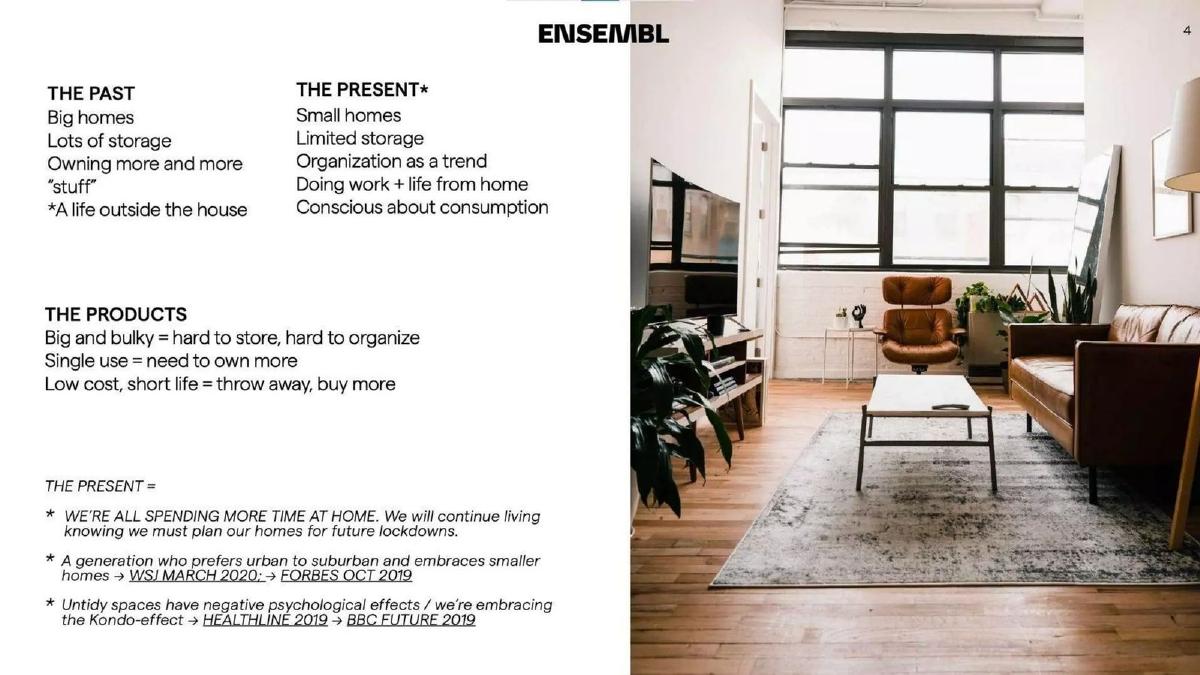
Slide 4 provides a sociological context for the product. It contrasts "The Past" (big homes, lots of storage, owning more stuff) with "The Present" (small homes, limited storage, organization as a trend). It cites sources like the WSJ, Forbes, and Healthline to support the claim that untidy spaces have negative psychological effects, specifically mentioning the "Kondo-effect." This slide effectively moves the problem from a simple storage issue to a wellness and lifestyle necessity.
The Solution: Functionality Meets Aesthetics
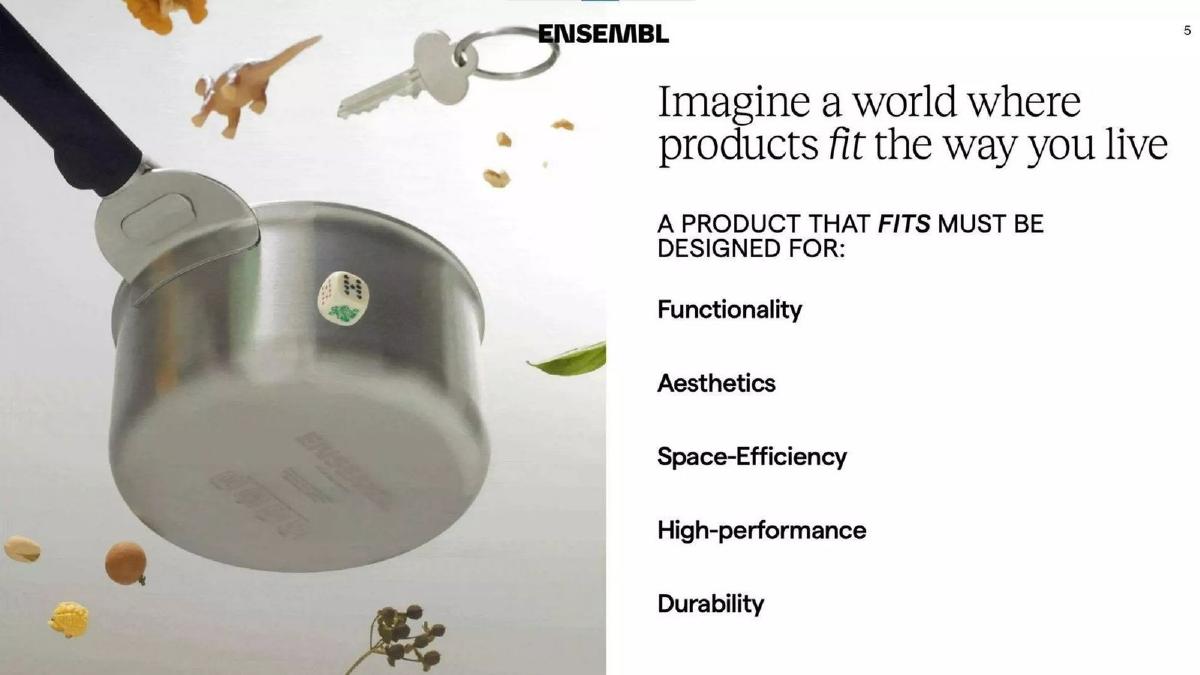
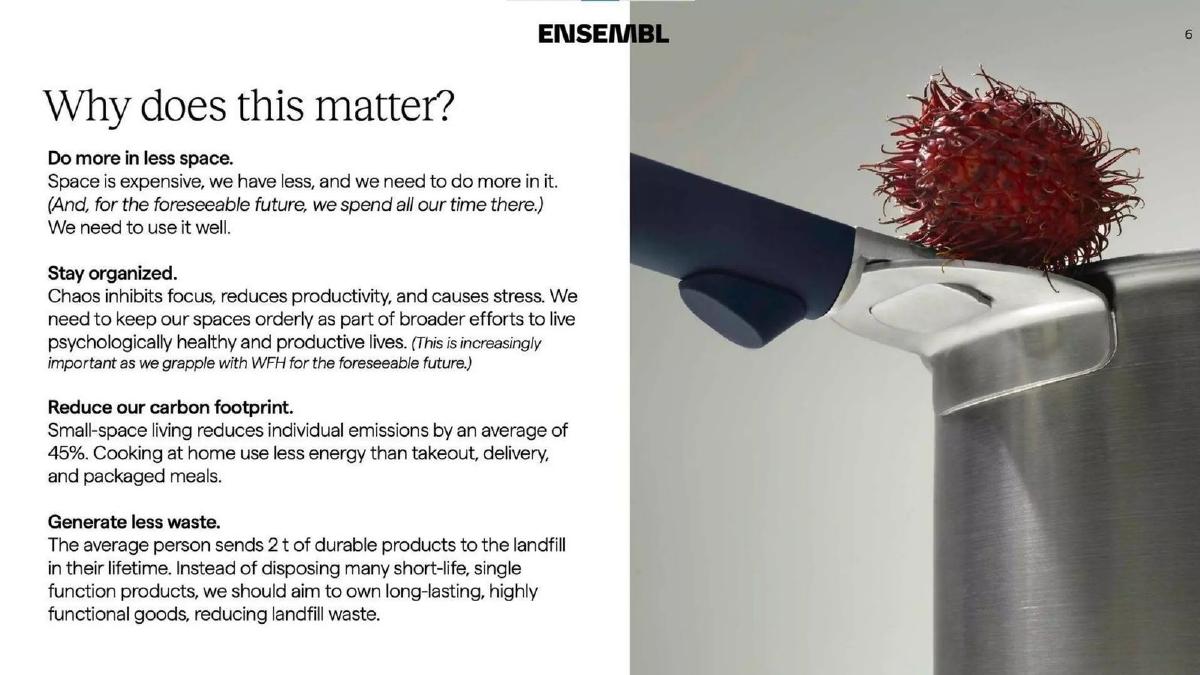
Slide 5 and Slide 6 transition into the Ensembl philosophy. Slide 5 lists the five pillars of a product that "fits": Functionality, Aesthetics, Space-Efficiency, High-performance, and Durability. Slide 6 answers "Why does this matter?" by linking space efficiency to reduced carbon footprints and waste reduction. It claims that small-space living reduces individual emissions by an average of 45% and notes that the average person sends 2 tons of durable products to landfills in their lifetime.
Slide 7 is a critical positioning map. It places Ensembl at a $1,029 price point, situated in a "White space opportunity" that is higher quality than space-saving competitors like T-fal ($199) and Calphalon ($599), but more modern in design than traditional premium brands like All-Clad ($1300) and Zwilling ($950). This slide is essential for justifying the high MSRP to potential investors by showing a clear gap in the market.
Product Deep Dive and IP
Slide 8 to Slide 10 introduce the Stackware Collection. Slide 8 provides a clean visual of the product line, while Slide 9 highlights the core innovation: custom patented removable handles. The deck claims these handles allow for 70% less space usage than traditional products and enable a seamless transition from stovetop to oven to table to fridge. A patent number (PCT/CA2019/000060) is cited at the bottom of the slide, providing a layer of defensibility.
Slide 10 focuses on the "Purposeful details" that differentiate the product from cheaper alternatives. These include 3.5 mm fully-clad stainless steel and aluminum construction, induction compatibility, dishwasher and oven safety, and transparent lids that lay flat. The mention of "laser-welded side brackets for rivet-free interiors" appeals to the culinary enthusiast who values ease of cleaning and professional-grade manufacturing.
Social Proof and Traction
Slide 11 and Slide 12 leverage external validation. Slide 11 showcases press logos from Architectural Digest (AD), WSJ, Gear Patrol, and House Beautiful. It also lists awards, including the 2021 GOOD DESIGN Award and the 2021 House Beautiful Small Space Award. Slide 12 features customer testimonials, including a professional chef and tech founders, reinforcing the idea that the product appeals to high-achieving, design-conscious professionals.
Slide 13 provides the first look at hard metrics. The company reports 6x growth in Q4, leading to stock-outs and pre-orders. It also notes that 8% of customers have made a repeat purchase, which is significant for a high-ticket durable good. The slide confirms the IP strategy, stating that a Canadian patent was granted in September 2021, with additional filings in the USA, Europe, Japan, Korea, China, and Australia.
Growth Strategy and The Muse
Slide 14 and Slide 15 outline the path forward. Slide 14 details an omni-channel approach: DTC (digital ads, micro-influencers), Bulk Sales (condo developers, yacht outfitters), and Wholesale (boutique design stores). Slide 15 looks "beyond" the kitchen, suggesting that Ensembl’s design philosophy could be applied to cleaning hardware, yard tools, and baby utility products. This hints at a much larger TAM than just cookware.
Slide 16 defines the target customer, or "The Muse." Justin and Blair are urban professionals earning $200k+. Justin is an early adopter who "loves to impress," while Blair prefers "logic and functionality to superfluous detailing." This level of customer persona detail shows that the brand has a very specific understanding of who is willing to pay $1,000 for a set of pots and pans.
Team and Omissions
Slide 17 introduces the team. Kate Swanson is the Founder & CEO, with a background at Norton Rose Fulbright. Chris Harsacky is the Head of Design, bringing experience from HUGE, Sonos, and Fitbit. The team is supported by advisors with backgrounds at McKinsey, Stanford, and various luxury home brands. The pedigree is strong in design and operations, which is vital for a hardware/DTC company.
Slide 18 and Slide 19 conclude the deck. Slide 18 is an Appendix list, noting that materials like COG breakdowns and financial projections are "available upon request." Slide 19 is a lifestyle image of a dinner party with the "Thank You" message.
What Works in the Ensembl Deck
The deck is visually stunning and perfectly aligned with the premium nature of the product. The use of high-quality photography and minimalist design reinforces the brand’s value proposition without needing to say it explicitly. The positioning map on Slide 7 is particularly effective; it clearly identifies a gap in the market and justifies a high price point by comparing Ensembl to established luxury incumbents rather than mass-market competitors.
Furthermore, the inclusion of patent details and specific manufacturing specs (like the 3.5 mm cladding) provides the "reason to believe" for the high performance claims. The traction slide (Slide 13) is also strong, showing that the product has international appeal and a surprising level of repeat purchases for a durable goods category.
What is Missing from the Ensembl Deck
The most glaring omission is the lack of a clear fundraising ask. There is no mention of how much capital the company is seeking, what the valuation is, or specifically how the funds will be used to scale. While Slide 18 mentions that financial projections are available in an appendix, including a high-level summary of unit economics (CAC, LTV, Gross Margin) in the main deck would have made the business case much more compelling.
Additionally, while the deck mentions "6x growth in Q4," it does not provide the baseline for that growth. Without absolute numbers (e.g., revenue grew from $100k to $600k), it is difficult for an investor to gauge the actual scale of the business. The competitive landscape could also be expanded to include newer DTC cookware brands like Great Jones or Caraway, which are mentioned briefly or omitted, but likely compete for the same "design-savvy" consumer, even if they lack the specific space-saving focus.
Founder Takeaways: What to Copy
Visual Storytelling: Use high-quality imagery that reflects your brand’s price point. Ensembl’s deck looks like a high-end design magazine, which makes the $1,000 price tag feel appropriate. · Specific Personas: Don't just say your target is "everyone." Defining "The Muse" with specific income levels and psychological traits (Slide 16) shows investors you know exactly how to target your marketing spend. · IP as a Moat: If you have a patent, highlight it. Ensembl uses its patent to differentiate itself from the "stagnant" designs of competitors, turning a mechanical feature into a strategic advantage. · Positioning Maps: Use a 2x2 grid to show the "white space" you occupy. It is one of the fastest ways to communicate your market entry strategy.
Frequently asked questions
- What is Ensembl's primary product innovation?
- Ensembl's primary innovation is the Stackware Collection, which features custom patented removable handles. According to Slide 9, this design allows the cookware to require 70% less space than traditional products. The handles enable the pieces to transition seamlessly from stovetop to oven, table, and fridge, addressing the needs of urban dwellers with limited storage.
- How does Ensembl justify its $1,029 price point?
- The company justifies its premium pricing by comparing itself to high-end brands like All-Clad ($1300) and Cristel ($1499) on Slide 7. It emphasizes 'Purposeful details' on Slide 10, such as 3.5 mm fully-clad construction, laser-welded side brackets for rivet-free interiors, and transparent lids that lay flat for storage, positioning the product as both a high-performance tool and a space-saving solution.
- Who is the target customer for Ensembl?
- Slide 16 defines 'The Muse' as Justin and Blair: urban dwellers aged 34-55, university-educated, and earning over $200k. These customers are described as early adopters who appreciate sleek, clean aesthetics and high functionality. Slide 13 notes that the primary current customer is male, aged 35-50, with a tech or design background.
- What is Ensembl's growth strategy?
- Ensembl employs an omni-channel growth strategy detailed on Slide 14. This includes DTC optimization through digital ads and micro-influencers, bulk sales to condo developers and yacht outfitters, and selective wholesale partnerships with retailers focused on design and small-space living. The company also plans to expand into kitchen tools, bakeware, and organizational hardware (Slide 15).
- What critical fundraising information is missing from the deck?
- The deck lacks a specific 'Ask' slide detailing the amount of capital sought, the intended use of funds, and the milestones the investment will enable. Additionally, while Slide 18 mentions financial projections and COG breakdowns in an appendix, these metrics are not included in the main presentation, leaving investors without immediate insight into unit economics or burn rate.