EnviroGold Global’s Q1 2024 investor presentation outlines a strategic shift toward a technology royalty model in the mining sector. The company utilizes its proprietary NVRO process to extract precious, strategic, and critical metals from mine and smelter waste (tailings). This approach allows them to partner with major metal producers—including a fully funded testing program with BHP—while avoiding the capital and operational expenditures of traditional mining. With a market cap of $33MM (CAD) and a high insider ownership of 47%, the company positions itself as a low-overhead, high-scalabil…
Key takeaways
- The company operates as a 'Technology Royalty Company,' licensing its NVRO process to project owners in exchange for a revenue royalty (Slide 3).
- EnviroGold claims a low-risk profile by avoiding responsibility for CapEx or OpEx, focusing instead on a small corporate team and quick diversification (Slide 4).
- A successful pilot of the NVRO proprietary leach process has been completed, and the technology is currently being tested by five major global metal companies (Slide 5).
- The company is part of the BHP 'Think and Act Differently' (TAD) cohort, with testing programs fully funded by TAD (Slide 5).
- As of late 2023, the company had a market cap of $33MM CAD at a share price of $0.17, with 200MM shares outstanding (Slide 6).
- Insider ownership is significant at 47%, while retail investors hold 32% and other large shareholders hold 21% (Slide 6).
- The company identifies a 'multi-billion-dollar market opportunity' in mine waste remediation and metal recovery (Slide 7).
- Management claims over 300 years of combined experience in metallurgy and mine rehabilitation, though individual bios are not provided in the reviewed slides (Slide 7).
Executive Summary: The Circular Economy of Mining
EnviroGold Global’s Q1 2024 Investor Presentation introduces a specialized niche in the natural resources sector: the recovery of valuable metals from waste. By positioning themselves as a "royalty technology-driven" company, they attempt to bridge the gap between environmental remediation and profitable mining. The deck focuses heavily on the efficiency of their business model and their high-level partnerships, specifically targeting investors interested in ESG (Environmental, Social, and Governance) and strategic metal supply chains.
Slide 1: Title and Positioning
The cover slide establishes EnviroGold Global as a "royalty technology-driven natural resources company." The subtitle emphasizes their mission: "helping the mining industry produce clean metal." The slide lists their public trading symbols on the CSE (NVRO), OTCQB (ESGLF), and FRA (YGK), signaling that this is a publicly traded entity rather than a private startup seeking venture capital. The imagery of a river through a forest reinforces the "clean" and "environmental" aspects of their branding.
Slide 2: The Value Proposition
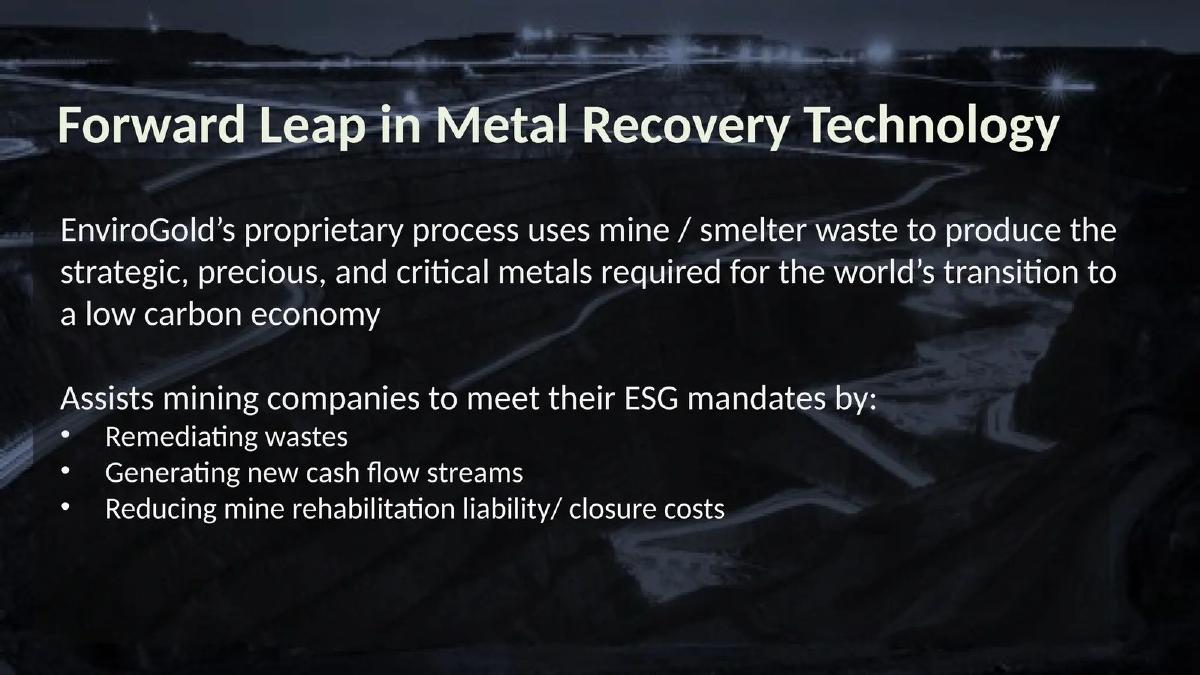
Slide 2, titled "Forward Leap in Metal Recovery Technology," defines the core problem and solution. The company uses a proprietary process to convert mine and smelter waste into "strategic, precious, and critical metals." This is framed as a necessity for the global transition to a low-carbon economy. The slide lists three primary benefits for mining companies: remediating waste, generating new cash flow, and reducing mine rehabilitation liabilities and closure costs. This slide effectively communicates that EnviroGold provides a service that solves a massive balance-sheet liability for traditional miners.
Slide 3: The Business Model
This slide clarifies the "Technology Royalty Company" structure. The goal is to sign royalty agreements with project owners across three categories: new projects, operating projects, and legacy tailings. The mechanism is simple: license the NVRO process in exchange for a revenue royalty. The slide mentions an "extensive pipeline of opportunities," though it does not quantify the number of deals currently in that pipeline.
Slide 4: Royalty Model Benefits
Slide 4 outlines why the royalty model is superior to traditional mining operations. Key points include high scalability due to low overhead and a small corporate team. Crucially, the company states it is "not responsible for CapEx or OpEx," which significantly lowers the risk profile compared to companies that must build and maintain their own processing plants. This model offers "direct exposure" to metal prices without the operational headaches of extraction.
Slide 5: Technical and Partnership Advances
This is the "traction" slide. It reports a successful pilot of the NVRO proprietary leach process. The most significant piece of social proof is the mention of the BHP "Think and Act Differently" (TAD) cohort. The slide notes that the technology testing program is "ongoing fully funded by TAD." Additionally, the company claims to be working with five major global metal production companies in total. This slide serves to validate the technology through third-party institutional interest.
Slide 6: Capital Structure
Slide 6 provides a snapshot of the company's financials as of the end of December 2023. The figures are in Canadian currency. The market cap is $33MM at a price of $0.17. The share structure includes 200MM shares outstanding and a fully diluted count of 259MM. A significant data point here is the ownership breakdown: 47% Insiders, 21% Other Large Shareholders, and 32% Retail. The presence of $5MM in unsecured convertible notes is also disclosed. The 52-week low/high is listed as $0.12 - $0.24.
Slide 7: Reasons to Invest
The final slide in this set summarizes the investment thesis. It highlights a "multi-billion-dollar market opportunity" and "significant near-term cash flow potential." It mentions a management team with "300+ years of experience," though it does not name the individuals or their specific backgrounds. The slide concludes by claiming "first mover" status in the category and "multiple catalysts ahead."
What EnviroGold Global Does Well
The deck is highly effective at articulating a complex industrial process as a simple, scalable financial product. By focusing on the "Royalty Model," the company appeals to investors who want exposure to the commodities market without the extreme capital intensity and operational risks of traditional mining. The inclusion of the BHP partnership (Slide 5) is a critical validator; without it, the proprietary technology claims would lack the necessary weight to convince skeptical investors in the resource sector. The clear breakdown of the capital structure (Slide 6) also demonstrates transparency regarding dilution and insider alignment.
Omissions and Weaknesses
While the deck explains the what and the why, it is thin on the how and the who. The following elements are missing from the provided slides:
Management Biographies: Slide 7 mentions 300+ years of experience, but there are no names, photos, or specific track records for the leadership team. In the mining and tech sectors, the specific expertise of the metallurgists and executives is paramount. · Unit Economics: There is no data on the cost-per-ton of processing waste versus the expected recovery value. While they don't pay the CapEx, the viability of the royalty depends on the project owner's ability to run the process profitably. · Project Pipeline Details: Slide 3 mentions an "extensive pipeline," but there is no map or list of geographic locations, types of metals, or the stage of these potential deals. · Financial Projections: Despite claiming "near-term cash flow potential" (Slide 7), there are no charts showing projected revenue, royalty percentages, or a timeline to profitability.
Founder Takeaways: Lessons from the Royalty Model
Founders in deep-tech or industrial sectors can learn from EnviroGold’s positioning. If your technology requires massive infrastructure to deploy, consider if a "Technology-as-a-Service" or "Royalty" model can lower the barrier to entry for your customers. By removing the CapEx burden from their partners, EnviroGold makes it much easier for a large incumbent like BHP to say "yes" to a pilot. Additionally, the use of a "Capital Structure" slide is a best practice for public or late-stage private companies; it answers the investor's question about "who else is in the boat" immediately and clearly.
Frequently asked questions
- What is the NVRO process mentioned in the deck?
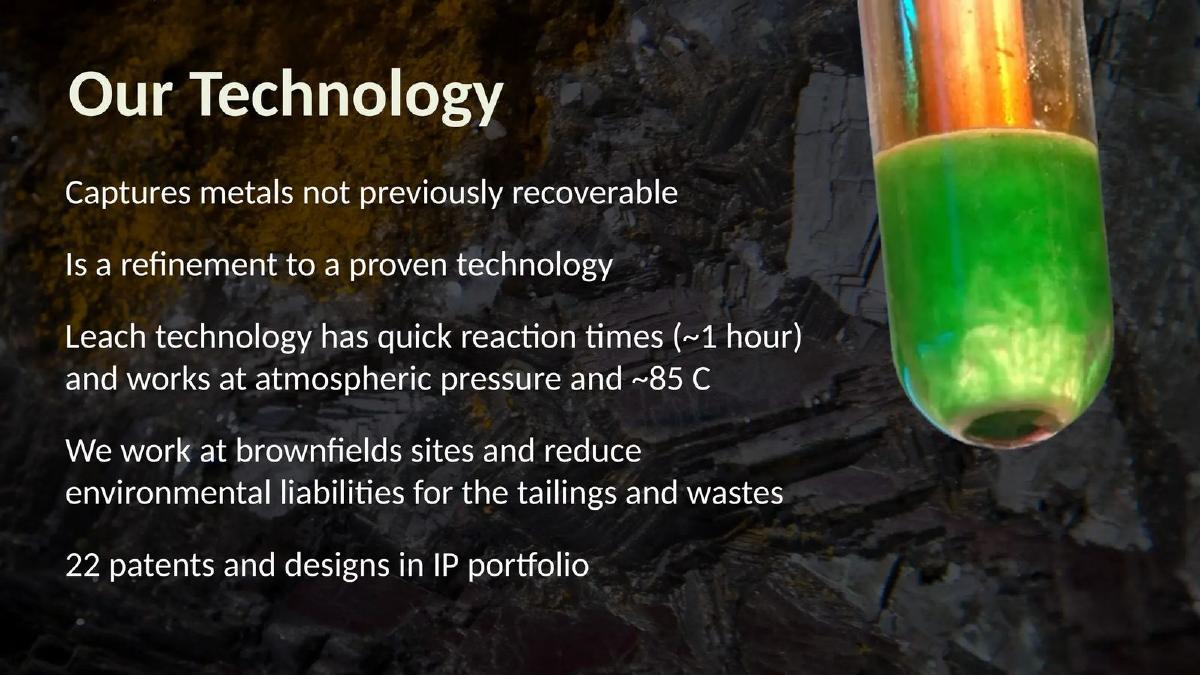
- The NVRO process is EnviroGold Global's proprietary leach technology designed to recover strategic, precious, and critical metals from mine and smelter waste. According to Slide 5, a successful pilot has been completed, and the process is undergoing continuous refinement while being tested by major global mining partners.
- How does EnviroGold Global generate revenue?
- The company utilizes a royalty-based business model. Rather than operating mines themselves, they license their proprietary technology to project owners of new, operating, or legacy tailings projects. In return, they receive a royalty on the revenue generated from the production of metals, as stated on Slide 3.
- What are the primary financial metrics disclosed in the presentation?
- Slide 6 discloses a market capitalization of $33MM CAD based on a $0.17 share price. It lists 200MM shares outstanding, 8MM warrants, 17.3MM options, and 12MM RSUs, leading to a fully diluted share count of 259MM. It also notes $5MM in unsecured convertible notes.
- Who are EnviroGold's current partners?
- While most partners remain unnamed, Slide 5 explicitly mentions BHP. EnviroGold is part of the BHP 'Think and Act Differently' (TAD) cohort. The slide also notes they are working with four other major global metal production companies to test their technology.
- What is the current ownership structure of the company?
- The capital structure is heavily weighted toward internal stakeholders. Slide 6 shows that 47% of the company is owned by insiders, 21% by other large shareholders, and 32% by retail investors. This high level of insider ownership often suggests strong alignment between management and shareholders.