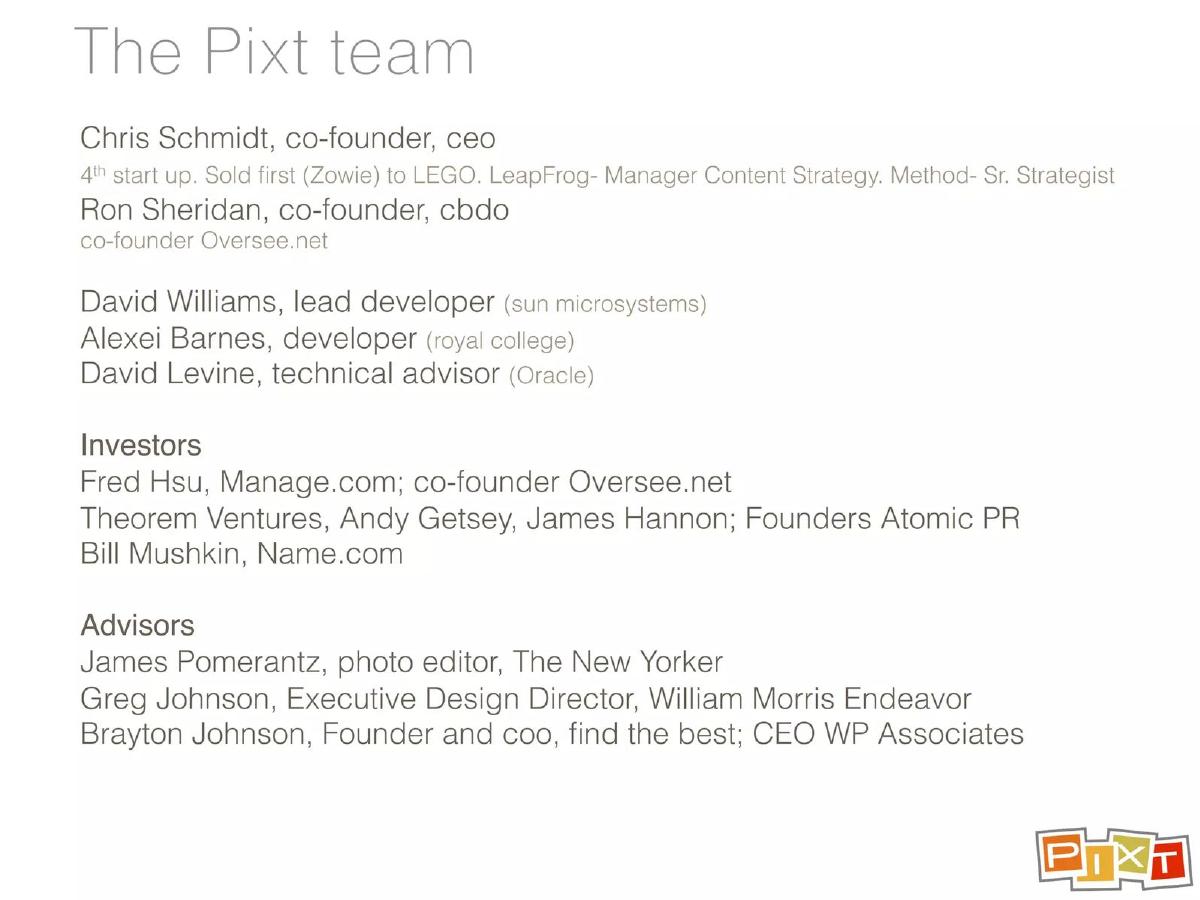
The Pixt deck, dating from May 2013, captures a specific era of the mobile social boom where photo aggregation was a primary focus. The company positioned itself as a 'photo host and aggregator,' pulling content from Facebook, Flickr, Picasa, Instagram, and YouTube into collaborative 'walls.' With 39,000 Android installs and 16,000 website users cited on slide 3, the startup demonstrated early cross-platform engagement. The deck is notable for its transparency regarding investment terms, detailing a $750,000 seed raise via a convertible note with a $5,000,000 cap. While it lacks a team slide…
Key takeaways
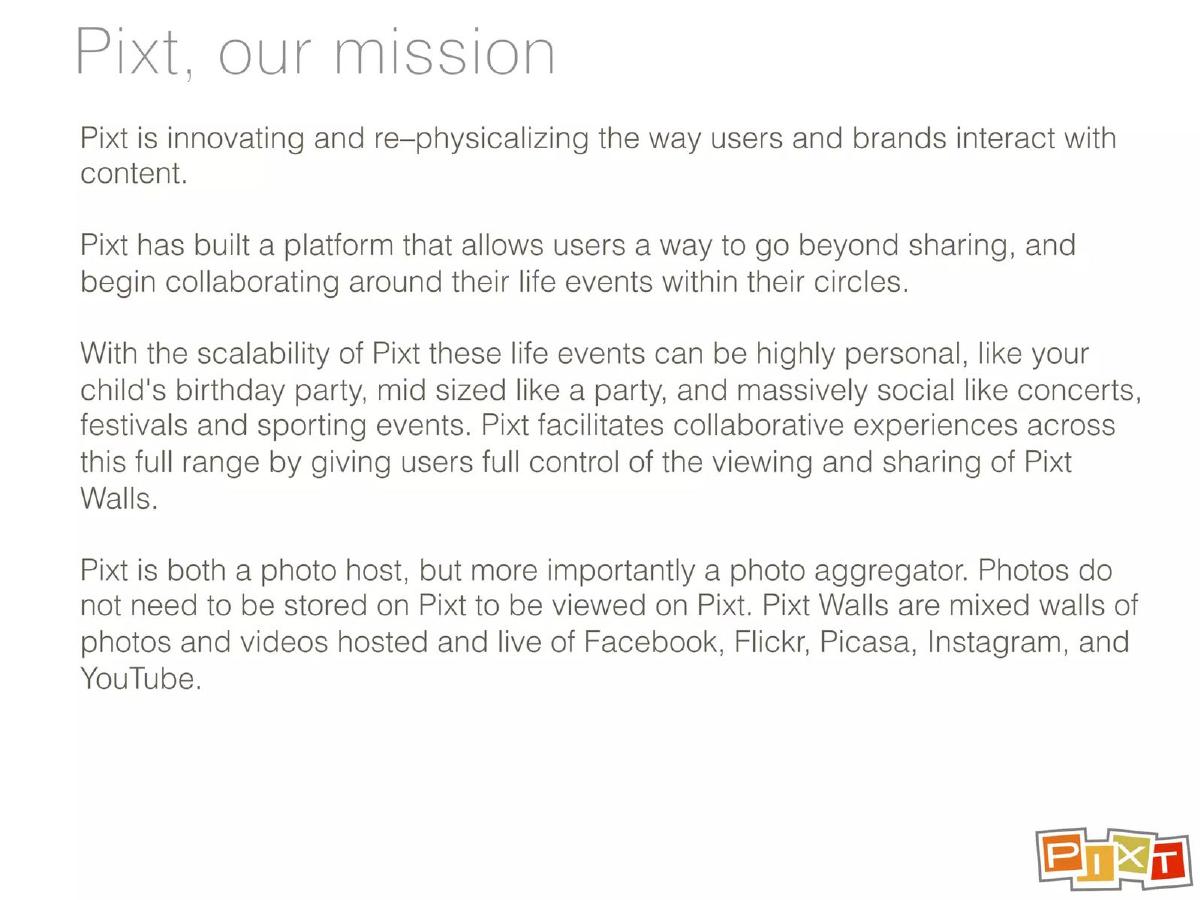
- Pixt identifies as both a photo host and an aggregator, pulling live content from five external social platforms (Slide 2).
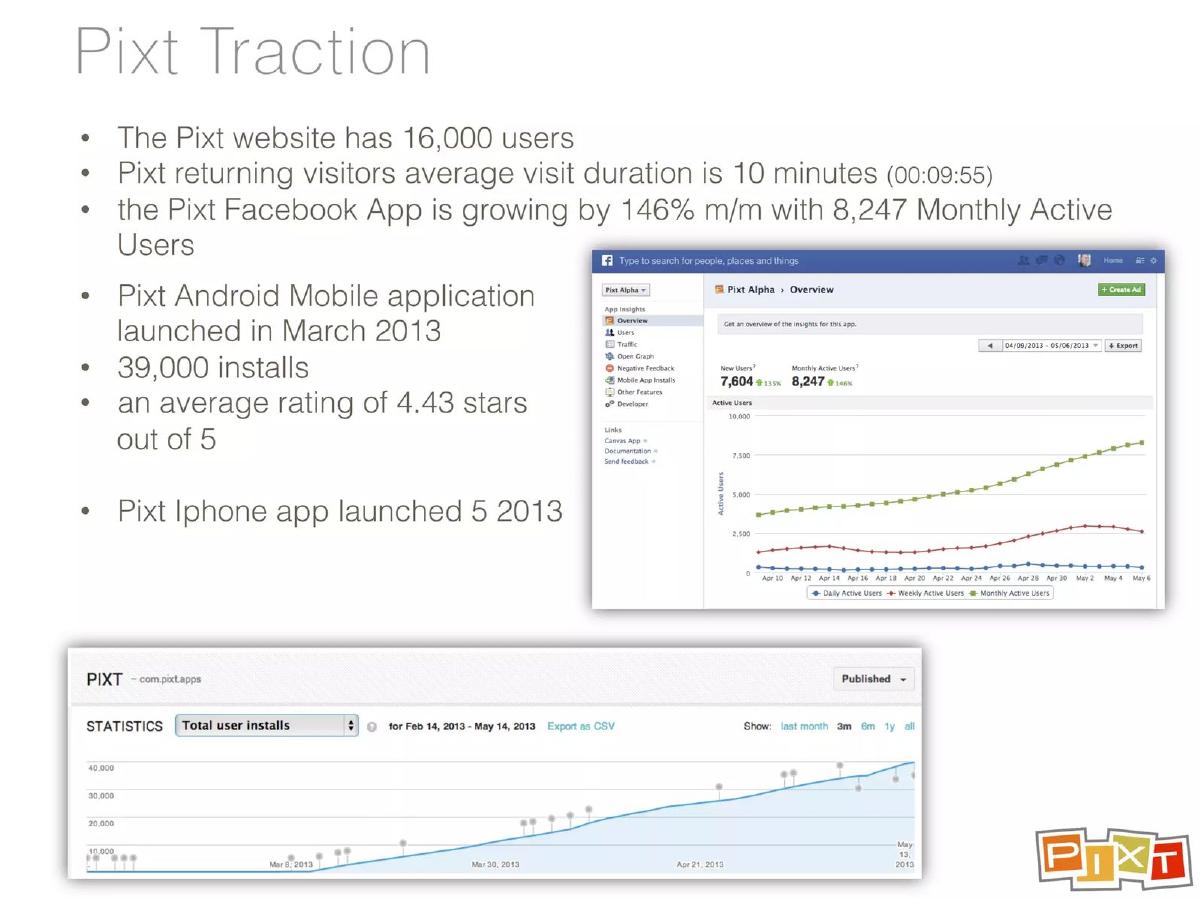
- The startup reported 39,000 Android installs and an average website visit duration of 9 minutes and 55 seconds (Slide 3).
- Facebook app growth was cited at 146% month-over-month, reaching 8,247 monthly active users (Slide 3).
- The market slide relies on 2012-2013 data, noting that mobile app revenues doubled since 2011 to surpass $30B (Slide 4).
- Revenue strategies include white-label walls for brands, affiliate commissions from storage/print partners, and premium user accounts (Slide 5).
- The 'Use of Funds' plan allocates capital for a 8 to 12-month runway and the addition of four new hires (Slide 6).
- The investment ask is a $750,000 convertible note with a $5M cap and tiered discounts for early investors (Slide 7).
- The deck lacks a dedicated 'Team' slide or 'Problem' slide in the provided 7-slide sequence.
Introduction
The Pixt pitch deck, dated May 2013, serves as a time capsule for the 'social aggregation' trend that followed the initial explosion of platforms like Instagram and Pinterest. At a time when digital content was becoming increasingly fragmented across different silos, Pixt proposed a unified 'wall' experience. This teardown examines the 7 slides provided from the original 14-slide deck, focusing on their traction, market positioning, and specific financial ask.
Slide 1: Title and Vision
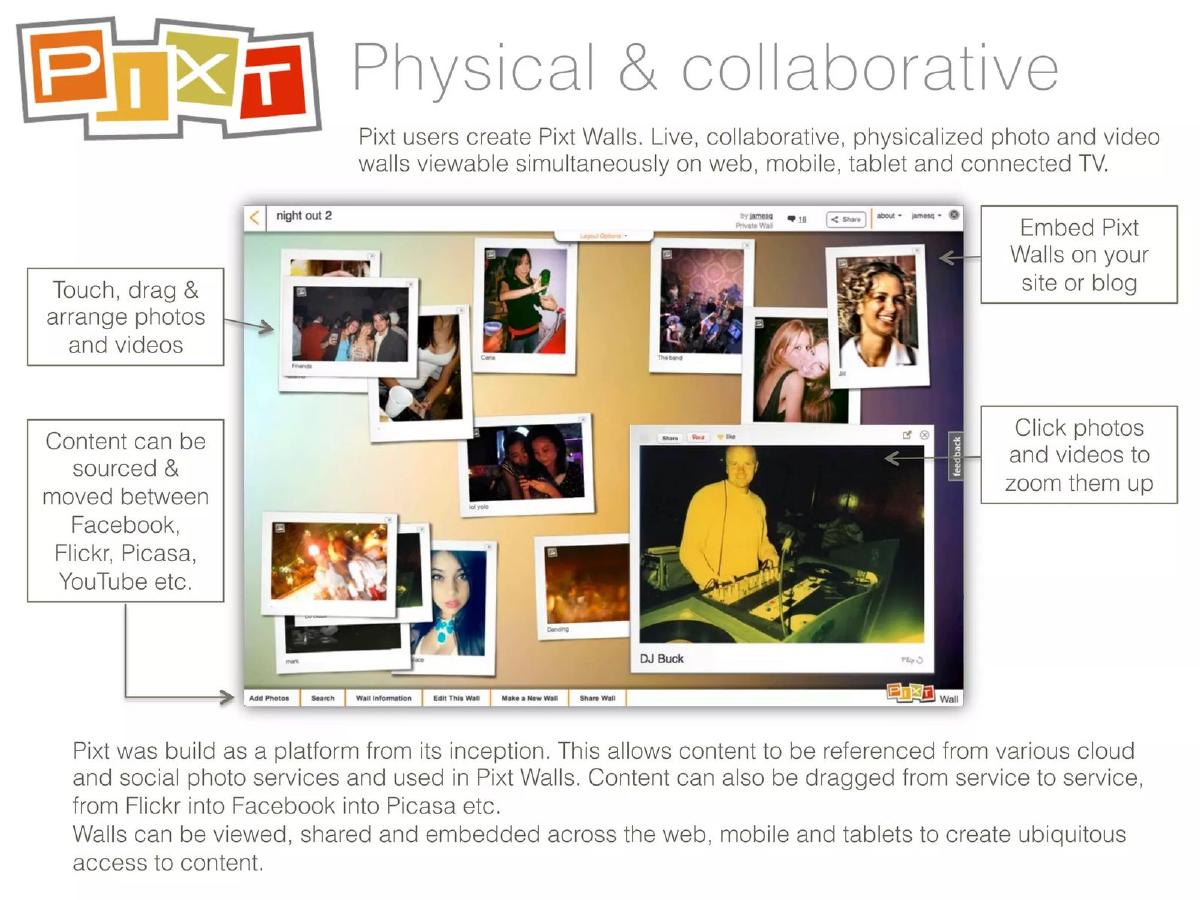
The cover slide establishes the multi-platform nature of the product. The tagline, "Your content, live and shared where you want it. Mobile, tablet, web and TV," emphasizes ubiquity. The visual components show the UI rendered across a smartphone, tablet, laptop, and television, suggesting that the 'Pixt Wall' is a flexible canvas for digital media regardless of the hardware.
Slide 2: The Mission
Slide 2 defines the company's purpose. Pixt describes its goal as "innovating and re-physicalizing the way users and brands interact with content." The term 're-physicalizing' is a unique choice, likely referring to the collage-style layout of the 'walls' which mimic physical photo boards. Importantly, this slide clarifies the technical approach: Pixt is a "photo aggregator." It explicitly lists integrations with Facebook, Flickr, Picasa, Instagram, and YouTube , noting that content does not need to be stored on Pixt to be viewed there. This positioning reduces friction for new users who already have established libraries elsewhere.
Slide 3: Traction Metrics
This is the strongest slide in the deck, providing granular data on early adoption. The founders report 16,000 website users and an average visit duration of 10 minutes (00:09:55) for returning visitors. This duration is significant for a social app, suggesting high engagement. The Android app, launched in March 2013, achieved 39,000 installs with a 4.43-star rating . The slide also includes screenshots of Facebook Insights showing 8,247 Monthly Active Users and a growth rate of 146% m/m . By including raw dashboard screenshots, the founders add a layer of credibility to their claims.
Slide 4: Market and Comparables
The market slide uses 2012 and 2013 data to justify the opportunity. It notes that "300 million photos are added to Facebook every day" and "Instagram has 90 million active users." These figures, while dated today, were the benchmarks of the era. The 'Comparable in the market' section lists several high-profile exits and valuations to anchor the company's potential: Pinterest at a $2.5B valuation , Instagram's $1B acquisition , and Pixable's $26.5M acquisition by SingTel . This list attempts to show that photo-centric platforms are highly liquid assets for investors.
Slide 5: Monetization Strategy
Pixt presents a diversified revenue model. They break it down into five categories:
Brand Accounts: White-label walls for brand sites, digital signage, and live event walls with analytics. · Affiliate Partnerships: Backups through storage providers like DropBox, Google Drive, and Amazon , as well as print partners like Shutterfly and Snapfish . · Affiliate Commissions: Direct links to Amazon, Ebay, and Overstock . · Advertising: Contextual ad insertion into sponsored walls. · Premium User Accounts: Paid feature sets for power users.
While comprehensive, this slide risks looking like a 'laundry list' of ideas rather than a focused strategy. However, for a seed-stage company, it demonstrates that the founders have considered multiple paths to sustainability.
Slide 6: Use of Funds
The 'Use of funds' slide is practical. It targets an "8 to 12 month growth phase." The roadmap includes launching a Pixt API and a Pixt Brand Platform . Hiring is specific: the addition of 2 developers and 2 marketing reps . This gives investors a clear picture of the immediate headcount expansion and the technical milestones the funding will support.
Slide 7: The Investment Opportunity
The final slide in this sequence details the financial ask. Pixt is raising a $750,000 convertible note with an option to increase the round by $500,000 . The terms are clearly defined: a $5,000,000 cap and a 6% annual interest rate . They use a tiered discount strategy to drive urgency: a 20% discount for the first $350,000 and a 10% discount for the rest. This level of detail on a pitch slide is rare and helpful for moving conversations toward a close.
What Works in This Deck
The traction slide is the highlight. By showing actual growth percentages and engagement times, Pixt proves that their 'wall' concept resonates with users. The inclusion of a TV interface in the vision slide was also forward-thinking for 2013, anticipating the rise of smart TVs as social hubs. Furthermore, the 'Investment Opportunity' slide is exceptionally transparent, removing the guesswork for potential angels regarding the structure of the deal.
What is Missing
The most glaring omission in this 7-slide set is the Team slide . In a seed round, the pedigree and technical capability of the founders are often more important than the current metrics. Also missing is a Problem slide . While the mission is stated, the deck doesn't explicitly articulate the 'pain point' users feel—why is viewing photos across multiple apps a problem that needs solving? Finally, there is no Unit Economics slide; while they list revenue streams, they don't explain the expected Customer Acquisition Cost (CAC) or Lifetime Value (LTV).
Founder Takeaways
Founders should emulate the Traction Slide (Slide 3) by using specific, verifiable data and screenshots from analytics platforms. It is much harder for an investor to dismiss a growth claim when they are looking at a Facebook Insights graph. Additionally, the tiered discount strategy on the investment slide is a clever way to reward early-check writers and create momentum in a fundraise. However, founders should ensure they lead with a strong 'Problem' statement to build an emotional case for the product before diving into the 'Mission' and 'Traction' data.
Frequently asked questions
- What is the core product offering of Pixt?
- Pixt is a platform designed to 're-physicalize' digital content by creating collaborative 'walls.' Unlike standard social networks, it acts as an aggregator, allowing users to view photos and videos hosted on Facebook, Flickr, Picasa, Instagram, and YouTube within a single interface across mobile, tablet, web, and TV.
- What were Pixt's primary traction metrics in 2013?
- According to slide 3, Pixt had 16,000 website users and 39,000 Android app installs following a March 2013 launch. Their Facebook app was growing at 146% month-over-month. They also highlighted a high engagement metric with returning visitors staying for an average of nearly 10 minutes.
- How did Pixt plan to generate revenue?
- The revenue model was multi-faceted, as shown on slide 5. It included B2B brand accounts (white-label walls, digital signage), affiliate partnerships with storage providers (Dropbox, Google Drive) and print services (Shutterfly), affiliate commissions from e-commerce (Amazon, eBay), and B2C premium user features.
- What were the specific terms of the investment round?
- Pixt sought a $750,000 seed round via a convertible note. The terms included a $5,000,000 valuation cap and a 6% annual interest rate. To incentivize early participation, they offered a 20% discount for the first $350,000 invested, dropping to a 10% discount for the remainder of the round.
- What key elements are missing from this pitch deck teardown?
- The provided 7-slide sequence is missing a 'Team' slide, which is critical for seed-stage investing. It also lacks a clear 'Problem' slide, instead jumping straight into the mission and product. Additionally, there is no detailed competitive landscape analysis beyond a list of market comparables.