Planet Clean II (PCR) positions itself as an established player in the recycling industry, claiming nearly three decades of experience and a current capacity of over 1,000 metric tons. The deck outlines a two-pronged expansion strategy: mobile plastic shredding trailers for remote land-based sourcing and hybrid freight ships designed to process plastic while in transit to international markets. Financial projections are exceptionally aggressive, forecasting a net income of $101,700,000 in the first year for the shipping segment alone, based on a 0% tax rate assumption. While the deck boasts s…
Key takeaways
- The company claims a 30-year history and existing operations in the UAE, Pakistan, India, China, Hong Kong, and East Africa (Slide 4).
- The core innovation involves 'Mobile Plastic Shredding Units' designed to reach remote areas that lack a large enough supply to be economically viable for traditional transport (Slide 5).
- A secondary innovation is the 'Hybrid Freight and Production Ship,' which processes plastic into finished products while sailing to destinations in the Middle East, Africa, or Asia (Slide 6).
- Management includes Captain Michalis Fountoglou, who has 29 years of shipping experience and has led over 450 successful S&P transactions (Slide 8).
- Financial projections for the 'Ship' segment estimate Year 1 revenue at $221,670,000 with a net income of $101,700,000 (Slide 9).
- The 'Factory' segment projections are smaller but still significant, starting at $21,690,000 in Year 1 revenue (Slide 10).
- Financial assumptions rely on a $1,205 selling price per ton against a $650 purchase price per ton (Slide 9 and 10).
- The deck omits a specific investment ask, valuation, or use of funds breakdown in the provided slides.
Executive Summary and Brand Identity
Slide 1: Title Slide
The deck opens with a clean, high-resolution image of a tropical beach, establishing an environmental theme. The logo for 'Planet Clean' features a stylized green and blue leaf/square icon. The subtitle, '#RecycleSmarter with Planet Clean Recycling,' serves as the company's primary slogan. The overall aesthetic is professional but leans heavily on stock environmental imagery.
The Environmental and Industrial Context
Slide 2: Problem
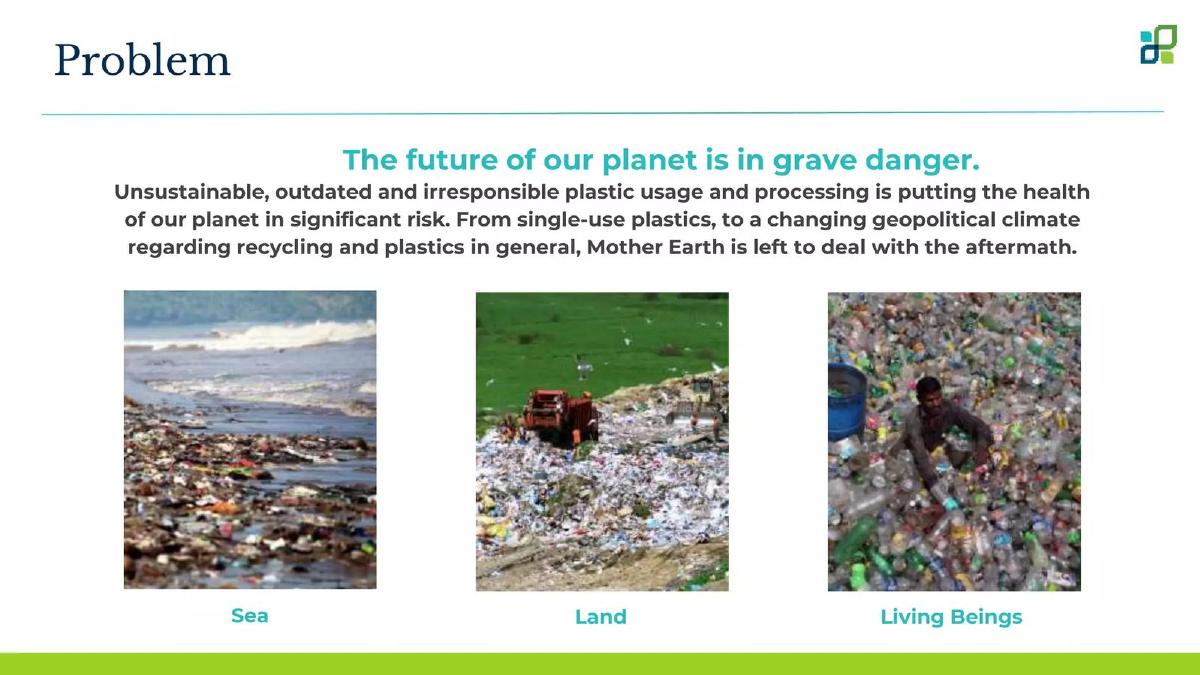
The problem slide uses a high-stakes emotional appeal, stating that 'The future of our planet is in grave danger.' It identifies three specific areas of impact: Sea, Land, and Living Beings, accompanied by photos of ocean debris, a landfill with heavy machinery, and a person surrounded by plastic bottles. The text cites 'unsustainable, outdated and irresponsible plastic usage' and a 'changing geopolitical climate regarding recycling' as the core issues. However, it lacks specific data points or quantified metrics regarding the volume of plastic waste or the specific failures of current recycling infrastructure.
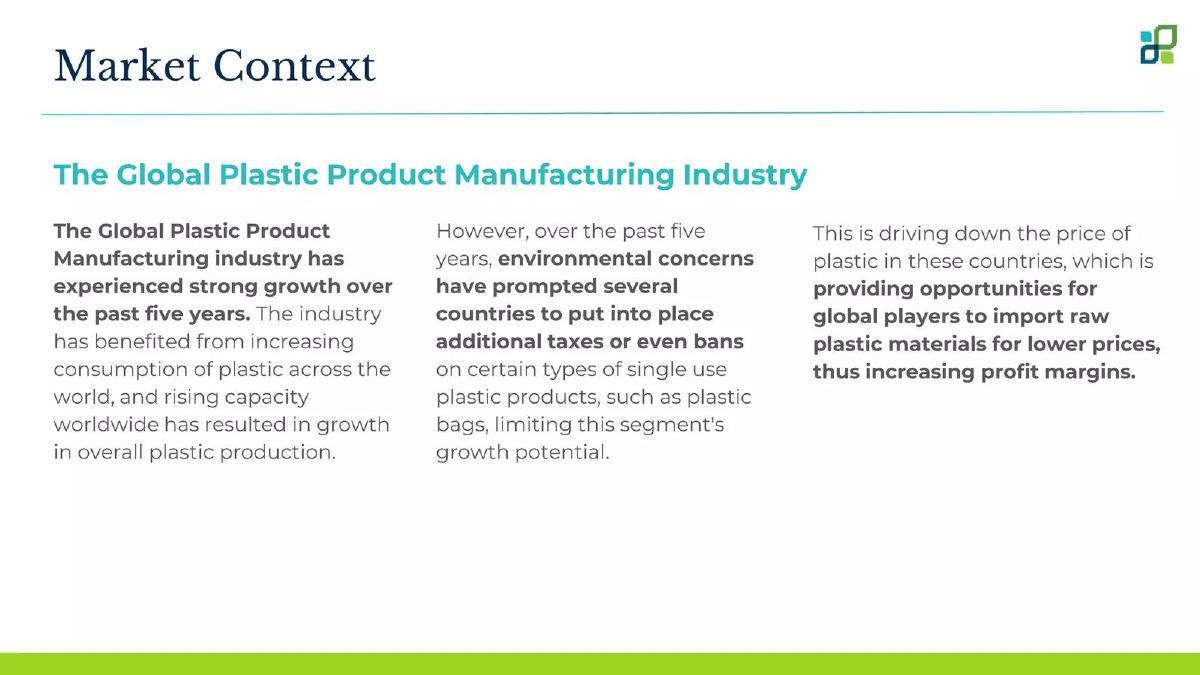
Slide 3: Market Context
This slide shifts from environmental concern to economic opportunity. It notes that the Global Plastic Product Manufacturing industry has seen strong growth, but environmental concerns and plastic bans are driving down the price of raw plastic in certain countries. The company identifies this as an opportunity for 'global players to import raw plastic materials for lower prices, thus increasing profit margins.' This slide is critical because it frames the business not just as a social good, but as a margin-expansion play based on market inefficiencies.
Company History and Capabilities
Slide 4: Planet Clean Recycling: At-a-Glance
Planet Clean establishes its credibility by claiming nearly 'three decades' of experience. The slide lists active markets including the UAE, Pakistan, India, China, Hong Kong, and east African nations. It describes an evolution from a 'trading house for recycled polymer processing' to a 'granule recycling and manufacturing/production business.' The company states it currently has a capacity of over 1,000 metric tons. This slide is intended to de-risk the investment by showing the team is not starting from scratch but is expanding an existing operation.
The Expansion Strategy: Land and Sea
Slide 5: P.1: Mobile Plastic Shredding Units
The first growth pillar involves 'Mobile Plastic Shredding Units.' The company plans to produce mobile trailers that travel to remote areas to shred plastic on-site. The goal is to pack shredded plastic into 'highly dense units' to make container export economically viable from regions that lack the volume to justify traditional transport. An illustration shows a truck being loaded with green blocks, representing the densified plastic. This addresses a specific supply chain bottleneck in the recycling industry: the high cost of transporting low-density waste.
Slide 6: P.3: Hybrid Freight and Production Ship
The second pillar is a 'Hybrid Freight and Production Ship.' The plan is to acquire vessels that process plastic while at sea. The slide claims this will 'save time while on voyage' and 'save costs by maximizing labor.' The finished products would be delivered directly to destinations in the Middle East, Africa, or Asia. The illustration shows a cargo ship with 'Phase 1' and 'Phase 2' processing areas located within the hull. This is a highly capital-intensive proposal that suggests a move toward complete vertical integration of the supply chain.
Value Propositions and Leadership
Slide 7: PCR and Management Team Value Propositions
This slide is a dense bulleted list of 14 value propositions. Key claims include 'Brand name recognition,' 'Established purchase agreements with customers,' and a 'Niche focus on targeting the farming and construction industries in North America.' It also mentions that 'Current demand is exceeding in-house production capacity,' which serves as a primary justification for the capital raise. The list is broad, covering everything from 'State-of-the-art manufacturing equipment' to 'Unbeatable prices,' though it lacks specific evidence for these claims.
Slide 8: PCRI Team Cont’d
The team slide focuses on two senior figures. Captain Michalis Fountoglou (Marine Operations) is presented as a highly experienced maritime professional with 29 years in the industry, including service in the Hellenic Navy and leadership in over 450 ship transactions. Brian Zucker (CPA) is introduced as the financial lead, with 25 years of experience in the securities industry and a history of working with hedge funds and public companies. The emphasis here is clearly on maritime execution and financial compliance rather than technology or environmental science.
Financial Projections and Assumptions
Slide 9: P.1 Financial Projections - Ship
The financial data for the shipping segment is remarkably aggressive. For the year 2020, the company projects $221,670,000 in revenue and $101,700,000 in net income. By 2024, these figures grow to $275,643,306 in revenue and $126,054,529 in net income. Key assumptions include a 0% tax rate, 8 round trip voyages per year, and a significant spread between the $650 purchase price per ton and the $1,205 selling price per ton. The 45%+ net income margin is extremely high for a heavy industry/logistics business.
Slide 10: P.3 Financial Projections - Factory
The factory segment projections are more modest but still substantial. Year 1 (2020) revenue is projected at $21,690,000 with a net income of $3,660,640. By 2024, net income is expected to reach $6,717,078. The assumptions cite a tax rate 'as agreed with State of Tennessee' and the same $1,205/$650 price spread used in the shipping segment. The inclusion of Tennessee suggests a specific geographic focus for their land-based manufacturing operations.
What Works / What is Missing
What Works
Clear Operational Strategy: The deck does a good job of explaining the logistics of their two main innovations (mobile trailers and processing ships). · Industry Experience: The team slide for Captain Fountoglou provides specific, quantifiable experience (450+ transactions) that is highly relevant to a ship-based business model. · Market Gap Identification: Identifying that remote areas are 'not economically viable to reach' with current methods provides a clear 'Why Now' for the mobile shredding units.
What is Missing
The Ask: There is no slide indicating how much capital the company is seeking to raise or what equity is being offered. · Use of Funds: For a business requiring the acquisition of ships and the manufacturing of trailers, a detailed CapEx breakdown is essential but absent. · Competitive Landscape: The deck assumes a vacuum. There is no mention of existing large-scale recyclers or other maritime waste initiatives. · Unit Economics: While the price per ton is mentioned, there is no breakdown of the operational costs per trailer or per voyage beyond high-level COGS. · Risk Factors: Operating a 'production ship' involves significant regulatory, environmental, and maritime risks that are not addressed.
Founder Takeaways
Be wary of 'Too Good to be True' Margins: Protesting a 45% net income margin in a capital-intensive, commodity-linked business like recycling will trigger immediate skepticism from sophisticated investors. Founders should ensure their margins reflect industry realities, including maintenance, insurance, and market fluctuations.
Tax Assumptions Matter: Stating a 0% tax rate because 'tax is paid by the buyer' is a non-standard financial assumption that requires significant legal and jurisdictional backing. Founders should be prepared to defend such claims with specific tax code references.
Vertical Integration requires CapEx Clarity: If your business model involves buying ships and building factories, your deck must show the 'Step 1' costs. Planet Clean jumps straight to the revenue generated by these assets without showing the cost to acquire them.
Leverage Specific Pedigree: The strongest part of this deck is the maritime experience of the team. In heavy industry plays, the 'Who' is often more important than the 'What.' Highlighting a lead with 450+ successful transactions is a powerful way to build trust in a high-CapEx model.
Frequently asked questions
- What is the primary business model of Planet Clean II?
- Planet Clean II operates as a vertically integrated recycling company. They source raw plastic waste from remote land areas using mobile shredding trailers and from the sea using hybrid ships. These ships are designed to process the waste into finished products while in transit to global markets, thereby reducing labor costs and maximizing time efficiency.
- Who are the key members of the management team?
- The deck highlights two primary figures: Captain Michalis Fountoglou, who leads Marine Operations with 29 years of experience in shipping and naval operations, and Brian Zucker, a CPA with over 25 years of experience in the securities industry, having served as CFO for various broker-dealers and hedge funds.
- How realistic are the financial projections in the deck?
- The projections are extremely aggressive. The shipping segment alone forecasts a net income margin of approximately 45.8% ($101.7M net income on $221.6M revenue) starting in Year 1. These figures assume a 0% tax rate and a consistent spread between purchase and selling prices, which may not account for market volatility or high capital expenditure.
- What geographic markets does the company target?
- The company claims an existing presence in the UAE, Pakistan, India, China, Hong Kong, and East African nations. Their expansion strategy focuses on sourcing from remote areas and delivering finished products to the Middle East, Africa, and Asia, while also mentioning a niche focus on North American farming and construction industries.
- What is missing from this pitch deck?
- The provided slides lack a clear 'Ask' (how much money they are raising), a 'Use of Funds' slide, and a 'Competition' slide. Additionally, there is no detailed breakdown of the capital expenditure required to acquire the ships or build the mobile units, which are central to their growth plan.