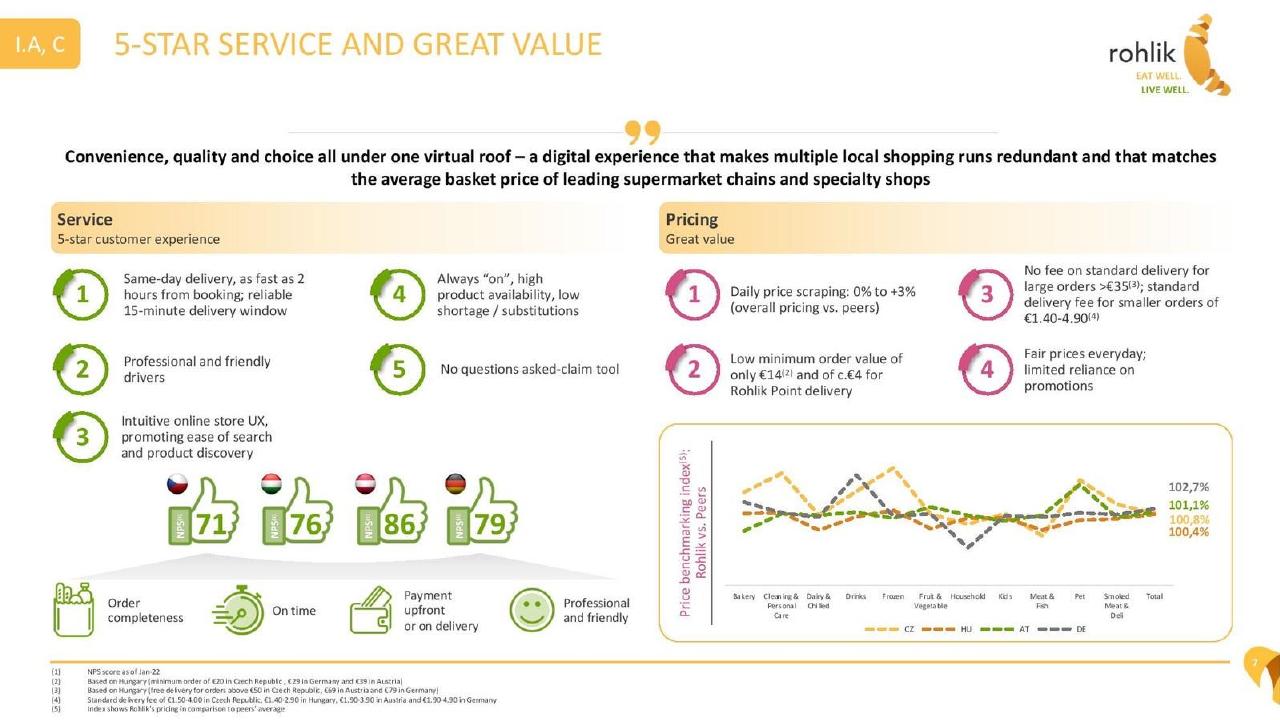
Rohlik’s Series F deck is a masterclass in positioning a logistics-heavy business as a high-margin technology leader. By raising $170M in 2024, as reported by Business Insider, the Czech-based company demonstrated how to pitch the 'boring' business of groceries using sophisticated automation and data-driven assortment strategies. The deck focuses heavily on the massive TAM opportunity in Europe, where online grocery penetration sits at a mere 3% compared to other sectors. Rohlik differentiates itself through a three-pronged value proposition: premium assortment (23k SKUs), competitive pricing…
Key takeaways
- The European grocery market represents a €1.9 trillion opportunity with only 3% online penetration as of 2021 (Slide 2).
- Rohlik targets a massive expansion from their €0.3bn current scale to a potential €188bn market at 20% penetration (Slide 2).
- Automation is central to their strategy, utilizing AutoStore systems, robots for dispatch, and AI-based demand prediction (Slide 4).
- The company claims a unique position by delivering on assortment, price, and speed simultaneously, whereas competitors like Ocado or Tesco often compromise on one (Slide 6).
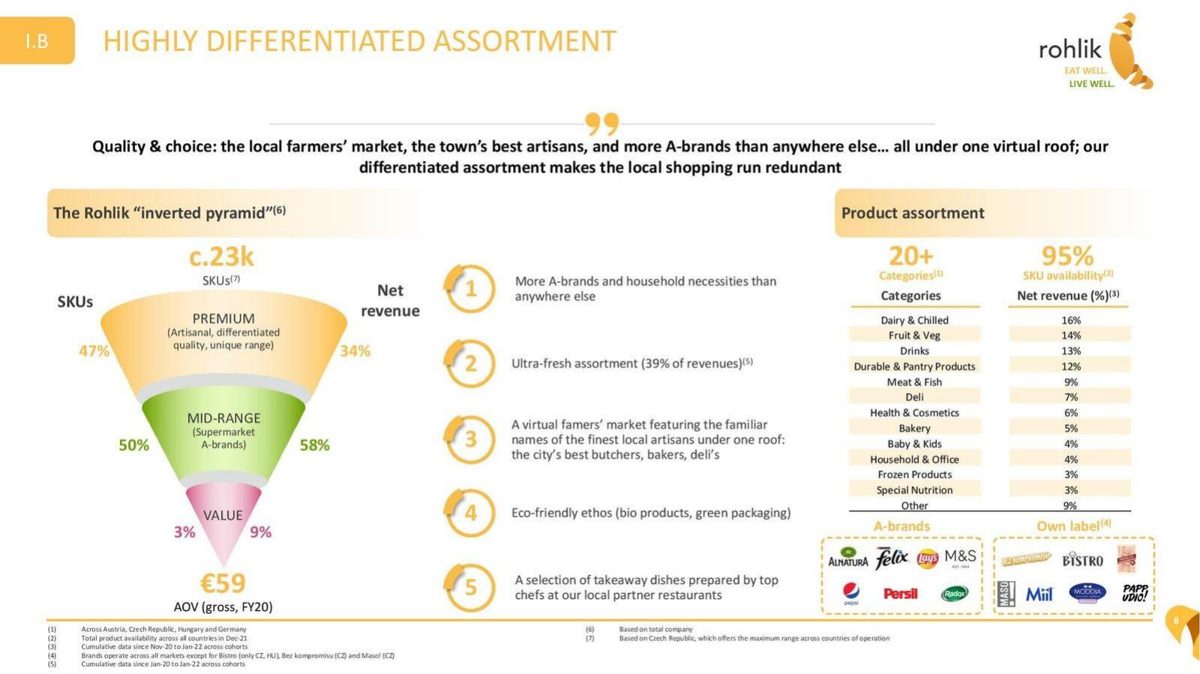
- Their 'inverted pyramid' model shows that 47% of SKUs are premium, contributing to 34% of net revenue (Slide 8).
- Mid-range products (supermarket A-brands) make up 50% of SKUs and 58% of net revenue (Slide 8).
- The business achieved a gross Average Order Value (AOV) of €59 in FY20 (Slide 8).
- ESG is integrated into the core pitch, featuring a 56/100 EcoVadis score and a goal for a full electric fleet by 2025 (Slide 10).
Rohlik Series F Pitch Deck Teardown
Rohlik is not just another grocery delivery startup; it is a logistics and automation powerhouse originating from the Czech Republic. In a sector that has seen massive consolidation and the failure of many 'quick commerce' players, Rohlik’s $170M Series F raise in 2024 stands as a testament to their sustainable unit economics and technological moat. This teardown examines the 11-slide management presentation that helped secure that funding.
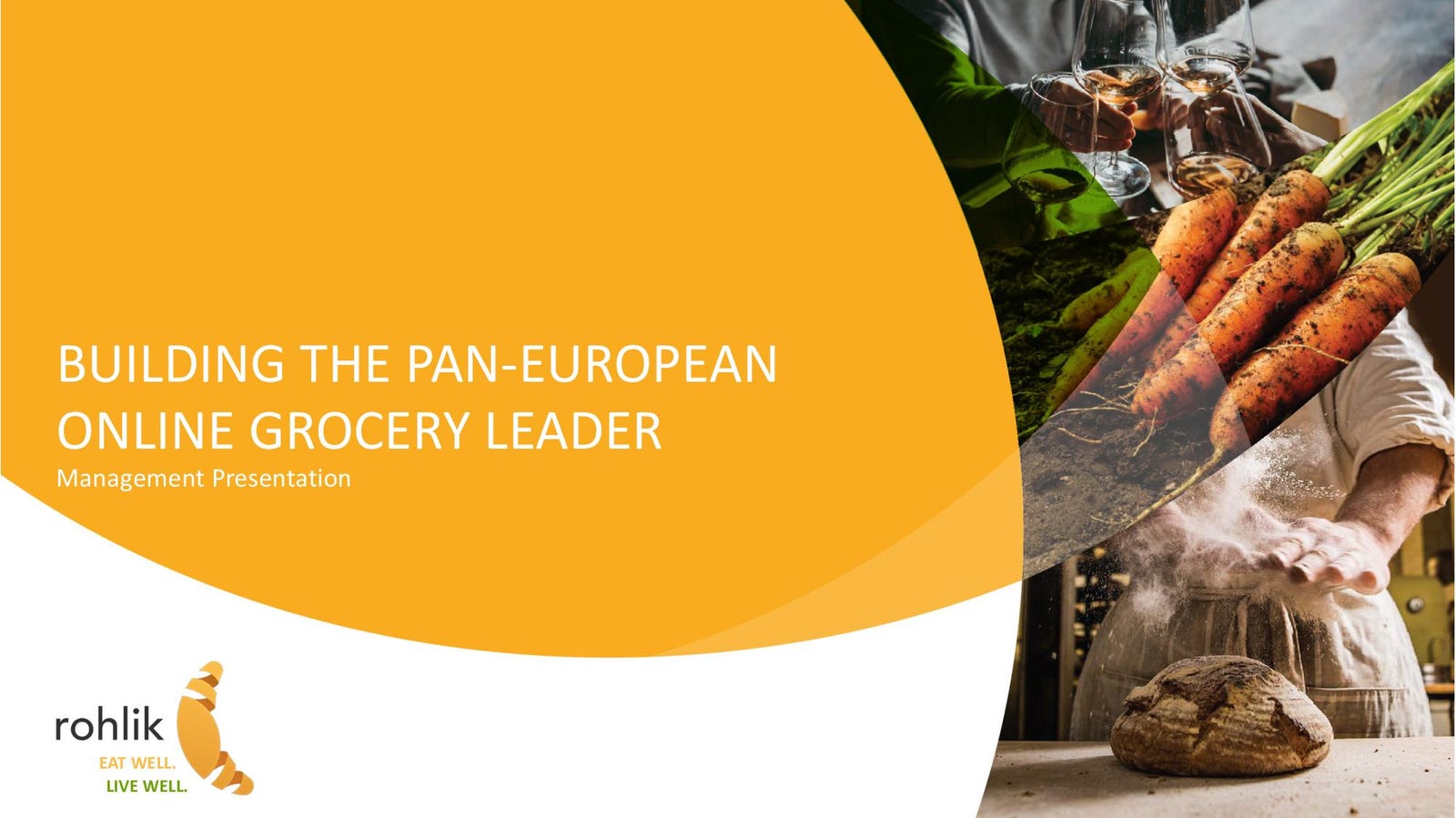
Slide 1: Title Slide
The deck opens with a clear, bold mission statement: "Building the Pan-European Online Grocery Leader." The branding is clean, utilizing a warm orange palette and high-quality imagery of fresh produce and artisanal bread. This immediately signals that Rohlik is positioning itself as a premium, food-first company rather than just a software platform. The subtitle "Management Presentation" indicates this is a high-level document intended for sophisticated investors who are already familiar with the basic mechanics of the industry.
Slide 2: The European TAM Opportunity
Slide 2 is a classic 'Market Opportunity' slide, but it uses data to create a sense of inevitability. It highlights that the European grocery retail market is massive (€1.9 trillion) but suffers from extremely low online penetration (3%). By comparing this to Fashion (16%) and Electronics (11%), Rohlik argues that grocery is the next frontier for digital disruption.
The slide uses a series of concentric circles to show growth potential. They start at their current position of €0.3bn and project a path to €188bn if they reach 20% penetration in their core markets. The 'Structural Trends' listed—such as premiumisation and limited full-service competition—serve to justify why Rohlik is the right vehicle to capture this growth. The inclusion of specific core markets in the footnotes (Czech Republic, Hungary, Austria, Germany, Romania, Italy, Spain) gives the TAM calculation geographic grounding.
Slide 4: Technology-Led Organization
This slide is crucial for a Series F company because it explains how they will achieve profitability at scale. Rohlik divides its technological moat into three categories: Commercial, Fulfilment/Last Mile, and Marketing. They highlight AI-based demand prediction and delivery routing algorithms, but the centerpiece is the 'Clear plan for FCs (Fulfillment Centers) automation.'
The visual of an AutoStore system—a grid-based robotic picking solution—is a strong signal to investors. It suggests that Rohlik is moving away from labor-intensive manual picking toward a capital-intensive but high-margin automated model. The slide explicitly states that automation will translate into "productivity increase, storage capacity optimisation and standardisation." This is a pitch for operational excellence, not just market share.
Slide 6: Unique Customer Value Proposition
Slide 6 uses a three-axis chart to visualize Rohlik’s competitive positioning. The axes are Assortment, Price, and Delivery Speed. This is a sophisticated way to show why they are winning. They position themselves in the 'sweet spot' with 23k SKUs (Assortment), 1.5-2 hour delivery (Speed), and low prices/free delivery over €50 (Price).
They directly name competitors like Ocado, Tesco, and 'Quick Commerce' players (like Getir or Flink). By doing so, they show that Quick Commerce has speed but no assortment, while traditional players like Tesco have assortment but no speed. Rohlik claims to be the "only player delivering on all 3 points." The star-rating graphic on the right side of the slide reinforces this, giving Rohlik five stars across all categories while showing the trade-offs their competitors must make.
Slide 8: Highly Differentiated Assortment
This is perhaps the most important slide for understanding Rohlik’s unit economics. They introduce the 'Rohlik Inverted Pyramid.' Most grocers focus on high-volume, low-margin value items. Rohlik flips this. Their data shows that while 'Value' items are only 3% of their SKUs, 'Premium' artisanal goods make up 47% of their SKUs and drive 34% of net revenue.
This strategy leads to a high Average Order Value (AOV) of €59 (as of FY20). A high AOV is the holy grail of delivery because the cost of the 'last mile' is relatively fixed regardless of whether the basket contains €20 or €60 of goods. By selling premium meat, bakery items, and 'A-brands,' Rohlik ensures each delivery is profitable. The slide also lists their private label brands like 'Miil' and 'Moddia,' which typically offer higher margins than third-party brands.
Slide 10: Strong Organisational Focus on ESG
In the current European investment climate, ESG (Environmental, Social, and Governance) is not optional. Slide 10 outlines Rohlik’s commitment to sustainability, citing a 56/100 EcoVadis score. They highlight 'Sourcing that cares' (local suppliers), 'Innovative eco-friendly packaging,' and a roadmap toward a full electric fleet by 2025.
Notably, they mention 'Labour initiatives' such as paying 10% above peer jobs and offering flexible scheduling for drivers. This is a strategic inclusion; in the gig economy, labor relations are a significant regulatory and operational risk. By showing they treat drivers as a valued part of the workforce, they de-risk the investment for ESG-conscious funds.
What Works in the Rohlik Pitch Deck
1. Data-Driven Differentiation: The deck doesn't just say they are better; it uses specific metrics like SKU counts (23k) and AOV (€59) to prove it. The comparison chart on Slide 6 is a very effective way to visualize a complex competitive landscape.
2. Focus on Automation: For a late-stage round, investors want to see how the company will scale without a linear increase in costs. The detailed breakdown of fulfillment center automation (Slide 4) addresses this directly.
3. The Inverted Pyramid Concept: This is a brilliant piece of framing. It takes a potential weakness (not being the cheapest) and turns it into a strength (having the highest value customers and best margins).
What is Missing from the Rohlik Pitch Deck
1. The Financials: As this is a 'Management Presentation' likely used in conjunction with a data room, the 11 slides provided are missing a detailed P&L, burn rate, and path to EBITDA positivity. While they mention AOV, they don't show the contribution margin per order.
2. The Team: There is no team slide in this selection. For a Series F, the individual founders are less important than the depth of the executive bench, but investors still want to see who is leading the international expansion.
3. The Ask: The deck does not explicitly state how much they are raising or how the funds will be allocated. According to publisher reports, the round was $170M, but the deck itself remains silent on the specific terms of the raise.
What Founders Should Copy
1. Use 'Concentric' TAM Slides: Don't just show one giant number. Show your current market, your near-term addressable market, and your long-term theoretical market. This makes your growth story feel grounded in reality.
2. Visualise Your 'Sweet Spot': If you are competing in a crowded market, use a multi-axis chart like Slide 6. It forces you to define exactly what your 'unfair advantage' is and shows investors that you understand your competitors' weaknesses.
3. Highlight Unit Economics via Assortment: If you have a high AOV, explain why. Rohlik’s breakdown of Premium vs. Value SKUs is a great way to show that your revenue isn't just luck—it's a result of a deliberate product strategy.
Conclusion
Rohlik’s deck is a sophisticated document for a sophisticated round. It moves past the 'problem/solution' phase of early-stage pitching and focuses entirely on market dominance, operational efficiency, and margin expansion. By positioning themselves as a 'technologically-led' retailer rather than a delivery service, they justified a massive $170M valuation in a challenging market environment.
Frequently asked questions
- What is Rohlik's core competitive advantage according to the deck?
- Rohlik positions itself as the only player that balances three critical pillars: a massive assortment (23k SKUs), rapid delivery (1.5-2 hours), and low prices (free delivery over €50). Slide 6 explicitly compares them to 'Quick Commerce' players who lack assortment and traditional supermarkets like Tesco who lack speed.
- How does Rohlik use technology to improve margins?
- Slide 4 details their 'Clear plan for FCs automation.' By integrating AutoStore systems for picking and robots for dispatch, they aim to increase productivity and reduce performance variability. They also use AI for demand prediction and advanced inventory management to minimize waste.
- What does the 'Inverted Pyramid' refer to in their business model?
- Found on Slide 8, it describes their product mix. Unlike traditional discounters, Rohlik leans heavily into 'Premium' and 'Mid-range' products. While 'Value' items are only 3% of SKUs, 'Premium' artisanal goods make up 47% of SKUs, driving a high AOV of €59.
- What are Rohlik's primary markets?
- According to the footnotes on Slide 2 and Slide 8, their core markets include the Czech Republic, Hungary, Austria, Germany, Romania, Italy, and Spain. The data provided in the deck is often indexed against their performance in the Czech Republic.
- How much did Rohlik raise with this deck?
- As reported by Business Insider, Rohlik raised $170 million in a Series F round in 2024. The deck itself serves as a 'Management Presentation' to support this late-stage capital infusion for further European expansion.