Romit’s 12-slide seed deck from 2016 represents a strategic rebranding of Robocoin, shifting focus from Bitcoin ATMs to a broader payment platform. The deck relies heavily on early traction metrics—280,000 transactions and 52% month-over-month growth—to validate their new direction. By positioning themselves as the 'high tech' solution for the 95% of the $7 trillion merchant banking market not served by Stripe or PayPal, they highlight a massive gap in the industry. The team leans on their history of transacting $150 million across 18 countries to establish credibility. However, the deck is n…
Key takeaways
- The company claims to have processed 280,000 transactions within five months of launch (Slide 2).
- Romit reports an average revenue of 400 basis points per transaction, which they state is 4x the industry average (Slide 3).
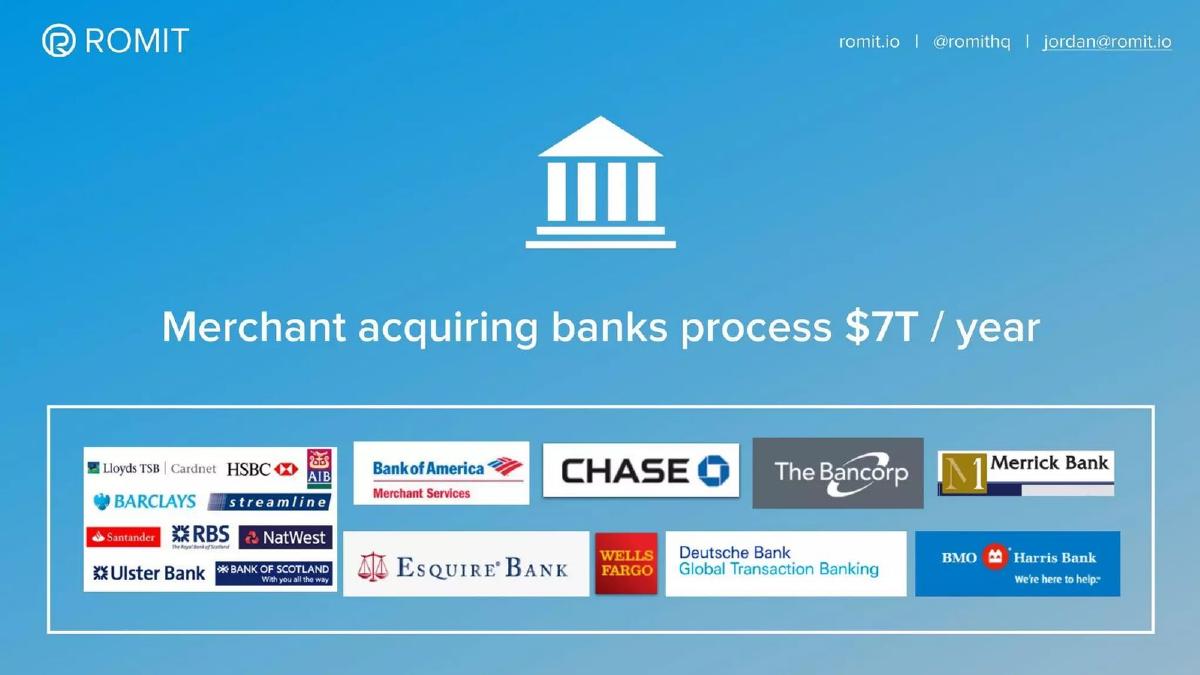
- The deck identifies a $7 trillion merchant banking market, noting that modern players like Stripe and PayPal handle less than 5% of total volume (Slides 4-5).
- A core value proposition is fraud reduction, claiming a drop in merchant chargebacks from 1.2% to 0.0079% (Slide 8).
- The founding team highlights their 'Ex-Bitcoin' background, having previously transacted $150M in 18 countries (Slide 9).
- The deck lists three specific banking partners with their respective assets: Merrick Bank ($24.6B), BMO Harris Bank ($22.2B), and Esquire Bank ($4.6B) (Slide 12).
- The company discloses having raised $945,000 prior to this deck, though the catalogue listing specifies a $125,000 seed round in 2016 (Slide 10).
- There is no explicit 'Ask' slide detailing the amount being raised or the intended use of funds.
The Pivot from Hardware to Infrastructure
The Romit pitch deck is a fascinating artifact of the mid-2010s fintech boom. Originally known as Robocoin—the company that launched the world's first Bitcoin ATM—the founders realized that the real value lay not in the physical kiosks, but in the software layer that managed high-risk transactions, compliance, and fraud. This deck represents the transition to Romit, a payment platform designed to modernize the legacy merchant banking industry. By focusing on the 'other 95%' of a $7 trillion market, Romit attempts to position itself as the Stripe for industries that Stripe won't touch.
The Hook: Traction and Market Opportunity (Slides 1-4)
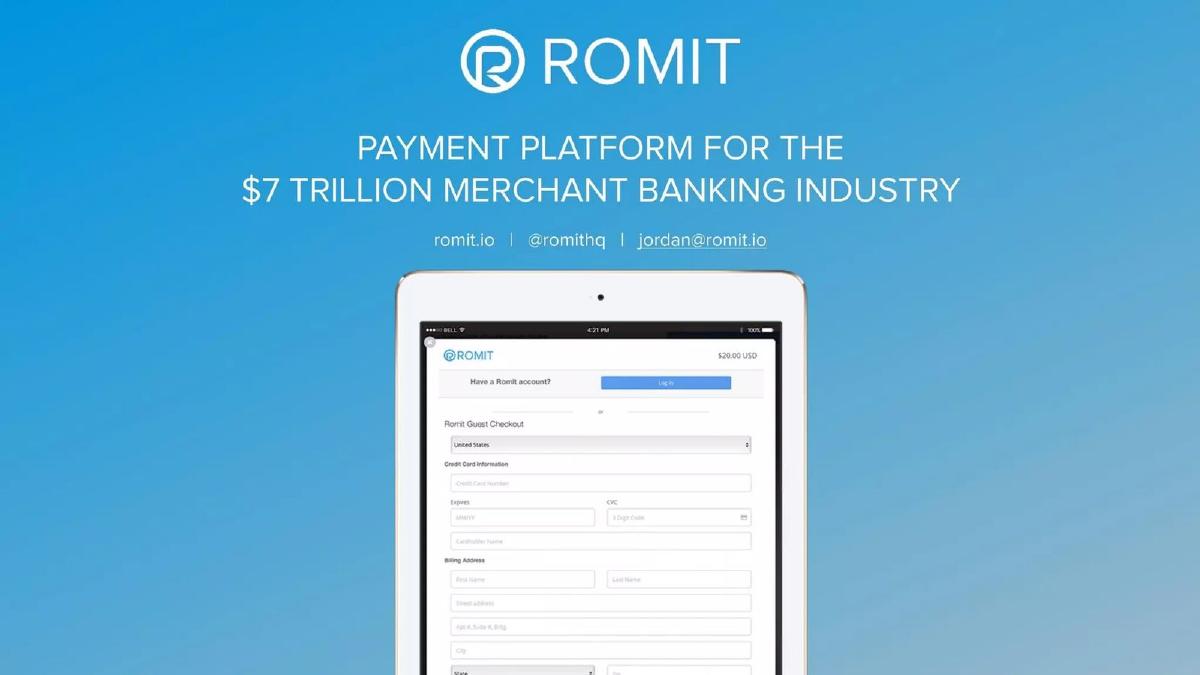
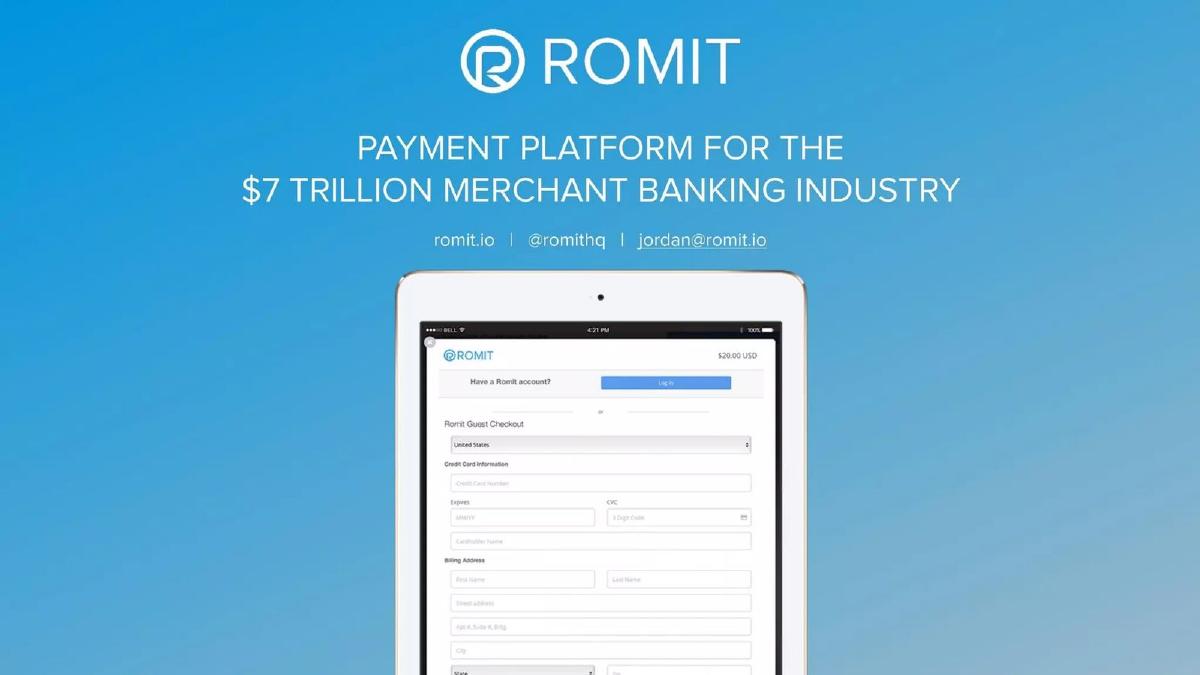
Slide 1: Title The deck opens with a clean, blue-gradient brand identity for Romit. The subtitle is bold: 'Payment platform for the $7 trillion merchant banking industry.' This immediately sets the scale. It doesn't mention Bitcoin on the cover, signaling a move toward a broader financial audience. A tablet mockup shows a guest checkout screen, emphasizing a user-friendly interface.
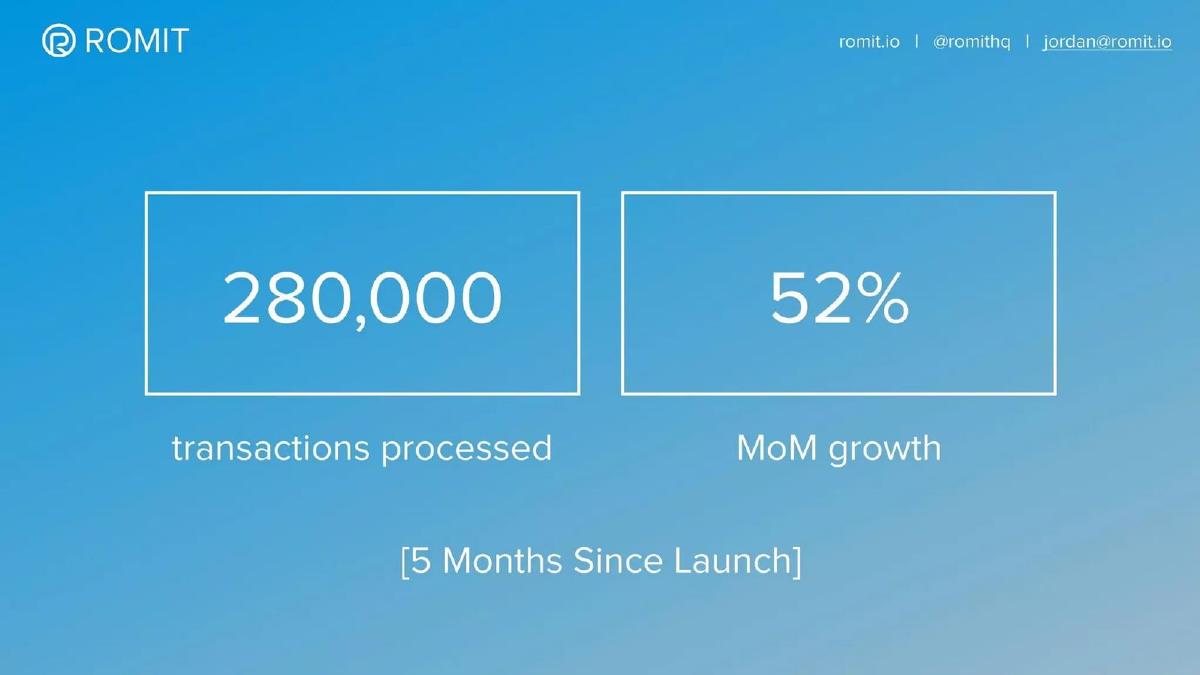
Slide 2: Traction Romit follows the 'Traction First' philosophy. Slide 2 presents two massive numbers: 280,000 transactions processed and 52% month-over-month growth. The footnote '[5 Months Since Launch]' adds urgency and proves velocity. For a seed-stage company, these are impressive figures that demand attention.
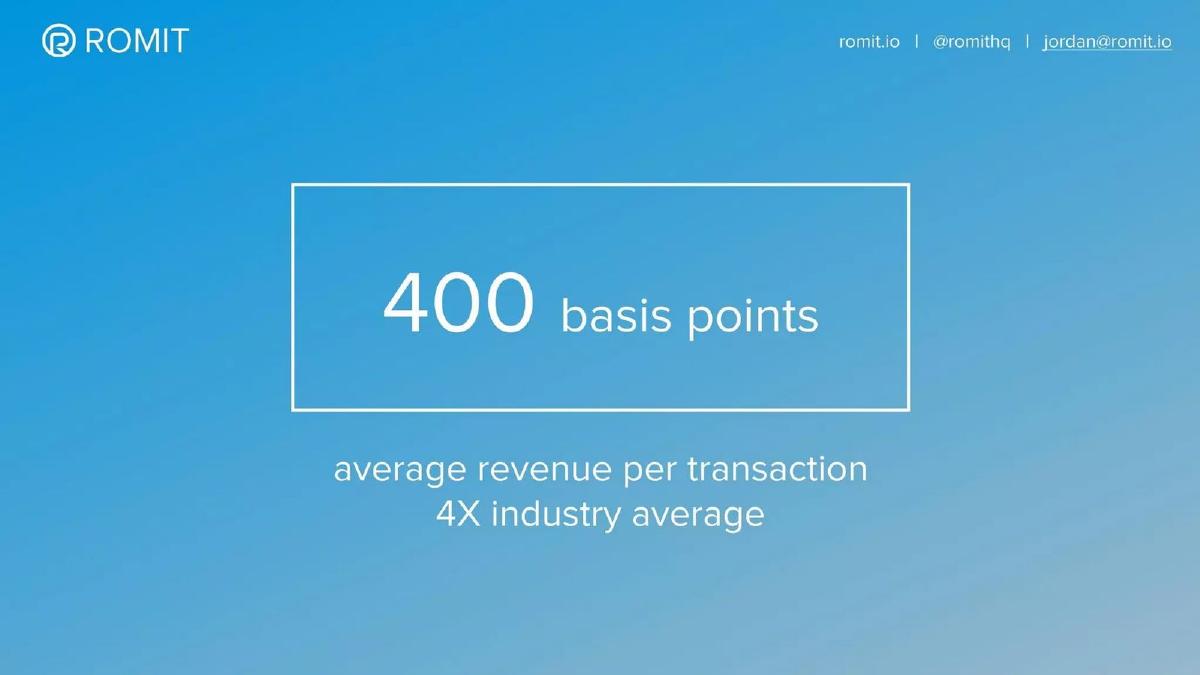
Slide 3: Revenue The momentum continues with Slide 3, which highlights '400 basis points' as the average revenue per transaction. By stating this is '4X industry average,' Romit is telling investors that they aren't just growing fast; they are highly profitable on a per-unit basis. This suggests they are operating in a niche (likely high-risk or cross-border) where merchants are willing to pay a premium for reliable service.
Slide 4: Market Size Slide 4 visualizes the $7 trillion merchant banking market by displaying logos of major global banks like Chase, HSBC, Wells Fargo, and Bank of America. This slide establishes the 'Old Guard' that Romit intends to either serve or disrupt.
The Problem: The Technology Gap (Slides 5-6)
Slide 5: The 5% vs. The 95% This is the core of Romit’s thesis. They show PayPal and Stripe logos and state they represent less than 5% of total credit card volume. This is a clever way to frame the competition; rather than fighting Stripe for the 5%, Romit is going after the massive, underserved majority.
Slide 6: The Pain Points Slide 6 identifies why the 'Other 95%' are struggling: they are 'Low Tech' and 'High Fraud.' This sets up Romit’s value proposition perfectly. The traditional banks have the volume, but they lack the modern software tools to protect that volume and provide a good user experience.
The Solution: High-Tech Infrastructure (Slides 7-8)
Slide 7: Product Interface Slide 7 shows the 'High Tech Solutions for the 95%.' The mobile screenshots show a 'Connect with Romit' OAuth-style login and a checkout screen. This mimics the ease of use found in modern fintech apps, promising to bring that same experience to legacy banking partners.
Slide 8: Fraud Mitigation This is perhaps the most important slide for a fintech investor. Romit claims to have reduced merchant chargebacks from 1.2% to a staggering 0.0079%. In the world of merchant acquiring, chargebacks are the primary profit killer. A reduction of this magnitude is a 'killer feature' that would make Romit an essential partner for any bank.
The Team and The History (Slides 9-10)
Slide 9: The 'Ex-Bitcoin' Team Romit finally reveals its heritage here. The team, led by Jordan Kelley and John Russell, highlights their experience as the 'Ex-Bitcoin Team.' They cite $150M transacted across 18 countries and 14 currencies. They include press clippings from Time and TechCrunch about 'Robocoin Bank' and 'Bitcoin ATMs.' This builds massive credibility; they aren't just theorizing about payments, they have already built a global network from scratch.
Slide 10: Funding Status Slide 10 is a simple text slide: 'WE ARE EATING THE PAYMENTS SPACE. $945K raised.' This shows they have already secured significant backing, though it doesn't specify who the investors are. It serves to show that the company is capitalized and moving fast.
Partnerships and Validation (Slides 11-12)
Slide 11: Partners Romit lists three key partners: Authorize.Net, Apriva, and Vantiv. These are major players in the payment gateway and processing space. Having these logos on a slide proves that Romit’s technology is already integrated into the existing financial ecosystem.
Slide 12: Merchant Banking Partners The final slide lists their current banking partners: Merrick Bank ($24.6B), BMO Harris Bank ($22.2B), and Esquire Bank ($4.6B). By showing the asset sizes of these banks, Romit reinforces the scale of the opportunity. They aren't just working with small credit unions; they are integrated with multi-billion dollar institutions.
What Works in This Deck
1. Traction-Led Narrative: By putting the 280,000 transactions on Slide 2, Romit bypasses the 'will this work?' question and moves straight to 'how big can this get?'
2. Clear Market Segmentation: The distinction between the 5% (Stripe/PayPal) and the 95% (Legacy Banks) is a brilliant piece of positioning. It makes the market feel wide open rather than crowded.
3. Quantifiable Value Prop: The chargeback reduction metric (Slide 8) is specific and highly valuable. It’s a 'painkiller' rather than a 'vitamin.'
4. Proven Team: Leveraging the Robocoin history shows the founders have 'been there, done that' in a highly regulated, technically complex global environment.
What is Missing from This Deck
1. The Business Model: While they mention 400 basis points of revenue, they don't explain the take rate versus the processing costs. Investors need to know the gross margins.
2. The Ask: There is no slide stating how much they are raising in this specific round or what the milestones for the next 18 months are.
3. Competitive Landscape: While they mention Stripe and PayPal, they don't address other 'high-risk' processors or newer crypto-to-fiat gateways that might be emerging.
4. Regulatory Strategy: Given their history in Bitcoin, a slide addressing how they handle KYC/AML and global compliance would have been beneficial to de-risk the investment.
What a Founder Should Copy
1. The 'Traction First' Approach: If you have numbers as good as Romit’s, don't bury them on Slide 10. Put them up front to set the tone for the entire pitch.
2. Use Logos for Credibility: The use of banking logos and partner logos (Slides 4, 11, and 12) does a lot of heavy lifting. It makes a small startup feel like a serious industry player.
3. Simple Visuals: The deck is not cluttered. Each slide has one main point, usually backed by a single large number or a few clear logos. This makes the deck very easy to digest in a 3-minute skim.
4. Framing the Market: Don't just say the market is big. Explain why the current winners (like Stripe) aren't actually winning the whole market. Finding the 'Other 95%' is a great way to frame a blue-ocean opportunity.
Frequently asked questions
- What is the primary problem Romit is solving?
- Romit targets the 'other 95%' of the $7 trillion merchant banking industry that is not served by modern payment processors like Stripe or PayPal. According to Slide 6, these traditional banks are 'low tech' and suffer from 'high fraud,' leading to a loss of merchants and volume. Romit positions itself as the technology layer that brings modern checkout experiences and advanced fraud mitigation to these legacy institutions.
- How does Romit justify its high revenue per transaction?
- On Slide 3, Romit claims an average revenue of 400 basis points (4%) per transaction. They state this is 4x the industry average. While the deck doesn't explicitly detail the fee breakdown, this high margin is typical for 'high-risk' payment processing or services involving cross-border remittances and cryptocurrency, which aligns with the team's background in Bitcoin ATMs.
- What evidence of product-market fit does the deck provide?
- The deck leads with traction, citing 280,000 transactions processed and 52% month-over-month growth within five months of launch (Slide 2). Furthermore, they demonstrate technical efficacy on Slide 8 by showing a near-total elimination of chargebacks (from 1.2% to 0.0079%), which is a critical metric for merchant acquirers.
- Who is the team behind Romit and what is their track record?
- The team is led by CEO Jordan Kelley and CTO John Russell. Slide 9 emphasizes their 'Ex-Bitcoin' status, noting they previously built a platform that transacted $150 million across 18 countries and 14 currencies. This refers to their time as Robocoin, the first Bitcoin ATM manufacturer, providing them with significant domain expertise in regulated financial technology.
- What is missing from this pitch deck?
- The deck is missing several standard components: a detailed business model (how the 400 basis points are split), a competitive landscape analysis beyond mentioning Stripe/PayPal, a roadmap for future product development, and a clear financial 'ask.' It also lacks a slide on unit economics or customer acquisition costs, focusing instead on top-line transaction volume and growth percentages.