Robin AI's 2021 Seed deck is a masterclass in identifying a massive, unaddressed pain point within a traditional industry. By quantifying the 'broken' state of legal contracting—citing a $30bn addressable market and a $500 per-contract internal cost—the company established immediate urgency. The deck successfully balances the promise of AI with the practical reality of human legal specialists, a hybrid approach that appeals to risk-averse legal departments. While the version analyzed redacts specific revenue figures, the narrative of 10x growth since March 2021 and a high-tier client list inc…
Key takeaways
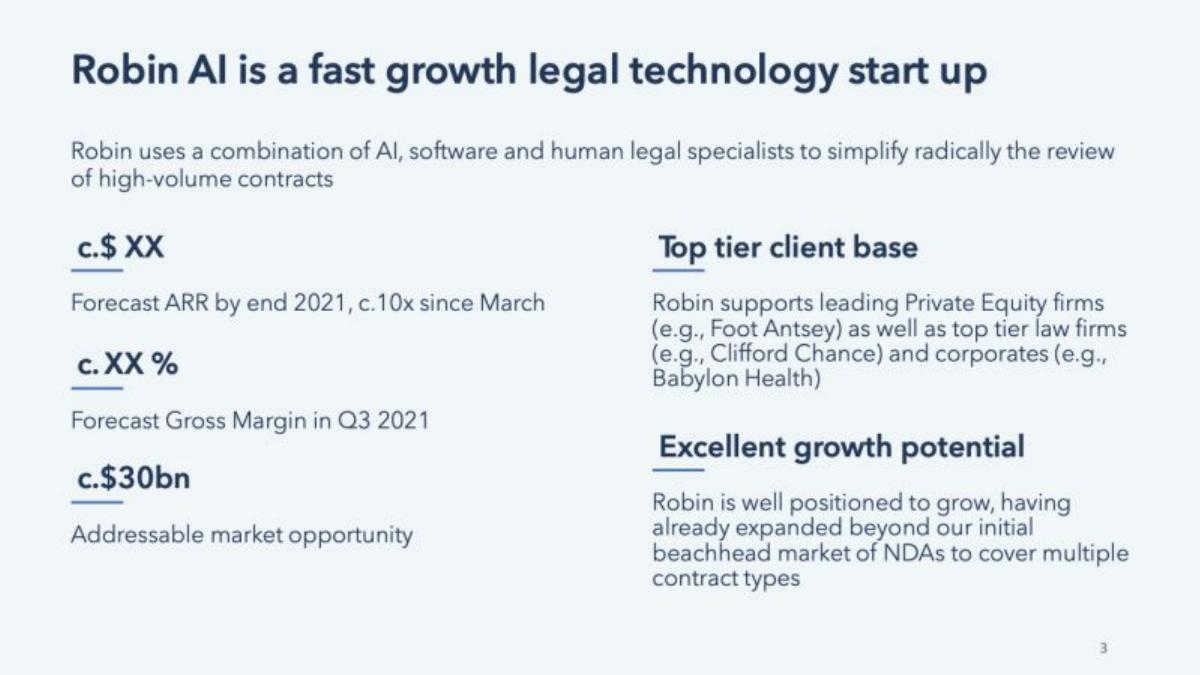
- The company identifies a $30bn addressable market opportunity for medium and large businesses in English-speaking countries on slide 3.
- Robin AI reports a 10x growth in forecast ARR between March and the end of 2021, according to slide 3.
- The deck lists high-tier clients including Private Equity firm Foot Anstey, law firm Clifford Chance, and corporate Babylon Health on slide 3.
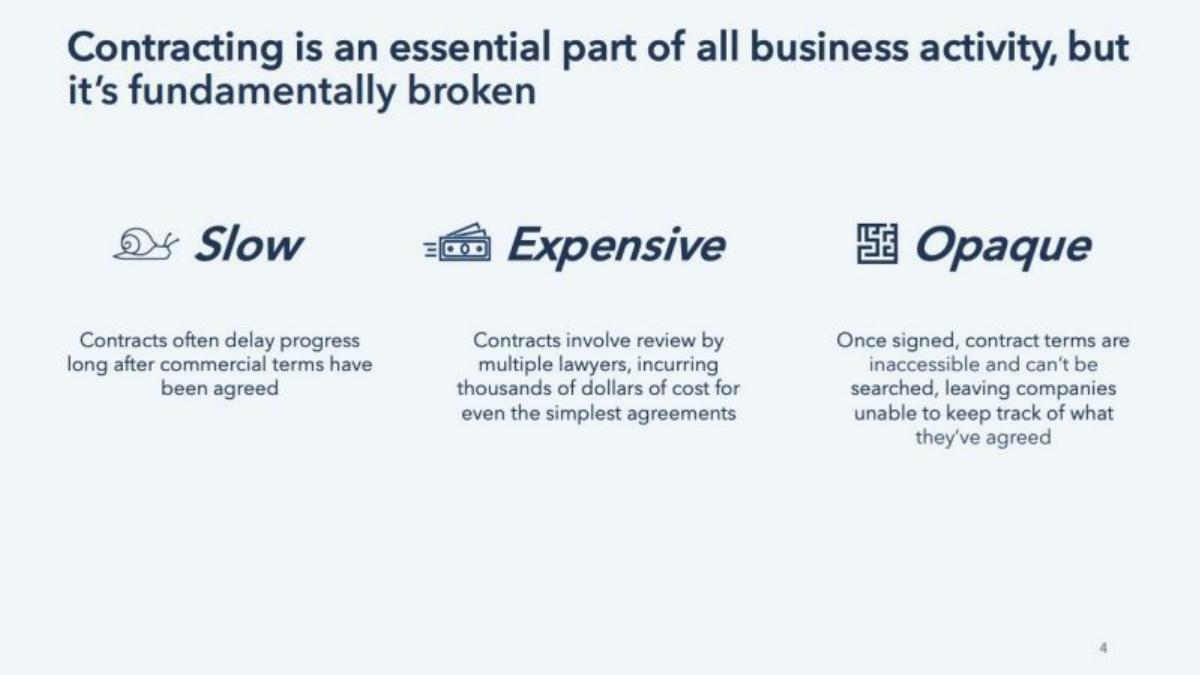
- Contracting is described as 'fundamentally broken' due to being slow, expensive, and opaque on slide 4.
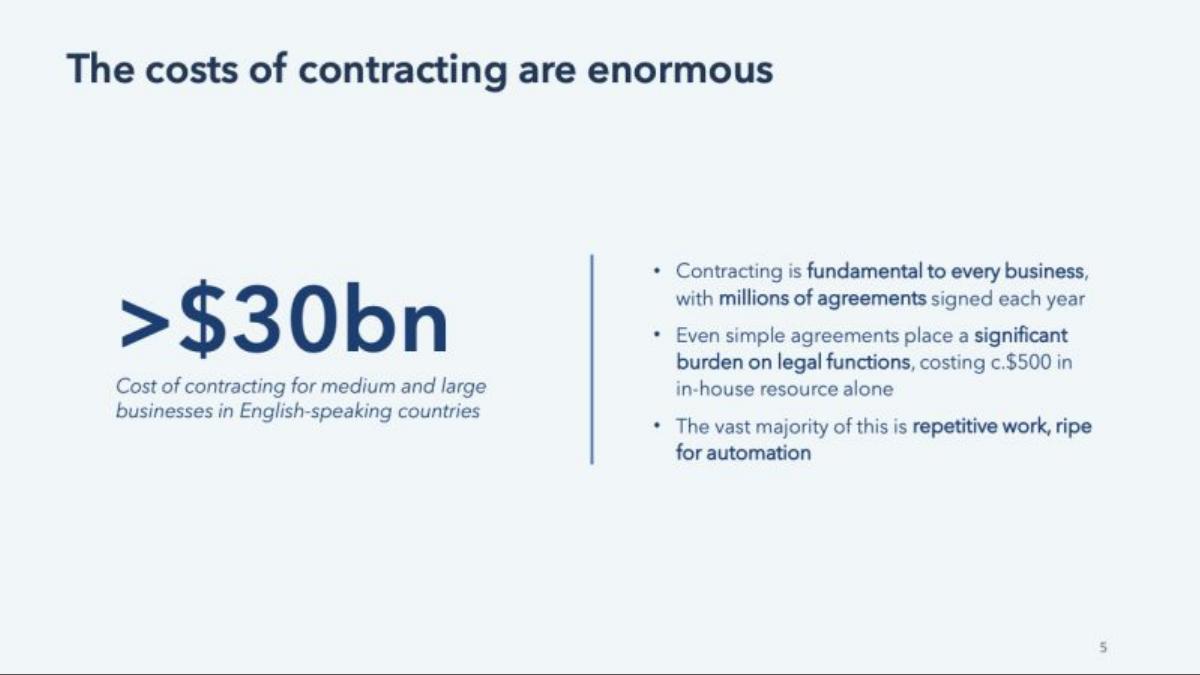
- Simple agreements are stated to cost approximately $500 in in-house resource alone on slide 5.
- The product offering is split into three pillars: drafting tools, AI-powered editing tools, and smart contracts for automatic negotiation on slide 7.
- A market adjacency map on slide 9 identifies Engagement Letters and Supplier Agreements as a $7.5bn opportunity.
- The company planned to scale to 39 full-time employees by the end of Q1 2022, as shown in the org chart on slide 11.
Introduction and Mission
The Robin AI pitch deck begins with a minimalist aesthetic, using a deep blue background and a simple bird logo on slide 1. This clean design language carries through the entire presentation, reflecting the company's core mission stated on slide 2: "Make contracts simple." For a legal tech startup, this simplicity is a strategic choice, contrasting with the dense, complex nature of the legal documents they aim to automate.
The Executive Summary
Slide 3 serves as a high-level overview of the business's health and trajectory. It defines Robin AI as a "fast growth legal technology start up" that uses a combination of AI, software, and human legal specialists. This 'human-in-the-loop' model is a critical detail; it reassures potential investors and clients that the technology isn't operating in a vacuum without professional oversight. The slide highlights three key metrics: a forecast ARR growth of "c.10x since March," a forecast gross margin for Q3 2021, and a "c.$30bn" addressable market. While the specific ARR and margin percentages are redacted in this version (marked as XX), the inclusion of names like Clifford Chance and Babylon Health provides immediate enterprise-grade credibility.
Defining the Problem
The Broken State of Contracting
Slide 4 and 5 focus on the 'Why.' The deck argues that contracting is "fundamentally broken" because it is slow, expensive, and opaque. Slide 4 uses icons to emphasize that contracts delay progress and incur thousands of dollars in costs for even simple agreements. Slide 5 quantifies this burden, noting that simple agreements cost approximately "$500 in in-house resource alone." By framing the problem as a massive financial drain on medium and large businesses, Robin AI transitions from a 'nice-to-have' tool to a cost-saving necessity. The claim that the "vast majority of this is repetitive work, ripe for automation" sets the stage for their solution.
The Failure of Existing Tech
Slide 6 is a transition slide with a bold statement: "The problem: Contract technology doesn't work." This is a classic 'anti-competitor' move. Instead of listing specific competitors, Robin AI dismisses the entire existing category, implying that previous attempts at legal tech have failed to solve the core issues of speed and accessibility. This creates a vacuum that Robin AI intends to fill with its 'Gen 2' approach.
The Solution: Product and Platform
The Smart Contract Editor
Slide 7 introduces the Smart Contract Editor . The slide breaks the solution into three functional areas: drafting tools, AI-driven editing tools, and smart contracts for automatic negotiation. The inclusion of a screenshot of the login page and a stylized illustration of a user suggests the product is beyond the conceptual stage and is currently functional. The emphasis on "playbooks" for negotiation is particularly important for legal departments that require consistency across all agreements.
The Queryable Contract Platform
Slide 8 focuses on the post-signature phase of the contract lifecycle. The "Queryable Contract Platform" addresses the 'Opaque' problem mentioned earlier. The screenshot shows a dashboard with searchable fields for filename, type, and group. This feature allows companies to treat their legal documents as structured data rather than static PDFs, enabling them to "keep track of what they've agreed," a pain point highlighted on slide 4.
Market Strategy and Scaling
Market Adjacency and Growth
Slide 9 is one of the most data-dense slides in the deck. It maps the "Robin AI Market Opportunity, by adjacency and size, 2021." The chart uses a bubble-map to show where the company currently operates (NDAs, NRLs, B2Bs at $600M) and where it plans to go. The "High customer adjacency, high product adjacency" quadrant identifies Engagement Letters (ELs) and Supplier Agreements (SAs) as a $7.5bn opportunity. This slide is crucial because it shows a logical path for expansion: starting with simple NDAs and moving into more complex, higher-value agreements like Corporate Financing ($10bn) and M&A ($9.4bn).
The Scaling Funnel
Slide 10 uses a funnel graphic to explain how the combination of services and software will scale. It starts at the bottom with a narrow focus on "AI+ NDAs" and moves upward through "Gen 1 software (QC)" and "Gen 2 software (Smart Contract Editor)" to reach "Service Provider Integration." This visualizes the company's evolution from a point solution to a platform that offers "Full market coverage - all contracts, all customers, all contract stages." It effectively communicates that the current product is just the entry point for a much larger ecosystem.
Team and Execution
Organizational Structure
Slide 11 provides a detailed organizational chart rather than the standard 'Founders' slide with headshots and logos of previous employers. The slide states a goal to "grow to 39 FTEs" by the end of Q1 2022. The chart breaks down the headcount into Technology (13 FTEs), Sales & Marketing (7 FTEs), and Operations (16 FTEs). Interestingly, the largest group is Operations, which includes 13 FTEs in "Legal and Product." This reinforces the hybrid model mentioned on slide 3—Robin AI is not just a software company; it is a tech-enabled service that requires significant legal expertise to function at scale.
Conclusion and Omissions
What Works
Quantified Pain: The deck does an excellent job of putting a dollar value ($500 per contract) on the problem. · Clear Expansion Path: Slide 9 provides a very logical roadmap for how the company will grow its revenue by moving into adjacent contract types. · Credibility: Naming top-tier law firms and PE firms as clients early in the deck (slide 3) removes the 'start-up risk' in the eyes of investors.
What is Missing
The Team's Background: While the org chart shows the planned structure, there is no information about the founders' specific expertise or why they are the right people to build this. · The Ask: There is no slide detailing how much money is being raised or what the specific milestones for the next 18 months are. · Competition: The deck claims existing tech doesn't work but doesn't explain how Robin AI specifically differs from other AI-legal players like Ironclad or Luminance.
Founder Takeaway
Founders should copy the way Robin AI uses Slide 9 (Market Adjacency) . Many decks simply show a massive TAM (Total Addressable Market) without explaining the steps required to capture it. Robin AI shows exactly which contract types they will tackle next and why those choices make sense based on their current customer base. Additionally, the use of a detailed org chart (Slide 11) is a strong way to show 'operational readiness'—it proves the founders have thought through the specific roles needed to hit their growth targets, rather than just asking for a lump sum of cash to 'hire engineers.'
Frequently asked questions
- What is Robin AI's core value proposition?
- Robin AI aims to 'make contracts simple' by combining AI, software, and human legal specialists. As stated on slide 3, this hybrid approach is designed to radically simplify the review of high-volume contracts, addressing the 'slow, expensive, and opaque' nature of traditional legal workflows described on slide 4.
- How does Robin AI define its market opportunity?
- The deck identifies a total addressable market of over $30bn on slide 5, specifically targeting medium and large businesses in English-speaking countries. Slide 9 further breaks this down by adjacency, highlighting a $7.5bn opportunity in Engagement Letters and Supplier Agreements, which are high-frequency and high-product-adjacency targets.
- What specific product features are highlighted in the deck?
- Slide 7 introduces the 'Smart Contract Editor,' featuring drafting tools for building contracts, AI tools for rapid reading and editing, and smart contracts that enable automatic negotiation based on playbooks. Slide 8 showcases a 'Queryable Contract Platform' that allows users to search and filter uploaded documents like supplier agreements.
- What was the company's growth trajectory at the time of the pitch?
- According to slide 3, Robin AI was experiencing significant momentum, forecasting a 10x increase in ARR from March 2021 to the end of the year. The deck also mentions expanding from a 'beachhead market' of NDAs into multiple other contract types to capture more of the market.
- What is missing from the Robin AI pitch deck?
- The deck omits a formal 'Ask' slide, which typically specifies the amount of capital being raised and the intended use of funds. It also lacks a dedicated slide for unit economics (LTV/CAC) and a detailed competitive landscape analysis, though it does mention that existing 'contract technology doesn't work' on slide 6.