RMFG’s 19-slide deck presents a compelling case for the 'sovereign manufacturing' thesis, arguing that U.S. robotics companies are currently stifled by a lack of domestic capacity. By positioning themselves as a software-defined contract manufacturer, RMFG claims to offer faster turnaround times for complex assemblies than traditional incumbents. The deck leans heavily on early traction metrics—shipping over 100,000 parts since July 2024—and technical efficiency, such as a 25% reduction in laser operator labor via vision models. While the deck lacks a detailed team slide or a specific financi…
Key takeaways
- RMFG identifies a critical gap in U.S. manufacturing, stating that companies are forced to vertically integrate or outsource to 'foreign adversaries' (Slide 5).
- The company reports shipping over 100,000 parts to more than 100 customers within months of their July 2024 launch (Slide 9).
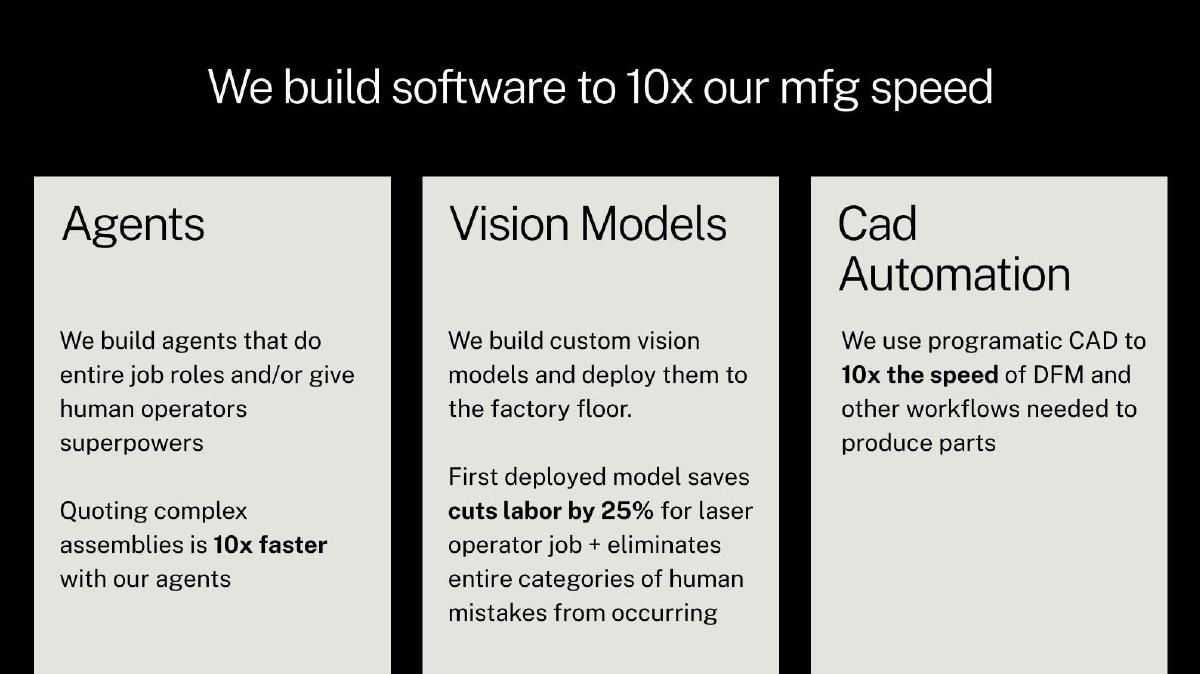
- Software is the primary lever for speed, with RMFG claiming their agents make quoting complex assemblies 10x faster (Slide 13).
- Operational efficiency is highlighted through a vision model that reportedly cuts labor by 25% for laser operator roles (Slide 13).
- The business model uses an automated online quoting platform as a top-of-funnel tool to maintain high machine utilization (Slide 11).
- Customer retention is a core metric, with 42% of customers returning for repeat orders (Slide 11).
- Physical expansion is rapid, with the factory footprint growing from 5,000 to 17,000 square feet (Slide 9).
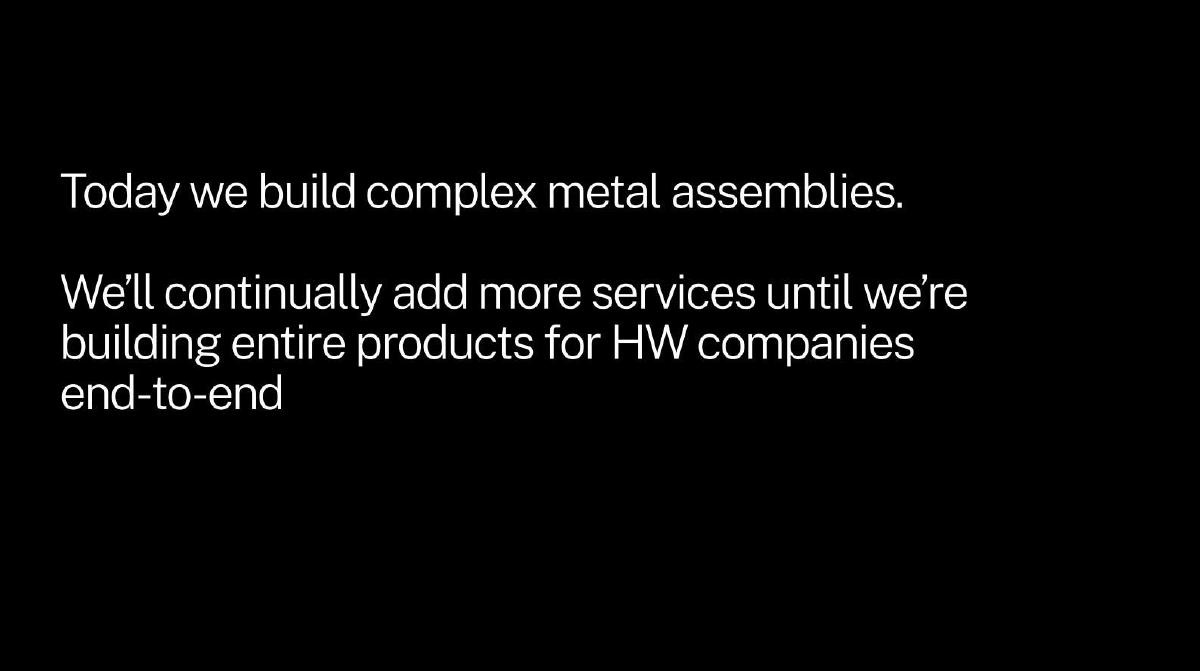
- The long-term vision is to move from complex metal assemblies to building entire products end-to-end for hardware companies (Slide 16).
The Sovereign Manufacturing Thesis
RMFG’s pitch deck is a masterclass in the 'American Dynamism' aesthetic. It focuses on a tangible, high-stakes problem: the inability of U.S. hardware startups to find reliable, fast, and domestic manufacturing. By framing the lack of capacity as a choice between expensive vertical integration or risky foreign outsourcing, RMFG positions itself not just as a machine shop, but as a critical piece of national infrastructure powered by modern software.
Slides 1-2: The Hook and the Identity
Slide 1 is a minimalist title slide featuring the RMFG logo. Slide 2 immediately defines the company's value proposition: 'the next generation contract manufacturer for fast-moving robotics & advanced hardware companies.' This is a targeted opening that ignores the general manufacturing market to focus on high-growth, high-complexity sectors.
Slides 3-6: The Macro Problem
Slides 3 through 5 build a narrative of scarcity. Slide 3 notes that robotics companies are scaling faster than ever, while Slide 4 points out the lack of domestic capacity. Slide 5 introduces the 'adversary' angle, stating that US companies are forced to 'outsource to foreign adversaries when they need critical parts.' This adds a layer of geopolitical urgency to the pitch. Slide 6 narrows the focus to 'custom assemblies,' claiming the problem is '10x worse' here because these parts involve multiple manufacturing processes, which traditional shops struggle to coordinate quickly.
Slides 7-8: The Software-Defined Solution
Slide 7 introduces the solution: 'software-defined factories' that ship faster than incumbents. The slide includes photos of the factory floor and CAD software interfaces, grounding the 'software' claim in physical reality. Slide 8 (text only) promises a breakdown of how they make assemblies faster, setting the stage for their technical deep dive.
Slides 9-10: Rapid Traction Metrics
Slide 9 is the most data-dense slide in the deck. Since their launch in July 2024, RMFG reports shipping over 100,000 parts to over 100 customers. They highlight '6-figure spend from multiple customers' and the fact that they tripled their floor space from 5,000 to 17,000 square feet. Crucially, they mention this was achieved with a '2-person engineering team,' emphasizing the leverage provided by their software. Slide 10 serves as a transition or placeholder for further traction details.
Slides 11-12: The Business Model and Funnel
Slide 11 explains their customer acquisition strategy. An online platform provides 'instant quotes,' which acts as an automated top-of-funnel. They report that 42% of customers return for repeat business. A chart shows 'Cumulative Quantity' growth from June 2024 through a projection to October 2025. Slide 12 explains the 'Upsell' strategy: use the simple parts to get customers in the door, then move them to high-value assembly work.
Slide 13: The Technical Moat
This slide breaks down the '10x' speed claim into three buckets: Agents (10x faster quoting), Vision Models (25% labor reduction for laser operators), and CAD Automation (10x speed for Design for Manufacturing). This slide is essential for justifying why RMFG is a venture-backable software company rather than a traditional service business.
Slides 14-15: Customer Validation
Slide 14 asserts that their customers are building 'advanced technology.' Slide 15 provides social proof via a testimonial from Augustus Doricko, Founder at Rainmaker, who credits RMFG with helping them ship a 'custom field-deployed radar system' on time. The inclusion of a photo of the hardware on a trailer provides visual evidence of the 'complex assemblies' RMFG handles.
Slide 16: The Long-Term Vision
RMFG isn't content with just sheet metal. Slide 16 outlines a roadmap: starting with complex metal assemblies and adding services until they are 'building entire products for HW companies end-to-end.' This expands their Total Addressable Market (TAM) from a component supplier to a full-scale outsourced factory.
Slides 17-19: Why Now and Closing
Slide 17 lists market drivers, including a 16% CAGR for robotics and the claim that the 'Robot market cap will surpass automotive.' It also notes that 'Advanced vision model technology' is the specific enabling technology that makes this business possible now. Slide 18 describes the team as 'lean' and 'fast,' though it lacks specific names or backgrounds. Slide 19 closes with the logo.
What Works in the RMFG Deck
Speed as a Feature: The deck repeatedly uses '10x' and 'fast-moving' to align with the needs of their target customers (startups). By quantifying the speed of quoting and labor reduction, they make the 'software-defined' claim more than just a buzzword. Physical Proof: The use of photos showing actual hardware being shipped (Slide 15) and factory floor expansion (Slide 9) is vital for a pre-seed company in the 'hard tech' space. It proves they aren't just building a dashboard, but are actually moving atoms. Clear Funnel Logic: The explanation of using instant quotes to fill machine capacity and then upselling to complex assemblies (Slides 11-12) shows a sophisticated understanding of manufacturing unit economics.
What is Missing from the RMFG Deck
The Team Slide: While Slide 18 mentions a 'lean team,' there are no bios, past successes, or technical credentials listed for the founders. For a $4.5M pre-seed round, investors usually want to see a deep pedigree in either software engineering or manufacturing operations. The Ask: The deck does not state how much they are raising or how the funds will be allocated. While we know from publisher reports that they raised $4.5M, the deck itself is silent on the capital requirements for further equipment or headcount. Competitor Landscape: The deck mentions 'incumbents' generally but does not address how they compete with other tech-forward manufacturers like Protolabs or Xometry, who also offer instant quoting and automated workflows.
Founder Takeaway: The 'Atomic' Traction Slide
Founders building in the physical world should study Slide 9. Instead of focusing on vague 'partnerships' or 'LOIs,' RMFG lists hard numbers: parts shipped, square footage added, and specific labor savings. This 'Atomic Traction'—measuring the actual output of the business—is far more persuasive to investors than high-level market projections. If you are building a service-enabled technology, show the efficiency gains at the task level (e.g., '25% labor reduction') to prove your software has real-world utility.
Frequently asked questions
- What specific manufacturing processes does RMFG currently offer?
- According to Slide 9, RMFG has launched multiple services including laser-cutting, bending, welding, hardware insertion, and light assembly. They currently focus on complex metal assemblies but plan to expand into end-to-end product manufacturing as they scale their software-defined factory model.
- How does RMFG use AI to differentiate itself from traditional machine shops?
- RMFG utilizes three main software pillars: AI agents for 10x faster quoting, custom vision models that reduce laser operator labor by 25%, and programmatic CAD to accelerate Design for Manufacturing (DFM) workflows by 10x. These tools are integrated into a custom-built Manufacturing Execution System (MES) as noted on Slides 9 and 13.
- What is RMFG's customer acquisition strategy?
- As shown on Slide 11, RMFG uses an online platform with an 'instant quote' feature to act as an automated top-of-funnel. This high-volume, low-friction entry point allows them to maintain high machine utilization before upselling those customers on higher-value, complex assembly work (Slide 12).
- What market trends is RMFG capitalizing on?
- Slide 17 identifies a 16% CAGR in the robotics industry and a 'wide-open space' for a dominant U.S. contract manufacturer. They argue that new AI capabilities are unlocking a surge of hardware startup ideas, all of which will require domestic manufacturing partners to avoid the costs of vertical integration.
- Is there information about the founders or the investment terms in the deck?
- The deck is notably lean on personnel and financial specifics. It mentions a '2-person engineering team, including founder' on Slide 9 and features a testimonial from a customer founder on Slide 15. However, it does not include a dedicated team slide or a slide detailing the $4.5M pre-seed round terms.