RIVR Robotics, formerly known as Swiss-Mile, presents a concise 8-slide deck that serves more as a historical timeline and future roadmap than a traditional problem-solution pitch. The deck tracks the company's progress from its 2019 founding at ETH Zurich through its 2024 rebranding and $22M seed round co-led by Jeff Bezos and HongShan. By focusing on technical milestones—such as achieving 90%+ reliability in 2021 and securing CE/ISO certifications in 2023—the company builds a narrative of disciplined execution. While the deck lacks traditional slides on market size, competitive landscape, o…
Key takeaways
- The company originated as Swiss-Mile, an ETH Zurich spin-off, before rebranding to RIVR Robotics in 2024 (Slide 1, 5).
- RIVR secured a $22M seed round co-led by Jeff Bezos (Bezos Expeditions) and HongShan in 2024 (Slide 5).
- Early technical validation included achieving 90%+ reliability for their MVP v1 in 2021 (Slide 3).
- The company moved from early pilot discussions in 2020 to 3+ paid pilot programs by 2023 (Slide 2, 4).
- A target funding of $20-25M for a Series A is set for 2025 to support scaling and manufacturing (Slide 6).
- The roadmap projects the company will be EBITDA-positive by the second half of 2026 (Slide 7).
- The leadership team is heavily academic, featuring four PhDs and a Professor from ETH Zurich (Slide 8).
- The deck omits standard sections such as Problem, Solution, Market Size (TAM), and Competition.
Executive Summary: The Narrative of Technical Maturity
The RIVR Robotics deck is a masterclass in chronological storytelling. Rather than following the standard Sequoia-style pitch format, it uses a timeline-based structure to demonstrate a consistent trajectory of growth and de-risking. By the time the reader reaches the final slide, the company has transitioned from a university lab project to a venture-backed entity with $22M in the bank and a clear path to profitability. This approach works particularly well for deep-tech and hardware companies where the primary investor concerns are technical feasibility and commercial viability.
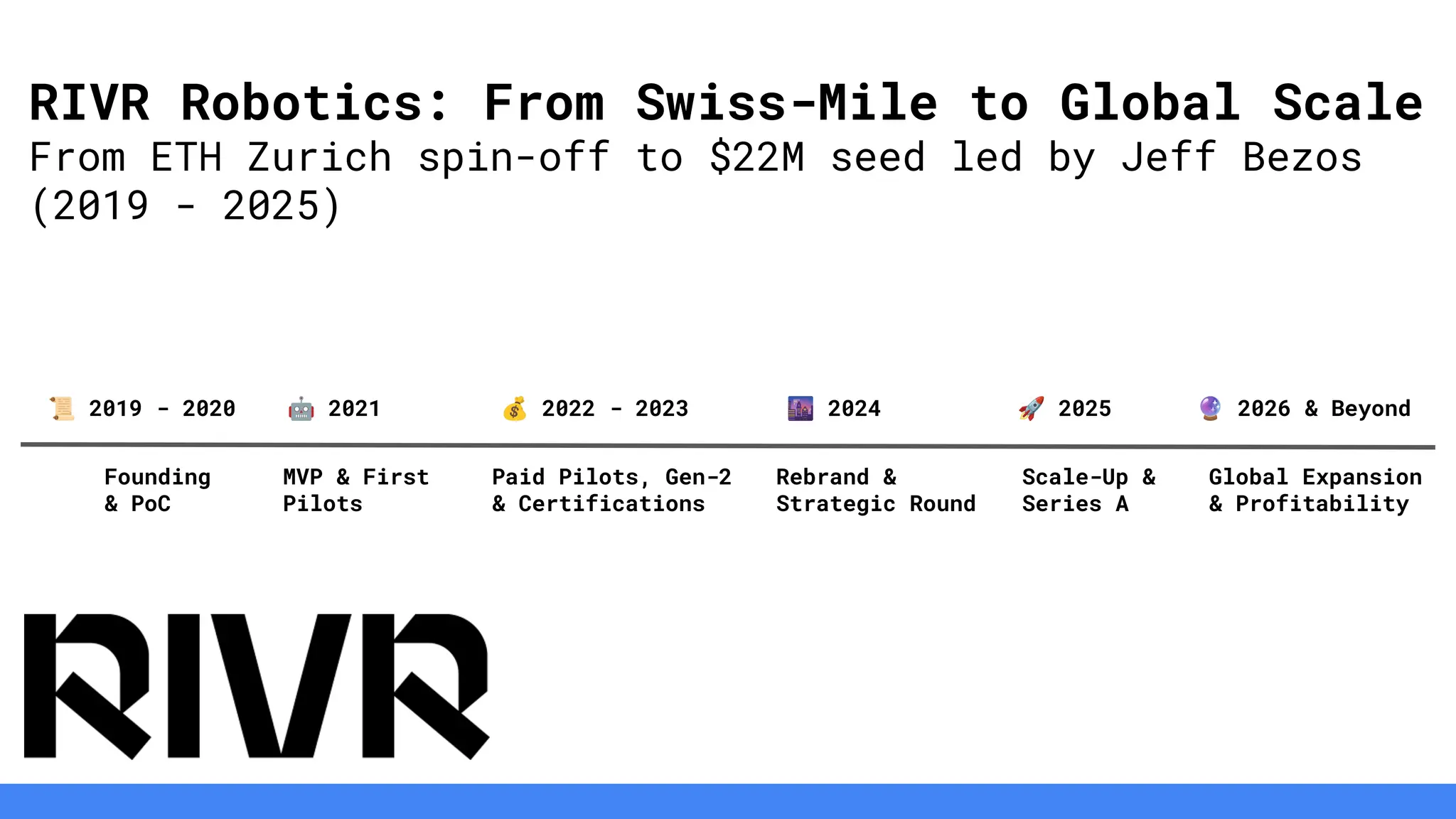
Slide 1: Title and Timeline Overview
The cover slide sets a bold tone, highlighting the transition 'From Swiss-Mile to Global Scale.' It immediately leads with its strongest social proof: a $22M seed round led by Jeff Bezos. The slide also introduces a horizontal timeline spanning 2019 to 2026+, categorizing the company's life stages from 'Founding & PoC' to 'Global Expansion & Profitability.' This provides an immediate roadmap for the rest of the presentation.
Slide 2: 2019 – 2020: Founding & Proof of Concept
This slide establishes the company's pedigree as an ETH Zurich spin-off. It details the construction of the first wheeled-quadruped PoC robot and the initiation of pilot discussions with logistics players. Financed by $0.7M in pre-seed funding (grants and angels), this period represents the transition from academic research to a nascent business entity.
Slide 3: 2021: MVP & First Pilots
In 2021, the company moved to 'MVP v1,' which was deployed in research and logistics pilots. The critical metric shared here is '90%+ reliability' in early autonomy. This is a vital inclusion for a robotics company, as it addresses the 'reliability gap' that often plagues early-stage hardware. The funding grew by an additional ~$1M during this phase.
Slide 4: 2022 – 2023: Paid Pilots and Certifications
This period marks a shift toward commercialization. The slide notes '3+ paid pilot programs' with anonymized customers (A, B, and C) and the securing of Letters of Intent (LOIs) for Annual Recurring Revenue (ARR). Technical milestones include the launch of Gen-2 hardware and the achievement of CE/ISO certifications. The funding mentioned is a ~$3M seed led by an unnamed lead investor, plus $0.5M in grants.
Slide 5: 2024: Rebrand & Strategic Round
This is the 'inflection point' slide. It announces the rebrand to RIVR Robotics and the commercial launch. The headline figure is the $22M seed round co-led by Jeff Bezos and HongShan. A photo shows the robot branded with 'Just Eat,' providing visual evidence of a real-world delivery application. The inclusion of the Amazon Industrial Innovation Fund among the investors signals strong strategic alignment with the logistics sector.
Slide 6: 2025: Scale-Up & Series A
Looking forward, the deck outlines the rollout of the Gen-3 platform, focusing on 'cost-down' measures and improved sensors. The business objective is expansion into multiple cities. Most importantly for potential investors, it explicitly states a 'Target Funding' of $20-25M for a Series A to support manufacturing, which is the typical bottleneck for robotics startups.
Slide 7: 2026 & Beyond: Global Expansion & Profitability
The penultimate slide focuses on the long-term vision. It targets international expansion into EU, MEA, and APAC markets. The financial goal is clearly stated: 'EBITDA-positive by H2 2026.' While these are projections, they provide a necessary 'end state' for the narrative established in the previous slides.
Slide 8: Founders & Key Team
The final slide lists the leadership team. The dominance of 'Dr.' titles (four out of five founders) and the presence of a Professor from ETH Zurich as an advisor reinforces the technical depth of the company. It suggests that the team possesses the specialized knowledge required to execute the complex robotics roadmap described in the deck.
What Works in the RIVR Robotics Deck
1. The Power of Pedigree: By repeatedly mentioning ETH Zurich and showcasing a team of PhDs, the deck leverages the reputation of one of the world's leading robotics institutions to build trust.
2. Incremental De-risking: The chronological format allows the founders to show how they solved one problem at a time: first the PoC, then reliability, then certifications, then paid pilots, and finally large-scale funding.
3. High-Signal Investors: Naming Jeff Bezos and the Amazon Industrial Innovation Fund is a massive shortcut to credibility. In the logistics and robotics space, there is no higher validation than interest from the founder of Amazon.
4. Visual Evolution: The photos on each slide show the hardware becoming progressively more polished and 'productized,' moving from a bare-bones red frame to a fully branded delivery unit.
What Is Missing from the RIVR Robotics Deck
1. Market Analysis: There is no mention of the Total Addressable Market (TAM). While the logistics application is implied, the deck doesn't quantify the opportunity or explain why now is the right time for this specific form factor.
2. Competitive Landscape: The deck operates in a vacuum. It does not mention other quadruped companies (like Boston Dynamics or Unitree) or other last-mile delivery solutions. Investors need to know why wheels-on-legs is the winning architecture.
3. Unit Economics: While 'cost-down' is mentioned for 2025, there is no data on the current cost to build a unit versus the revenue it generates. For a hardware company, the path to profitability depends entirely on these margins.
4. The 'Why': The deck explains what happened and when, but it spends very little time on the 'Problem' slide. It assumes the reader already agrees that last-mile delivery is a problem that needs a robotic solution.
Founder Takeaways: How to Use This Strategy
If you are a deep-tech founder with a long development cycle, the chronological roadmap is your best friend. It turns a 'speculative' investment into a 'momentum' investment. To replicate this, ensure you have specific, measurable milestones for every year—don't just list 'development.' Use metrics like 'reliability percentage,' 'hours logged,' or 'certifications achieved' to prove progress. Finally, if you have a high-profile lead investor, put their name on the first and middle slides; in the world of venture capital, social proof is often more persuasive than a hundred pages of market data.
Frequently asked questions
- What is the primary product of RIVR Robotics?
- Based on the visual evidence across slides 2 through 7, the product is a wheeled-quadruped robot designed for mobility and logistics. The hardware has evolved through three generations, with the 'Gen-3 platform' mentioned for a 2025 rollout. The robots are shown performing tasks such as navigating stairs and carrying delivery boxes for brands like Just Eat and Evri.
- Who are the key investors in RIVR Robotics?
- Slide 5 identifies a $22M seed round co-led by Jeff Bezos (via Bezos Expeditions) and HongShan. Other participants in the round include the Amazon Industrial Innovation Fund, Armada Investment, and Linear Capital. Earlier rounds were supported by grants, friends and family, and angel investors, totaling approximately $1.7M before the 2024 seed round.
- What are the company's financial projections?
- The deck provides high-level milestones rather than a detailed spreadsheet. Slide 7 states that the company expects to reach break-even as more units are deployed and aims to be EBITDA-positive by H2 2026. Additionally, Slide 6 notes a target for a $20-25M Series A round in 2025 to fund manufacturing and scaling.
- How has the company's branding evolved?
- The company was founded in 2019 as 'Swiss-Mile,' a name it maintained through its early proof-of-concept and pilot phases. Slide 5 explicitly notes a 2024 rebrand to 'RIVR Robotics,' coinciding with their commercial launch and the $22M strategic funding round.
- What is the background of the founding team?
- The team is characterized by deep technical and academic expertise. Slide 8 lists five co-founders, including CEO Dr. Marko Bjelonic, two CTOs (Dr. Lorenz Wellhausen for software and Dr. Giorgio Valsecchi for hardware), and COO Alexander Reske. The academic lead and advisor is Prof. Dr. Marco Hutter, reinforcing the company's roots as an ETH Zurich spin-off.