Rippling’s 2019 Series A deck is a masterclass in narrative-driven fundraising. Eschewing the traditional high-design, low-text format, the 11-slide document functions as a detailed investment memo. It articulates a sophisticated thesis: that the root cause of administrative friction is the fragmentation of employee data across siloed systems. By positioning Rippling as the 'ingestion point' for all employee data—spanning HR, IT, and Finance—the deck argues that the company is building a new category of 'Employee Management System' rather than a mere HRIS. Despite being text-heavy, the deck i…
Key takeaways
- The deck defines the core problem as the 'fragmented employee data' across dozens of disconnected business systems (Slide 2).
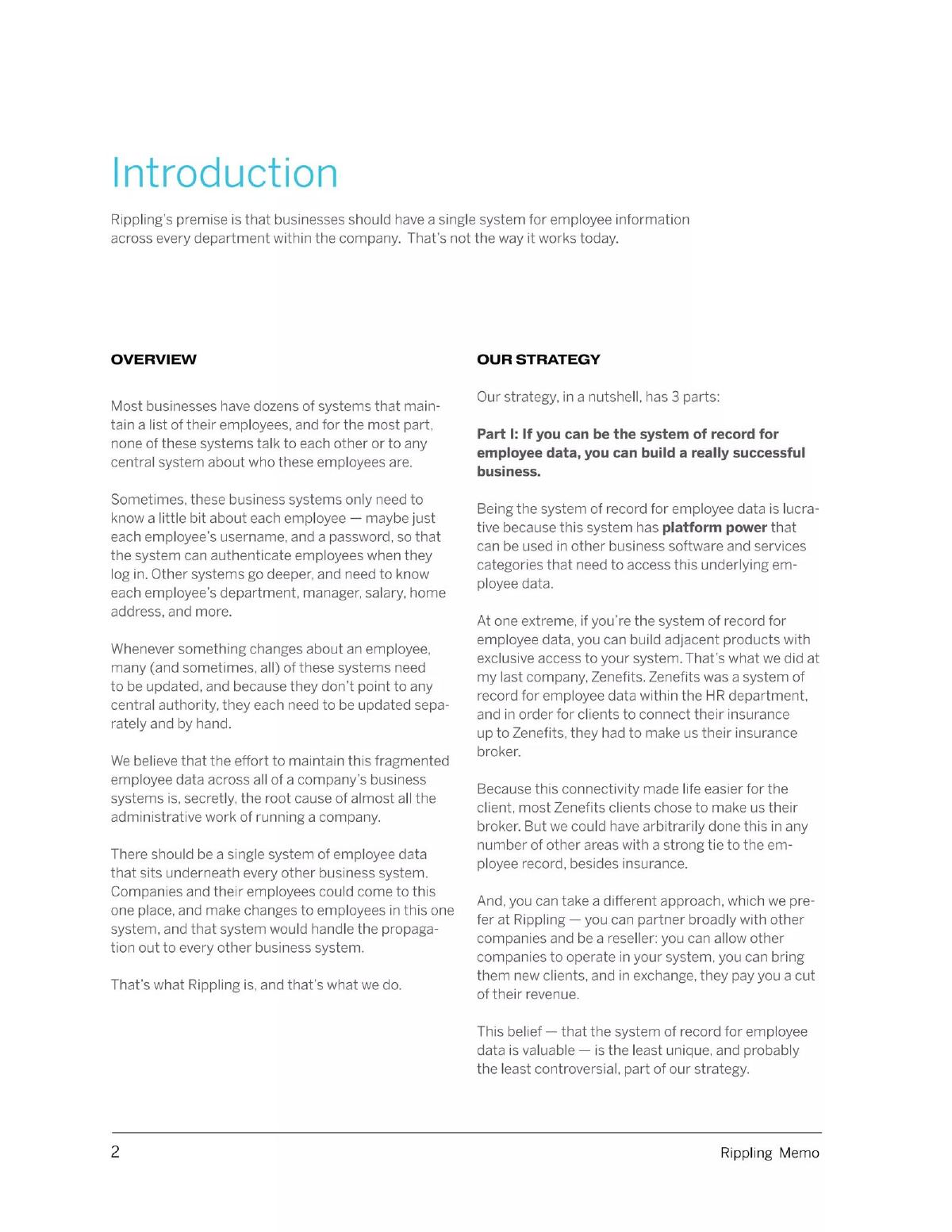
- Rippling positions itself as the 'system of record' that handles data propagation to all other business systems (Slide 2).
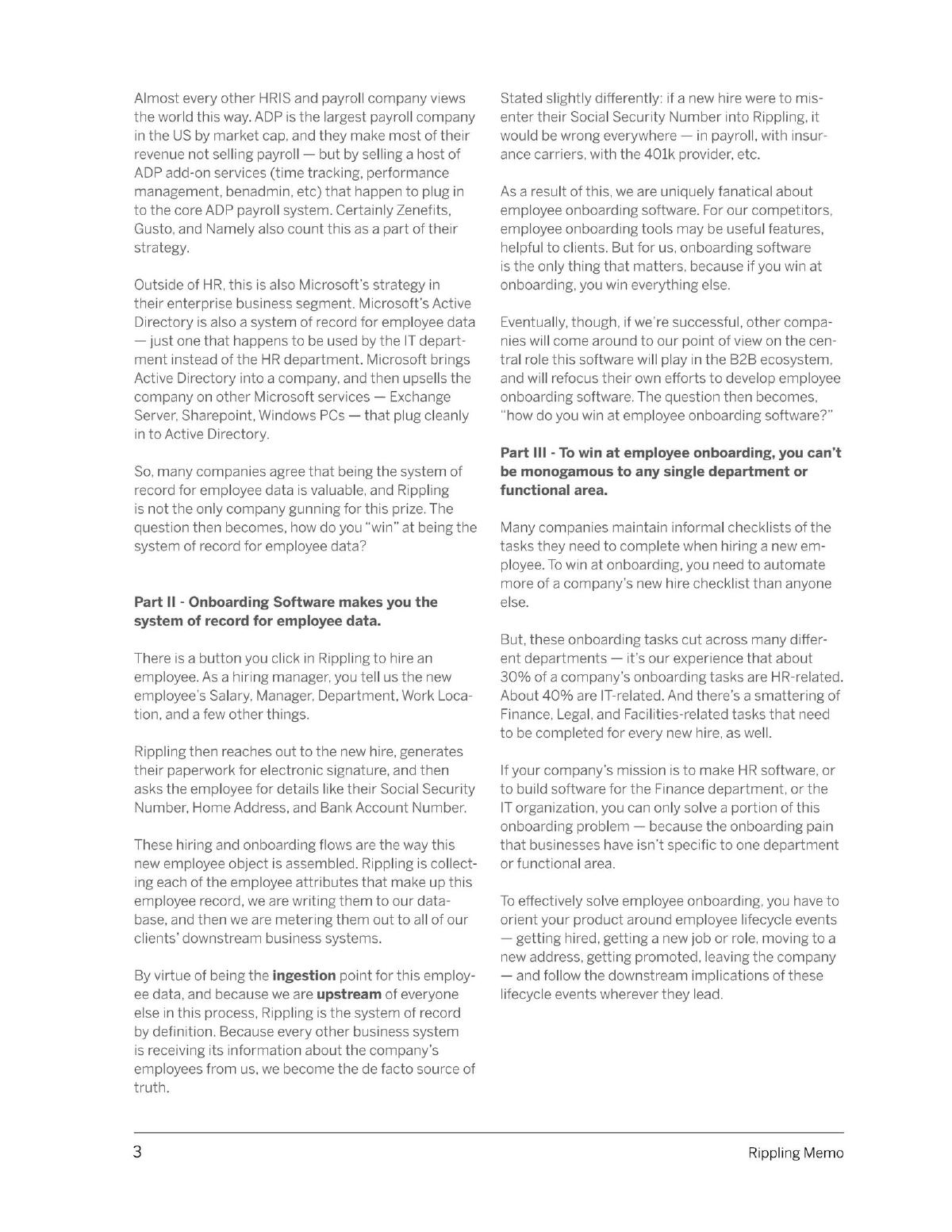
- The strategy relies on winning 'employee onboarding' to become the upstream source of truth for all employee attributes (Slide 3).
- The product is presented as a hybrid of three categories: HRIS, Identity/SSO, and Endpoint Device Management (Slide 5).
- The company reported an average 20% month-over-month growth in Total Bookings ARR since January 2018 (Slide 8).
- Rippling achieved a Net Promoter Score (NPS) of 70 in January 2019, with a several-month average of 66 (Slide 9).
- The deck acknowledges high OpEx burn due to the 'large surface area' of the product, requiring the rebuilding of payroll, benefits, and identity systems simultaneously (Slide 9).
- The 'Why Now' argument cites the 'SaaS revolution' and the increasing complexity of managing access across dozens of cloud tools (Slide 10).
The Compound Startup Thesis: A Deep Dive into Rippling’s Series A Memo
Rippling’s 2019 Series A deck is a significant departure from the 'Airbnb-style' visual deck that has dominated Silicon Valley for a decade. Instead of high-resolution imagery and minimal text, Rippling presents an 11-page memo. This format is intentional; it reflects the complexity of their 'compound startup' model—a strategy where a company builds multiple deeply integrated products simultaneously rather than focusing on a single niche.
Slide 1: The Premise
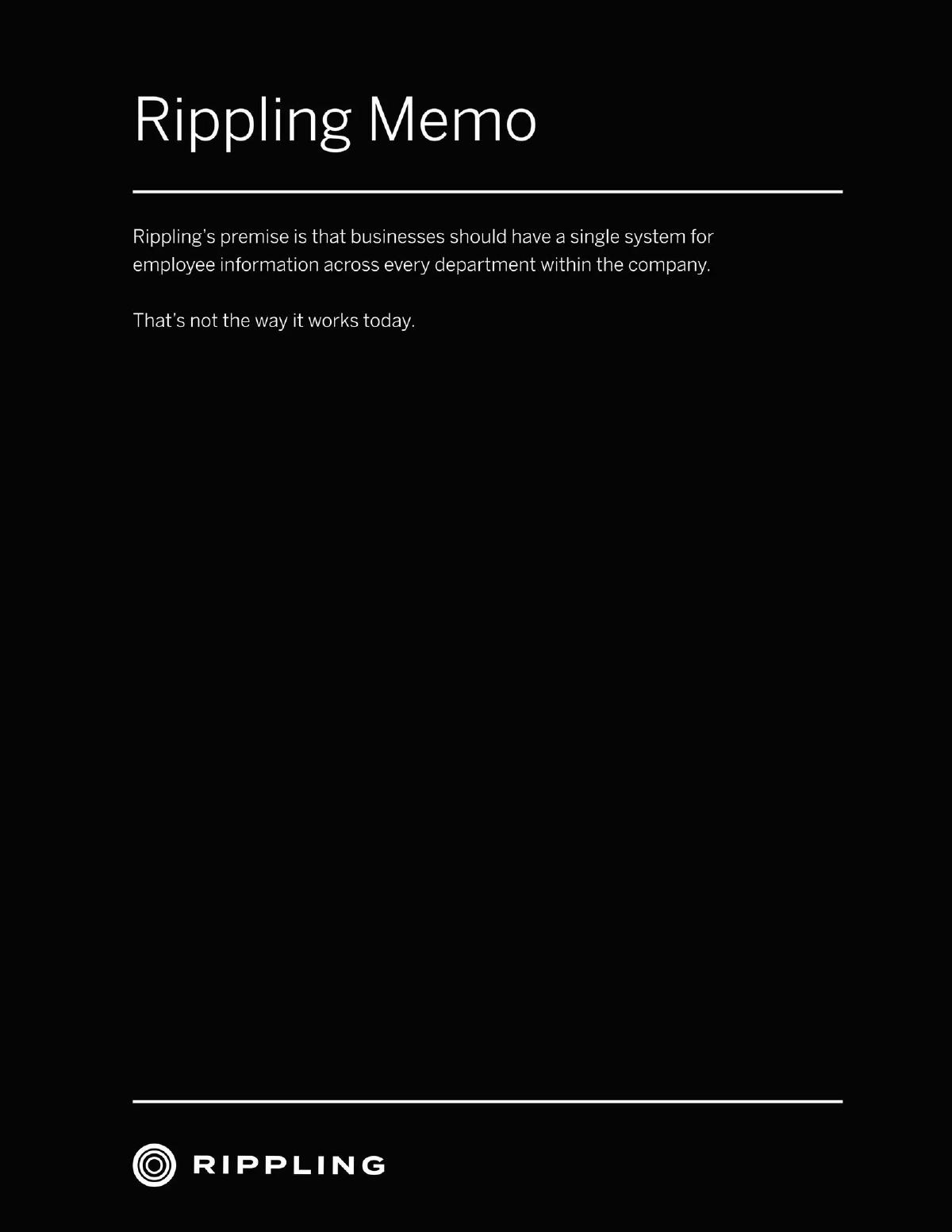
The cover slide is stark: white text on a black background. It establishes the company's core thesis immediately: 'Rippling’s premise is that businesses should have a single system for employee information across every department within the company.' It follows this with a simple, provocative hook: 'That’s not the way it works today.' This sets the stage for a narrative centered on fixing a fundamental structural flaw in business software.
Slide 2: Introduction and Strategy Part I
Slide 2 dives into the 'Overview' and 'Our Strategy.' The text identifies the problem as 'fragmented employee data.' It argues that because business systems don't talk to each other, administrative work is manually duplicated across dozens of tools. Strategy Part I is stated clearly: 'If you can be the system of record for employee data, you can build a really successful business.' The slide references the founder's experience at Zenefits, noting that Zenefits was a system of record for the HR department, which allowed them to pull clients into their insurance brokerage. Rippling's goal is to expand this 'platform power' beyond HR.
Slide 3: Winning Onboarding (Strategy Part II & III)
Slide 3 explains how Rippling intends to become that system of record. The answer is 'Onboarding Software.' The memo argues that because Rippling is the 'ingestion point' for new hire data (SSN, home address, bank account), it is naturally 'upstream' of every other system. Strategy Part III emphasizes that to win, a company cannot be 'monogamous to any single department.' It points out that onboarding is 30% HR-related, 40% IT-related, and 30% split between Finance, Legal, and Facilities. By solving the whole checklist, Rippling becomes the de facto source of truth.
Slide 4: The Onboarding Sidebar
This slide clarifies Rippling’s definition of 'onboarding software.' It dismisses competitors who build simple 'project management apps' for HR tasks. The distinction made here is 'downstream systems connectivity.' If a tool just assigns a task but doesn't actually create the user account in AWS or GitHub, it isn't a source of truth. This slide reinforces the technical depth of the Rippling solution compared to 'lightweight' competitors.
Slide 5: Product Overview
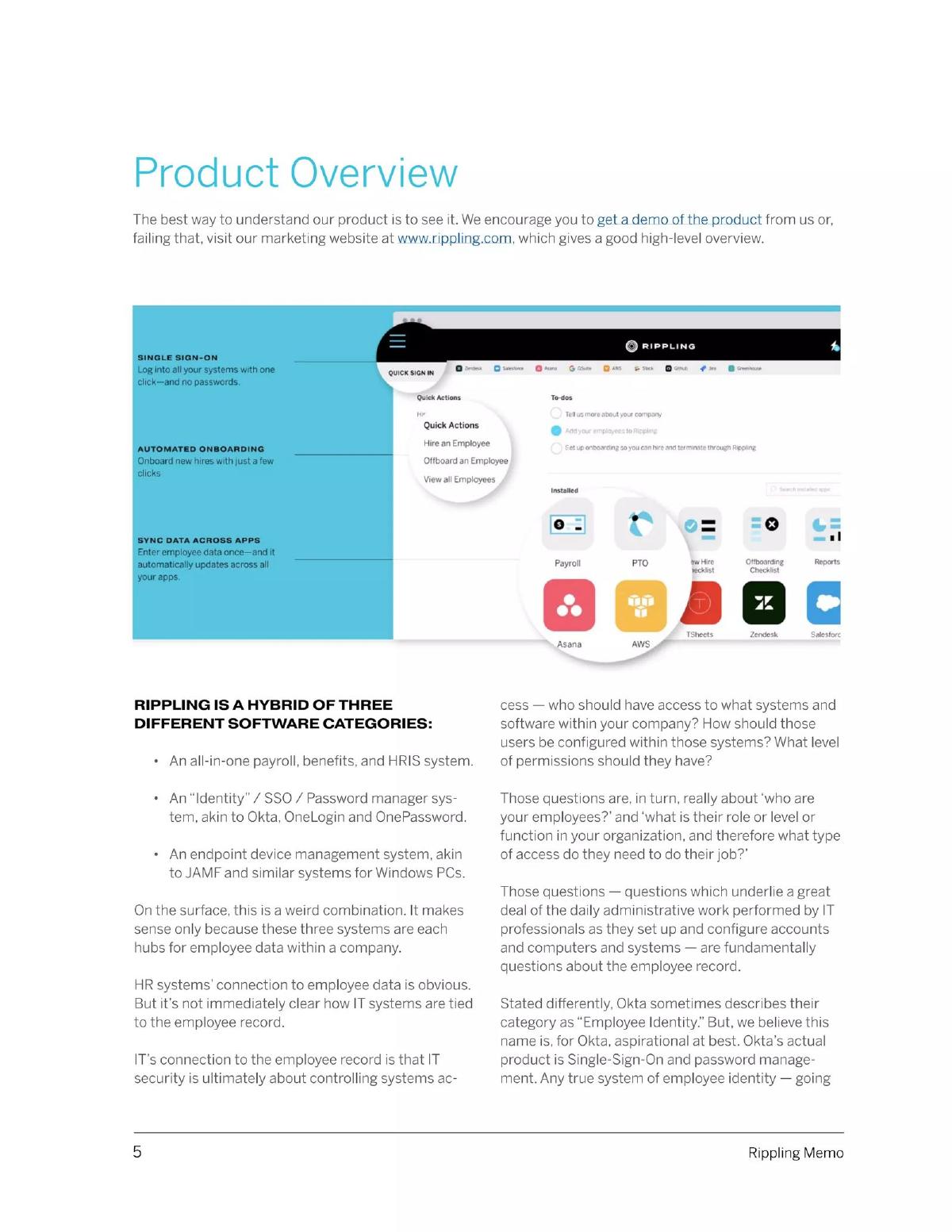
Slide 5 provides the first visual of the product interface. It describes Rippling as a hybrid of three categories: 1. All-in-one payroll/HRIS , 2. Identity/SSO/Password management (like Okta), and 3. Endpoint device management (like JAMF). The memo justifies this 'weird combination' by explaining that IT security is fundamentally about controlling who has access to what, which is a question that can only be answered by the employee record.
Slide 6: The IT Connection
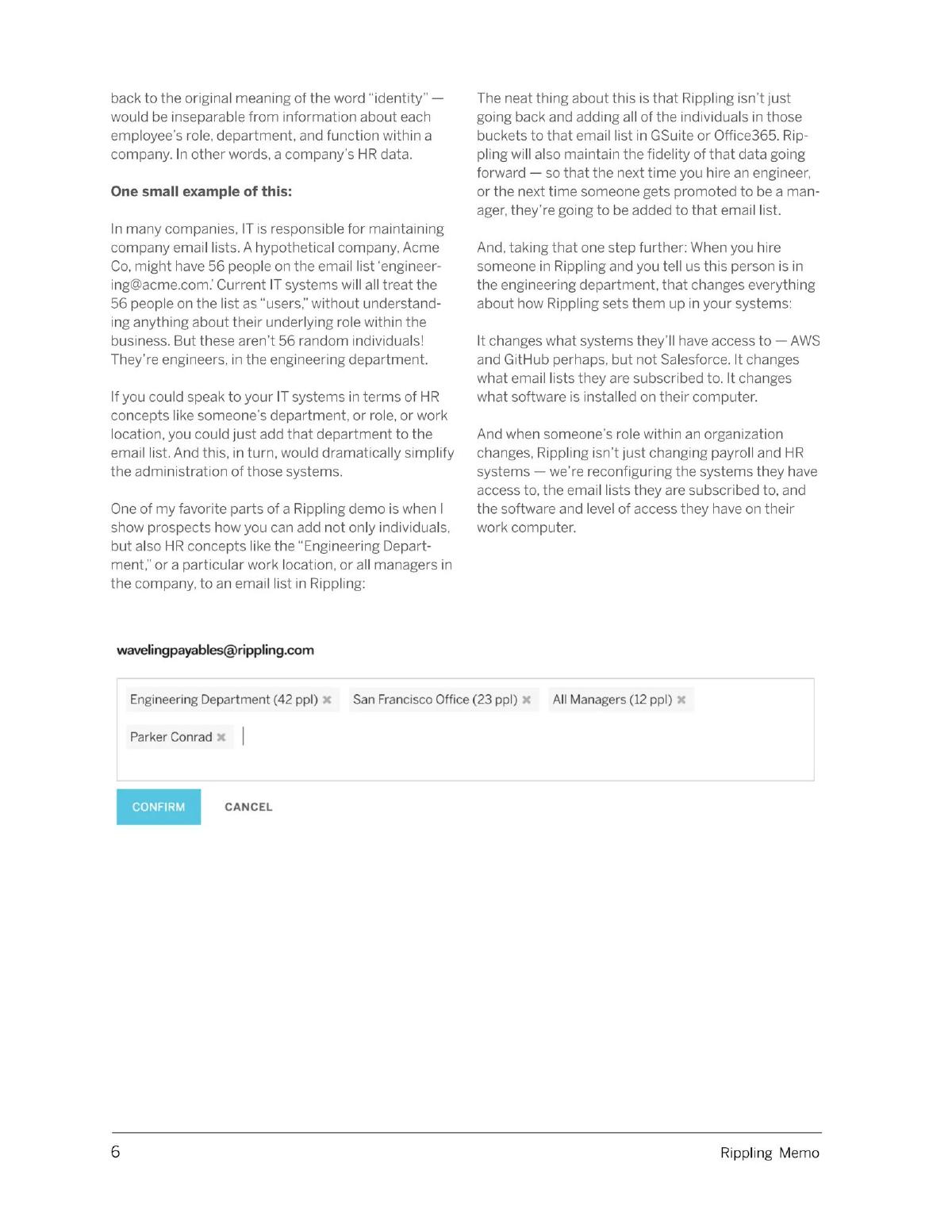
Slide 6 illustrates a specific use case: maintaining email lists. It uses a hypothetical 'Acme Co' to show how IT systems usually treat people as 'users' without context. Rippling allows IT to speak in 'HR concepts,' such as automatically adding everyone in the 'Engineering Department' in 'San Francisco' who is a 'Manager' to a specific email list. A screenshot shows the interface for this attribute-based filtering, demonstrating the power of integrated data.
Slide 7: Competition
The competition slide is categorized by the three sectors Rippling touches. On the Payroll/HR side , they name Gusto, Zenefits, Namely, ADP, and Paychex. On the Identity side , they list Okta, OneLogin, LastPass, and OnePassword. On the Device Management side , they cite JAMF and Microsoft. The core argument is that these competitors stay in their 'swim lanes,' while Rippling’s value comes from the 'thick' integration between these categories.
Slide 8: Performance to Date
Slide 8 introduces the hard data. Rippling launched its benefits product in May 2018. Since January 2018, they have averaged 20% Month over Month growth in Total Bookings ARR. The slide notes that this growth is accelerating, reaching 25% in the last four months and 29% in January 2019 . A line graph shows the 'MoM Growth in Total Bookings ARR' with a clear upward-sloping linear trend. Specific ARR dollar amounts are redacted as '$XXmm.'
Slide 9: NPS and R&D Investment
Slide 9 focuses on quality and cost. It reports an average NPS of 66 , with a peak of 70 in January 2019. The 'R&D Investment' section is an honest appraisal of their high burn rate. It states that building Rippling 'isn't cheap' and required rebuilding systems that took competitors 'tens of millions of dollars to build.' The slide admits the total OpEx burn to date is '$XXmm' and is 'more substantial than most startups,' but argues this is justified by the 'large surface area' they have successfully built.
Slide 10: Why Now?
The 'Why Now' slide attributes their timing to two factors: 1. Increasing Pain: The 'SaaS revolution' has created a systems administration headache that didn't exist five years ago. 2. Market Evolution: The success of Okta made companies adopt SAML and API endpoints, which Rippling can now 'plug in to' to get hundreds of integrations live quickly. It also mentions that off-the-shelf tax engines and API-first development (React) made it easier to build a complex payroll system than it was in the past.
Slide 11: Network Effects & The Supermarket for SaaS
The final slide presents the 'bull case.' It argues that unlike the fragmented payroll market (where ADP only has 15-20% share), the 'Employee Management System' category will have strong network effects. As more third-party engineers build apps for the platform with the most integrations, market share will concentrate. The slide predicts a 'winner-take-most' dynamic similar to smartphone app stores, where the leader might hold 60% market share.
What Rippling’s Deck Does Well
Strong Narrative Logic: The deck follows a 'First Principles' approach. It doesn't just say what they built; it explains the structural reality of the market that makes their product inevitable. · Direct Competitive Reframing: Instead of a feature-comparison checklist, Rippling explains why their competitors' 'swim lane' philosophy is fundamentally flawed for the modern SaaS era. · Metric Transparency: Including NPS and acknowledging high burn rate builds credibility with sophisticated investors. It shows the founders understand the trade-offs of their strategy. · Clarity of Vision: The concept of being 'upstream' of other software is a powerful mental model that justifies why they can eventually expand into almost any B2B software category.
What is Missing from the Deck
Team Slide: There is no slide dedicated to the founders or key hires. While Parker Conrad's history is mentioned, the lack of a formal team slide is unusual for a Series A. · The 'Ask': The deck does not state how much money they are looking to raise or what the specific valuation expectations are. · Use of Funds: There is no breakdown of how the new capital will be allocated (e.g., 50% Sales, 50% Engineering). · Unit Economics: While ARR growth is shown, there is no mention of LTV (Lifetime Value), CAC (Customer Acquisition Cost), or churn rates, which are standard for SaaS Series A decks.
What Other Founders Should Copy
The Memo Format for Complex Products: If you are building a 'compound startup' or a platform that is hard to explain in 10 words, don't be afraid of text. A well-written narrative can be more persuasive than a vague visual slide. · Focus on 'The Root Cause': Rippling doesn't say 'HR is hard.' They say 'HR is hard because data is fragmented.' Identifying the technical root cause of a business problem makes your solution feel more 'correct.' · Address the 'Burn' Head-On: If your strategy requires high capital intensity, explain why. Rippling framed their high burn as a 'bet' on a large surface area that is now winning deals against mature companies. · Use 'Platform Power' Arguments: Explain how your product becomes more valuable as it sits in the middle of other tools. Investors love 'toll booth' or 'system of record' businesses because they are incredibly sticky.
Frequently asked questions
- Why did Rippling use a memo format instead of a standard pitch deck?
- Rippling used a memo format to provide the depth required for their 'compound startup' thesis. Because they were building a product that spans HR, IT, and Finance, a traditional slide deck might have seemed unfocused. The memo allowed Parker Conrad to explain the structural reasons why a single system of record is valuable and how it creates a defensible moat through network effects.
- What are the key financial metrics mentioned in the Rippling Series A deck?
- The deck highlights a 20% average month-over-month growth rate in Total Bookings ARR from January 2018 to January 2019. It also notes that growth accelerated to 25% in the four months leading up to the deck's creation, hitting 29% in January 2019. Specific ARR figures are redacted as '$XXmm' on Slide 8.
- How does Rippling differentiate itself from competitors like Gusto or Zenefits?
- Rippling differentiates by refusing to stay in the 'HR silo.' On Slide 7, they argue that competitors like Gusto and Zenefits view the world narrowly as HR software. Rippling positions itself as a hybrid that includes Identity/Access Management (competing with Okta) and Device Management (competing with JAMF), making it the 'upstream' source for all departments.
- What does the deck say about the company's R&D and burn rate?
- On Slide 9, the deck is transparent about the high cost of their strategy. It states that building Rippling 'isn't cheap' because they had to rebuild multiple complex systems (payroll, SSO, device management) simultaneously. Consequently, their total OpEx burn to date is described as 'more substantial than most startups,' though specific figures are redacted.
- Is there a team slide in the Rippling Series A deck?
- No, the 11-slide deck provided does not include a dedicated team slide. While it mentions Parker Conrad’s previous experience at Zenefits in the text of Slide 2, it lacks the traditional headshots and bios of the founding and executive team typically found in Series A pitches.