Ridealux is a London-based luxury transportation startup aiming to capture the premium ground transport market through a mix of B2B corporate contracts and high-end B2C services. The pitch deck functions more as a condensed business plan than a traditional venture capital deck, focusing heavily on operational logistics and financial modeling. With a Year 1 revenue target of £1.63 million and a projected 19% profit margin, the company relies on a fleet of 10 vehicles achieving 6 billable hours per day. While the deck excels at outlining unit economics and risk mitigation, it completely omits a…
Key takeaways
- The company projects a Year 1 revenue of approximately £1.63 million based on a 10-vehicle fleet (Slide 7).
- Financial projections rely on an average utilization rate of 6 billable hours per vehicle per day at a rate of £75/hour (Slide 7).
- The business model includes three pricing tiers: Economy Luxury (£45-60/hr), Premium Luxury (£60-85/hr), and VIP Exclusive (£85-150+/hr) (Slides 5-6).
- Ridealux intends to scale from 8-12 vehicles in Year 1 to a fleet of 40+ vehicles by Year 3 (Slides 4-7).
- Operational costs are detailed with £420,000 allocated for chauffeur compensation and £360,000 for vehicle leasing/financing in Year 1 (Slide 7).
- The deck identifies 'Ground Alliance' as the chosen dispatch and management system for technology integration (Slide 6).
- There is no mention of the founding team, their experience, or the specific amount of capital being raised (Slides 1-10).
- The strategy emphasizes B2B corporate retainers, projecting £180,000 per year from this stream alone (Slide 7).
Executive Summary and Market Positioning
Slides 1-2: Introduction and Problem Statement
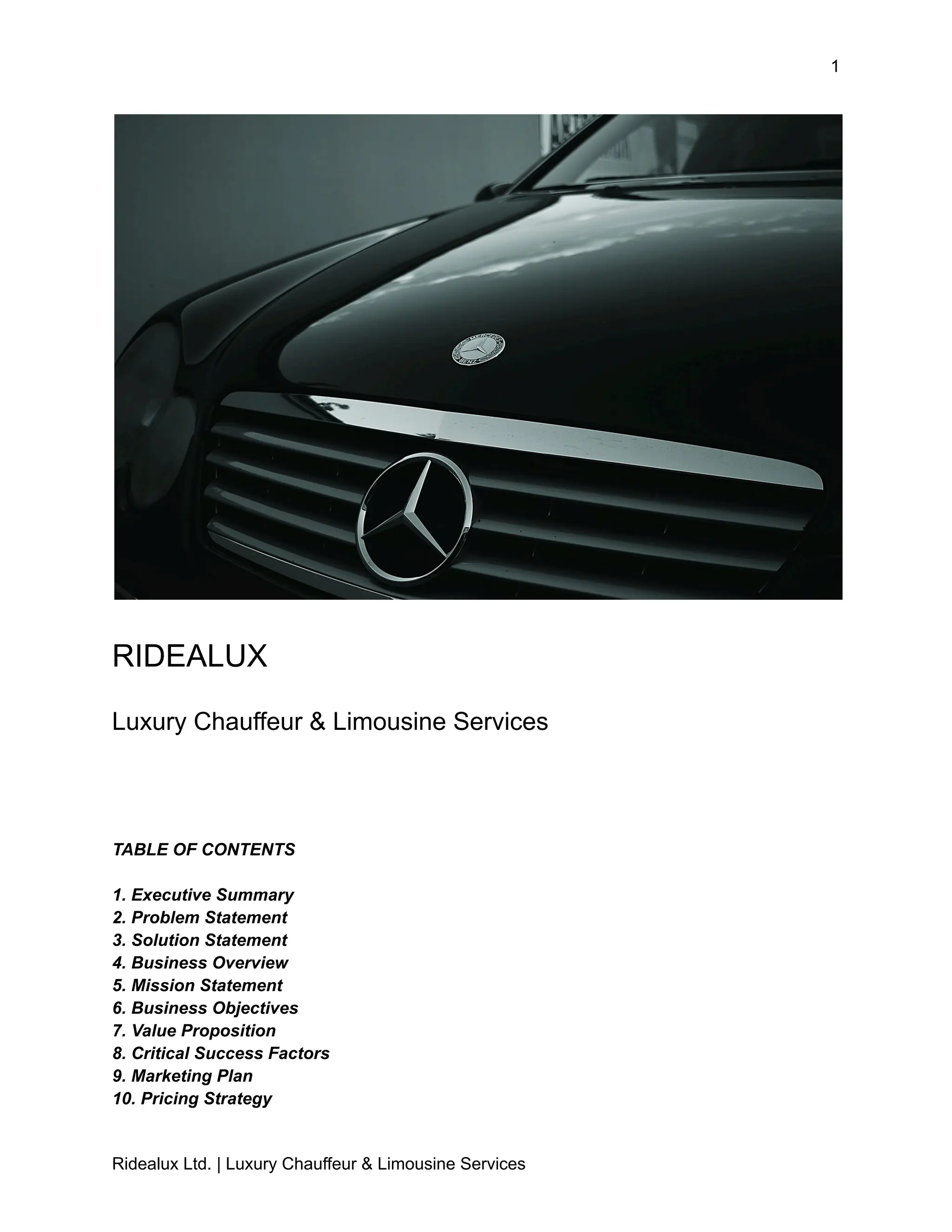
The Ridealux deck opens with a high-resolution image of a Mercedes-Benz, immediately signaling its focus on the luxury segment. Slide 1 establishes the company as a "Luxury Chauffeur & Limousine Services" provider based in London. The table of contents is unusually long for a 10-slide deck, listing 15 sections, which suggests that some slides contain multiple sections of a traditional business plan. Slide 2 provides contact details, specifying the market focus as Central London and the Greater London Metropolitan Area. The Executive Summary on Slide 2 notes that the company aims to address the "growing demand for luxury ground transportation" among corporate clients and high-net-worth individuals. The Problem Statement identifies five key gaps in the current London market: inconsistent service quality, lack of specialization, limited technology integration, a shortage of professional chauffeurs, and difficulty maintaining high-quality fleets.
Slide 3: Solution and Business Overview
Slide 3 outlines the Ridealux solution, which rests on four pillars: Premium Fleet Management (Mercedes S-Class, BMW 7 Series, Range Rover), Professional Driver Excellence (rigorous vetting and multi-language capability), Technology Integration (mobile app and real-time tracking), and Customer Experience Focus (24/7 support and loyalty programs). The Business Overview section defines the company as a "newly established" entity. It lists five distinct business models: B2C point-to-point transfers, B2B corporate contracts, Special Events (weddings), Airport Services, and Tourism partnerships with luxury hotels. This diversification is a strategic attempt to ensure fleet utilization across different times of the day and week.
Strategic Objectives and Value Proposition
Slide 4: Mission and Growth Targets
Slide 4 contains the Mission Statement: "To provide London's most discerning travelers with exceptional luxury ground transportation characterized by professionalism, reliability, and uncompromising attention to detail." The Business Objectives are broken down by year, providing a clear roadmap for scaling. Year 1 goals include establishing a presence with 8-12 vehicles and securing 15-20 corporate account clients. Year 2 targets expansion to 20-25 vehicles and a 15-20% profit margin, along with expansion to regional UK airports like Heathrow and Gatwick. By Year 3, the company aims for a 40+ vehicle fleet and expansion into other major UK cities such as Manchester and Birmingham. These milestones give investors a tangible way to measure progress, though the capital requirements for such a fleet expansion are not explicitly stated on this slide.
Slide 5: Value Proposition and Success Factors
Slide 5 details the Value Proposition, emphasizing GPS tracking, professional arrival guarantees, and transparent pricing. The "Critical Success Factors" section highlights the operational necessities: driver quality, customer service excellence, fleet maintenance, and strategic partnerships. This slide transitions into the Marketing Plan, which specifies the fleet composition (Mercedes-Benz S-Class, BMW 7 Series, and Range Rover Evoque). The target markets are segmented into four groups: Corporate Clients, Luxury Travel & Tourism, Special Occasions, and Hotel & Hospitality Partners. This segmentation aligns with the business models introduced on Slide 3.
Financial Modeling and Operational Logistics
Slides 5-6: Pricing Strategy and Operations
The Pricing Strategy begins on Slide 5 and carries over to Slide 6. Ridealux utilizes a tiered pricing model: "Economy Luxury" at £45-60 per hour, "Premium Luxury" (the standard offering) at £60-85 per hour, and "VIP Exclusive" at £85-150+ per hour. Slide 6 also introduces "Corporate Packages" featuring monthly retainer agreements with discounted rates. The Operational Plan on Slide 6 is comprehensive, covering vehicle fleet management (acquisition, financing, and maintenance), driver management (recruitment and training), and technology systems. Notably, the company identifies "Ground Alliance" as its dispatch and management system, showing that they have already selected a vendor for their core infrastructure.
Slides 7-8: Detailed Financial Projections
Slides 7 and 8 provide a deep dive into the Year 1 financial assumptions. Ridealux assumes an average fleet of 10 vehicles with a utilization rate of 6 billable hours per day, 300 days per year, at an average rate of £75/hour. This results in £1.35 million in annual revenue from standard bookings. Additional streams include £180,000 from corporate retainers and £96,000 from events, bringing the total estimated Year 1 revenue to ~£1.63 million. The cost structure is equally detailed: Fixed costs include £360,000 for vehicle leasing/financing, £90,000 for insurance, and £120,000 for admin salaries. Variable costs are dominated by chauffeur compensation at £420,000 and fuel at £140,000. Slide 8 concludes the financial section with a projected Year 1 profit of £310,000, representing a 19% margin. This level of granular financial detail is rare in early-stage decks and provides a strong basis for due diligence.
Risk Management and Conclusion
Slides 8-10: Risks, KPIs, and Final Summary
Slide 8 includes a Risk Mitigation table, addressing concerns like low early demand (mitigated by pre-selling corporate contracts) and vehicle downtime (mitigated by backup fleet arrangements). Slide 9 lists Key Metrics & Success Indicators, categorized into Operational, Financial, Customer Experience, and Growth KPIs. Specific targets are mentioned, such as an on-time arrival rate of >98% and a customer satisfaction rating of >85%. Slide 10 serves as the Conclusion, reiterating that Ridealux is positioned to become a leading provider by combining luxury assets with professional standards and modern technology. It emphasizes that the company competes on value and service rather than just price.
What Ridealux Does Well
The Ridealux deck is exceptionally strong in its financial transparency. By listing the exact number of billable hours and the specific cost of chauffeur compensation, the founders allow an investor to stress-test the business model immediately. If utilization drops to 4 hours instead of 6, the impact on the bottom line is easy to calculate. Furthermore, the inclusion of a specific technology partner (Ground Alliance) shows that the operational planning has moved beyond the conceptual stage. The tiered pricing strategy is also well-conceived, as it allows the company to maximize the utility of different vehicle types across various customer segments.
What is Missing from the Deck
The most glaring omission is the Team slide. In a service-heavy business like a chauffeur company, the experience of the operations manager and the recruitment lead is paramount. Investors need to know who is managing the fleet and who has the connections to secure the 15-20 corporate accounts mentioned on Slide 4. Secondly, there is no "Ask" slide. The deck details the costs of leasing and insurance but does not state how much equity or debt financing is required to cover these startup costs. Finally, the deck lacks a competitive analysis. While it mentions the "competitive transportation sector" in London, it does not name specific rivals or explain how Ridealux will win market share from established incumbents like Addison Lee or Wheely.
Founders: What to Copy from this Deck
Granular Revenue Assumptions: Use Slide 7 as a template for showing how you arrive at your revenue totals. Breaking it down by hours, days, and rates makes the numbers believable. · Tiered Pricing: The breakdown of Economy, Premium, and VIP tiers on Slides 5-6 is an excellent way to show how you will capture different segments of the market. · Risk Mitigation Table: The table on Slide 8 is a professional way to show that you have considered the downsides and have a plan to handle them. · Specific KPIs: Listing target percentages for arrival rates and satisfaction (Slide 9) shows a commitment to operational excellence that appeals to sophisticated investors.
Frequently asked questions
- What is the primary revenue driver for Ridealux?
- The primary driver is the core chauffeur service, projected to generate £1.35 million annually from a 10-vehicle fleet. This is supplemented by £180,000 in corporate retainers and £96,000 from events and weddings, totaling an estimated £1.63 million in Year 1 revenue.
- How does Ridealux plan to differentiate itself from standard ride-hailing apps?
- Ridealux focuses on 'Professional Excellence' through background-checked, trained chauffeurs and a premium fleet including Mercedes S-Class and Range Rovers. Unlike mass-market apps, they offer bespoke service customization, 24/7 support, and dedicated account management for B2B clients.
- What are the projected profit margins for the business?
- The deck projects a Year 1 profit margin of approximately 19%, resulting in £310,000 in profit. By Year 2, the objective is to maintain a 15-20% margin, and by Year 3, they aim to achieve 20%+ profit margins as the fleet scales.
- What technology stack does the company intend to use?
- Ridealux plans to utilize a mobile application for real-time booking, a CRM for customer relationship management, and specifically names 'Ground Alliance' as their dispatch and management system to ensure seamless digital operations.
- What is missing from this pitch deck that an investor would need?
- The deck is missing a Team slide, which is critical for assessing execution risk. It also lacks a 'The Ask' slide, meaning it does not state how much money is being raised, the valuation, or how the funds will be allocated across the fixed and variable costs listed.