Foursquare's 2009 seed deck is a masterclass in vision-led storytelling that secured $1.35M by capitalizing on the SoLoMo trend. While light on hard metrics, it excelled by proving its business model through organic merchant behavior and leveraging Dennis Crowley’s founder-market fit. The deck successfully framed a simple check-in utility as a sophisticated engagement flywheel and a foundational data platform.
Key takeaways
- Show, don't just tell, your business model by highlighting organic user behaviors that validate future revenue streams.
- Turn your product into a game by creating systems of status, competition, and collection that drive core business goals.
- Frame your solution with elegant simplicity using familiar analogies to describe complex ideas in a single sentence.
- Weaponize your founder-market fit by making your unique experience or unfair advantage central to the narrative.
- Signal your platform vision early to show investors you are building a foundational data layer or ecosystem, not just an app.
The Moment in Time: Summer 2009, The Dawn of SoLoMo
To understand the genius of this pitch deck, you have to transport yourself back to the summer of 2009. The world was wildly different. The iPhone was only two years old, and its App Store was just celebrating its first birthday. Twitter was hitting its explosive growth phase, teaching the world about real-time status updates in 140 characters. Facebook was the king of the social web, but it was still overwhelmingly a desktop experience. The concept of "checking in" to a physical location via a mobile app was a niche, almost bizarre, behavior. This was the primordial soup from which the "SoLoMo" (Social, Local, Mobile) trend would emerge and dominate the next three years of tech startups.
Into this environment walked Dennis Crowley and Naveen Selvadurai with Foursquare. This wasn't just any pitch from any founder. Dennis Crowley was the co-founder of Dodgeball, a pioneering location-based social network that ran on SMS. Google had acquired Dodgeball in 2005, only to let it languish and eventually shut it down in early 2009. For investors, Crowley wasn't just a founder with an idea; he was the creator of the category, returning with better technology (smartphones and GPS instead of SMS) to finish what he started. This deck wasn't just a pitch; it was a triumphant second act. It secured a $1.35M seed round co-led by two of the sharpest firms of the era, Union Square Ventures and O’Reilly AlphaTech Ventures, setting the stage for one of the most iconic startups of the mobile boom.
A Slide-by-Slide Walkthrough
The Foursquare deck is a masterclass in concise, vision-led storytelling. It's remarkably short and text-heavy by today's standards, but every word is chosen to build a compelling narrative around product, engagement, and a revolutionary business model. Let's break it down.
The Hook: A Simple, Powerful Definition
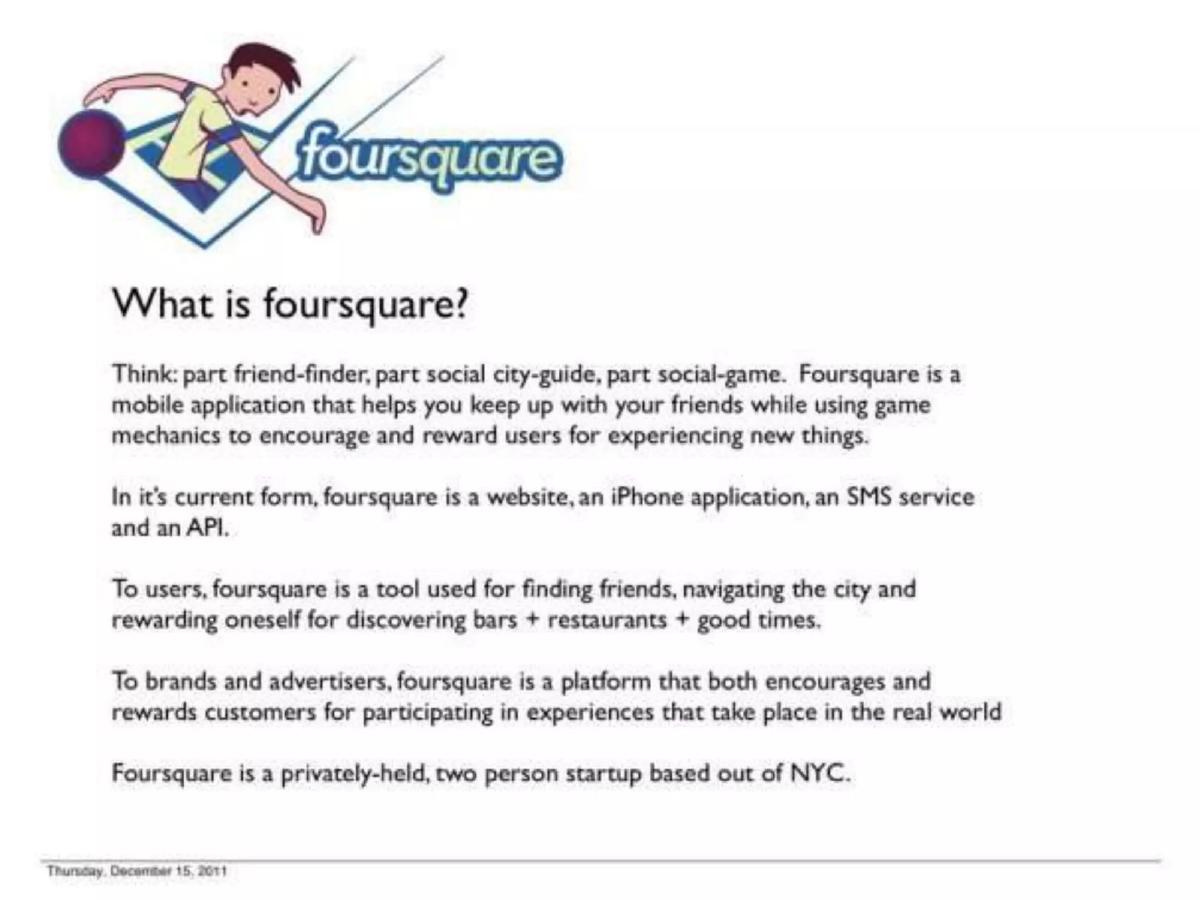
The deck opens with a slide titled "What is foursquare?" instead of a traditional problem slide. This is a strategic choice. The problem—the disconnect between our online social lives and our real-world activities—was still latent. Foursquare's job was to define both the problem and the solution in one go. They do this brilliantly:
Think: part friend-finder, part social city-guide, part social-game. This single sentence is incredible. It uses familiar concepts ("friend-finder," "city-guide") and combines them with a novel, exciting element ("social-game"). It immediately tells an investor what box to put them in, while also making it clear they are creating a new category. The slide goes on to define the value proposition for both users ("finding friends, navigating the city") and brands ("platform that...rewards customers for participating in experiences"). This dual-sided value prop is established on the very first content slide, a sign of a well-considered business strategy from day one.
The Core Loop: Check-ins, Friends, and Places
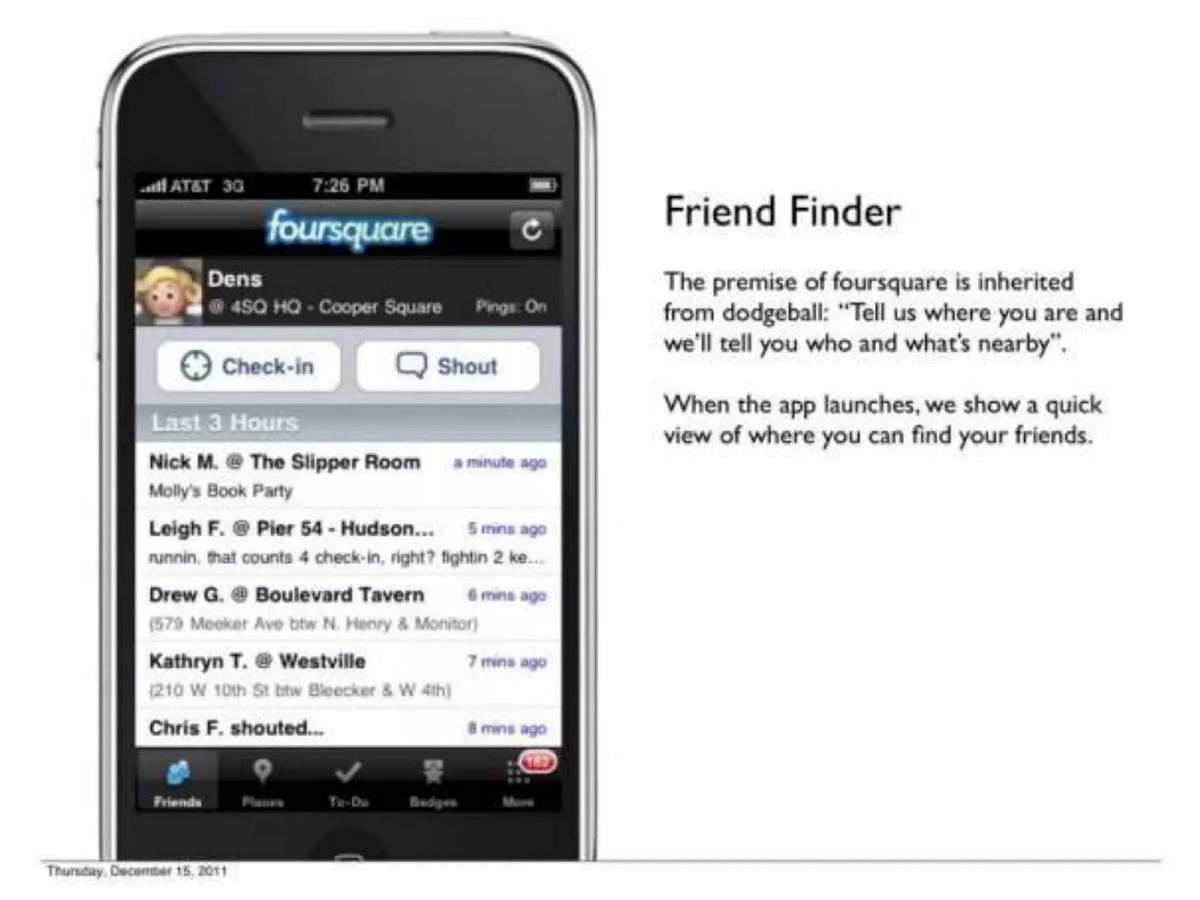
The next few slides walk through the fundamental user journey. It starts with the "Friend Finder," explicitly calling out its heritage from Dodgeball. This is both a nod to the founder's expertise and a clear explanation of the core social utility: "Tell us where you are and we'll tell you who and what's nearby." It’s a simple, powerful feedback loop.
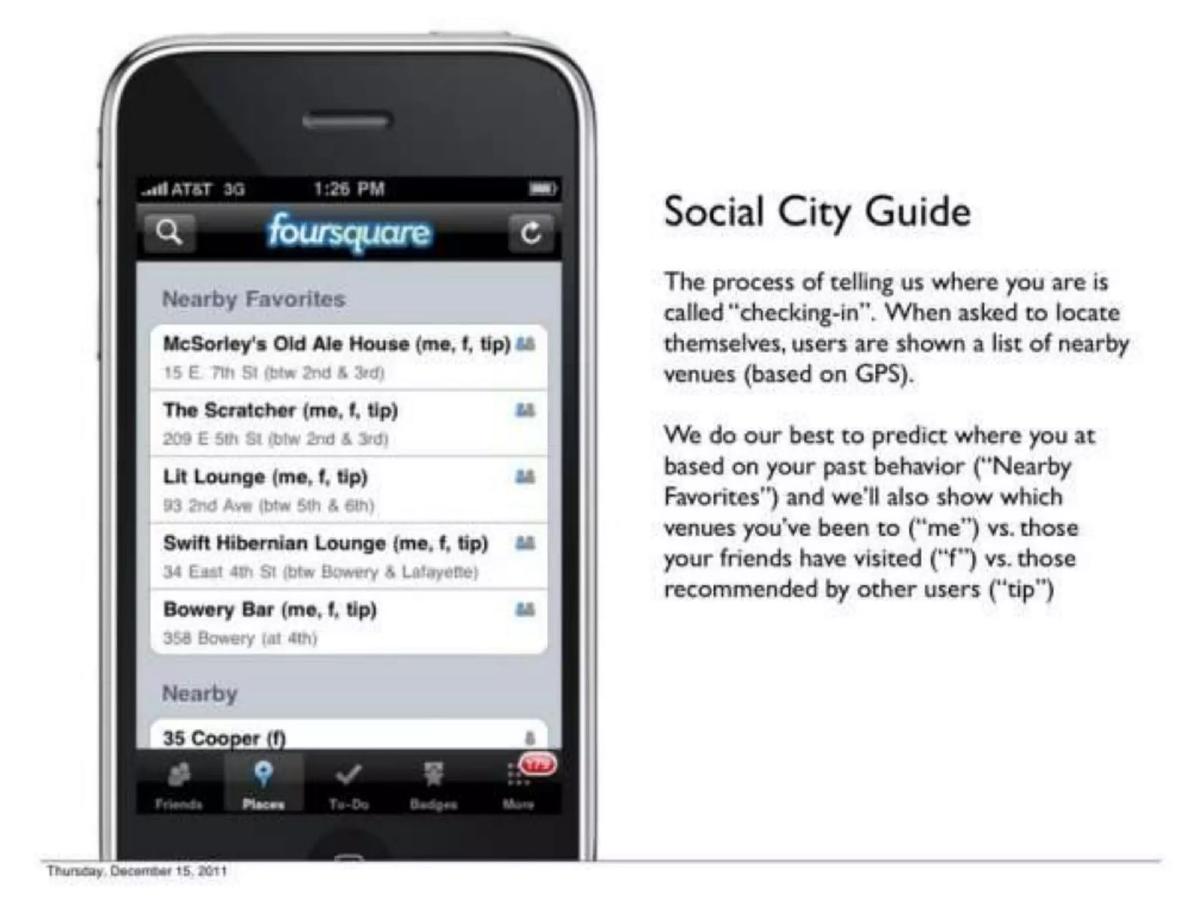
Then comes the "Social City Guide" slide, which introduces the core mechanic: the "check-in." This action is the central atomic unit of the entire Foursquare ecosystem. The deck explains how they make this process intelligent by showing nearby venues prioritized by the user's past behavior ("Nearby Favorites"). This focus on personalization and reducing friction was key. A small but critical detail is the annotation on the venue list showing which places "me," "f" (friends), or other users ("tip") have been to. This adds layers of social proof and utility directly into the product's main function.
The Secret Sauce: Gamification as an Engagement Flywheel
This is where the Foursquare pitch transcends from a simple utility to something truly special. A series of slides—"Checkins Earn Points," "Leaderboard," and "Badges"—unveils a sophisticated system of game mechanics designed to drive repeat usage and create powerful emotional hooks.
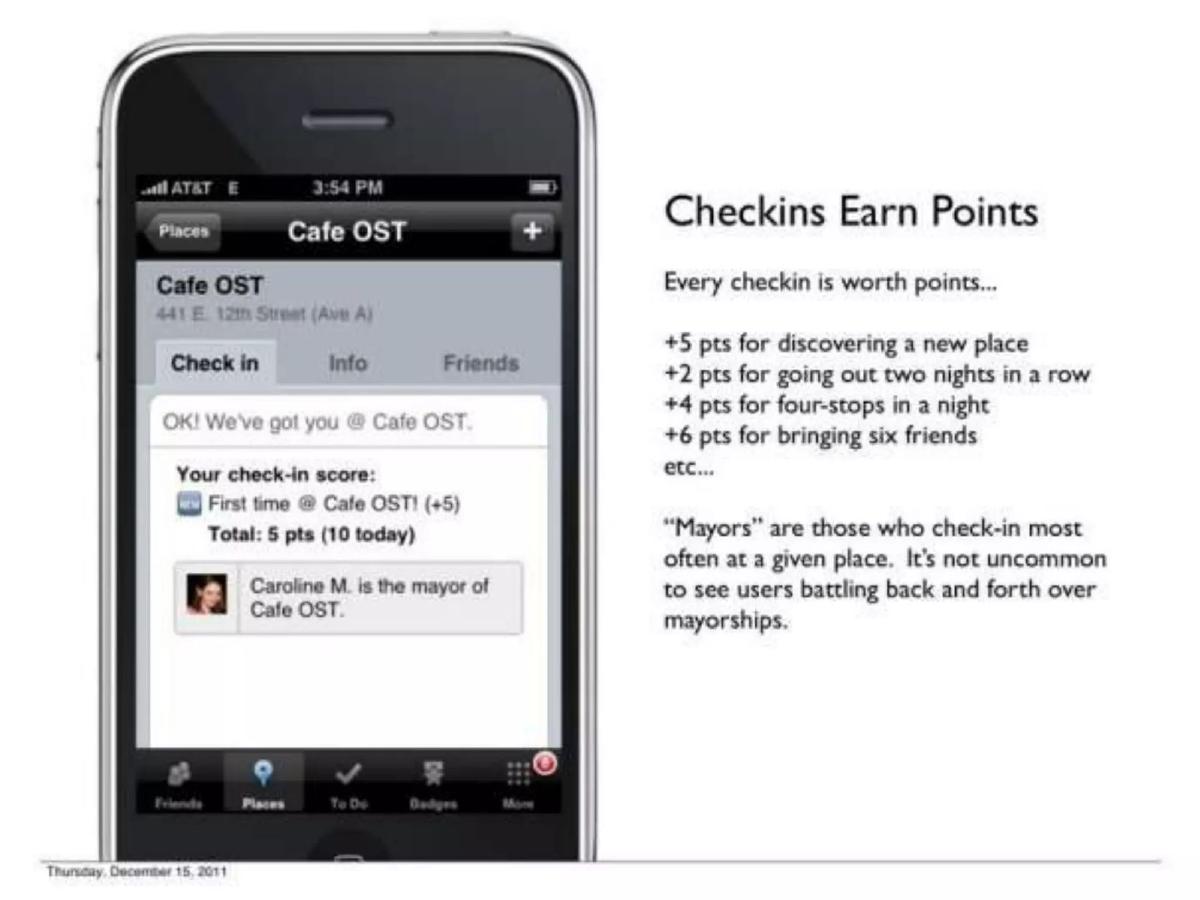
Points: The deck explains that every check-in is worth points, with bonuses for novel behaviors like discovering a new place, creating a streak, or visiting multiple stops in one night. This turned a simple action into a measurable, accumulable score. · Mayorships: The concept of the "Mayor"—the user who checks in most often at a given place—was pure genius. It created a tangible, location-specific status that users would compete for. The competition was public, hyperlocal, and a powerful driver of repeat visits. This wasn't just a game; it was a battle for social status in the real world. · Leaderboards: The deck frames the leaderboard as the "high score for Saturday night." This simple feature tapped into our innate desire for competition and social comparison, encouraging users to check in more frequently than their friends to climb the ranks. · Badges: Badges acted as achievements, rewarding users for exploring and hitting certain milestones (e.g., the "School Night" badge for staying out late or a badge for visiting multiple parks). This collection mechanic encouraged users to break their routines and explore new parts of their city, directly reinforcing the "social city-guide" value proposition.
Together, these elements created a powerful engagement flywheel. Checking in earned you points, which placed you on a leaderboard, which might earn you a badge, and could eventually lead to a coveted mayorship. Each system reinforced the others, creating a sticky product that was fun to use even without the explicit social utility of finding friends nearby.
Early Validation and The Business Model Vision
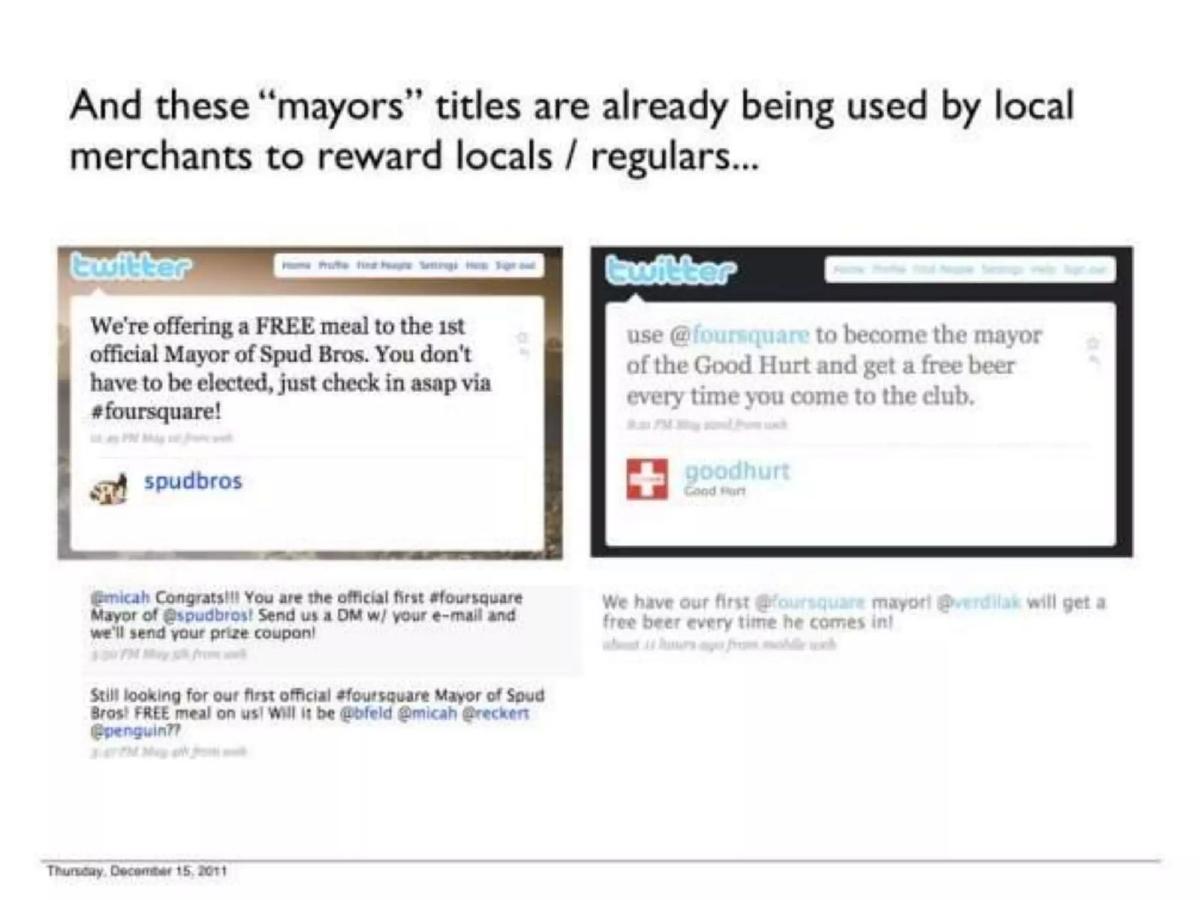
Perhaps the most brilliant part of the entire deck is how it leverages the "Mayors" feature to prove its business model. On the "Checkins Earn Points" slide, Foursquare includes screenshots of tweets from real local businesses like Spud Bros. and The Good Hurt. These businesses were organically, without any prompting or tools from Foursquare, offering free food and drinks to their Foursquare Mayors. This was the ultimate proof point. Foursquare didn't have to say, "We believe businesses will pay to reach customers this way." They could say, "Look, it's already happening. All we have to do is build the tools to capture that value." This is founder gold. It transforms a theoretical business model into an observed behavior.
The deck then formalizes this with two dedicated revenue slides. The primary model is "lead generation." They articulate a vision for a performance-based local advertising platform that was years ahead of its time: "We have a unique opportunity to offer metrics for local advertising: 'an offer was shown and X% of users responded within 3 hours'." This was a direct assault on the unmeasurable world of print coupons and local ads.
They also outline "incremental revenue steams," including sponsored badges (a brilliant native advertising concept), redeemable points (a loyalty platform), and targeted banner ads. This showed investors a multi-layered monetization strategy, demonstrating deep thought about the long-term commercial potential of the platform.
The Platform Play and The Team
The final slides round out the vision. They showcase the website as a "passively updated" profile of your real-world life, a clever contrast to the manual curation of Facebook. A "Trivia" slide acts as a summary and traction stand-in. It highlights their (modest) launch in 20 cities, cross-platform support (iPhone, mobile web, SMS), and most importantly, lays out the platform vision: "foursquare was developed on an API which is currently in private beta and will soon be released to the public (closely following the Twitter model)."
In 2009, citing the Twitter API strategy was a powerful signal. It told investors they weren't just building an app; they were building a foundational data layer for the real world. This dramatically expanded the total addressable market and the scope of their ambition.
Finally, the "Trivia" slide names the team: Dennis Crowley and Naveen Selvadurai. Listing Dennis's credentials ("formerly dodgeball / Google") was the closing argument. It established unimpeachable founder-market fit. He had the vision, the experience, and the scar tissue to make Foursquare succeed where Dodgeball could not. For a seed-stage company, the team is often the most important factor, and Foursquare's founding team was its ultimate trump card.
What Worked and Why Investors Said Yes
This deck, despite its simplicity, was devastatingly effective for several key reasons:
Crystal-Clear Vision in a Hot Market: Foursquare perfectly captured the nascent excitement around mobile, social, and local. They articulated a future where digital interactions drove real-world behavior, and they presented a product that was the embodiment of that future. · Ingenious and Defensible Gamification: The points/badges/mayors system was not just a feature; it was the core of the product. It created a powerful, addictive user experience that was difficult for a competitor like Yelp to simply bolt on. It created a data moat and a behavioral moat simultaneously. · Business Model Grounded in Organic Behavior: The anecdote of businesses rewarding mayors was worth more than any financial projection. It moved the entire monetization plan from the realm of hypothesis to observation, dramatically de-risking the investment. · Founder-Market Fit Personified: Dennis Crowley's personal story was inextricably linked with the product vision. Investors weren't just betting on an idea; they were betting on the one founder in the world who was uniquely qualified to execute it. This was the sequel everyone wanted to see. · Massive Platform Ambition: By immediately positioning themselves as an API-driven platform akin to Twitter, they signaled that their ambitions went far beyond being a simple consumer check-in app. They were building a new utility for the internet.
What Was Weak or Missing?
By 2024 standards, the deck has some glaring omissions that would be heavily scrutinized today.
Hard Traction Metrics: The deck is conspicuously silent on user numbers. There is no mention of Daily Active Users (DAU), Monthly Active Users (MAU), check-in volume, user retention, or growth rates. The "20 US cities" is a vanity metric at best. For a seed round from this founder in 2009, vision and team were enough. Today, even at seed, you'd need to show more quantitative proof of life. · No Market Sizing (TAM/SAM/SOM): The deck makes zero attempt to quantify the market size for local advertising or mobile platforms. It assumes investors understand the opportunity is massive. While likely a safe assumption for their audience, modern decks are expected to provide a detailed analysis of the Total Addressable Market. · No Competitive Landscape: Besides a passing shot at "Yelp-style reviews," the deck doesn't mention a single competitor. In 2009, companies like Gowalla, Brightkite, and Loopt were direct competitors. A modern deck would require a 2x2 matrix or a detailed feature comparison to show how Foursquare was different and better. · The "Ask": The document itself doesn't state how much money the team is raising or what the funds will be used for. This was almost certainly handled in the verbal pitch, but it's a standard component of pitch decks today.
5 Lessons to Steal for Your Pitch Today
Show, Don't Just Tell, Your Business Model: Find your version of the "mayors get free beer" tweet. Is there any way you can show customers or partners organically using your product in a way that validates your future business model? This is infinitely more powerful than a spreadsheet. · Turn Your Product into a Game (Intelligently): A well-designed gamification loop is not about slapping points on things. It's about creating systems of status, competition, and collection that drive your core business goals. How can you make using your product emotionally rewarding? · Frame Your Solution with Elegant Simplicity: Foursquare's "part friend-finder, part social city-guide, part social-game" is perfect. Practice explaining your complex idea using simple, familiar analogies. Can you describe it in a single sentence that is both understandable and intriguing? · Weaponize Your Founder-Market Fit: If your personal story or unique experience gives you an unfair advantage, make it central to your narrative. Why are you the only person/team in the world who can win in this market? Don't be shy about it. · Signal Your Platform Vision Early: Even if you're starting with a simple app, show investors you're thinking bigger. Are you building a dataset? An ecosystem? A new protocol? Hinting at the long-term platform play (like Foursquare's API) can dramatically increase your perceived value and potential outcome.
Foursquare: Then vs. Now
The Foursquare of today is a testament to the power of a pivot and the enduring value of data. The vision pitched in this 2009 deck—a consumer-facing social game—largely did not become the massive, enduring business they hoped. The check-in craze peaked around 2012. User growth slowed, and the challenge of monetizing small local businesses at scale proved formidable.
In 2014, Foursquare made a bold move, splitting its app in two. The check-in and gamification features were moved to a new app, Swarm, while the Foursquare app was reimagined as a discovery engine (City Guide), directly competing with Yelp. This was a confusing move for many users and marked the end of the original Foursquare experience.
However, beneath the surface, something far more valuable was happening. Years of check-ins had created one of the most sophisticated and accurate location datasets on the planet. Foursquare realized its true asset wasn't the consumer app, but the B2B location data platform that powered it.
Today, Foursquare is a location technology platform company. It offers a suite of APIs and SDKs that power location-based experiences in thousands of other apps, including Twitter, Uber, Samsung, and Microsoft. The business model isn't ads for local coffee shops; it's enterprise SaaS contracts and data licensing. While Swarm still exists for a dedicated community of life-loggers, the real business is the Foursquare Location Cloud. They successfully pivoted from a volatile B2C social app to a stable, highly profitable B2B data powerhouse. The company pitched in 2009 may be gone, but its legacy—the data—built a much bigger, more sustainable enterprise in its place. It's the ultimate startup pivot story.
Frequently asked questions
- How much did Foursquare raise with this deck?
- This deck was instrumental in helping Foursquare raise a $1.35 million seed round in late 2009. The round was co-led by two prominent venture capital firms, Union Square Ventures and O'Reilly AlphaTech Ventures.
- Why are there no hard user numbers (DAU/MAU) in the deck?
- At this early stage (a two-person team in private beta), they likely didn't have impressive absolute metrics. They compensated brilliantly by focusing on the strength of the product vision, the elegant gamification loops, and the team's incredible founder-market fit. Dennis Crowley's prior success with Dodgeball allowed investors to bet on the team and vision over early traction numbers, a luxury most founders don't have today.
- What was the biggest risk for investors at the time?
- The biggest risk was behavioral. In 2009, it was not at all certain that a critical mass of people would adopt the novel behavior of 'checking in' to physical locations. It was a public declaration of your whereabouts, raising privacy and social acceptance questions. A secondary risk was whether the business model, while showing promising organic signs, could scale effectively to tens of thousands of small merchants.
- How did Foursquare's business model eventually evolve from what was pitched?
- The initial model of lead generation for local merchants proved incredibly difficult to scale. The real value turned out to be the massive, proprietary location dataset they were building. Foursquare pivoted from a B2C-focused ad model to a B2B data and technology platform. Today, they primarily sell access to their location data and developer tools (APIs, SDKs) to large enterprises via SaaS contracts, a far more scalable and profitable business.
- What happened to the original Foursquare app and the game mechanics?
- In 2014, Foursquare split the original app into two. 'Foursquare City Guide' became a discovery and recommendation app (like Yelp), while a new app called 'Swarm' inherited all the check-in functionality and game mechanics. Mayorships, badges, points, and leaderboards still exist within Swarm, serving a dedicated niche community of users.