Frakture’s deck is a classic example of a pre-seed technical pitch, leaning heavily on a macro labor shortage thesis to justify its existence. The company identifies a specific gap in the market: while many tools provide automation or analysis, few successfully turn data into 'timely, contextual, personal' action without heavy human intervention. By citing a projected shortage of 140,000 to 190,000 data analysts by 2018, the deck positions Frakture as a necessary labor-saving technology. However, the deck lacks critical investor information, including a team slide, financial projections, or a…
Key takeaways
- The deck identifies a projected shortage of 140,000-190,000 data analysts in the US by 2018 as a primary market driver (Slide 2).
- Frakture categorizes the competitive landscape into three buckets: Automation, Analysis, and Optimization, claiming no tool does all three well (Slide 3).
- The technology stack is explicitly defined, utilizing Redshift for column store databases and MongoDB for object stores (Slide 4).
- The product is currently in the prototype stage, with the interface layer built on Node.js to deliver results to desktops and tablets (Slide 4).
- The company defines its target market as CMOs and agencies with marketing budgets exceeding $1 million across at least four channels (Slide 5).
- Operational goals for the next 6-12 months include building a team of 5-7 people and working with a 'Gamma' cohort of clients (Slide 5).
- The deck omits a team slide, failing to identify the 'geeks' solving these engagement problems (Slide 5).
- There is no financial data, business model, or specific capital request included in the provided slides.
Frakture Pitch Deck Analysis
The Frakture pitch deck is a concise, 11-slide presentation (of which 6 are analyzed here) that focuses on the intersection of big data and marketing automation. The deck uses a high-contrast design and technical terminology to appeal to a sophisticated, data-driven audience. It positions the company as a solution to a specific labor crisis in the analytics field, rather than just another marketing dashboard.
Slide 1: Title and Tagline
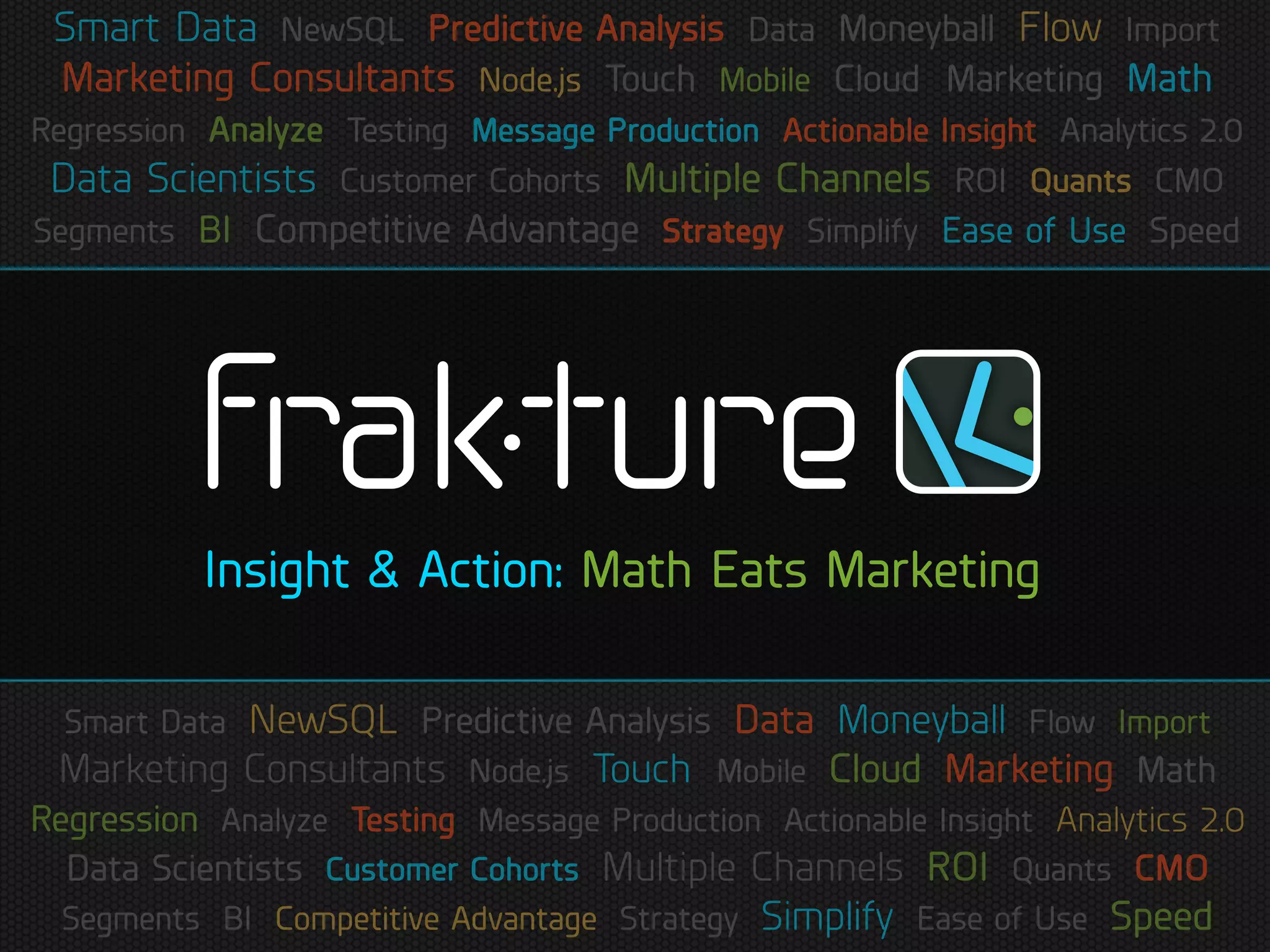
The cover slide introduces the company name, Frakture, accompanied by a stylized 'F' logo. The tagline, "Insight & Action: Math Eats Marketing," sets a clear tone. It suggests that the company is moving beyond qualitative marketing into a quantitative, algorithmic approach. The background features a word cloud of industry buzzwords like "Predictive Analysis," "Node.js," "Actionable Insight," and "ROI," which serves to immediately signal the company's technical domain to the viewer.
Slide 2: The Problem
Slide 2 outlines the market pain points. It identifies two primary issues: the difficulty of obtaining good analytics and the struggle to turn those insights into action. The most compelling piece of data on this slide is the citation of a "2018 Data Analyst Shortage," projecting a gap of 140,000 to 190,000 people with deep analytical skills in the US. By quantifying the labor shortage, Frakture justifies the need for an automated solution. The slide also notes that "a fancy dashboard is insufficient" and that being an expert in every marketing channel is impossible for human teams. The bottom banner concludes that tools doing all three things (Analysis, Action, and Simplicity) well do not exist.
Slide 3: Who's Trying (Competitive Landscape)
This slide uses three funnels to categorize the competitive landscape. Automation includes giants like Adobe, Marketo, and Eloqua. Analysis features Collective, MediaMath, and GoodData. Optimization lists Optimizely, Hootsuite, and AppNexus. By grouping these well-known entities, Frakture attempts to show that the market is fragmented. The implication is that while these companies are "trying," they are limited to their specific silos, leaving a gap for a platform that integrates all three functions into a single workflow.
Slide 4: The Technology We're Building
Frakture gets specific about its technical stack on Slide 4. They describe their "working prototype" as having three components:
Data, Data, Data: ETL libraries designed to ingest millions of records and identify them to the person in seconds. · Segment and Prediction Engine: A backend utilizing Redshift (column store), MongoDB (object store), and custom modeling exposed via an API. · Interface: A Node.js layer that delivers interactive charts and manages campaigns across multiple channels to desktops and tablets.
This level of technical detail is intended to build credibility with investors who understand data infrastructure, proving the founders have moved past the ideation phase.
Slide 5: The Company We're Building
This slide serves as a roadmap and market strategy document. Frakture defines its 6-12 month focus as building a team of 5-7 people and testing the prototype with a "Gamma" cohort of clients . The target market is specifically defined as entities with >$1M marketing budgets and presence on at least four channels. This specificity is a strength, as it shows the founders have a clear idea of their Ideal Customer Profile (ICP). The slide ends with a branding goal: to be seen as "Geeks solving Marketing/Engagement problems with a simple, elegant solution."
Slide 6: Contact Information
The final slide returns to the branding established on the cover, providing the website, an email address, and social handles. Notably, it includes a link to their AngelList profile (angel.co/frakture), which was a standard call to action for startups seeking seed funding during this era. The use of the peace sign icon next to the AngelList link adds a touch of personality to an otherwise very technical deck.
What Works in This Deck
Specific Problem Quantification: By citing the 190,000-person analyst shortage, the founders move the problem from a vague annoyance to a measurable economic gap. This makes the "why now" argument much stronger for investors.
Technical Transparency: Listing specific technologies like Redshift, MongoDB, and Node.js helps technical due diligence. It shows the team has made architectural decisions and isn't just selling vaporware.
Clear ICP: Many early-stage decks claim their product is for "everyone." Frakture’s decision to target companies with >$1M budgets and 4+ channels shows a disciplined approach to go-to-market strategy.
What Is Missing
The Team Slide: This is the most significant omission. In a pre-seed or seed deck, the team is often more important than the product. The deck mentions "geeks," but provides no names, bios, or evidence of their ability to build what is described. Without knowing who is behind the "wicked fast" ETL libraries, an investor cannot assess execution risk.
Business Model: There is no mention of how Frakture intends to make money. Is it a SaaS subscription, a percentage of ad spend, or a per-record ingestion fee? The lack of a pricing model makes it impossible to judge the scalability of the business.
The Ask: The deck does not state how much money the company is looking to raise or what the specific milestones for that capital will be beyond "building a team of 5-7." A pitch deck without an ask is just a presentation.
Unit Economics and Traction: While the deck mentions a "Gamma" cohort, it provides no data on existing pilot results, user engagement, or cost to acquire a customer. Even at the prototype stage, some indication of early interest or letters of intent (LOIs) would strengthen the case.
What a Founder Should Copy
The Competitive Funnels: The way Slide 3 categorizes competitors by function (Automation vs. Analysis vs. Optimization) is an excellent way to simplify a crowded market. It allows the founder to explain where they fit without having to disparage every individual competitor.
The Roadmap Structure: Slide 5’s breakdown of "Focus," "Target Market," and "Build Brand" is a clean way to communicate a 12-month plan. It covers team growth, customer acquisition, and market positioning in three simple blocks.
The Tagline Strategy: "Math Eats Marketing" is a memorable, punchy phrase that encapsulates the company's entire philosophy. Founders should strive for a 3-5 word phrase that summarizes their disruptive angle.
Frequently asked questions
- What is the core problem Frakture is trying to solve?
- According to Slide 2, the problem is twofold: good analytics are difficult to obtain due to a massive shortage of skilled data analysts (up to 190,000 by 2018), and turning those insights into action is technically difficult. Frakture argues that existing tools fail to bridge the gap between having data and creating 'relevant, timely, contextual, personal' engagement.
- How does Frakture differentiate itself from competitors like Adobe or Marketo?
- Slide 3 segments the market into Automation (e.g., Marketo, Eloqua), Analysis (e.g., GoodData, MediaMath), and Optimization (e.g., Optimizely, Hootsuite). Frakture claims that tools doing all three of these things well and simply do not exist, implying their solution is an all-in-one platform that handles the full lifecycle from data ingestion to campaign management.
- What is the current state of Frakture's technology?
- As of Slide 4, Frakture has a 'working prototype.' This includes ETL libraries for ingesting millions of records, a prediction engine using Redshift and MongoDB, and a Node.js interface layer. The tech is designed to produce interactive timelines and manage full campaigns across multiple channels.
- Who is the ideal customer for this platform?
- Slide 5 specifies a very narrow target market: CMOs, consultants, and agencies serving companies with at least a $1 million marketing budget. Furthermore, these companies must be active across a minimum of four channels and have 'Smart Analytics/Data folks' who can recognize the ROI of the tool.
- What are the company's immediate milestones?
- The company aims to expand its headcount to 5-7 employees within 6-12 months (Slide 5). During this same period, they plan to move their prototype into testing with a 'Gamma' cohort of clients to refine the product and build the brand as a 'simple, elegant solution' for marketing problems.