FREEWHEEL is a speculative travel platform designed for a future where autonomous vehicles are the norm. The deck, dated July 2027, proposes a service that connects users with drivable vintage cars and boutique hotels in rural territories where manual driving remains legal. It identifies two primary segments: Gen C (born 2015-2025) who view driving as a novel historical experience, and Gen Y who seek nostalgia. While the deck claims 1,000+ monthly active users on slide 07, it lacks critical fundraising components including a team slide, specific financial asks, unit economics, or a clear reve…
Key takeaways
- The deck is dated July 2027, framing the business as a response to a future world of home automation and smart transit (Slide 01).
- The platform targets 'Gen C' consumers (born 2015-2025) who have never driven a car and see it as a memorable escape (Slide 07).
- FREEWHEEL claims exclusive partnerships with Turo for P2P car rentals and 'OUTBACK', described as Airbnb's certified collection of boutique hotels (Slide 05).
- The fleet consists of mid-70s to early millennium cars converted to Tesla technology to meet ECO standards (Slide 06).
- Current traction is stated as 1,000+ monthly active users (Slide 07).
- Market size figures (3 Billion for TAM, 100 Million for SAM) are accompanied by a footer stating 'All numbers are pure bullsh*t' (Slide 08).
- There is no team slide, no financial ask, and no breakdown of how the company generates revenue (Omission).
- The roadmap for Q3 includes the rollout of company-owned vehicles to increase profits, shifting from a pure platform model (Slide 09).
Executive Summary: A Speculative Leap into 2027
The FREEWHEEL pitch deck is a unique artifact that functions more as a speculative design project than a traditional investment document. Dated July 2027, the deck assumes a near-future reality where autonomous vehicles have rendered manual driving a niche, leisure activity. While it follows a standard pitch structure, the content is built on hypothetical cultural shifts and explicitly fictionalized market data. For a fundraising analyst, this deck serves as a case study in narrative-driven pitching, though it fails to provide the hard financial data required for a real-world transaction.
Slide 1: Title and Positioning
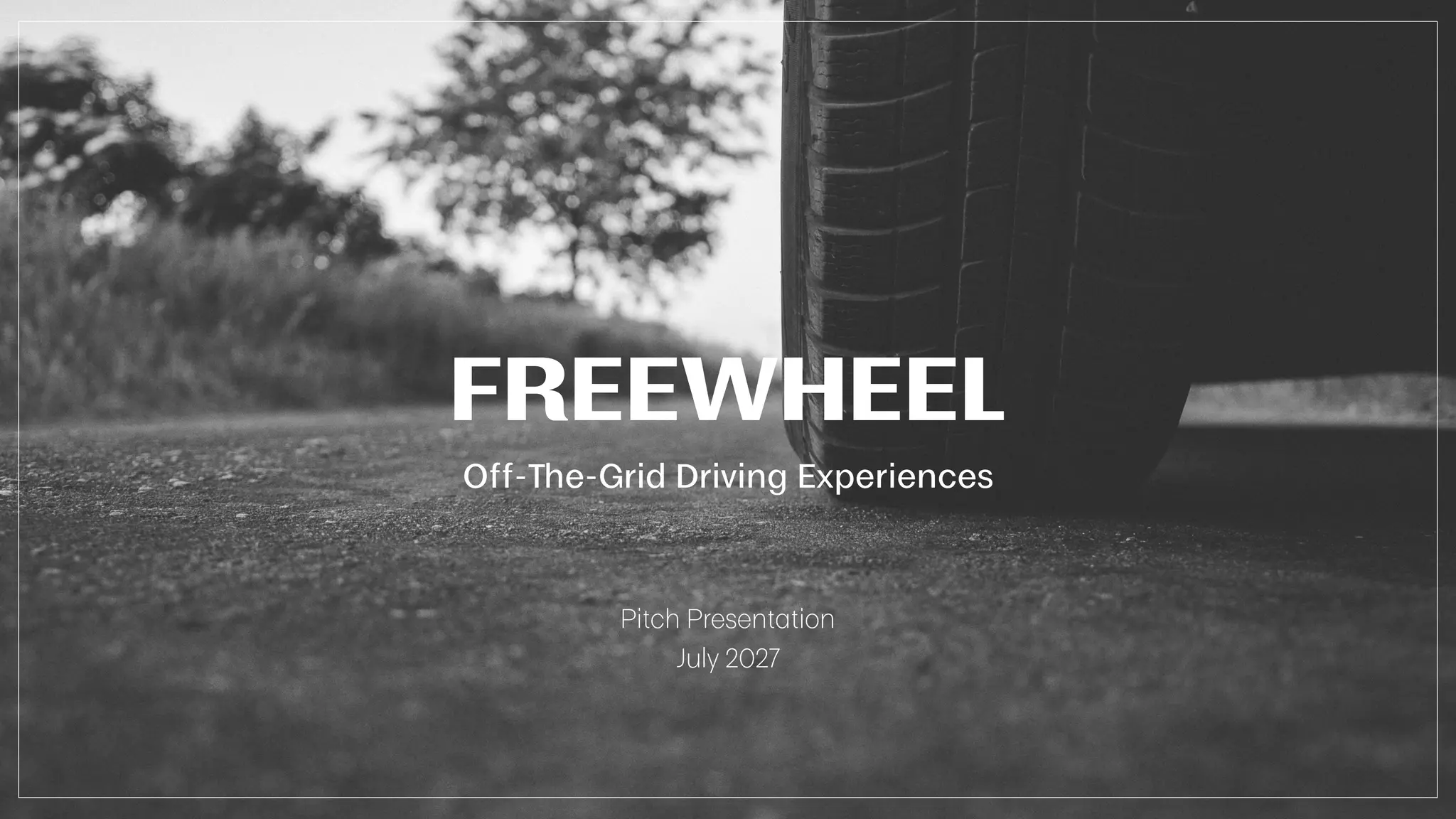
The cover slide establishes the brand identity: FREEWHEEL . The subtitle, "Off-The-Grid Driving Experiences," immediately narrows the focus to the experiential travel sector. The date "July 2027" is the first indicator that this deck is operating in a future-dated context. The imagery of a car tire on a rural road reinforces the "off-the-grid" theme.
Slide 2: The Opportunity
Slide 02 identifies two cultural trends driving the business. First, it cites "Off-the-grid lifestyles" among Gen C consumers (defined here as those born 2015-2025), who supposedly crave manual experiences after being raised in a world of total automation. Second, it points to a "Vehicle modification" subculture that illegally mods self-driving cars for manual control, inspired by a revival of 2000s-era racing films like The Fast and the Furious . This slide sets the stage for a "rebellion-as-a-service" business model.
Slide 3: The Idea
The core product is described as a platform for leisure travelers. Users book "drivable vehicles" and "boutique hotels" located in rural American territories where manual driving remains legal. The slide features two images: a vintage green sports car with gull-wing doors and a remote, modern cabin in a desert landscape. This clarifies that the startup is a marketplace connecting assets (cars and rooms) to a specific user intent (manual driving).
Slide 4: How It Works
This slide uses a five-step iconographic flow to describe the user journey. It introduces a persona, "Margie," who feels discontented and downloads the FREEWHEEL app. She browses car models and hotel locations, experiences the "magic" of off-grid driving, and earns loyalty points. The process is standard for a travel booking app, emphasizing ease of use and retention through a loyalty program.
Slide 5: The Technology
FREEWHEEL claims its platform is integrated with "today’s premier services," listing Google, Apple, and Amazon for payments and authentication. The slide also mentions "exclusive partnerships" with Turo for P2P car rentals and OUTBACK , which it describes as "Airbnb’s certified collection of boutique hotels across rural America." These partnerships are presented as the backbone of the service's inventory.
Slide 6: Competitive Advantage
The company claims a first-to-market advantage based on three pillars:
Variety: A fleet of cars from the mid-70s to the early 2000s, converted to Tesla technology to meet "current ECO standards." · Exclusivity: Access to "off-the-radar" Airbnbs along famous driving routes like Blue Ridge Parkway and Route 12 Utah. · Loyalty: A program offering "First Dibs" access to limited batch automobiles.
This slide suggests the company may eventually move from a pure marketplace to an asset-heavy model by owning its own "limited batch" cars.
Slide 7: Marketing and Audience Segments
FREEWHEEL claims to have 1,000+ monthly active users . The audience is split into two groups: 75% are "Gen C Experientials" who have never driven and see it as a historical escape, and 25% are "Gen Y Nostalgics" who grew up driving and are currently experiencing a midlife crisis. This is a sophisticated way to segment a market, though the "Gen C" definition relies entirely on the deck's 2027 setting.
Slide 8: Market Size (TAM/SAM/SOM)
Overall Online Travel (TAM): 3 Billion · Experiential Travel (SAM): 100 Million · Trips with FREEWHEEL (Market Share): 50 Million
Crucially, the bottom right corner contains a disclaimer: "All numbers are pure bullsht" . This confirms that the deck is a template or a conceptual exercise rather than a report of actual or projected financial performance.
Slide 9: Milestones
Q1: Annual planning and investor relations. · Q2: Continued user acquisition via referral programs. · Q3: Rollout of the first batch of "company-owned vehicles" to build a fleet and increase profits. · Q4: A complete UX overhaul including lifestyle content and ancillary products.
The transition to company-owned vehicles in Q3 is a significant strategic shift that would require substantial capital expenditure, which is not addressed in the deck.
Slide 10: Conclusion
The deck ends with a simple "THANK YOU" over a black-and-white image of a highway. There is no contact information, no call to action, and no summary of the investment terms.
What Works in This Deck
The narrative arc is exceptionally strong. By creating a specific future scenario (a world without manual driving), the founders make a niche product feel like a necessary cultural outlet. The use of personas like "Margie" and specific generational definitions (Gen C vs. Gen Y) helps an investor visualize the exact customer profile. The visual design is clean, consistent, and professional, utilizing a monochromatic palette that fits the "off-the-grid" aesthetic.
What Is Missing
As a fundraising document, this deck is incomplete. There is no Team slide , which is usually the most important factor for early-stage investors. We do not know who is building this or if they have the automotive or hospitality expertise to execute it. There is no Ask ; the deck never specifies how much money is being raised or what the milestones for that specific capital would be. The Business Model is vague ; while it mentions "larger profits" from owning vehicles, it doesn't explain the current commission or fee structure for the marketplace. Finally, the Financials are non-existent , with the market slide explicitly stating the numbers are fake.
Founder's Takeaway: Copy the Narrative, Fix the Data
Founders should look at this deck as a masterclass in storytelling and world-building . If you are pitching a product that doesn't fit into a current, well-defined category, creating a "future history" can be a powerful way to justify your existence. However, the blatant admission that the market numbers are "bullsht" would be a fatal error in a real pitch. A founder should use this level of high-concept branding but back it up with a real Team slide, a clear Revenue Model, and a specific Ask. The idea of "retro-fitting" old assets with new tech (Tesla engines in vintage cars) is a compelling "unfair advantage" that should have been expanded upon with technical details or IP claims.
Frequently asked questions
- What is the core problem FREEWHEEL is solving?
- FREEWHEEL addresses a psychological need for 'off-the-grid' leisure in a highly automated future. According to slide 02, it targets consumers fascinated by manual control as a diversion from everyday life dominated by AI and smart transit. It frames driving not as utility, but as a 'new, exciting and memorable experience' for younger generations who have never operated a vehicle manually.
- Who are the target customers for this platform?
- Slide 07 identifies two segments: the Primary Audience is 'Gen C Experientials' (75%), born between 2015 and 2025, who view driving as a connection to history. The Secondary Audience is 'Gen Y Nostalgics' (25%), who grew up driving and use the service to reconnect with their youth, often during a 'midlife crisis' triggered by the transition to self-driving vehicles.
- How does the technology work according to the deck?
- Slide 05 claims the platform is 'open and integrated' with Google, Apple, and Amazon for instant money transfers and authentication. It relies on APIs or partnerships with Turo for vehicle supply and a service called 'OUTBACK' (attributed to Airbnb) for rural boutique hotel bookings. The cars themselves are retrofitted with modern Tesla electric drivetrains to remain street-legal under future environmental laws.
- What are the major omissions in this pitch deck?
- The deck lacks several standard venture capital requirements. There is no slide introducing the founders or management team. There is no 'Ask' slide detailing how much capital is being raised or the valuation. Most importantly, there are no unit economics or revenue figures; the deck mentions 'larger profits' on slide 09 but never explains the current take rate or fee structure.
- Is the market data in the deck reliable?
- No. Slide 08 explicitly includes a disclaimer in the bottom right corner stating, 'All numbers are pure bullsh*t'. The figures—3 billion for the total market and 50 million for FREEWHEEL's share—appear to be placeholders. This, combined with the 2027 date, suggests the deck is a conceptual design piece or a 'speculative fiction' business plan rather than a document for an active 2024 fundraise.