Dstlry’s 26-slide seed deck is a masterclass in leveraging founder reputation to secure capital in a niche media market. By positioning themselves as the 'anti-publisher,' co-founders David Steinberger and Chip Mosher use their ComiXology background to establish immediate credibility. The deck focuses on a creator-first model that includes upfront fees, royalties from the first sale, and company ownership—a significant departure from traditional industry standards. While the deck is light on hard financial projections and unit economics, it compensates with strong qualitative social proof, in…
Key takeaways
- The founders leverage their exit from ComiXology as a primary credibility marker on slides 6 and 7.
- Dstlry differentiates itself by offering creators ownership in the company, as stated on slide 13.
- The company claims a 91% positive sentiment rating from its customer base on slide 22.
- The business model relies on a 'digital drop culture' approach to collectibles, defined on slide 2.
- Early traction is demonstrated through three specific 2023 releases: The Devil's Cut, Gone, and Somna on slide 19.
- The deck lists strategic industry shareholders including Kodansha and Delcourt on slide 24.
- Dstlry was named 2023 Publisher of the Year by The Beat, providing external validation on slide 21.
- The deck omits a specific 'Ask' slide detailing the use of funds or valuation targets.
The Hook: Digital Drop Culture
Dstlry opens its 26-slide deck by immediately carving out a niche that sits at the intersection of traditional media and modern digital scarcity. Slide 2 defines the company as a "digital drop culture collectibles company with creators at its core." This phrasing is intentional; it signals to investors that this isn't just a comic book publisher, but a platform play leveraging the 'drop' mechanics popularized by streetwear and NFT markets.
Founder Pedigree as the Primary Asset
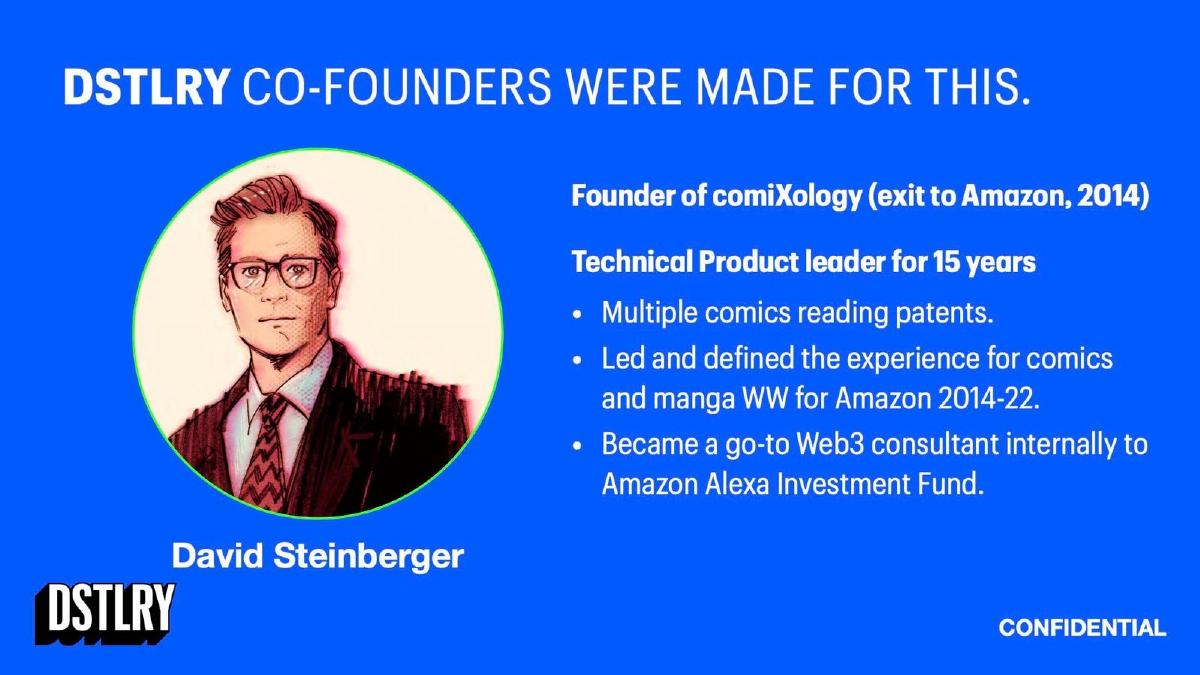
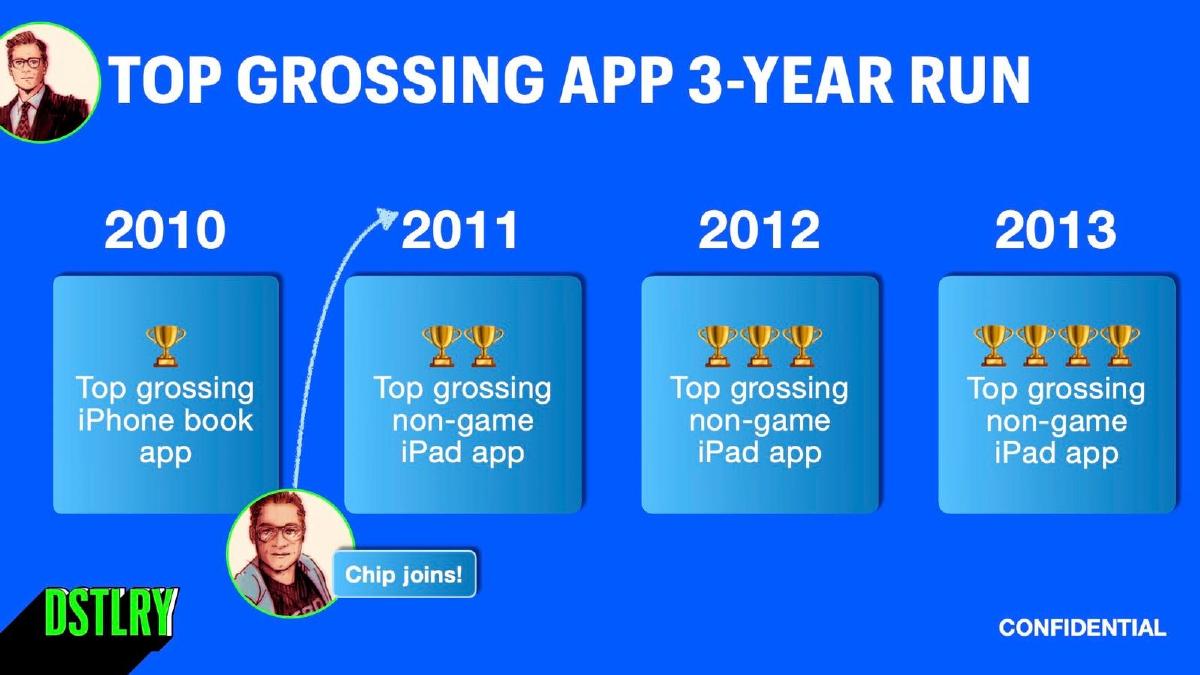
Slides 4 through 8 are dedicated entirely to the co-founders, David Steinberger and Chip Mosher. In a seed round, the team is often the most important factor, and Dstlry leans into this heavily. Slide 6 shares stats on ComiXology, the digital comics giant the founders previously led. By including a quote from Forbes writer Rob Salkowitz on slide 7—stating it is "hard to think of many other people who have had as big an impact on the 21st century comics business" —the deck establishes that these are not outsiders trying to disrupt an industry, but insiders who already have.
The Problem: The Exploited Creator
Slide 12 addresses the industry's pain point directly: "Creators are taken advantage of by publishers, or are ill-served by them." This sets the stage for Dstlry's 'different kind of publisher' narrative. By identifying the talent as the underserved party, Dstlry positions its business model as the solution to a labor problem in the creative arts.
The Solution: The Three Pillars of Creator Equity
Slide 13 is perhaps the most critical slide for understanding the company's competitive advantage. It lists three specific ways they treat creators like stars: upfront fees, royalties from the first sale, and ownership in the company. The asterisk at the bottom notes these are among "a dozen or more updates to the traditional model." This equity-sharing model is designed to attract top-tier talent who would otherwise stay with major houses like Marvel or DC, or go fully independent.
Social Proof and Market Validation
The middle section of the deck (Slides 15-21) focuses on external validation. Slide 15 features quotes from the New York Times and IGN, while slide 21 highlights their "2023 Publisher of the Year" award from The Beat. To prove that the 'thesis is working' (slide 18), the deck showcases three specific 2023 releases on slide 19: "The Devil's Cut," "Gone," and "Somna." This transition from theory to practice is vital for a seed stage company to prove they can actually ship product.
Customer Sentiment Data
Slide 22 provides a quantitative look at qualitative feelings. The company reports that 91% of customers feel positive about Dstlry. The slide breaks down open-ended responses, noting that 25.9% used the word "creators" and 22.3% used the word "love." While this isn't a replacement for a P&L statement, it demonstrates a highly engaged and loyal early adopter base, which is crucial for a 'drop culture' business model.
The Strategic Flywheel
Slide 25 illustrates the "DSTLRY Flywheel." It connects four key elements: Top Creators, Top Content, Premium Product, and Fan Engagement. An arrow labeled "Media" feeds back into the creators and content, suggesting that the brand's visibility helps attract more talent, which creates better content, leading to higher engagement. This is a standard venture capital trope, but it effectively summarizes how the different parts of the business reinforce one another.
Shareholders and Advisors
Slide 23 and 24 list the support system behind the founders. The advisory team includes Lorenzo di Bonaventura (a major film producer) and John Schappert. The shareholder list on slide 24 is particularly impressive for a seed round, featuring Kodansha, GFR Fund, and Delcourt. Having established international publishers like Kodansha on the cap table provides a level of industry defense that most startups lack.
What Dstlry's Deck Does Well
Founder-Market Fit: The deck does an exceptional job of proving that Steinberger and Mosher are the right people to build this. They don't just list titles; they use third-party testimonials to validate their status as industry icons.
Clear Differentiation: The 'Creator-First' model isn't just a slogan; slide 13 breaks it down into tangible financial benefits (equity and first-dollar royalties) that distinguish them from incumbents.
Visual Identity: The deck uses a bold, high-contrast blue and white theme that feels modern and 'premium,' matching their description of their physical and digital formats on slide 17.
What is Missing from the Dstlry Deck
The Ask: As reported by Business Insider, the company raised $5M, but the deck itself (at least the version analyzed) does not include a slide detailing how much they are raising, the valuation, or the specific milestones they intend to hit with the capital.
Unit Economics: While the deck mentions royalties and fees, it provides no data on the cost of acquisition (CAC), the lifetime value of a collector (LTV), or the margins on their 'premium physical and digital formats.'
Market Size (TAM): There is no slide addressing the Total Addressable Market. While the founders' history at ComiXology implies they know the market, investors usually want to see a calculation of the digital collectibles and comic book market potential.
Technology Deep-Dive: The publisher summary mentions a 'digital marketplace with verified ownership,' which usually implies blockchain or NFT technology. The deck avoids technical jargon, which makes it readable, but it leaves the 'how' of the digital marketplace largely unexplained.
Founder's Playbook: What to Copy
Use Social Proof Early: Dstlry doesn't wait until the end to show they are liked. They weave quotes from creators, journalists, and customers throughout the entire narrative.
Highlight Strategic Investors: If you have industry giants like Kodansha on your cap table, make sure they have their own slide. It signals to other investors that the industry has already 'blessed' your disruption.
Focus on the 'Why': Slide 12's focus on how creators are 'taken advantage of' creates an emotional hook. It gives the company a mission beyond just selling books—it makes them a champion for the talent.
Keep the Flywheel Simple: The flywheel on slide 25 is easy to understand at a glance. It shows how the business scales without needing a complex spreadsheet to explain the logic.
Frequently asked questions
- What is Dstlry's core value proposition for creators?
- According to slide 13, Dstlry offers creators a three-pronged incentive structure: upfront fees, royalties starting from the very first sale, and equity ownership in the company itself. This is designed to contrast with traditional publishing models where creators may feel 'taken advantage of' or 'ill-served,' as mentioned on slide 12.
- Who are the founders and what is their track record?
- The company was co-founded by David Steinberger and Chip Mosher. Slides 5 through 8 detail their backgrounds, specifically highlighting their roles at ComiXology. Steinberger is credited with having a massive impact on the 21st-century comics business, while Mosher is noted for his ability to secure industry awards like the Eisner for 'Afterlift'.
- How does Dstlry define its market category?
- Dstlry defines itself on slide 2 as a 'digital drop culture collectibles company.' This suggests they are moving beyond traditional publishing into a scarcity-based digital marketplace model, likely utilizing the 'verified ownership' mentioned in the publisher summary to drive secondary market value.
- What evidence of product-market fit does the deck provide?
- The deck provides three forms of validation: successful 2023 releases (slide 19), high customer satisfaction data showing 91% positive sentiment (slide 22), and industry accolades such as being named '2023 Publisher of the Year' (slide 21).
- Who are the key investors in Dstlry?
- Slide 24 lists several strategic and venture shareholders, including 1am Gaming, GFR Fund, and major international publishers Kodansha (Japan) and Delcourt (France). This indicates strong cross-border industry support for their model.