Dutch’s Series A deck is a masterclass in narrative-driven fundraising, leveraging the founder’s pedigree as a co-founder of Hims to justify a rapid expansion into veterinary telehealth. The deck highlights a significant market gap: while human telehealth has matured, pet care remains fragmented between simple triage apps and traditional brick-and-mortar clinics. By building a proprietary EMR platform and securing VCPR (Veterinarian-Client-Patient Relationship) compliance, Dutch positions itself as a full-stack medical provider rather than a mere referral service. Despite having launched only…
Key takeaways
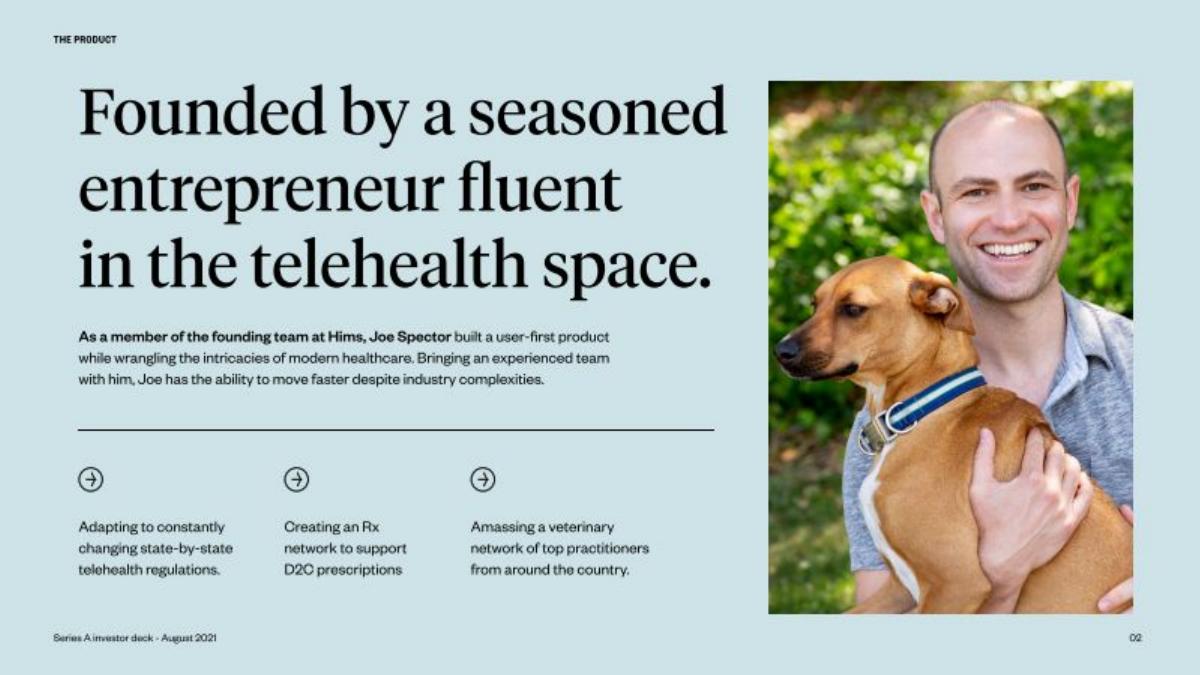
- The founder, Joe Spector, leverages his experience as a founding team member at Hims to establish immediate credibility in the telehealth space (Slide 2).
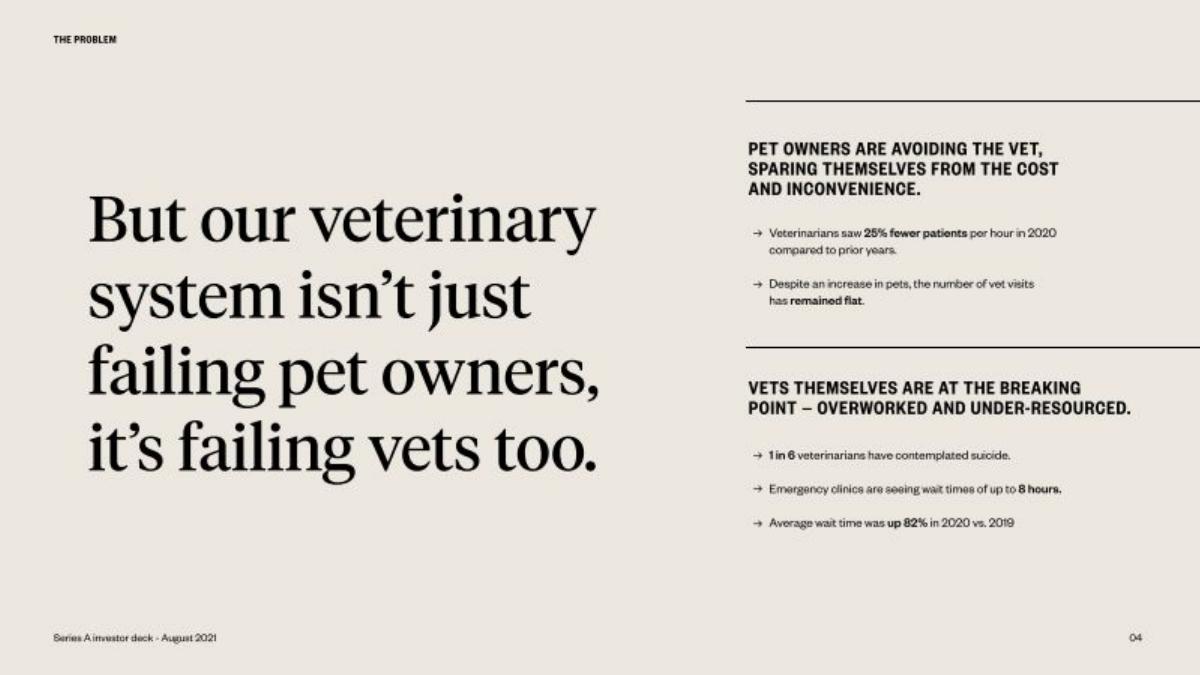
- Dutch identifies a critical supply-side crisis, noting that 1 in 6 veterinarians have contemplated suicide and wait times increased by 82% in 2020 (Slide 4).
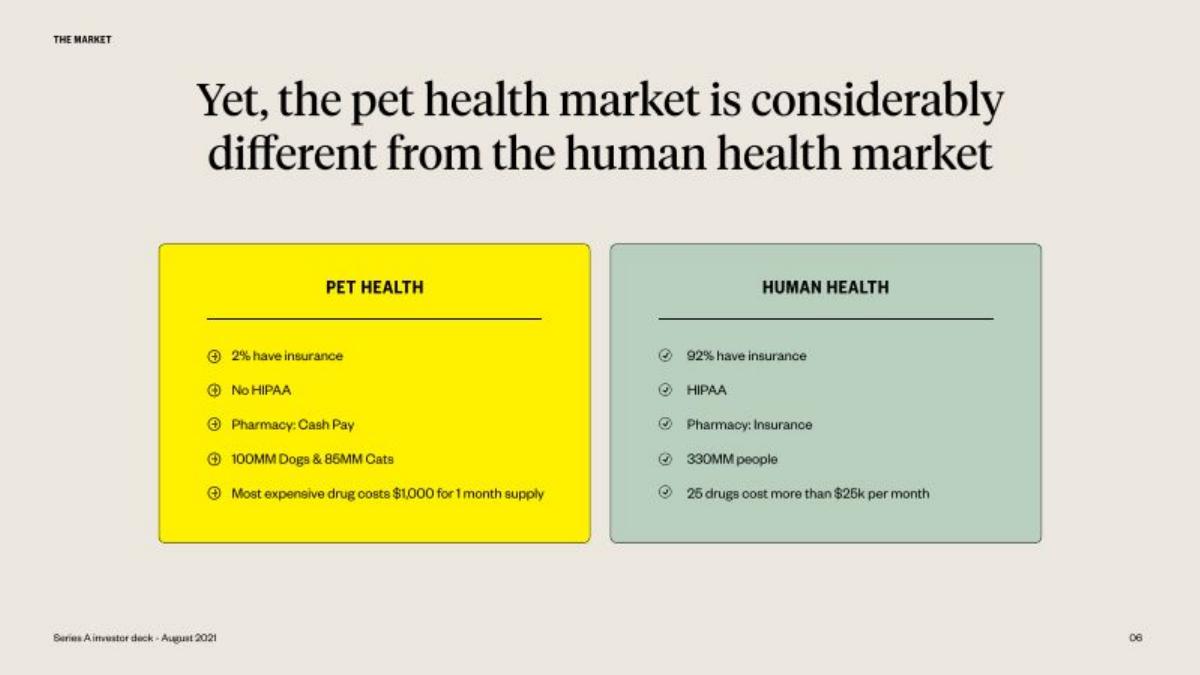
- The deck highlights structural advantages in pet health versus human health, such as the lack of HIPAA requirements and a predominantly cash-pay pharmacy model (Slide 6).
- A proprietary EMR platform is presented as the primary moat, allowing for asynchronous communication and white-label licensing opportunities (Slide 12).
- Early traction metrics show an 8x increase in quiz completion and a purchase conversion increase of 40% within the first month of launch (Slide 14).
- The business model relies on high LTV projections, estimating $468 for anxiety-related cases and $250 for allergy cases against a sub-$200 CAC (Slide 14).
- The deck explicitly asks for $15M to reach 62,400 subscriptions and $75M in revenue by 2023 (Slide 17).
- The competitive landscape is categorized into four distinct buckets: tele-vet services, D2C food, online pharmacies, and modern brick-and-mortar (Slide 8).
Executive Summary: The Hims Playbook for Pets
Dutch’s Series A pitch deck, dated August 2021, is a strategic document designed to convince investors that the successful direct-to-consumer (D2C) telehealth model for humans can be seamlessly translated to the veterinary market. Led by Joe Spector, a co-founder of Hims, the company positions itself not just as a convenience tool, but as a necessary solution to a collapsing traditional veterinary infrastructure. The deck successfully balances high-level market trends with granular product differentiation, specifically focusing on their proprietary technology stack and regulatory navigation.
Slide 1-2: Founder Pedigree and Team Credibility
The deck opens with a high-quality lifestyle image of a dog, immediately establishing the sector. However, the real work begins on Slide 2 . Instead of starting with the problem, Dutch starts with the founder. The headline, "Founded by a seasoned entrepreneur fluent in the telehealth space," directly references Joe Spector’s role at Hims. This is a classic Series A move: when the product is early, sell the operator. The slide lists three specific execution capabilities: adapting to state-by-state regulations, creating an Rx network, and amassing a veterinary network. This sets the stage for a 'moat' built on operational complexity rather than just software.
Slide 3-5: Defining a Two-Sided Problem
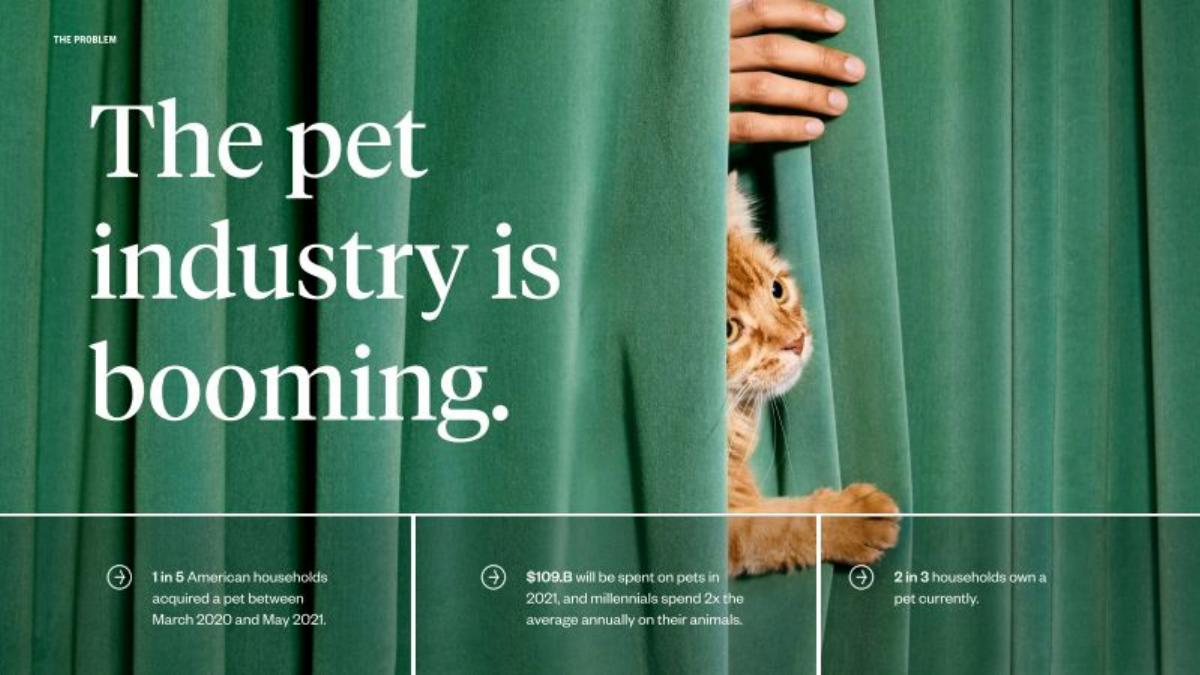
Slide 3 establishes the market tailwinds, noting that "1 in 5 American households acquired a pet between March 2020 and May 2021" and that the industry reached "$109.B" in spending. Slide 4 shifts to the 'why now' by highlighting a systemic failure. It notes that veterinarians saw "25% fewer patients per hour in 2020" and, most strikingly, that "1 in 6 veterinarians have contemplated suicide." By framing the problem as both a consumer inconvenience (8-hour wait times) and a practitioner crisis, Dutch justifies a model that offloads work from physical clinics to digital platforms.
Slide 6: The Structural Advantage of Pet Health
One of the most insightful slides in the deck is Slide 6 , which compares Pet Health to Human Health. It points out that only "2% [of pets] have insurance" and there is "No HIPAA." For an investor, this translates to lower administrative overhead, faster product iteration, and a more direct cash-pay relationship with the consumer. It effectively argues that the pet market is actually a better business environment for telehealth than the human market.
Slide 7-9: The Product and Competitive Landscape
Slide 7 outlines the four pillars of the Dutch service: Online Consultations, Vet-Prescribed Treatment Plans, D2C Medications, and Unlimited Follow-ups. Slide 8 provides a sophisticated competitive analysis. Rather than a standard 2x2 grid, Dutch categorizes competitors into four buckets: Tele-vet (Airvet, Vetster), D2C Food (Ollie, Farmer’s Dog), Online Pharmacy (Chewy), and Modern Brick-and-Mortar (BondVet, Small Door). The claim is that Dutch is the only "end-to-end" solution. Slide 9 presents the roadmap, showing an expansion from anxiety and allergy treatments today into palliative care and chronic diarrhea in 2022, and eventually custom pet food and insurance by 2023.
Slide 10-12: The Technology Moat (EMR)
Slide 11 uses a checklist to show that Dutch is the only player with a proprietary EMR (Electronic Medical Record) platform and VCPR compliance. Slide 12 goes deeper into why this matters. A "homegrown EMR" allows for asynchronous communication, is pharmacy agnostic, and enables the prescription of controlled substances. Crucially, it mentions a "Future licensing opportunity," suggesting that Dutch could eventually pivot or expand into a SaaS model for other veterinarians, and notes that external SaaS EMRs can cost "upwards of $100K/month."
Slide 13-14: Traction and Unit Economics
Despite being live for "less than a month" at the time of the deck's creation, Slide 14 presents aggressive engagement data. It claims "Quiz completion up 8X" and "Purchase conversion up 40%." The unit economics are the highlight here: an "Expected LTV (Anxiety)" of "$468" against an "Expected CAC" of " While these are 'expected' figures rather than historical averages, they provide the mathematical framework for how the $15M investment will be deployed.
Slide 15-16: Social Proof and Market Readiness
Slide 15 uses a quote to illustrate consumer behavior: "I think her day-to-day problems are more trainer-worthy than vet-worthy." This supports the idea that there is a massive 'middle ground' of pet care that is currently ignored because the barrier to visiting a physical vet is too high. Slide 16 provides a collage of press coverage from Forbes and Yahoo Finance, including a mention of celebrity investor Jimmy Fallon, to signal market momentum.
Slide 17: The Ask and Financial Projections
The final substantive slide, Slide 17 , details the "$15MM Series A" ask. The use of proceeds includes growing the team to 32, spending "$16MM" on performance marketing (notably more than the total ask, implying they are also using existing cash or debt), and expanding to 32 states. The P&L summary is ambitious, projecting a jump from "$1,300,000" in 2021 revenue to "$75,000,000" in 2023, with gross profit margins scaling from "40%" to "65%."
What Works in This Deck
Founder-Market Fit: The deck leans heavily on the Hims connection. In the VC world, 'pattern matching' is a powerful force, and showing that the founder has already solved these specific regulatory and logistics hurdles in a different vertical is highly persuasive. · Supply-Side Empathy: Most telehealth decks focus only on the consumer. By highlighting the suicide rates and burnout of veterinarians, Dutch shows they understand the supply side of their marketplace, which is often the harder side to solve. · Regulatory Clarity: The explicit mention of VCPR (Veterinarian-Client-Patient Relationship) shows that the company isn't just a tech layer; they are building a legally compliant medical practice. · Visual Hierarchy: The deck uses a bold, high-contrast color palette (yellow, purple, and cream) that feels modern and professional, matching the brand identity developed by Red Antler mentioned on Slide 13.
What Is Missing or Weak
Historical Data: Because the company had only been live for a month, the traction metrics are based on very short-term trends. The LTV and CAC figures are 'expected,' which requires a high degree of trust from the investor. · Churn Analysis: There is no mention of expected retention or churn rates. In a subscription-based model (starting at $39/mo), retention is the most critical metric for long-term viability. · Pharmacy Logistics: While they mention a D2C pharmacy network, the deck is light on the specifics of how they manage inventory, shipping, and cold-chain requirements for certain medications. · VCPR Limitations: The deck glosses over the fact that VCPR laws vary wildly by state; in some states, a physical exam is still required to establish a relationship before a vet can prescribe medication via telehealth. The deck implies a universal solution that may face local legal headwinds.
Founder Takeaways: What to Copy
The Comparison Matrix: Slide 11 is an excellent example of how to use a checklist to show that you are the only company checking every box. It forces the investor to view the market through your specific set of requirements. · The 'Human vs. Pet' Slide: If you are entering a niche market that is a derivative of a larger market, create a slide like Slide 6. It explains why your specific niche is actually a better business opportunity than the 'parent' industry. · Roadmap Specificity: Slide 9 doesn't just say 'we will grow.' it lists specific medical conditions (Arthritis, Urinary incontinence) and products (Stool analysis, Private label OTC). This shows a deep understanding of the product-led growth path. · Use of Proceeds Table: Slide 17 connects the headcount, revenue, and subscriptions in a single view. This allows investors to see exactly how their capital translates into specific growth milestones.
Frequently asked questions
- Who led the Dutch Series A round and how much was raised?
- According to the catalogue facts, Dutch raised $20M in its Series A round. The round was co-led by Forerunner Ventures and Eclipse Ventures. Interestingly, Slide 17 of the deck shows an initial ask of $15M, suggesting the round was oversubscribed or the target was increased during the fundraising process.
- What is Dutch's core product offering?
- Dutch provides an end-to-end veterinary telehealth service. As detailed on Slide 7, this includes online consultations, vet-prescribed treatment plans, D2C shipping of prescription medications and supplements, and unlimited follow-up care. They aim to establish a full Veterinarian-Client-Patient Relationship (VCPR) rather than just providing one-off triage.
- How does Dutch differentiate itself from competitors like Chewy or Airvet?
- Slide 11 provides a comparison matrix. Unlike Chewy or 1800PetMeds, which focus on pharmacy and e-commerce, or Airvet and Pawp, which focus on triage, Dutch claims to be the only player combining an EMR platform, pharmacy capabilities, and future insurance products under a subscription model starting at $39/month.
- What are the key financial projections in the deck?
- On Slide 17, Dutch projects significant growth from 2021 to 2023. They estimated ending 2021 with 10,800 subscriptions and $1.3M in revenue, scaling to 62,400 subscriptions and $75M in revenue by 2023. They also projected gross profit margins increasing from 40% to 65% over the same period.
- What regulatory hurdles does the deck address?
- Slide 2 and Slide 13 mention the complexity of state-by-state telehealth regulations. The company emphasizes its ability to navigate these 'industry complexities' and notes that they expanded their footprint from 12 to 32 states through deep diligence on state-by-state laws following their seed round.