The dynaCERT investor deck from February 2016 presents a solution for the global diesel emissions problem through its HydraGen technology. Rather than replacing diesel engines, dynaCERT proposes an electrolysis-based retrofit that injects hydrogen and oxygen to improve combustion efficiency. The deck highlights a transition from its origins as Dynamic Fuel Systems to a more focused business model following 2010 engine testing. Key value propositions include reduced fuel consumption, lower emissions, and increased torque. While the deck successfully identifies a massive total addressable marke…
Key takeaways
- The company claims its technology provides 9X flame speed compared to diesel, leading to more complete combustion (Slide 10).
- dynaCERT transitioned from producing HHO (Brown's gas) to a patent-pending system that separates hydrogen and oxygen (Slide 7).
- Field trials conducted with Pepsi on Detroit Diesel Series 60 engines through 2012 are cited as producing positive results (Slide 7).
- The HydraGen system includes an Electronic Control Unit (ECU) described as the 'brains' of the system, featuring an in-cab tablet display (Slide 13).
- Market strategy is bifurcated between North America (larger units) and International markets (tighter configurations for less room between cab and trailer) (Slide 16).
- The deck identifies a massive market opportunity, citing 2007 data showing transportation is 96% reliant on oil (Slide 22).
- Future market penetration plans include establishing testing opportunities with OEMs for use with Exhaust Gas Recirculation (EGR) systems (Slide 19).
- The company is publicly traded, listing tickers TSX:V DYA and OTCBB: DYFSF on every slide footer.
Introduction and Visual Identity
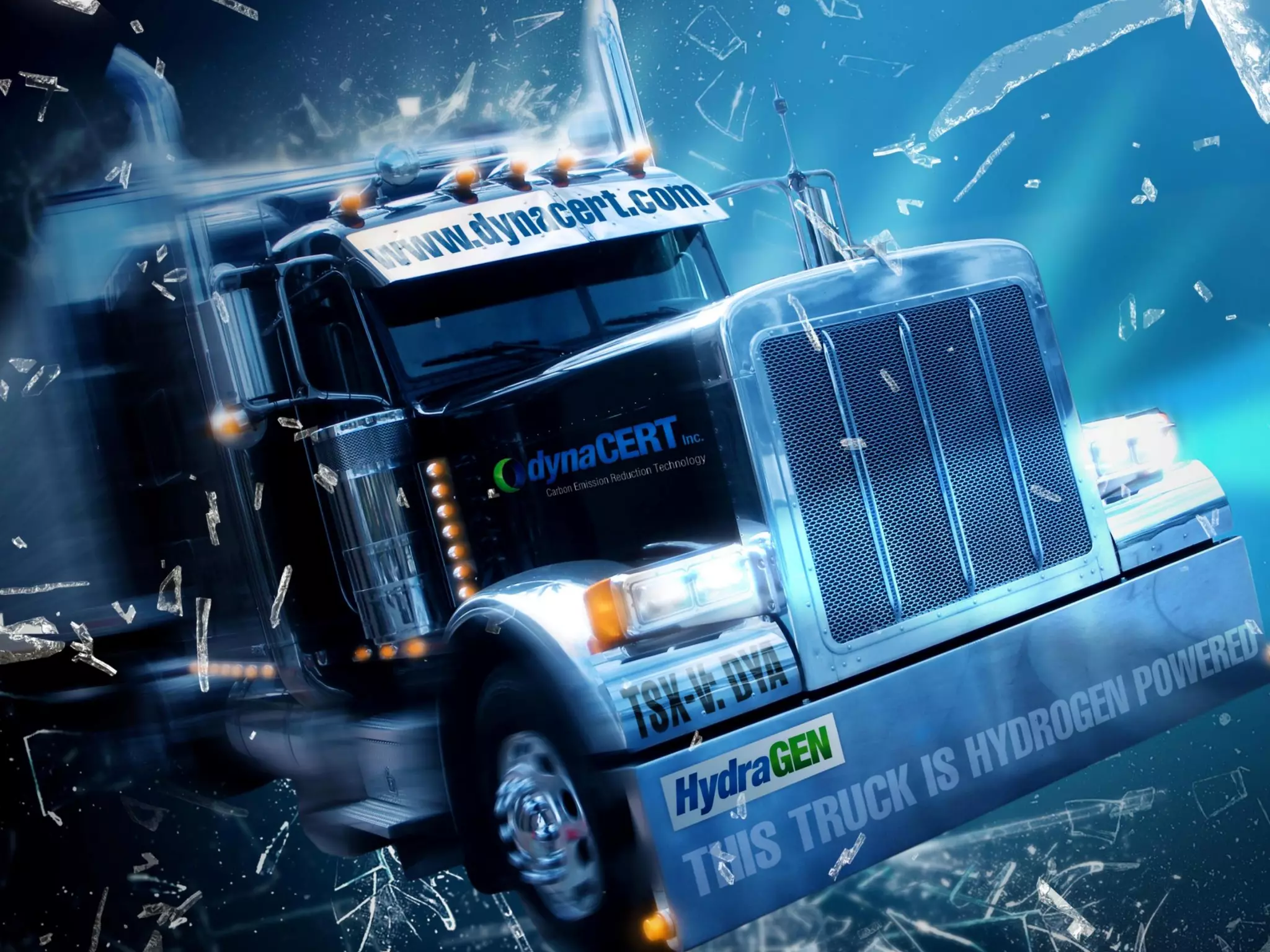
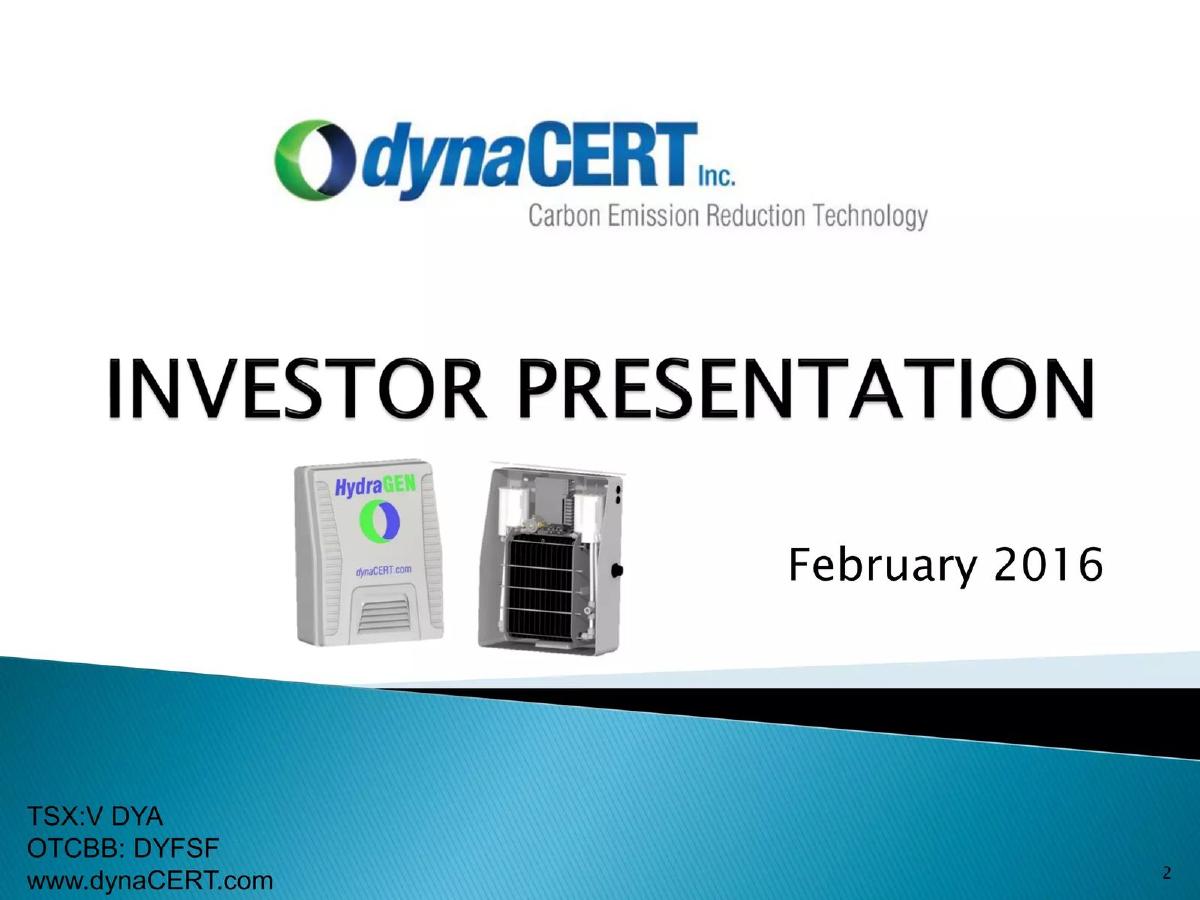
The dynaCERT investor presentation from February 2016 opens with a high-impact, stylized image of a heavy-duty truck breaking through glass. This visual choice immediately signals a 'disruptive' intent within the traditional trucking industry. The cover slide prominently features the company's web address and its stock tickers (TSX:V DYA), establishing its status as a publicly traded entity from the outset. The subtitle, 'Carbon Emission Reduction Technology,' clearly defines the sector.
Slide 4: The Value Proposition
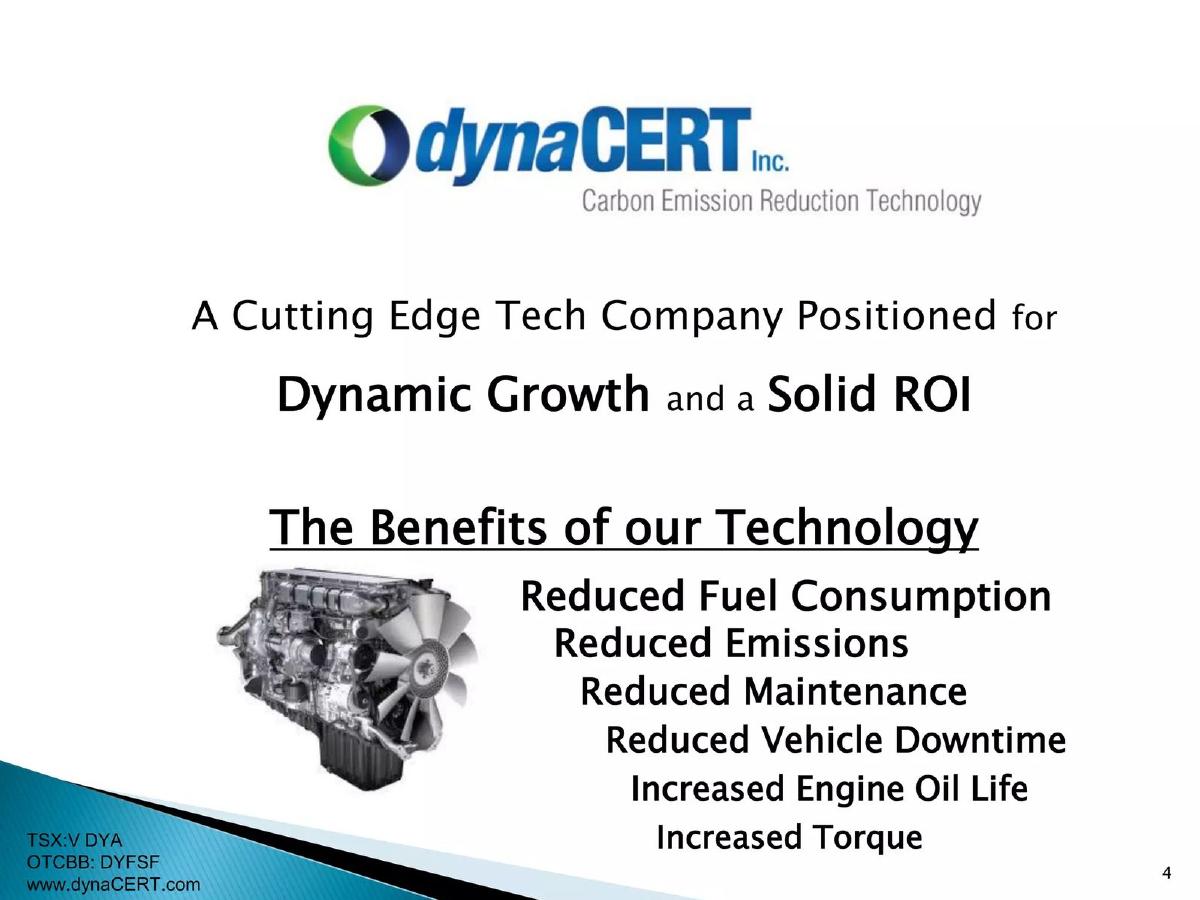
Slide 4 serves as the executive summary of benefits. It positions dynaCERT as a 'Cutting Edge Tech Company' focused on 'Dynamic Growth and a Solid ROI.' The slide lists six specific operational advantages: reduced fuel consumption, reduced emissions, reduced maintenance, reduced vehicle downtime, increased engine oil life, and increased torque. By leading with fuel and maintenance reduction, the company appeals directly to the bottom-line concerns of fleet managers, rather than relying solely on environmental altruism.
Slide 7: Company Background and Pivot
This slide provides a brief history of the firm, noting its origin as Dynamic Fuel Systems Inc. It admits that early efforts with 'JetStar' units producing HHO (Brown's gas) generated only 'small sales.' This honesty is a strategic move to highlight the 'Refocused and Strengthened Business Model' that followed. The company points to 2010 engine testing as the turning point where they discovered that separating hydrogen and oxygen gases provided unique combustion characteristics. The mention of patent-pending status and 2012 trials with Pepsi adds a layer of intellectual property protection and third-party validation.
Slide 10: Technical Mechanics
Titled 'How it WORKS,' Slide 10 dives into the physics of the HydraGen system. The central claim is a '9X flame speed vs diesel,' which supposedly allows for a 'stable flame front' and 'complete combustion.' The slide argues that this technology counteracts the efficiency losses typically caused by standard emission hardware like Exhaust Gas Recirculation (EGR), Selective Catalytic Reduction (SCR), and Diesel Particulate Filters (DPF). The tagline 'HydraGen lets DIESEL DO DIESEL' suggests that the technology returns the engine to its optimal performance state while cleaning up the output.
Slide 13: The Electronic Control Unit (ECU)
To move beyond being seen as a simple mechanical 'add-on,' Slide 13 introduces the ECU, described as the 'Brains of the HydraGen.' This component handles electronically optimized gas injection and interfaces with an in-cab tablet display for the driver. The slide also features the logo of RMF Design and Manufacturing Inc., an ISO 9001:2000 certified partner, which suggests that dynaCERT has outsourced its high-tech manufacturing to an established electronics firm to ensure quality and scalability.
Slide 16: Product Development Strategy
This slide addresses the physical constraints of the global trucking market. It acknowledges that North American trucks offer 'lots of room for install,' allowing for larger units. Conversely, the 'International Market' section notes the need for a 'tighter configuration' due to less room between the cab and trailer. This demonstrates that the company has moved past the prototype stage and is thinking about the engineering requirements for global distribution and varied vehicle architectures.
Slide 19: Future Market Penetration
Slide 19 is a 'logo slide' designed to build investor confidence through association. It lists Pepsi, Cummins, TTSI, Schneider National, and Navistar. The bullet points outline a strategy of establishing distribution agreements in overseas markets and testing opportunities with Original Equipment Manufacturers (OEMs). While the slide mentions 'agreements and ongoing testing,' it does not specify if these are paid pilots, binding purchase orders, or informal letters of intent, which is a common ambiguity in early-stage industrial decks.
Slide 22: Macro Market Context
The final slide in this selection provides the 'Big Picture' context. Using data from 2007 (which was somewhat dated by 2016), it shows that transportation is the sector most heavily reliant on oil (96%). This chart justifies the company's focus on diesel engines; even as renewable energy grows in the electric power sector, the transportation sector remains a massive, untapped opportunity for carbon reduction through combustion optimization.
What Works Well in This Deck
Clear Problem/Solution Fit: The deck does an excellent job of identifying the 'efficiency tax' paid by fleet owners to meet modern emission standards (EGR/SCR/DPF) and positioning HydraGen as the solution that recovers that lost efficiency.
Technical Specificity: Instead of vague claims about 'better engines,' the deck cites specific metrics like '9X flame speed' and the separation of hydrogen and oxygen, which gives technical investors something concrete to evaluate.
Strategic Partnerships: The inclusion of RMF Design and Manufacturing provides a credible answer to the 'how will you build this?' question, moving the company away from 'garage startup' status.
What Is Missing from the Deck
Unit Economics: There is no mention of the cost to manufacture a HydraGen unit versus the retail price. Investors cannot calculate the 'Solid ROI' promised on Slide 4 without knowing the payback period for a fleet owner.
Financial Projections: The provided slides contain no revenue targets, burn rate information, or historical financial performance, despite the company being publicly traded.
Competitive Landscape: The deck assumes dynaCERT is the only solution. It fails to mention other hydrogen-injection competitors or the long-term threat of total electrification (EV trucks), which was already a nascent topic in 2016.
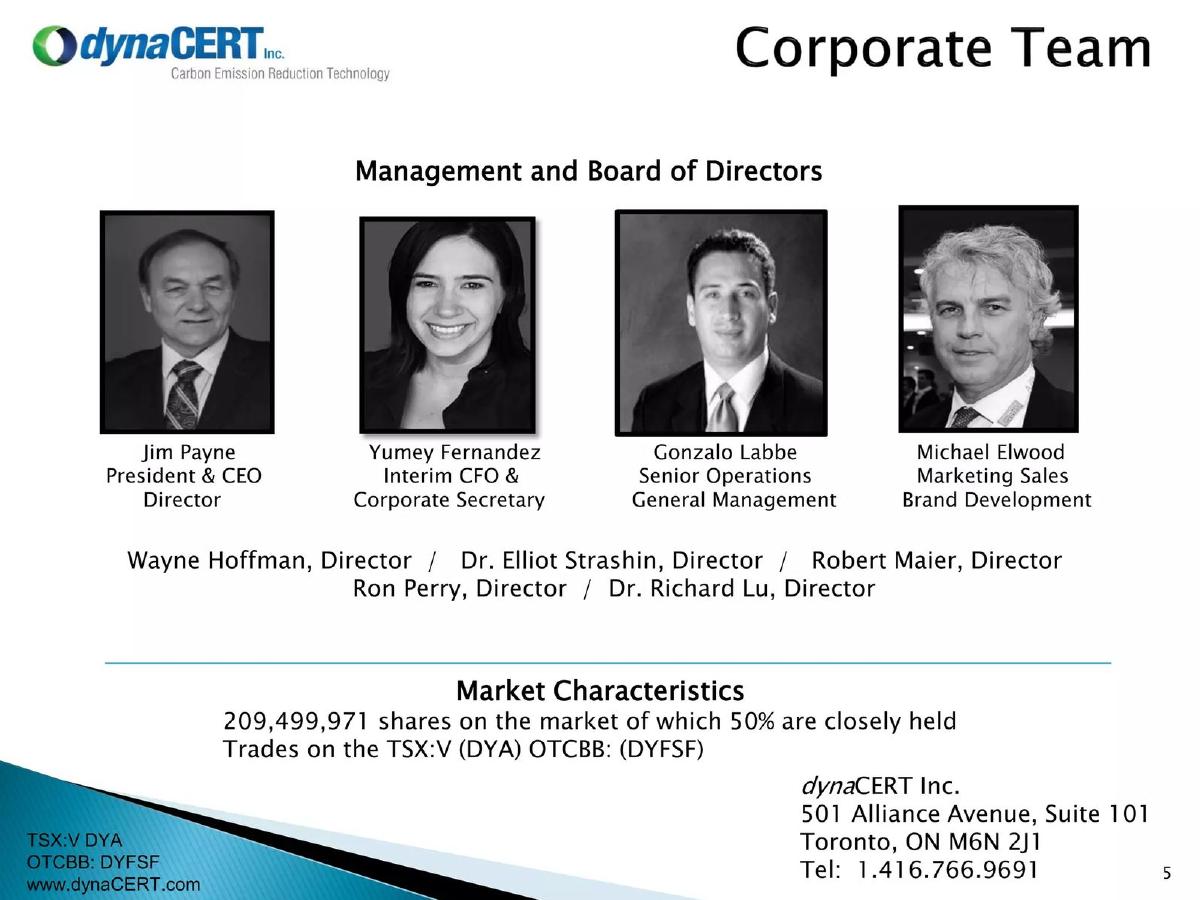
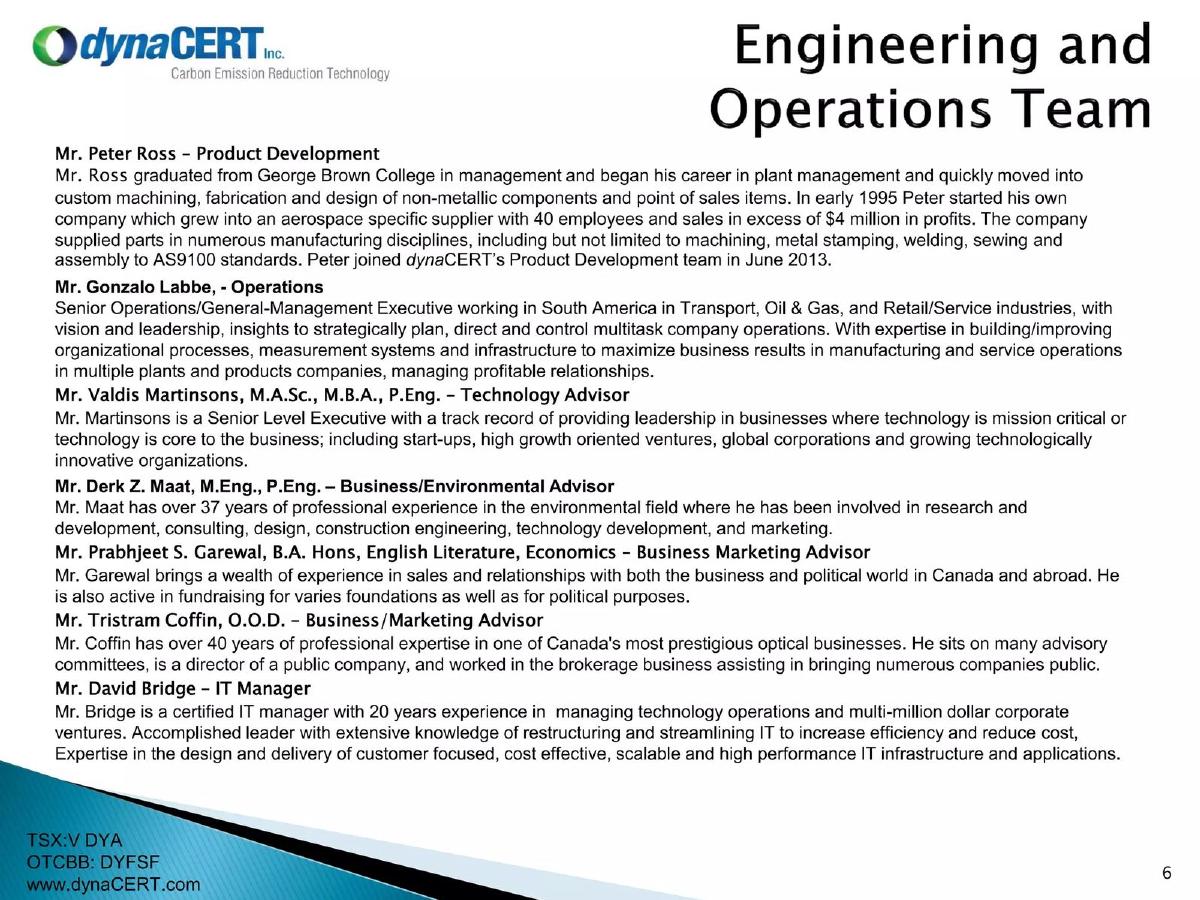
The Team: There are no slides introducing the leadership, engineering team, or board of directors. In industrial tech, the pedigree of the engineering team is often as important as the technology itself.
Founder Takeaways
Address the 'Legacy' Opportunity: dynaCERT correctly identifies that the world cannot replace every diesel engine overnight. Founders in the climate-tech space should look for 'bridge technologies' that improve existing infrastructure while the world transitions to fully green alternatives. · Use Third-Party Validation: Mentioning the Pepsi trials is the strongest part of the deck. If you have a pilot with a Fortune 500 company, it should be the centerpiece of your credibility strategy. · Design for Global Constraints: Slide 16 shows a sophisticated understanding of how product design must change based on regional regulations and vehicle form factors. Founders should always show they understand the physical realities of their target markets. · Avoid Dated Data: Using 2007 data in a 2016 presentation (Slide 22) can make a company look out of touch. Always use the most recent available statistics to frame your market size.
Frequently asked questions
- What is the core technology behind dynaCERT's HydraGen?
- HydraGen is an electrolysis-based system that separates water into hydrogen and oxygen gases. These gases are then injected into the air intake of a diesel engine. According to Slide 10, this creates a 'lean burn' environment with a flame speed nine times faster than diesel alone, resulting in more complete combustion and fewer emissions at the source.
- What specific benefits does dynaCERT claim for fleet owners?
- On Slide 4, the company lists six primary benefits: reduced fuel consumption, reduced emissions, reduced maintenance, reduced vehicle downtime, increased engine oil life, and increased torque. The overarching goal is to provide a 'Solid ROI' for logistics companies by counteracting the efficiency-reducing effects of standard emission solutions like DPF and SCR.
- Who are dynaCERT's primary partners or trial participants?
- Slide 19 lists several high-profile companies under 'Future Market Penetration,' including Pepsi Co., Schneider, TTSI, and Navistar. The company specifically mentions that field trials with Pepsi on Detroit Diesel engines were completed by 2012 with positive results, which serves as a primary credibility marker for their technology.
- How does dynaCERT plan to adapt its product for different global markets?
- Slide 16 outlines a two-pronged product strategy. In North America, where trucks typically have more space for installations, the unit size can be larger. For international markets, dynaCERT is developing a 'tighter configuration' to accommodate the limited room between the cab and trailer common in European and Asian truck designs.
- What is the scale of the market opportunity presented in the deck?
- The deck uses macro energy statistics to frame the opportunity. Slide 22 shows that as of 2007, the transportation sector was 96% dependent on oil. By positioning their technology as a way to make these existing oil-dependent engines cleaner and more efficient, dynaCERT implies a total addressable market encompassing nearly the entire global trucking fleet.